



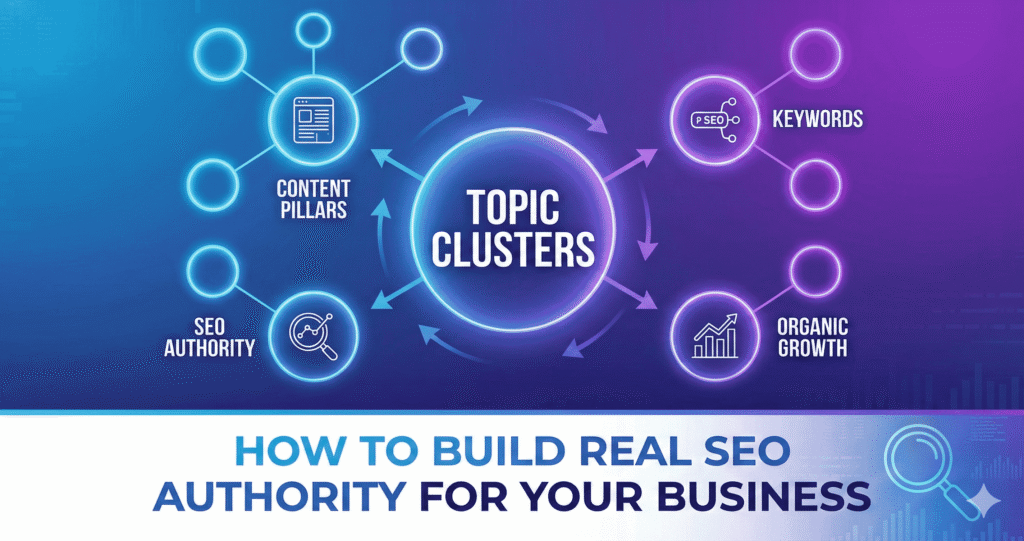
Organic traffic isn’t a stroke of luck. It comes from authority. Not keyword-stuffed pages that flop. Yet business owners are bombarded by agencies promising rankings with thin, siloed content. Topic clusters change that.
They group your content around core themes, showing Google you know your stuff. Done right, clusters make your site a trusted hub. Sustainable traffic, no fluff, just results.
This guide gives you a practical framework for building topic clusters — not vague advice, but a step-by-step process backed by sourced case studies with real numbers, not invented ones. If you want a professional gap analysis before you start building, our SEO audit team can map exactly where your site’s coverage is thin.
What Are Topic Clusters?
Topic clusters connect a broad pillar page to multiple cluster pages. The pillar covers the main theme, and A topic cluster is a pillar page — a comprehensive overview of a broad subject — surrounded by cluster pages that each go deep on one subtopic. Every cluster page links back to the pillar, and the pillar links out to each cluster. That two-way linking is what separates a cluster from a pile of loosely related blog posts.
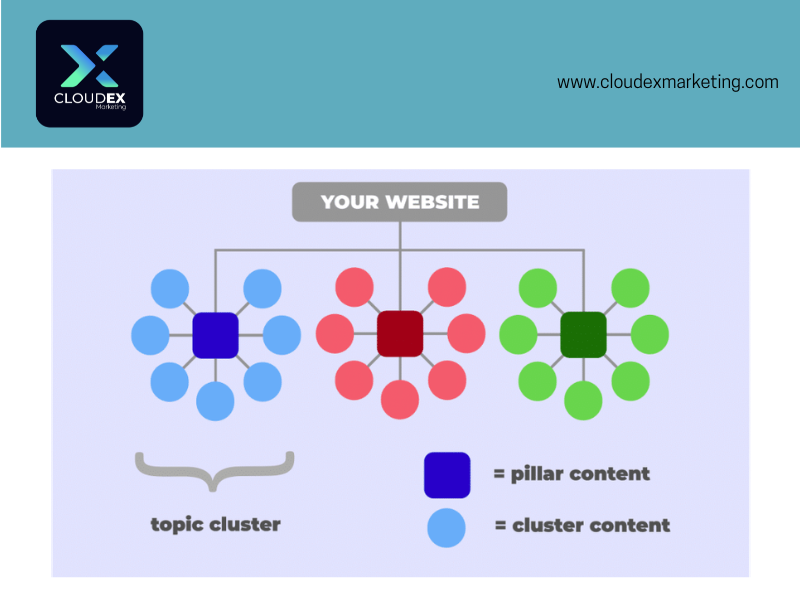
Picture a library. The pillar page is the section sign (“Cookbooks”). Cluster pages are the individual books, organized by cuisine underneath it. A visitor — or a search engine — can see at a glance how everything relates, and that relationship is the signal search engines use to judge depth of expertise.
The model has three components: one pillar page targeting a broad, high-volume term; a set of cluster pages targeting specific long-tail questions within that topic; and a consistent internal linking pattern connecting them in both directions.lusters like “emergency boiler repair Manchester.” The result? Dominates local packs, outranks competition.
Why Topic Clusters Work for SEO
Google’s quality guidelines weigh Experience, Expertise, Authoritativeness, and Trustworthiness (E-E-A-T) heavily, and topic clusters are a structural way to demonstrate all four. A single well-organized cluster doesn’t just rank for its head term — it captures the long tail of questions searchers ask around that term, and each ranking page reinforces the others through internal links.
The results, when documented, are substantial. <cite index=”12-1″>One case study from Minuttia showed a single topic cluster ranking for over 1,100 keywords and generating roughly 100 organic clicks on weekdays</cite>. Separately, <cite index=”18-1″>UK ecommerce retailer Land of Rugs saw its blog page views rise by around 119% in the first half of 2022 compared to the same period the year before</cite>, after shifting from product-only pages to a cluster-based content strategy, and <cite index=”18-1″>the resulting content is estimated to have generated over £100,000 in revenue since January 2021</cite>.
The mechanism is straightforward: internal links pass relevance and authority between pages, long-tail cluster pages capture searches a broad pillar never could on its own, and the cumulative signal tells Google — and increasingly, AI answer engines — that your site is a legitimate authority on the topic rather than a page that happens to mention it once.
Step 1: Choose a Core Topic
Start with one topic, not five. The best starting point sits at the intersection of three things: what your business actually sells or does, what your audience is demonstrably searching for, and where your current content — or your competitors’ — has a visible gap.
Look at your past content for pages that already get some traffic but never quite ranked; a cluster can often push a mediocre single page into a mediocre pillar surrounded by strong support. Check competitor sites for topics they’ve covered thinly. And listen to the actual questions your sales or support team fields — those are cluster topics that convert.
Pick a topic broad enough to support 8–15 subtopics, but narrow enough that you could plausibly become the best resource on it within your niche.
Step 2: Research Keywords & Search Intent
Once you have a candidate topic, validate it with keyword data before writing anything. Pull search volume, difficulty, and — critically — intent for your seed term and its variations. A high-volume keyword is worthless as a pillar if searchers want a product page and you’re planning a guide, or vice versa.
Group the keywords you find by what the searcher actually wants:
| Search Intent | Signal Words | Best Page Type |
|---|---|---|
| Informational | “what is,” “how to,” “guide” | Cluster page or the pillar itself |
| Commercial investigation | “best,” “vs,” “review” | Cluster comparison page |
| Transactional | “near me,” “cost,” “hire,” “buy” | Service/product page linked into the cluster |
| Navigational | Brand or specific product names | Not a cluster target — exclude |
Your pillar should usually target the broadest informational or commercial term with the highest volume. Cluster pages then split off to cover each intent category so you’re not trying to answer five different searcher needs on one page.
Step 3: Map Pillar and Cluster Pages
Before writing a single word, draw the structure out. List your pillar topic at the center, then list every subtopic keyword cluster underneath it, grouped by theme.
For example, a pillar on “restaurant operating costs” might branch into cluster pages on labor cost breakdowns, bookkeeping essentials for restaurants, and food waste reduction — each targeting a distinct long-tail query, each linking back up to the pillar under a relevant heading, and each linking sideways to at least one other cluster page in the group.
This map becomes your content calendar and your linking blueprint at once. It also exposes gaps and overlaps before you’ve spent any writing time — if two planned pages would compete for the same keyword, you catch it here, not after both are published and cannibalizing each other in search results.
Step 4: Create Quality Content
Publish the pillar page first, since every cluster page will link to it. The pillar should be comprehensive enough to stand alone as a resource — most run 2,000–4,000 words — and needs the primary keyword in the title, H1, and opening paragraph, with secondary terms woven in naturally rather than stuffed.
Cluster pages can be shorter and more specific, but they still need to fully answer the question they’re targeting. Use headings, real examples, and data from credible sources rather than vague claims — that’s what actually earns the “expertise” half of E-E-A-T, not keyword density.
If in-house bandwidth is the bottleneck, our content writing services team writes cluster content built to this exact structure, sourced and fact-checked before it ever gets linked into your pillar.
Step 5: Build Internal Links
Internal linking is what turns a folder of related articles into an actual cluster. Every cluster page links up to its pillar, the pillar links down to every cluster page, and cluster pages link sideways to two or three closely related siblings.
Anchor text matters here more than most teams realize. Use descriptive, keyword-relevant anchor text — “restaurant labor cost breakdown,” not “click here” or “read more.” Vary the exact phrasing across links pointing to the same page so the anchor profile looks natural rather than templated.
A site that goes from scattered, disconnected posts to a linked cluster structure typically shows the difference immediately in a site-crawl visualization: isolated nodes become a connected hub-and-spoke graph, and pages that previously had zero internal links suddenly sit two clicks from the homepage instead of orphaned four or five clicks deep. That crawlability change is often what unlocks the ranking movement, not the content itself.
Step 6: Monitor, Measure, and Maintain
A cluster isn’t finished at publication — it needs to be tracked and refreshed like any other asset. Tag your target keywords by cluster in your rank tracker so you can see cluster-level movement, not just individual page performance. Watch organic sessions, average pages per session for cluster visitors, and — increasingly — whether your pages get cited in AI-generated answers.
Set a maintenance cadence. Quarterly is a reasonable default: audit each cluster for pages that have dropped in rankings, update statistics and examples that have gone stale, and check for content decay — pages that were once ranking well but have slowly lost position as competitors published fresher coverage.
Maintenance isn’t only editorial. A cluster can be well-written and still lose visibility if technical SEO issues that block crawling creep in — broken internal links, orphaned pages after a site redesign, or a pillar page that accidentally picked up a noindex tag. Run a technical check alongside your content refresh, not instead of it.
Add new clusters incrementally rather than launching five at once — two to three new clusters per quarter is sustainable for most teams and gives you time to actually monitor what you built before starting the next one.
5 Common Topic Cluster Mistakes

Keyword cannibalization. The most common failure mode: two cluster pages targeting the same or nearly identical keyword, splitting ranking signals between them instead of consolidating authority on one page. Audit your keyword map before publishing, not after.
Pillars that are too broad. A pillar trying to cover an entire industry in one page ends up shallow on every subtopic and ranks for nothing in particular. Narrow the pillar until it’s specific enough to fully cover in 2,000–4,000 words, and push the rest into cluster pages.
Orphaned cluster pages. Publishing a cluster page without linking it into the pillar — or forgetting to link the pillar back down to it — leaves the page structurally invisible as part of the cluster, even if the content itself is good.
Thin clusters with too few supporting pages. A pillar with only two or three cluster pages underneath it doesn’t demonstrate the depth of coverage that makes the model work. Most effective clusters run eight to fifteen supporting pages.
Treating clusters as a one-time project. Clusters built and then abandoned decay. Competitors publish fresher content, search intent shifts, and a cluster that isn’t revisited quarterly gradually loses the ground it gained.
FAQ
How many cluster pages does a pillar need? Most effective clusters run eight to fifteen cluster pages. Fewer than that tends to under-demonstrate topical depth; many more becomes hard to maintain and link coherently.
How long should a pillar page be? Most pillar pages run 2,000–4,000 words — long enough to comprehensively introduce the topic and link out to every cluster page, without trying to also cover the depth that belongs on the cluster pages themselves.
Do topic clusters help with AI search visibility, not just Google? Structural topical depth is one of the signals AI answer engines use to decide which sites to cite, since a well-linked cluster gives a clearer picture of a site’s expertise on a subject than a single isolated page.
What’s the difference between a topic cluster and a content silo? The terms describe closely related ideas — grouping related content together — but clusters emphasize bidirectional internal linking between a central pillar and its subtopics, while “silo” historically referred more to URL/folder structure.
How do I know if my existing content already qualifies as a cluster? Check whether your related pages link to each other and to a clear central page. If they were written independently over time with no deliberate linking pattern, they’re related content, not yet a cluster.
How often should a cluster be updated? A quarterly review is a reasonable default: refresh statistics, check for ranking drops, add new subtopics that have emerged, and confirm internal links still resolve correctly.
Can keyword cannibalization happen within a well-planned cluster? Yes, if two cluster pages are mapped to overlapping keywords rather than distinct intents. Mapping your keywords by search intent before publishing, as in Step 2, is what prevents this.
Should I build multiple clusters at once? Generally no. Building one cluster fully — pillar plus all planned cluster pages, properly linked — before starting the next gives you a complete asset to measure, rather than several half-finished clusters diluting your team’s attention.