


Your competitors are ranking for keywords you’ve never published about. Your competitors have entire content clusters you’re missing. Meanwhile, you’re creating content in a vacuum, hoping it ranks. This is the reality for most businesses that skip gap analysis.
An SEO gap analysis reveals the exact keywords, topics, and content formats your competitors rank for that you’re completely missing. It’s not complicated. It’s systematic research that shows you where to focus effort for maximum ranking impact. Unlike guessing which topics matter, gap analysis is evidence-based. You’re following proven search demand.
What Is SEO Gap Analysis
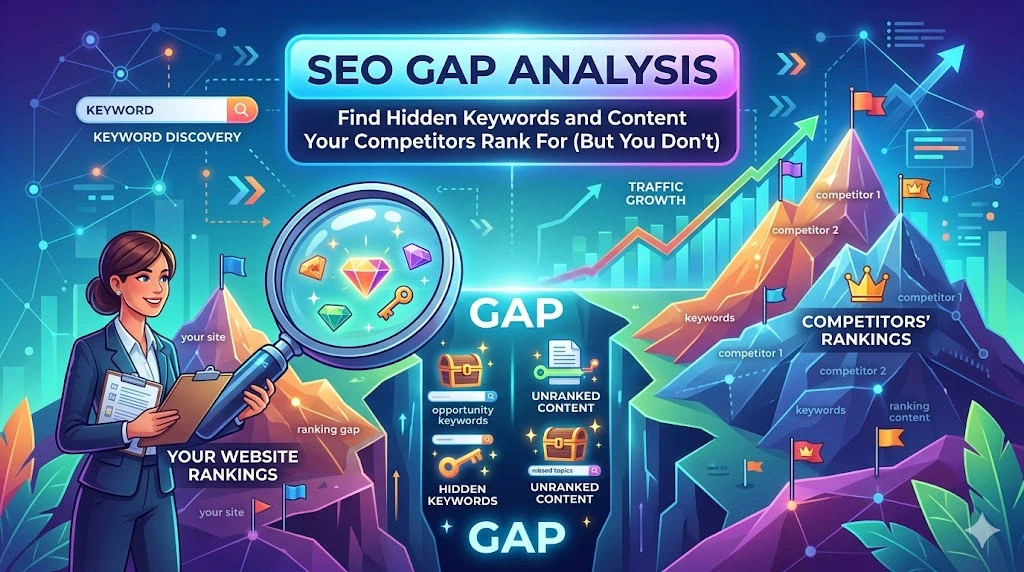
Gap analysis answers one question: Where are competitors getting search traffic that we’re not?
Imagine your competitor ranks for 200 keywords. You rank for 120 keywords. The gap is the 80 keywords they rank for that you don’t. But it goes deeper. It’s also:
- Topics they cover in depth that you barely mention
- Questions they answer that you ignore
- Content formats (FAQs, comparisons, how-tos) you’re not using
- Entity relationships establish that you don’t
- SERP features (featured snippets, AI Overviews) appear in, but you don’t
- Authority signals (backlinks) they’ve earned that you haven’t
Our professional SEO agency in Pakistan gets you a proper gap analysis that reveals all of these. It becomes your content roadmap, showing exactly what to create next for maximum impact.
Why Gap Analysis Matters
Search has changed dramatically since 2022. AI Overviews appear above traditional results. Entity-based understanding matters more than keyword matching. Topical authority is evaluated holistically across your entire website, not page-by-page. If competitors are dominating these new elements and you’re not, gap analysis reveals it.
A competitor appearing in AI Overviews while you don’t is a visibility gap. A competitor covering a topic comprehensively while you have one thin page is a gap. A competitor with 50 backlinks to similar content, while you have 5, is a gap. Gap analysis shows all of it.
Without it, you’re competing blind. With it, you have a map.
The 5-Step Gap Analysis Process
Step 1: Identify Your Real Competitors (Not Just Your Business Rivals)
You probably think your competitors are the other companies in your industry. That’s partially true, but it’s incomplete.
Your actual SEO competitors are the domains ranking where you want to rank. A finance blog might be your real competitor for “best mortgage brokers,” even if they don’t offer mortgages. They own that real estate.
Here’s what to do:
Search your target keywords on Google. The domains appearing in the top 10 positions are your SEO competitors. Write them down.
Use tools like Semrush or SpyFu to see overlapping competitors. Enter your domain. The tool shows which domains share keywords with you. Those are your organic competitors.
Select 3-5 of these competitors for deeper analysis. Pick ones with strong authority (they’ve been ranking for years, appear across multiple keywords). Don’t choose tiny blogs or brand-new domains.
Example: If you’re a plumber in Karachi targeting “emergency plumbing services,” your real competitors aren’t just other plumbers. They’re all domains ranking in Google’s top 10 for that search. That includes local directories, service review sites, and established plumbing blogs.
Step 2: Run Keyword Gap Analysis (Find Missing Keywords)
This step shows you exactly which keywords competitors rank for that you don’t.
Open Semrush’s Keyword Gap Tool (or similar tool in Mangools, Ahrefs, SpyFu):
- Enter your domain
- Enter your 3-5 competitors’ domains
- Click “Compare”
The tool shows you keywords bucketed into categories:
- Shared: Keywords all domains rank for (you already cover these)
- Missing: Competitors rank here, you don’t (this is what you need)
- Weak: You rank lower than competitors (improvement opportunities)
- Strong: You rank higher than competitors (protect these)
Filter the “Missing” list by:
- Search volume: Focus on terms getting at least 50+ monthly searches (unless very niche)
- Keyword difficulty: Choose keywords you can realistically rank for based on your domain authority
- Commercial intent: Prioritize keywords that match your business model (not just informational fluff)
Example output: Your keyword gap analysis might show competitors rank for:
- “best CRM software for small business”
- “CRM software pricing comparison”
- “free CRM alternatives”
- “CRM software setup guide”
While you’ve only written about “what is CRM software?” That’s your gap. Your high-intent keyword opportunities you’re missing.
Our SEO company in Pakistan, with real, honest, and effective approaches, helps you fill this gap and strengthen your position online.
Step 3: Discover Broader Topic and Content Gaps
Keywords are just numbers. But behind those keywords are entire topics and content clusters you’re missing.
Visit your top 3 competitors’ websites directly. Look at:
- Their blog/resource center: What topics do they publish about regularly?
- Their pillar pages: Do they have comprehensive guides covering multiple angles?
- Their content clusters: Do they have related articles linking to each other?
Go to Google and search your target keywords. Look at “People Also Ask” boxes. These show the questions people ask related to your keyword. If competitors answer these questions and you don’t, that’s a gap.
Example: You publish “How to Choose CRM Software,” but competitors have also written:
- “CRM Software for Sales Teams” (angle you missed)
- “CRM Implementation Best Practices” (related topic)
- “CRM Software vs Traditional Tools” (comparison angle)
- “10 CRM Software Features Explained” (educational angle)
These are content gaps, angles, and subtopics within your main topic that competitors cover but you don’t.
Step 4: Check Your Own Content for Quality and Freshness Gaps
Sometimes your gap isn’t missing pages. It’s outdated or incomplete existing pages.
Go to Google Search Console. Look at:
- Pages with declining impressions (your traffic is dropping)
- Pages ranking on page 2 (positions 11-20, very close to page 1)
- Pages with low click-through rates (users aren’t clicking even though you rank)
These pages have “internal gaps”. They’re missing information, outdated, or incomplete compared to competitors covering the same topic.
Fix these by:
- Updating statistics (replace 2023 data with 2026 data)
- Adding missing sections that competitors cover
- Improving heading structure (clearer organization)
- Adding FAQs addressing common questions
- Including visual content (screenshots, tables, examples)
A page that was good in 2023 might be mediocre in 2026 if competitors have improved theirs.
Step 5: Create Your Prioritized Action Roadmap
You now have a mountain of data. This step turns it into an executable plan.
Group your findings into three buckets:
High Impact / Low Effort (Do First):
- Update existing weak pages with missing sections
- Create 2-3 new pages targeting high-volume missing keywords
- Add the FAQ sections competitors have, but you don’t
High Impact / High Effort (Do Next):
- Build new content clusters that competitors have
- Create original research or data studies
- Redesign major sections of your website
Low Impact / Nice-to-Have (Skip For Now):
- Very low search volume keywords
- Low commercial intent keywords
- Niche topics outside your core business
Assign deadlines. Make people accountable. Execute in order.
What to Do With Your Gap Analysis Results
Don’t just analyze. Implement!
Create new content: For every high-volume missing keyword, create a page optimized for that keyword and its variations.
Build content clusters: Group related keywords into topics. Create a pillar page covering the main topic, then supporting pages diving deeper into subtopics. Link them internally.
Refresh existing pages: Update pages showing on page 2 or declining in impressions with missing information, new data, and better structure.
Improve visibility: Look at where competitors appear in featured snippets or AI Overviews, but you don’t. Update your page structure to match, add FAQs, summaries, and step-by-step sections.
Build backlinks: Look at which domains link to competitors’ similar content. Create better content than theirs, then reach out to those domains, pitching yours.
Avail the Real Value of Gap Analysis Today
Gap analysis removes guesswork. You’re not hoping topics matter. You’re seeing proof that competitors rank and get traffic from them. You’re not publishing randomly. You’re filling proven gaps.
Businesses that do gap analysis quarterly rank faster and more sustainably than those guessing. The data guides strategy. Effort compounds. Traffic compounds.
Pakistani businesses particularly benefit because competition for international keywords is intense. Gap analysis shows you where Pakistani audiences search differently, where local competitors are weak, and where you have genuine advantages competitors haven’t exploited.
At Cloudex Marketing, our professional SEO services begin with a comprehensive gap analysis, finding your biggest opportunities, and creating roadmaps, ensuring every piece of content serves measurable ranking and traffic goals rather than hope-based publishing.
Let’s partner up and start your gap analysis this week. Identify 3-5 competitors. Find 20 high-opportunity missing keywords. Create a 60-day plan to fill your biggest gaps. Watch what happens.