



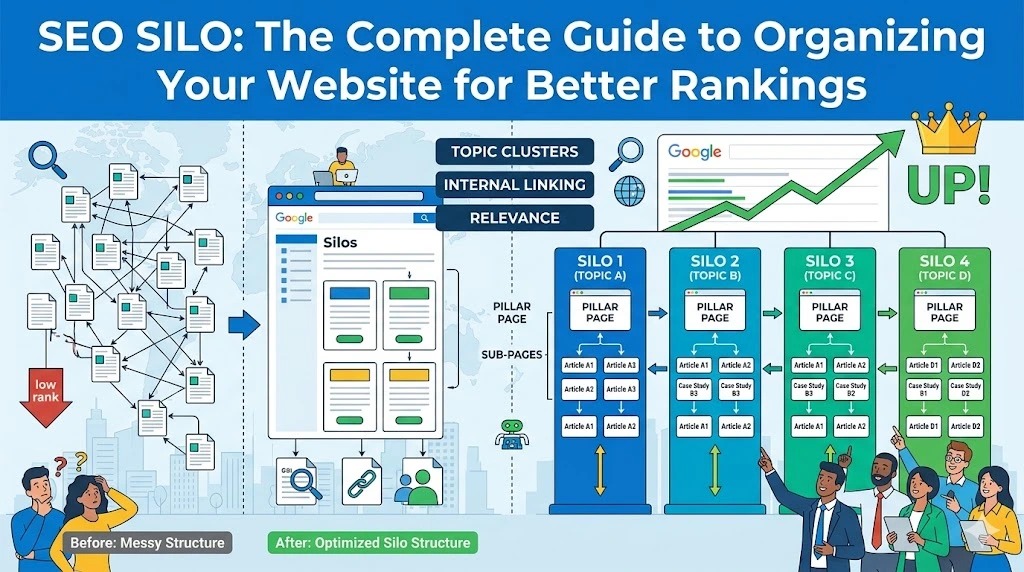
Your website is a mess of random pages that Google can’t understand. One page about coffee makers links to a page about digital marketing. Another page about coffee prices links to an article about SEO tips. Google sees no clear structure. Your rankings suffer.
This is what happens when you ignore SEO silos. A silo is simply organizing your website logically so Google (and users) understand your topic structure.
This guide shows exactly how to build silos and why they matter.
What Is an SEO Silo?
A silo is a group of related pages organized around a main topic. Think of it like a filing cabinet. The cabinet is your website. Each drawer is a main topic. Inside each drawer are folders containing related subtopics. Each folder contains individual pages.
Example: An e-commerce site selling fitness equipment could have silos like:
- Silos for “Weight Training” (with pages for dumbbells, barbells, weight plates)
- Silos for “Cardio Equipment” (with pages for treadmills, ellipticals, and stationary bikes)
- Silos for “Yoga and Flexibility” (with pages for yoga mats, resistance bands, foam rollers)
Each silo is completely separate. A page about dumbbells links to other weight training pages, not cardio pages. A page about treadmills links to other cardio pages, not yoga pages.
Google sees clear topic organization. Users see logical navigation. Both rank better.
Why Silos Matter for SEO
Google rewards websites with a clear structure. When pages within a topic link to each other, Google understands the relationship between them. It sees “weight training” as your area of expertise in that silo. It ranks your weight training pages higher because they’re organized comprehensively.
Without silos, Google sees random pages scattered everywhere. It can’t understand what your site specializes in. Your rankings suffer even if individual pages are well-written.
Silos also improve user experience. When someone lands on your “dumbbell buying guide,” they see links to other weight training pages. They stay on your site longer. They explore more. Google sees engagement signals. Engagement signals boost rankings.
Additionally, silos make internal linking natural and effective. Instead of randomly linking pages, you link strategically within your topic. Each internal link passes authority downward through the silo structure, strengthening your entire topic.
How to Build SEO Silos (Step-by-Step)
Step 1: Identify your main topics
What are the core topics your business covers? For a fitness equipment store, that’s weight training, cardio, and flexibility. For a digital marketing agency, that’s SEO, paid ads, and content marketing. Pick 3-5 main topics maximum.
Step 2: Plan subtopics within each silo
Under “weight training,” your subtopics could be dumbbells, barbells, kettlebells, and weight plates. Under “cardio,” that’s treadmills, ellipticals, stationary bikes, and rowing machines. Each main topic has 4-8 subtopics.
Step 3: Identify individual pages
Under “dumbbells,” your pages could be “best dumbbells for home gym,” “dumbbell weight guide,” “adjustable vs fixed dumbbells,” and “dumbbell exercises for beginners.” Each subtopic has 3-5 supporting pages.
Step 4: Organize your website architecture
Your URL structure should reflect a silo organization:
- /weight-training/ (main silo page)
- /weight-training/dumbbells/ (subtopic page)
- /weight-training/dumbbells/best-dumbbells-home-gym/ (individual page)
This URL structure tells Google your topic hierarchy immediately.
Step 5: Create a pillar page for each silo
The pillar page is the main hub. It covers the entire topic broadly. It links to all subtopic pages. It’s usually your longest, most comprehensive page.
Step 6: Create cluster pages for each subtopic
Cluster pages dive deeper into specific aspects. They’re shorter than pillar pages but more focused. They link back to the pillar page and to related cluster pages.
Step 7: Create supporting pages
These are individual articles answering specific questions. They link to their parent cluster page. They don’t link to unrelated silos.
Step 8: Build internal linking strategically
All links within a silo point to other pages within that same silo. Links rarely cross silos (only when necessary for context).
What Happens When You Ignore Silos
Your rankings will plateau or decline. Without a clear structure, Google can’t understand your expertise in specific topics. Your pages compete with each other instead of supporting each other. You get fewer rankings for fewer keywords.
Your internal linking becomes random. Pages link everywhere. No clear authority flows downward. Each page stands alone instead of being strengthened by related pages.
User experience suffers. Visitors land on a page and see no relevant content. They bounce. They go to your competitor’s better-organized site. Google sees high bounce rates. Rankings drop further.
Your content clusters never achieve topical authority. Google rewards sites demonstrating complete coverage of topics. Without silos, you never demonstrate comprehensive coverage. You publish scattered articles instead of organized clusters.
Real consequence: A Pakistani e-commerce site selling mobile phones ignored silos. They had pages for “iPhone models,” “Android phones,” “phone accessories,” and “phone repair tips,” all linking randomly. Google couldn’t determine its specialty. They ranked for almost nothing. Their competitor organized the same content into silos. The competitor’s site now ranks 3x better.
Implementation Tips for Your Business
Start small. Don’t restructure your entire website immediately. Pick one main topic. Create pillar and cluster pages for it. Let it rank. Then move to the next silo.
Let our SEO agency in Pakistan audit the current structure of your website. Many websites have accidental silos already. We will be your honest SEO agency, where we will identify the existing structure and strengthen it systematically.
Make URL structure clear. Your URL hierarchy should match your content hierarchy. This tells both users and Google your organizational logic.
Link consistently. Every cluster page links to its pillar. Every supporting page links to its cluster. Consistency matters more than perfection.
Don’t force silos. Every topic shouldn’t have 20 supporting pages. Create only pages serving real user intent.
Measuring Silo Success
Track rankings by topic. Are your weight training pages ranking better as a group? Are cardio pages improving? When silos work, entire topic clusters rank better.
Monitor topical authority. Our SEO company in Pakistan tracks how many keywords you rank for within each silo. Increasing keyword breadth per silo shows growing topical authority.
Measure traffic flow. Users should navigate within silos naturally. If navigation data shows users jumping between unrelated silos, restructure your internal linking.
The Bottom Line
SEO silos are organizational architecture, not technical magic. They’re simply grouping related content logically so Google understands your expertise and users find relevant information easily.
Without silos, you publish random pages hoping for some rank. With silos, you build topic authority systematically. Your competitors using silos will outrank your scattered content every time.
Start today. Identify your main topics. Organize pages logically. Build internal linking around that structure. Watch your rankings improve as Google understands your website’s expertise.
Our SEO team in Pakistan implements silos as a foundational strategy, not an afterthought. Proper silo architecture is the difference between scattered rankings and systematic topical dominance.