
On-Page SEO Services in the UK
Give every important page a clear job in search. Our on-page SEO services in the UK establish what each priority URL should rank for, what searchers expect to find and whether the current page is actually the right one for that demand. We then improve the content, structure, internal signals and search presentation needed to help that page compete and turn qualified visibility into useful action.
Good On-Page SEO Starts Before We Change the Page
Changing a title, adding copy or inserting more keywords is easy. The harder decision is whether the page deserves optimisation in the first place, what search demand it should own and what stronger performance would mean for the business.
Is There a Search Opportunity?
We first establish whether valuable demand exists, how competitive it is and whether improving this URL creates a realistic opportunity. Finding something editable on the page does not prove that editing it is worthwhile.
Give the Page a Search Job
We determine which searches genuinely belong to the URL by examining demand, intent, current rankings, competing results and the page types Google already rewards.
Give the Page a Commercial Job
We establish what useful action should follow the visit. Depending on the page, that can mean enquiring, buying, booking, comparing, requesting a quote or moving to the next relevant step in the website.
What Our On-Page SEO Services Cover
Different pages underperform for different reasons. Our on-page SEO work connects search intent, content, structure, internal relationships and SERP signals around what each priority URL genuinely needs rather than applying the same optimisation checklist across the website.
 Search Intent & Keyword Mapping
 Search Intent & Keyword Mapping
Our keyword mapping connects related searches with the URL best suited to satisfy them. We assess primary demand, secondary query groups, existing rankings, SERP patterns, business relevance and the page types already performing. Search intent optimisation then establishes what people expect to find when making those searches. Search volume informs the opportunity; it does not decide the strategy alone.
SEO Content Optimisation
 SEO Content Optimisation
Good SEO content optimisation improves usefulness rather than simply making copy longer. We identify missing information, outdated sections, unnecessary copy, weak headings, unanswered questions, entity gaps and unclear information hierarchy. Existing content can be expanded, trimmed, reorganised or retained depending on the evidence. Where larger content work is required, our SEO content writing services keep search intent and commercial purpose connected.
 Titles, Metadata & Page Structure
Titles, Metadata & Page StructureWe review title tags, meta descriptions, H1s, heading hierarchy, URLs, introductory copy, alt text and relevant HTML structure. Title tag optimisation and metadata optimisation can strengthen how a page communicates its subject and appears in search, but metadata is only one part of website SEO optimisation. It cannot compensate for targeting the wrong intent or using the wrong page.
Internal Linking & Page Authority
 Internal Linking & Page Authority
Our internal linking services establish clearer relationships between important pages and the supporting content around them. We assess contextual links, anchor context, orphan pages, crawl pathways, hub relationships, and where internal authority needs stronger direction. Links should help users and search engines understand how pages relate, not appear simply because an SEO checklist says another internal link is needed.
Cannibalisation & Content Consolidation
 Cannibalisation & Content Consolidation
Several URLs can sometimes compete for the same search purpose, leaving Google uncertain about which page deserves visibility. We investigate keyword cannibalisation, overlapping intent, near-duplicate pages and situations where the wrong URL ranks. Depending on the evidence, content consolidation can involve merging, differentiating, retargeting, redirecting or strengthening an existing page rather than creating another one.
Structured Data & SERP Signals
 Structured Data & SERP Signals
Relevant schema markup can give search engines more explicit information about content and entities. We review appropriate markup such as Breadcrumb, Service, Organization, Product, Article, and LocalBusiness where applicable, while ensuring structured information matches what users can actually see. Schema can support search understanding and eligibility for relevant features; it does not automatically improve rankings or guarantee rich results.
Get a Custom On-Page SEO Package
Share your priority pages, current rankings and growth goals, and we’ll shape an on-page SEO package around the specific approaches, strategies, and fixes your website really needs.
Six Questions We Answer Before Optimising a Page
A keyword alone does not tell us how a page should be optimised. We need to understand why someone searched, what Google currently rewards, whether the page provides the right information, and how it fits within the wider website. These factors determine whether the existing URL needs improvement, a different purpose, or no major change at all.
Why is the person searching?
Keywords tell us what someone typed, but search intent tells us what they expect to find next. We examine the query alongside the current SERP to understand the need behind the search before deciding how the page should respond to it.
- Informational, commercial or transactional intent
- Local or location-sensitive searches
- Questions behind the main query
- Results Google currently prioritises
- Expectations before someone clicks
We use those signals to align the page with the actual search purpose. If we misunderstand why someone is searching, optimising more aggressively for the keyword will not solve the underlying mismatch.
Is this the right kind of page?
Before optimising an existing URL, we look at the pages already earning visibility for the target searches. The SERP helps us determine whether Google is rewarding a service page, category, guide, comparison, product or another result format.
- Page types dominating the results
- Commercial versus informational results
- SERP features appearing around them
- Formats used by competing pages
- Where the existing URL differs
We use this evidence to decide whether the current page can compete with better optimisation or whether the website is asking the wrong type of page to do the job.
Does the page give the searcher what they need?
We examine the information already on the page against its search purpose and competing results. Rather than automatically adding more copy, we identify what is genuinely missing, what adds little value, and what prevents the important information from being understood quickly.
- Important topics and entities
- Questions left unanswered
- Outdated or unnecessary information
- Heading and information hierarchy
- Commercially relevant details
We optimise for useful completeness rather than arbitrary length. Sometimes that requires adding content; sometimes we achieve a stronger page by trimming, restructuring or clarifying what is already there.
Does the wider website support this page?
No page operates completely on its own. We examine how the URL connects with related services, categories, guides and other supporting content to understand whether the wider website reinforces or weakens the role we want that page to perform.
- Contextual internal links
- Relevant supporting pages
- Anchor text and surrounding context
- Navigation and crawl pathways
- Position within the site hierarchy
We use those relationships to make the page's role clearer for users and search engines. A commercially important URL should not sit in isolation when relevant pages elsewhere on the website provide no meaningful pathway to it.
Does the page give people a reason to believe it?
Ranking brings someone to the page; it does not automatically make them trust what they find. We assess whether the claims, information, and offer are supported by the kind of evidence a prospective customer needs before feeling confident enough to continue.
- Genuine customer testimonials
- Relevant examples or case studies
- Credentials and experience
- Data or supporting evidence
- Clear processes and service details
We select proof based on the page and the decision being made, rather than applying identical trust elements to every URL. The stronger the commitment being asked of the visitor, the stronger the evidence we want around that decision.
What should the visitor do next?
We establish the logical next action based on the page's search and commercial job. A visitor researching a subject needs a different next step from someone comparing providers or actively searching for a company to hire.
- Request a quote or enquiry.
- Book a call or appointment
- Purchase the relevant product
- Compare services or options
- Continue to the next useful page
We then make that route clear without turning on-page SEO into a CRO service. Our job is to ensure the qualified traffic we help the page attract does not arrive at a dead end with no obvious way forward.
Not Every Page Deserves the Same SEO Investment
A website can contain hundreds of pages without containing hundreds of worthwhile optimisation opportunities. We prioritise URLs where valuable demand, commercial importance and a fixable performance gap come together.
Focus the Work Where It Can Count
Even a commercially valuable page should not automatically move to the front of the queue. Existing quality, implementation effort, authority, overlapping URLs and the size of the performance gap all affect what should happen next. That helps Cloudex Marketing distinguish between pages that need immediate work and pages better left alone.
Find the Opportunity
We assess search demand, current rankings, competition, SERP fit and the size of the optimisation gap. A page already sitting close to valuable searches can deserve attention before another URL starting with no realistic search opportunity.
Consider What It Can Produce
Search opportunity is only half the decision. We consider lead potential, revenue value, conversion potential, and the page’s role in the customer journey before deciding how much optimisation effort it deserves.
Fix What Can Move You Up
A clear search opportunity plus a fixable weakness creates a stronger optimisation case. We identify where changes to intent, content, structure, internal links or SERP presentation have a realistic opportunity to improve performance.
Leave Strong Pages Alone
Not every audit finding deserves an edit. If a page already satisfies its search purpose and performs strongly, unnecessary rewriting can introduce risk without creating additional value. Sometimes the correct SEO recommendation is to do nothing. SEO effort belongs where it can create meaningful movement, not where a checklist happens to find another task.
When Multiple Pages Compete for the Same Search
Keyword cannibalisation exists when several URLs create a genuine conflict around the same search purpose and that overlap harms performance. Two pages are not automatically cannibalising each other simply because they mention the same keyword.
First, We Decide Which Page Should Own the Search
A service page, old URL, and supporting article can sometimes compete for essentially the same demand. Google may alternate between them, favour the less useful destination, or divide signals that would be stronger around one clearly defined page.
Cloudex identifies the intended search owner before deciding what needs changing.
Depending On The Situation, We Can:
- Differentiate pages serving genuinely different intents
- Consolidate overlapping information into the stronger URL
- Redirect obsolete pages where appropriate
- Retarget pages towards distinct search demand
- Strengthen internal signals towards the intended URL
- Leave them alone when no genuine conflict exists
This is where keyword mapping becomes part of website architecture rather than a spreadsheet containing one keyword beside every URL.
Businesses targeting multiple locations require particular care because duplicated location pages can create unnecessary overlap. Our local SEO services address geographic page structures where local intent genuinely justifies dedicated coverage.
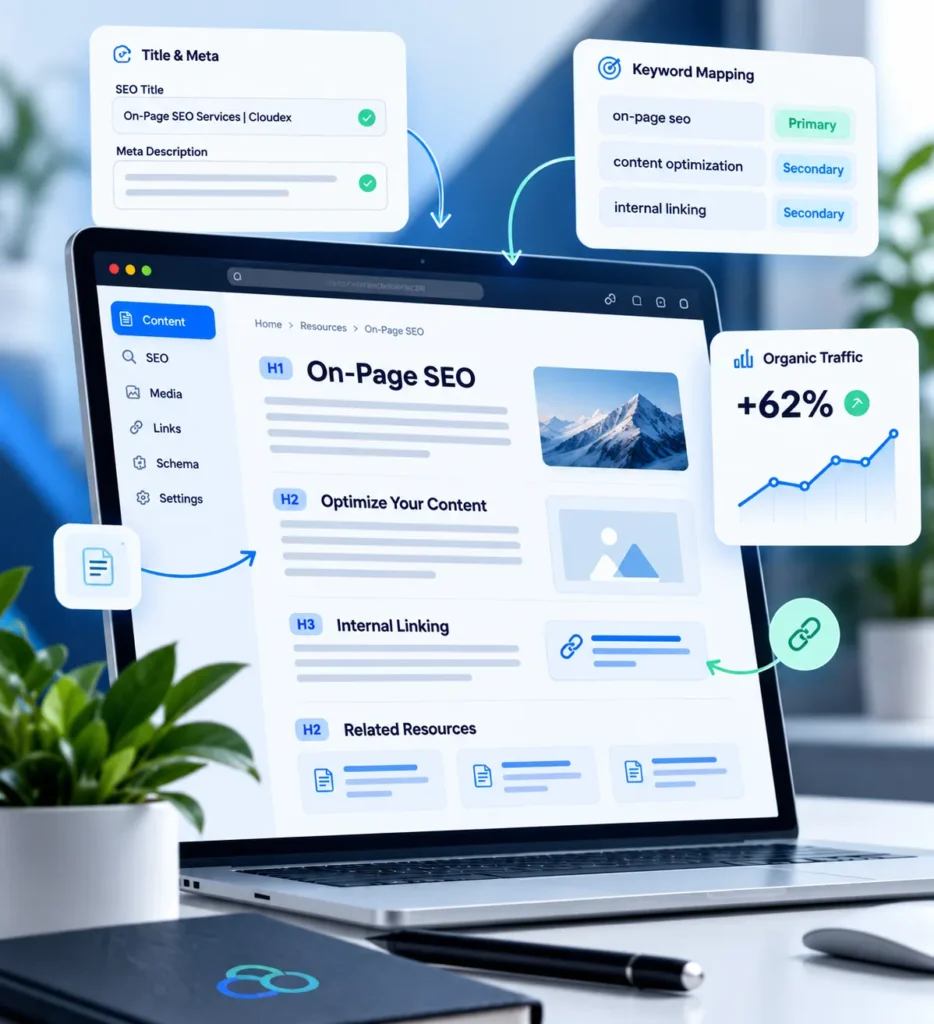
Organic Traffic From On-Page SEO
Cloudex Insights
From Search Demand to Better Pages
Cloudex Marketing follows a clear sequence: understand the current page, establish its search job, decide whether it deserves priority, and measure what happens after the right changes go live.
Diagnose
Analyse existing URLs, queries, rankings, content, and page-level performance.
Map
Connect search demand and intent with the URL best suited to own it.
Prioritise
Choose pages combining realistic search opportunity with meaningful commercial value.
Optimise
Improve content, structure, metadata, internal links, and relevant page signals.
Implement
Publish or coordinate approved changes without unnecessarily sacrificing existing value.
Measure
Compare search ownership, visibility, traffic, and commercial response after approved changes go live.
Four Core On-Page SEO Pillars
Strong on-page performance comes from four connected pillars: the right URL owning the right demand, satisfying the search properly, receiving support from the wider website, and giving qualified visitors a clear route forward.
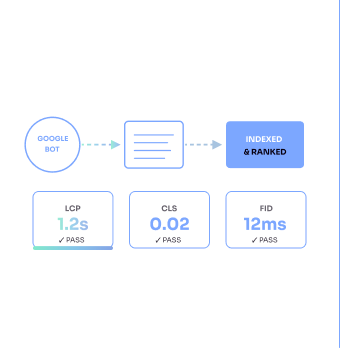
Search Ownership
Every important URL needs a clearly defined search role before optimisation begins.
- Decide which queries genuinely belong to each page.
- Match search demand with the most suitable existing or new URL.
- Separate overlapping pages before stronger optimisation creates further conflict.
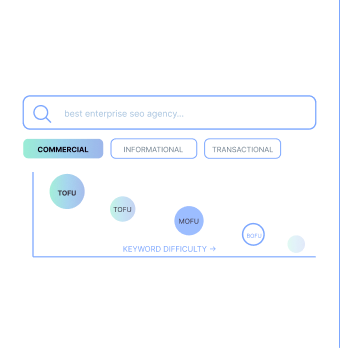
Intent Satisfaction
Ranking requires more than mentioning the right terms. The page needs to deliver what the searcher came expecting to find.
- Compare the page against the result types Google currently rewards.
- Cover the questions, entities, and decision-making information the search requires.
- Add, remove, or restructure content based on usefulness rather than word count.
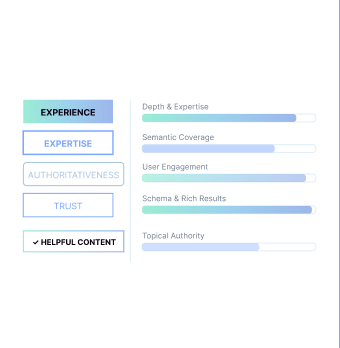
Page Context
A URL performs inside a wider website, so its relationship with surrounding pages matters.
- Build relevant internal links from supporting content and related commercial pages.
- Use anchors and surrounding context that clarify the destination’s purpose.
- Strengthen page hierarchy without creating unnecessary competing URLs.
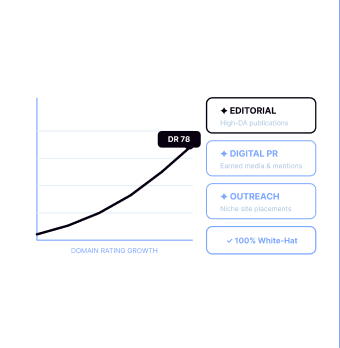
Search-to-Action Alignment
Visibility earns the visit. The page still needs to help the right visitor understand what happens next.
- Keep search intent and commercial purpose aligned within the same page.
- Make propositions, proof, and next steps easy to understand.
- Measure both search improvement and the actions qualified visitors take afterwards.
60-Day Page Performance & Search Growth Commitment
Within the first 60 days, priority pages will have a clearer search role, stronger alignment with search intent, and a defined optimisation path based on evidence. We keep every recommended change tied to the problem it is intended to solve and avoid unnecessary edits to pages already performing well. If agreed-on on-page work is not completed to the standard set in scope, we correct it without adding another fee.
Target Low-Fruit Pages To Gain Instant Rankings
Your website can already contain pages sitting closer to valuable search demand than you realise. Cloudex Marketing finds those opportunities, establishes what is holding them back, and prioritises the changes worth making.
Why Choose Us For On-Page SEO Work in UK
The difference is not how many page elements we can change. It is whether there is a clear reason for changing them. Optimisation is the output. Better page performance is the objective.
How We’re Different
Establish what the URL should win before editing it.
Optimise around what the searcher actually expects to find.
Invest where opportunity and commercial value justify the work.
Measure whether the page actually performs better.

What We Avoid
Find a keyword and start inserting it across the page.
Treat repetition as evidence of stronger relevance.
Apply the same checklist across every indexable URL.
Count rewritten words, titles, and tasks as the result.
What Our Clients Say About Working With Us
Results matter, but so does the experience of getting there. Our client reviews reflect the communication, clarity, responsiveness, and practical support businesses receive while working with Cloudex Marketing.
Alistair Vance

The strategy brought our website, content, and search work together, making our overall marketing feel much more focused.
Harry Williams
They brought structure to our marketing without making it complicated, and our website now supports growth more clearly.
Isla Davies
I liked that they never pushed services we didn’t need. The plan stayed practical, focused, and easy for our team to use.
Tony Brown
On-Page SEO FAQs for UK Businesses
These are the practical questions businesses should understand before investing in on-page SEO, from what gets changed to how Cloudex Marketing decides whether changing it is worthwhile.
What are on-page SEO services?
On-page SEO services improve how individual website pages target, satisfy, and convert relevant search demand. Cloudex Marketing works across page purpose, keyword mapping, search intent, content, headings, metadata, internal links, structured data, consolidation, and other page-level signals according to what each URL needs.
What is the difference between on-page SEO and technical SEO?
On-page SEO primarily improves the purpose, relevance, and information of individual pages; technical SEO primarily improves how search engines access, process, and understand the website. The disciplines overlap in areas such as internal linking, structured data, and architecture. Explore our technical SEO services for the technical side.
What is the difference between on-page and off-page SEO?
On-page SEO strengthens what exists on and around the page, while off-page SEO strengthens external authority and recognition. Our off-page SEO services cover areas such as competitor authority analysis, relevant link acquisition, digital PR, and external mentions.
How do you choose which pages to optimise first?
We combine search demand, current rankings, search intent, commercial importance, page quality, competition, and the size of the optimisation gap. A URL deserves priority when stronger performance has realistic upside for both organic visibility and the business, not simply because an audit found something editable.
Can you optimise content that is already ranking?
Yes. Existing rankings provide useful evidence about how Google currently understands a page. We review its queries, SERP, intent, content gaps, and competing URLs before making changes. A successful page should not be completely rewritten simply because an optimisation tool suggests more words or keywords.
How long does on-page SEO take to work?
Search engines need to recrawl and process changed pages before the full effect can be assessed. Some changes can be recognised quickly, while ranking and traffic response depends on the existing position, competition, authority, search demand and the type of optimisation completed. We establish the pre-change baseline and judge performance after the page has had sufficient opportunity to be recrawled and reassessed.
How much do on-page SEO services cost in the UK?
Pricing depends on website size, priority URLs, competition, existing content, implementation requirements and the wider campaign scope. Cloudex Marketing determines what actually needs work rather than selling arbitrary quantities of optimised pages. We establish which pages genuinely need work and the level of optimisation or implementation required before recommending an appropriate scope and investment.
Find the Pages With the Strongest Search Opportunity
Your website may already contain pages sitting close to commercially valuable demand. Others may target the wrong searches, compete with another URL, or simply need a clearer reason to rank. Cloudex Marketing identifies which pages deserve attention, establishes what each one should own, and focuses optimisation on the changes most capable of improving search and commercial performance.