
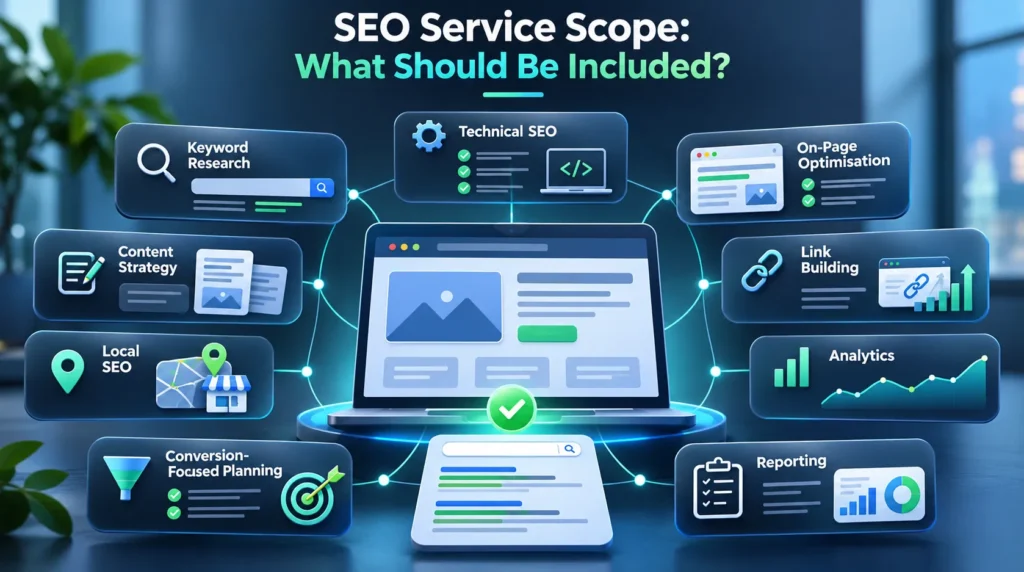
An SEO service scope should define the research, technical optimisation, on-page improvements, content work, off-page activities, reporting, and implementation responsibilities included in your agreement with an SEO provider.
It should also explain what’s excluded, who carries out the work, what you’ll receive, and how progress will be measured.
A Complete SEO Package: Sometimes an Illusion
A proposal labelled Complete SEO Package doesn’t necessarily include everything your website needs. One agency might provide audits and recommendations, while another handles implementation, publishing, and ongoing quality checks.
Both can legitimately offer SEO services. But they’re selling different levels of responsibility.
This guide explains what belongs in a professional SEO scope, what should be optional, and how to tell whether you’re paying for recommendations or actual work.
What Is the SEO Scope of Work?
An SEO scope of work (SOW) is a written agreement describing the activities, deliverables, responsibilities, and limits of an SEO engagement.
It defines what the provider is expected to do, what the client must supply, how the work will be accepted, and how changes to the agreement will be handled.
A clear scope answers six questions:
- What problems are we trying to solve?
- Which SEO activities are included?
- Who will implement the recommendations?
- What deliverables will we receive?
- How will completion and performance be evaluated?
- What happens when additional work is required?
The distinction between strategy, implementation, and results matters.
Strategy identifies what should happen. Implementation puts those decisions into practice. Results show what happened afterwards. An SEO agency can be responsible for the first two without being able to guarantee the third.
Is an SEO Scope the Same as an SEO Strategy?
SEO Strategy
An SEO strategy explains the objectives, opportunities, and priorities behind the work.
SEO Scope
The scope establishes which parts of that strategy a provider is contracted to deliver.
For example, a strategy might identify the need for better commercial landing pages. The scope should specify whether that includes research, writing, design changes, publishing, and quality assurance.
An SEO audit is another distinct element. It diagnoses problems and opportunities, but it does not automatically include resolving everything discovered.
What Are the Main Components of SEO Services?
A comprehensive SEO engagement can involve five core disciplines, supported by research, measurement, and implementation management. These disciplines work together but serve different purposes.
| SEO Component | What It Covers |
| Technical SEO | Crawling, rendering, indexability, site architecture and technical accessibility |
| On-page SEO | Page relevance, titles, headings, internal links and content optimisation |
| Content SEO | Search-intent research, topic planning, content creation and maintenance |
| Off-page SEO | Relevant backlinks, digital PR, mentions and external credibility |
| Local SEO | Geographic relevance, local pages and eligible Google Business Profiles |
In Some Cases
Local SEO is conditional on the business model. A nationwide online business does not automatically need Google Maps optimisation.
Similarly, link building, site-speed development and content production shouldn’t be included simply to complete a package checklist. The scope should reflect identified requirements.
1. Discovery, Audit and Strategy in the SEO Scope of Work
A serious SEO engagement starts by understanding the website and the business it supports.
Before recommending new articles or backlinks, the provider should understand how customers search, which pages already perform, and what prevents the site from competing effectively.
Business and Audience Discovery
The discovery process should establish:
- Products and services that matter commercially.
- Target locations and customer segments.
- Customer questions, objections and buying considerations.
- Existing enquiry and sales channels.
- Priority conversions and internal business goals.
- Available website, development and content resources.
A UK business selling specialist engineering services needs different content and conversion priorities from a restaurant or online clothing retailer.
SEO Audit and Baseline Assessment
An initial SEO audit evaluates your website’s technical health, content quality, structure, off-page signals, and existing search performance to identify problems and opportunities.
The assessment should cover crawling and indexing errors, internal links, page relevance, content gaps, website architecture, backlinks, and organic search visibility. It should also establish a performance baseline using Google Search Console and analytics data.
A crawl report identifies technical findings, but it doesn’t explain which problems matter most or how they affect your business. A complete audit connects those findings to practical decisions through a structured process of collecting evidence, diagnosing issues, prioritising fixes, implementing changes, and validating results.
A useful audit deliverable contains:
- Identified issues: The problem, affected URLs, and supporting evidence.
- Impact assessment: How each issue affects search visibility, website accessibility, or business objectives.
- Recommended actions: The specific changes needed to resolve the problem.
- Priority and ownership: Which issues need attention first and who is responsible for implementation.
- Validation criteria: How to confirm that the corrections have worked.
For example, if an important service page isn’t indexed, the onsite audit should investigate the underlying cause rather than simply flagging the URL. That investigation could involve checking crawl accessibility, indexing directives, canonical tags, internal links, and Google’s reported indexing status.
The final deliverable should be a prioritised, evidence-based action plan, not a spreadsheet containing hundreds of unexplained errors.
Competitor, Keyword and Search Intent Research
SEO research should go beyond collecting high-volume keywords. It should identify the searches associated with your services, customer problems, locations, comparisons, and purchasing decisions.
Competitor research then helps establish which websites compete for those searches and what your website lacks.
Expected deliverables can include a search-intent map, relevant competitor analysis, keyword-to-page mapping, and a prioritised list of opportunities.
SEO Roadmap and Priorities
Research should become an actionable plan. The roadmap needs to distinguish immediate fixes, dependencies, important page improvements, and longer-term opportunities.
For example, a website with indexing problems affecting its core services should not automatically prioritise publishing new blog articles.
A Comprehensive SEO Audit Is Not the Same as Comprehensive SEO Delivery
An agency can inspect every major SEO discipline and still be contracted only to provide recommendations. Before signing, establish whether implementation, testing, publishing, and ongoing monitoring are included.
2. Technical SEO: What Should Be Included in the SEO Scope of Work?
Technical SEO covers the systems and website characteristics that affect how search engines access, render, interpret, and index pages. The exact requirements depend on the website’s technology, size, and existing problems.
Crawling and Indexability
The scope should assess whether important URLs can be discovered, crawled, and considered for indexing.
This can include:
- robots.txt rules.
- XML sitemap accuracy.
- Indexing directives and meta robots tags.
- Canonicalisation and duplicate URL handling.
- HTTP status codes.
- Redirect chains and loops.
- Orphan pages and internal-link discovery.
- JavaScript rendering where relevant.
- Pagination and URL parameter behaviour.
Crawling and indexing are different processes. A page being crawled does not guarantee it will be indexed. Similarly, placing a URL in an XML sitemap does not force Google to index it.
Website Architecture and Internal Links
Technical work should examine how pages relate within the website.
Important questions include whether commercial pages can be reached through useful internal links, whether duplicate page groups compete for the same purpose, and whether site navigation reflects the business’s actual services.
Internal linking supports both page discovery and user navigation. It deserves an explicit place in the scope rather than being treated as an occasional content-writing task.
Page Performance and Mobile Experience
An assessment can examine loading performance, mobile rendering, layout stability, and user interaction delays.
Core Web Vitals provide specific measurements of loading, responsiveness, and visual stability. They are related to website performance but are not a complete measure of website speed or usability. The contract should distinguish performance diagnosis from development implementation.
For example, an agency may identify a costly JavaScript component but lack responsibility for rebuilding it.
Structured Data and Security
Other relevant activities include evaluating supported structured data, checking that markup accurately reflects visible page content, and identifying HTTPS or technical configuration problems affecting search access.
Implementing schema markup does not guarantee rich results. And identifying a security issue does not mean the SEO provider is contracted to perform cybersecurity remediation.
What to ask: Does technical SEO include resolving the issues, coordinating developers, or delivering recommendations only?
You can review the specialised work involved in technical SEO services.
3. On-Page SEO: What Should Be Included in the SEO Scope of Work?
On-page SEO improves how an individual web page communicates its purpose to search engines and visitors. It involves far more than inserting target keywords.
Titles, Metadata and Page Structure
A defined on-page scope can include:
- Page titles and meta descriptions.
- H1 and supporting heading structure.
- Search-intent alignment.
- Introductory answers and main content relevance.
- Internal link placement and descriptive anchors.
- Image alt text where appropriate.
- Page-specific content updates.
- Duplicate or competing page analysis.
- Relevant calls to action.
Title tags help describe pages in search results, while meta descriptions can influence the snippets Google chooses to display. Neither guarantees a particular presentation.
Content Relevance and User Intent
Every important page should have a clear function.
A commercial service page should explain what the business provides, who it serves, what the work involves, and how customers can enquire. An informational guide should answer the question behind the search without turning every paragraph into a sales pitch.
The scope should specify whether the agency is responsible for improving existing content, writing replacement copy, or only identifying content weaknesses.
Internal Linking and Related Content
On-page work should also consider how articles, service pages, and case studies support one another.
For example, an informational article explaining a problem can link to the relevant service page when the reader needs professional support. A service page can link to a detailed guide when visitors need more context before making a decision.
These relationships should follow the subject and reader’s needs, not an arbitrary number of internal links per page.
Related: On-Page SEO Guide
4. SEO Content Strategy, Writing and Publishing in the SEO Scope of Work
Content services are among the easiest parts of an SEO agreement to misunderstand.
A promise to deliver a certain number of articles doesn’t establish whether those articles are needed, researched properly, or connected to business outcomes.
What Should Content Strategy Include?
A content strategy can cover:
- Commercial landing-page opportunities.
- Informational topics and supporting guides.
- Customer questions and buying-stage comparisons.
- Relevant topical relationships.
- Content gaps and competing URLs.
- Content refreshing and consolidation.
- Internal linking and publishing priorities.
The objective is not to produce the largest possible content library. It’s to create or improve pages with a clear role in the website’s search strategy.
Content Creation Deliverables
When writing is included, the agreement should clarify whether each deliverable covers:
- Topic and search-intent research.
- Content briefs and outlines.
- Drafting and editorial review.
- Subject-matter expert input.
- Fact-checking and claim approval.
- Images or other supporting media.
- Internal links and metadata.
- Publishing and post-publication checks.
- Revisions and final approval.
A content brief, a draft article, and a published, quality-checked page are three different deliverables.
Service Pages, Location Pages and Supporting Articles
Businesses also need to distinguish different content formats.
Service pages support commercial searches. Location pages explain genuine geographic relevance. Guides, comparisons and case studies answer questions and support purchasing decisions.
A location page must provide meaningful information for that area. Replacing a town name across hundreds of nearly identical pages does not establish useful geographic relevance.
Google’s spam policies identify doorway pages and scaled, low-value content as problematic practices.
Does Content Need Updating Every Month?
No fixed publishing or refresh schedule applies to every website. An agency should review content when facts change, user needs evolve, pages underperform, or better information becomes available.
Sometimes consolidating overlapping articles is more useful than creating additional content.
Related: Topic Clusters: How to Build Real SEO Authority
5. Off-Page SEO, Link Building and Digital PR in the SEO Scope of Work
Off-page SEO concerns relevant external references and credibility beyond your own website.
It can involve link earning, partnership references, digital PR, industry mentions, and other legitimate promotional activity.
Backlink Analysis and Link Earning
The scope might include reviewing existing backlinks, identifying relevant publications, reclaiming lost links, and conducting outreach.
An agency should explain how it evaluates the relevance and risk of prospective links.
A backlink is an output or reference from another website. Link building is the activity intended to acquire or earn links. They are related, not interchangeable.
A large number of links isn’t automatically evidence of a successful campaign.
Digital PR and Other Off-Page Activities
Digital PR can involve original research, useful resources, expert commentary, or stories that attract editorial coverage.
Not every earned link requires a digital PR campaign, and not every brand mention produces a backlink. If a proposal includes both digital PR and link building, ask what each activity actually delivers.
Where external authority is an established priority, off-page SEO services can form a distinct part of the engagement.
What Should Be Excluded?
A responsible scope should not promise guaranteed editorial placements, guaranteed ranking improvements, or bulk links designed to manipulate search results.
Paid advertising and sponsorship links are not inherently prohibited, but links paid for as advertising should be appropriately qualified rather than passed off as editorial ranking signals.
The agreement should also state whether media placement fees, research, production, and outreach-related expenses are included.
Related: Off-Page SEO Guide
6. Local SEO and Google Business Profile Management Should be Described in the SEO Scope of Work
Local SEO should be included when a business depends on customers searching within specific locations or service areas. This can involve the website, Google Maps visibility, and accurate information about the business.
What Does Local SEO Cover?
Relevant activities include:
- Google Business Profile assessment and optimisation.
- Appropriate categories, services, and business details.
- Eligible location and service-area configuration.
- Local landing-page improvements.
- Accurate business listings and citations.
- Review management guidance.
- Relevant local links and references.
- Local search performance reporting.
A Google Business Profile is not the same thing as a website location page. They are separate resources with different roles.
Does Every UK Business Need a Google Business Profile?
No.
Google Business Profile eligibility depends on whether a business meets Google’s requirements, including qualifying in-person customer contact.
A remotely operated digital business does not become eligible simply by renting a virtual address or targeting London.
An SEO provider should verify eligibility rather than promise map visibility to every business.
What About Businesses Serving Several Locations?
The scope should identify which locations are actually served and what evidence supports the geographic claims.
Local landing pages should describe meaningful differences in services, coverage, availability, or other useful local information.
For businesses with legitimate geographic requirements, local SEO services can include both local website optimisation and relevant business-listing work.
Related: Guide to Local SEO
7. AI Search Visibility: What Belongs in an SEO Scope?
Modern SEO scopes should consider how a business is represented across traditional search and AI-assisted discovery experiences.
That doesn’t mean every company needs a separate, expensive collection of AI optimisation deliverables.
Technical and Content Requirements for AI Search
Useful work includes ensuring important information is accessible, accurate and consistent across a business’s website.
Relevant activities can involve:
- Crawlable, indexable content.
- Clear descriptions of products, services and organisations.
- Accurate facts and supported claims.
- Logical page structure and relevant internal links.
- Appropriate structured data.
- Consistent brand information across important sources.
- Monitoring of observable mentions and referral activity.
Search retrieval and answer generation are distinct processes. An AI system can retrieve information without necessarily quoting or linking to the original page.
Likewise, writing concise answers does not guarantee that a website will receive citations in ChatGPT or Google AI Overviews.
Google states that
its AI Overviews and AI Mode do not require special markup beyond established Search requirements.
What Should an AI SEO Provider Actually Deliver?
If AI visibility is part of the agreement, request specific activities and evidence.
These might include an analysis of relevant search experiences, improvements to factual content, citation or mention monitoring, and clearly explained measurement limitations.
Ask how the provider distinguishes observed mentions, referral sessions, and estimated visibility.
A dashboard showing a brand appearing in a small set of AI prompts is not proof of overall market visibility or revenue impact.
For practical approaches, see our guide to strategies for improving AI visibility.
8. Conversion Experience & Website Design Explained in the SEO Scope of Work
SEO brings relevant people to a website. The website must still help them take the next step.
That makes conversion experience a useful supporting consideration, particularly for businesses buying SEO to generate enquiries, bookings or sales.
What Should SEO Cover?
A search-focused review can examine whether important landing pages contain clear information, useful calls to action, accessible navigation and functioning enquiry paths.
It can also identify mobile usability issues or gaps between the searcher’s intention and the content they reach.
What Requires a Separate Scope?
A complete website redesign, advanced conversion testing, checkout rebuild, or custom development project is not automatically included in an SEO retainer.
The agency should identify such work, explain its relevance, and specify who is responsible.
For example, fixing a contact form may be an immediate commercial priority even when it has no direct relationship with keyword rankings.
9. SEO Reporting, Analytics & Measurement Explanation Should Be in the SEO Scope of Work
An SEO scope should state what will be measured, which tools will be used, and how results will be communicated.
Without this, clients can receive polished reports without understanding whether meaningful progress occurred.
Search Performance Metrics
Common metrics include:
- Google Search impressions and clicks.
- Relevant query visibility.
- Landing-page performance.
- Search click-through rate.
- Organic search sessions.
- Important page indexing and technical status.
Google Search Console provides search performance data, while web analytics can help assess what visitors do after reaching the website. Neither tool alone tells the complete commercial story.
Commercial Performance Metrics
Depending on the business, reporting can include:
- Qualified leads and consultation requests.
- Contact form submissions.
- Tracked phone enquiries.
- Bookings and purchases.
- Organic revenue where attribution is available.
- Lead quality or sales outcomes from business records.
A traffic increase is not automatically a revenue increase. Marketing attribution also has limitations, particularly where customers interact with several channels before purchasing.
What Should a Monthly SEO Report Contain?
A useful report should connect three things:
Work completed > observed changes > next decisions.
It should identify published or updated URLs, important technical fixes, relevant off-page activity, meaningful performance changes, and the next priorities.
When performance declines, the report should explain what is known, what is being investigated, and what cannot yet be established.
10. SEO Implementation, Quality Assurance, & Responsibilities Outlined in the SEO Scope of Work
This is the part of a service agreement that deserves particular attention. An agency can identify the right improvements, yet the engagement can still fail operationally if nobody is responsible for implementing them.
Who Makes the Changes?
The scope should distinguish the responsibilities of the SEO provider, development team, content team, and client.
| Responsibility | What Must Be Agreed |
| SEO provider | Research, recommendations, agreed implementation, testing, and reporting |
| Website developer | Code changes, technical fixes, deployments and specialist development |
| Content team | Drafting, editing, publishing and content maintenance |
| Client | Approvals, business information, access, legal review and feedback |
| Account manager | Communication, delivery coordination and issue escalation |
These are possible role allocations, not a mandatory organisational structure. A full-service provider can handle several responsibilities. What matters is that every important task has an owner.
What Counts as a Completed Deliverable?
| For a technical fixCompletion should involve verifying the deployed change. | For contentIt could involve publication, correct metadata, internal linking, and editorial approval. |
| For a reportIt means the client can understand the findings and decisions rather than simply receive exported data. | The agreement The agreement should define acceptance criteria proportionate to the task. |
Client Responsibilities
The client must provide accurate business information, suitable access, and timely approval when those activities are necessary.
For regulated industries, content may require qualified review before publication.
The client should also retain appropriate control over business-critical accounts, domains, and owned assets, with intellectual property and licensing terms explicitly documented.
11. The Scope Should Specify Which SEO Services Are Optional or Project-Specific
Not every SEO activity belongs in a standard monthly agreement. The following services should be included only where the website’s requirements justify them.
Website Migration SEO | Project-Specific
A migration can involve URL mapping, redirect planning, staging-site reviews, canonical checks, internal-link updates, and post-launch validation.
This is particularly important when changing domains, content management systems, or website architecture.
If you’re planning a major change, SEO migration services should be scoped around the actual risks of that project.
Ecommerce SEO | Optional
Ecommerce work can involve product and category pages, faceted navigation, inventory-related URLs, structured data, and organic revenue measurement.
A service-based website does not require this same scope.
International and Multilingual SEO | Optional
International projects can require country targeting, language-specific content, hreflang, site structure, and market-specific search research.
Targeting all of the United Kingdom is not the same as international SEO. England, Scotland, Wales and Northern Ireland form the UK, and their differences can matter for regional search strategy.
Enterprise SEO | Optional
Large organisations need attention to templates, governance, platform dependencies, automation, multiple stakeholders and extensive URL collections.
Enterprise SEO can involve coordination across development, product, editorial and analytics teams.
SEO Recovery and Manual Actions | Project-Specific
A sudden traffic decline should be investigated before anyone assumes Google has penalised a website. Relevant causes can include technical failures, content changes, competitors, seasonality, or algorithmic changes. An actual manual action should be assessed through Google Search Console and handled according to the issue identified.
For a business dealing with an established manual action or a suspected search visibility problem affecting its operations, our SEO penalty removal service is the solution for that business.
Diagnosis, corrective implementation, reconsideration requests where applicable, and recovery monitoring should be scoped separately. No provider can guarantee reinstatement of previous rankings.
SEO Outsourcing and White Label Delivery | Optional
Marketing agencies can contract another provider to carry out SEO work under their own brand.
This creates additional requirements for confidentiality, client communication, branding, quality assurance and reporting.
White label SEO is a delivery model, not simply another name for ordinary SEO.
The contract should identify which agency owns the client relationship and which supplier fulfils the work.
12. What Should Not Automatically Be Included in an SEO Service Scope?
The term full-service SEO does not mean unlimited work.
Common exclusions or separate services include:
- Complete website redesign and custom development.
- Paid advertising management and advertising spend.
- Hosting, cybersecurity, and routine server administration.
- Third-party software subscriptions and licensing.
- Professional photography, video production, and extensive design.
- Legal, medical, or financial compliance approval.
- Extensive ecommerce functionality changes.
- Brand identity and broader marketing strategy.
- Unlimited content revisions or publishing.
- Guaranteed rankings, traffic, leads, or AI citations.
These activities can support organic growth, and an agency may offer them. They should not be assumed to be included without written confirmation.
A Service Is Not Included Simply Because It Is Mentioned
If an SEO proposal says technical SEO is covered, establish whether that means an audit, a set of recommendations, minor fixes, or full developer-led implementation. Broad service names are not substitutes for defined deliverables.
13. What Should Be Included in an SEO Scope of Work Document?
An effective scope of work should make it possible to verify what was purchased. Before signing, check that the agreement includes the following.
Objectives and Baseline
Define the relevant business goals, target market, website properties, and available performance baseline.
Included Activities and Deliverables
Specify the workstreams, outputs, implementation arrangements, and quality checks. Where quantities are relevant, define them without encouraging unnecessary production simply to meet a quota.
Exclusions and Dependencies
Record development limitations, content approvals, third-party costs, required access, and tasks not covered.
Timelines and Review Points
Establish delivery milestones, dependencies, and review arrangements. A delivery deadline for a technical fix is different from an expected date for improved search rankings.
Communication and Reporting
Specify reporting frequency, contact arrangements, decision ownership, and escalation procedures.
Ownership and Access
Clarify ownership of accounts, published content, source files, data and other work products.
Change Requests and Exit Arrangements
Explain how additional work is agreed, how the contract can end, and what the client receives during handover. A well-defined exit process should include necessary account access, outstanding deliverables and documentation for work already completed.
14. Example SEO Scope of Work for a UK Service Business
Consider a hypothetical company providing commercial heating services across several UK regions. Its website has established service pages but weak local relevance, overlapping articles and limited organic enquiry measurement.
A suitable SEO engagement might be structured as follows:
| Workstream | Proposed Deliverable |
| Discovery and strategy | Commercial service assessment, relevant query mapping and priority roadmap |
| Technical SEO | Indexability review, internal-link improvements and prioritised corrections |
| On-page SEO | Optimisation of important service pages |
| Content SEO | Consolidation of overlapping articles and development of missing supporting content |
| Local SEO | Verified geographic targeting and improvements to appropriate local pages |
| Measurement | Search Console analysis, enquiry tracking review and monthly reporting |
| Quality assurance | Testing of implemented changes and documentation of completed work |
This is an example, not a universal service package.
If the business already has strong technical foundations, the provider can allocate more effort towards commercial pages and supporting content. If a major indexing problem emerges, that might become the immediate priority.
The key is to agree on how changes to priorities affect the contracted deliverables.
15. How to Compare SEO Service Scopes Before Hiring
When comparing proposals, don’t start with the number of activities. Start with the actual responsibilities.
Ask whether each provider has explained:
- What the website needs.
- Why the recommended work matters.
- Which pages, systems, or business areas are involved.
- Who will complete the work.
- What constitutes acceptable delivery.
- How work will be measured.
- What requires further approval or a separate agreement.
- How findings will inform the next stage.
Two proposals can use the same labels, including technical SEO, content, and reporting, while offering fundamentally different levels of service.
The strongest scope is not the one promising everything. It is the one that defines the necessary work clearly enough to execute, review, and verify. Therefore, do not decide in a hurry. Take time, compare, evaluate, and choose the right SEO service for your business.
If you’ve already selected a provider, our guide on what an SEO agency actually does each month helps you evaluate ongoing delivery and ensure you receive what you’re paying for.
Frequently Asked Questions
1. What Is SEO Scope?
SEO scope defines the activities, deliverables, responsibilities, and boundaries of a search engine optimisation project or ongoing agreement. It clarifies what the provider will deliver, what the client must supply, and how work will be evaluated.
2. What Is the 80/20 Rule in SEO?
The 80/20 rule is a prioritisation principle suggesting that a smaller proportion of activities can account for a large share of results. It isn’t a fixed mathematical rule for Google rankings. For example, fixing indexing problems affecting important service pages could create more value than making minor changes across dozens of low-priority articles. The practical lesson is to prioritise by expected impact rather than task volume.
3. What Is Included in SEO Services?
SEO services can include audits, keyword research, technical optimisation, on-page improvements, content creation, internal linking, off-page work, local SEO and reporting. The actual inclusions depend on the provider’s agreement and your website’s requirements. For a business evaluating professional support, our SEO services in the UK page outlines the available disciplines.
4. What Are the 5 Components of SEO?
A practical five-part classification is technical SEO, on-page SEO, content SEO, off-page SEO, and local SEO. These are useful service categories rather than an official five-part ranking formula. Research, measurement, and strategy support several of them, while local SEO applies only where geographic relevance matters.
5. Does an SEO Package Include Website Development?
Not automatically. SEO work can identify development problems, but implementing code changes, rebuilding templates, or redesigning pages depends on the agreement. Ask whether development work is performed by the SEO provider, your own developer, or a separate supplier.
6. Should SEO Services Include AI Search Optimisation?
An SEO strategy should consider relevant AI-assisted discovery experiences, but a separate AI package is not necessary for every business. Key AI SEO activities include accurate content, accessible pages, consistent business information, and sensible visibility monitoring. For more detail, explore our strategies to improve AI visibility.
7. Is Link Building Included in Every SEO Service?
No. Link building depends on the website’s needs, existing backlink profile, competition, and agreed strategy. A technical recovery project, for instance, can be completed without acquiring new backlinks. If link building is included, the provider should explain its methods, deliverables, and risks.
8. Can I Hire an SEO Agency for a One-Off Project Instead of Monthly Services?
Yes. A defined SEO audit, technical investigation, migration, or content assessment can be delivered as a standalone project. However, ongoing seo services are more suitable when your website needs continuing research, implementation, monitoring, and improvement.
Your SEO Scope Should Be Clear Before the Work Begins
The purpose of an SEO service scope is simple: establish what your business needs, what the provider will do, and how the work can be evaluated. You don’t need to buy every SEO discipline. You need an appropriate combination of research, implementation and measurement, with responsibilities clearly documented.
Need an SEO proposal built around your website’s actual requirements?
Cloudex Marketing provides SEO services for UK businesses, including technical optimisation, on-page SEO, content and organic search strategy. Explore our SEO services or contact Cloudex Marketing to discuss the work your website needs.