



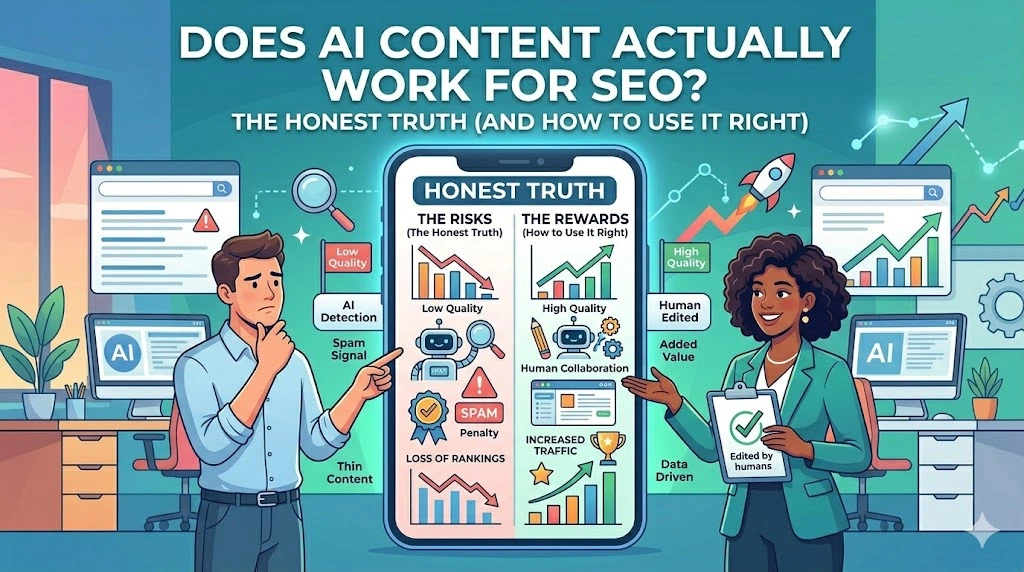
Google doesn’t ban AI content. But most AI content still ranks terribly. The difference isn’t whether the content came from AI. It’s whether the AI was used as a tool or a replacement. When AI replaces human judgment, content fails. When AI supports human expertise, content succeeds.
This distinction matters more than marketers realize. Thousands of businesses publish AI-generated articles expecting ranking improvements, then wonder why nothing changes. They’re using AI wrong.
This guide shows exactly when AI works for SEO and when it sabotages your rankings.
The Honest Truth: Google’s Stance on AI Content
Google officially permits AI-generated content. They don’t ban it. They don’t automatically penalize it. But they absolutely penalize low-quality AI content created solely to manipulate rankings.
Google’s official position: “Appropriate use of AI or automation is not against our guidelines. This means it is not used to generate content primarily to manipulate search rankings, which is against our spam policies.”
Translation: AI is fine. Spam is not. Unfortunately, most AI content falls into the spam category.
The March 2024 Core Update targeted this exact problem. Google identified patterns in how AI content was being abused. Bulk-published low-value articles, content created with zero human oversight, expired domains republished with AI articles, and excessive content volume over quality. Google penalized these aggressively.
The result:
New websites publishing pure AI content saw dramatic ranking drops. Established sites with authority continued ranking despite using AI. This tells you everything about Google’s actual stance: Authority matters more than content origin.
This is critical:
Google measures content quality using E-E-A-T standards (Experience, Expertise, Authoritativeness, Trustworthiness). AI-generated content frequently fails E-E-A-T because it lacks genuine expertise and human experience.
The Three Main Problems With AI-Only Content
Problem #1: AI Hallucinations (Making Up False Information)
AI language models frequently “hallucinate”. They confidently state false information as fact. They invent statistics. They cite studies that don’t exist. They create plausible-sounding sources that never existed.
Example: An AI tool generates an article claiming “Research from Harvard Medical School shows X cures Y.” You publish it. Months later, you discover that the study doesn’t exist. Your site now contains false medical information.
The consequences:
- Users lose trust and bounce
- Google detects low authority and stops ranking you
- You face potential legal liability for false health claims
- Your brand reputation suffers permanently
This is why relying entirely on AI for content creation is dangerous. You’re gambling with your website’s credibility every time you publish.
Problem #2: Content Lacks Human Emotion and Creativity
AI writes accurately but blandly. It hits required keywords but lacks personality. It answers questions technically but doesn’t engage emotionally.
Engagement matters for SEO because it signals value. When users spend time on a page (dwell time), Google interprets that as relevance. When users bounce immediately (high bounce rate), Google interprets that as irrelevance.
AI content frequently generates high bounce rates because:
- It reads like a textbook, not a helpful guide
- It lacks personal examples and anecdotes
- It lacks the stylistic elements that make writing memorable
- It provides information, but not understanding
A human writer shares a story about why they recommend something. They explain not just what to do but why. They inject personality. AI generates bullet points.
Google rewards engaging content. AI content is rarely engaging enough to rank well, especially against human-written competitors.
Problem #3: AI Content Lacks Originality
AI tools pull information from existing web content and synthesize it. They don’t create truly original insights. They remix what already exists.
When multiple competitors use the same AI tools and ask about the same topics, they receive nearly identical articles. You end up with duplicate content accidentally, simply because the AI synthesized the same sources the same way.
Additionally, pure AI content offers nothing competitors don’t already have. Your competitive advantage disappears. Even if you rank temporarily, you’ll lose rankings to competitors with unique perspectives and original research.
When AI Content Actually Does Rank (And Why)
Short-term, low-stakes content:
Weather forecasts. Sports scores. Real estate listings. Automated finance reports. This content has been AI-generated for years and ranks well because AI is perfect for this use case, pure data synthesis, no expertise required, no room for hallucinations because data is verifiable.
Highly authoritative sites using AI as support:
The Verge published an AI-generated article about printers that ranked on page one. Why? The Verge has massive domain authority. Google trusts them. The site has proven expertise and reputation. The AI article benefited from that authority. A new website publishing the same article would rank nowhere.
Content following E-E-A-T guidelines:
AI content that includes human expertise, verifiable sources, author credentials, and clear authority sometimes ranks. But it’s the human overlay making it work, not the AI.
The pattern is clear: AI content ranks when it’s supported by existing authority. Without authority, pure AI content sinks.
How to Use AI for SEO the Right Way (AI as Tool, Not Replacement)
Strategic AI Use Case #1: Keyword Research Acceleration
Feed your target keyword into ChatGPT or Claude and ask for related keywords, search intent variations, and long-tail opportunities. AI can generate keyword ideas in seconds that would take humans hours.
This works because:
- Keyword generation is low-stakes (no accuracy risk, you verify in SEO tools anyway)
- AI excels at pattern recognition across data
- Human verification catches AI’s bad suggestions
- You save 80% of research time
Best practice: Use AI to generate 200+ keyword ideas, then filter through actual search volume and keyword difficulty data. Keep human judgment filtering AI suggestions.
Strategic AI Use Case #2: Content Research and Information Gathering
Instead of manually reading 10 competitor articles, ask AI to summarize them. Ask AI to compile background information on a complex topic. Ask AI to explain technical concepts clearly.
This works because:
- You’re using AI for summarization, not creation
- You’ll verify all information independently before publishing
- Humans catch hallucinations during the review process
- You reclaim hours spent on tedious research
Best practice: Use AI to compile background information quickly, then have subject matter experts review everything before human writers use it.
Strategic AI Use Case #3: Content Outline and Structure
Ask AI to create an outline for your article. What sections should it include? What questions should you answer? What order makes sense?
This works because:
- AI is good at organizing information logically
- Outlines don’t require accuracy (they’re just structure)
- Humans decide which sections matter most
- Writers use the outline as a starting point, not a final product
Best practice: Generate an outline, review for gaps, let human experts decide what’s important, then human writers fill in the outline with actual expertise and original examples.
Strategic AI Use Case #4: Title and Meta Description Ideas
Ask AI to generate 20 title tag ideas and 20 meta description options. Review them, pick the best, tweak slightly. This saves time on creative development without accuracy risk.
This works because: You’re reviewing every option. Bad suggestions are immediately obvious. You’re speeding up ideation, not replacing creative thinking.
The Framework: Human-in-the-Loop Content Creation
This is the only AI content approach that actually works:
Step 1 (AI): Generate keyword ideas, research summaries, content outlines, and structure suggestions.
Step 2 (Human): Review AI output. Catch hallucinations. Verify information. Decide what matters.
Many SEO companies in Pakistan tell you that publishing AI-generated content without human review is being reckless with your site’s authority. At the same time, our SEO services in Pakistan never skip human review and expertise.
Step 3 (Human): Write actual content using AI research as a starting point. Add personal expertise, examples, a unique perspective, and creativity.
Step 4 (Human): Fact-check everything. Verify sources. Remove any information lacking credibility.
Step 5 (Human): Optimize for SEO, readability, and E-E-A-T standards.
Step 6 (Human): Final review before publishing.
Notice: Humans are involved in every step except step 1. This is intentional. This is how content ranks.
When Not to Use AI Content (Even as Support)
YMYL topics (Your Money, Your Life):
Healthcare, finances, legal advice, and relationship counseling. These require genuine expertise and human authority. AI support is fine (research, outlining). AI creation is a disaster.
Industry-specific technical content:
If you’re a software company, don’t use AI to create technical documentation. Your engineers need to write it. AI can help organize, but expertise must be human.
Brand-critical content:
Product descriptions, company story, mission statements. These need a human voice and an authentic perspective. AI can draft, but humans must rewrite.
Content establishing topical authority:
If you’re positioning as an expert, don’t use AI to demonstrate that expertise. Your original insights and unique perspective are what establish authority. AI synthesis of existing content does the opposite.
The Real Risk: What Most Businesses Get Wrong
The dangerous assumption: “AI has gotten so good that I can publish AI content directly without review.”
The reality: Google’s systems are smarter at detecting low-effort AI content than ever. Even if content passes grammar checks, Google’s quality systems evaluate:
- Whether information is verifiable and accurate
- Whether the author has demonstrated expertise
- Whether the content offers unique value or just remixes existing information
- Whether the site has established authority on this topic
- Whether user behavior (dwell time, bounce rate) indicates engagement
AI content fails these checks consistently.
The safer approach: Use AI to accelerate human work, not replace it. Let humans make final decisions about what to publish.
How to Know If Your AI Content Actually Works
Good signals:
- Click-through rate from search stays stable or increases
- Dwell time increases (users spend time on the page)
- Bounce rate stays low
- Rankings improve in 30-60 days
- Users engage with content (comments, shares, conversions)
- Search Console shows consistent impressions
Bad signals:
- Rankings drop after publishing
- Impressions decrease month-over-month
- Click-through rate drops significantly
- Bounce rate increases
- Users leave immediately without engaging
- Google Search Console shows declining visibility
- AI detection tools flag content as machine-generated
If you’re seeing bad signals, stop publishing AI content. Audit existing AI content and either remove it or have humans rewrite it.
Implementation Checklist for AI Content
If you decide to use AI:
✓ Only use AI for research, outlining, and ideation
✓ Have subject matter experts review all AI-generated research
✓ Have humans write the actual content
✓ Fact-check every statistic and claim
✓ Include author credentials showing expertise
✓ Add unique examples and personal experience
✓ Ensure content offers something competitors don’t
✓ Review for E-E-A-T compliance before publishing
✓ Monitor performance in Search Console
✓ Remove content if rankings drop after publishing
If you’re currently publishing pure AI content:
✓ Audit existing AI content performance
✓ Identify which content is ranking vs. underperforming
✓ Remove underperforming AI content or rewrite with human expertise
✓ Add human expertise to any remaining AI content
✓ Consider redirecting low-performing pages to higher-quality alternatives
✓ Stop publishing pure AI content immediately
Our SEO agency in Pakistan audits your current content and helps identify which pieces need human attention. Content audits are essential in 2026 because much of the 2024-2025 AI content is now underperforming.
The Bottom Line: AI is a Tool, Not a Solution
AI doesn’t write content. AI helps humans write content faster.
Google rewards expertise, authority, and originality. AI provides none of these without human input. The businesses winning in 2026 aren’t using AI to replace writers. They’re using AI to help expert writers work faster.
A world-class writer using AI as a research tool beats an AI tool publishing autonomously every single time. This won’t change. Google’s systems are designed to reward human expertise and penalize content created purely for manipulation.
The businesses using AI intelligently are accelerating their content production while maintaining quality. The businesses hoping AI could replace experts are watching their rankings collapse.
Our SEO team in Pakistan understands this distinction. If you’re currently drowning in AI content that isn’t ranking, our SEO experts in Pakistan will always love to help you audit, remove underperformers, and rebuild with a human-first approach supported by AI tools.