


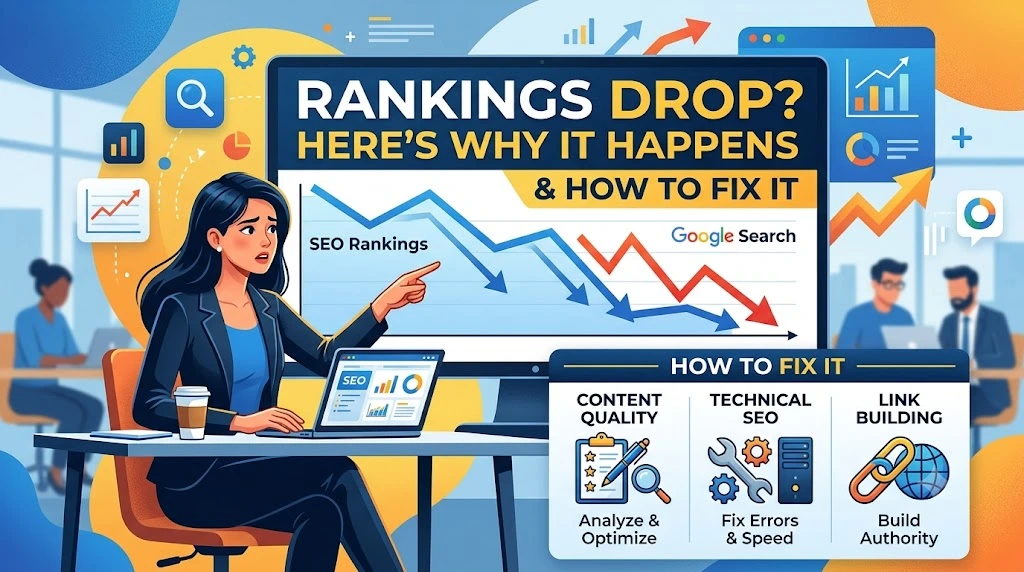
Yesterday, your website sat comfortably at position three. Today struggles at position eight. Panic sets in immediately.
Was it an algorithm update? Did competitors overtake you? Did Google decide your content had suddenly become irrelevant?
Before making frantic changes, hoping something sticks,
Understand this:
Ranking drops happen for identifiable reasons requiring systematic diagnosis rather than desperate guessing. Understanding SEO fundamentals means recognizing that position changes occur constantly, but meaningful drops signal something specific has changed, requiring attention rather than random optimization, hoping for improvement.
What Are Ranking Drops and When Should You Actually Worry
Ranking drops occur when pages lose position in search results, leading to organic traffic decline. Sometimes this means falling from position three to position eight for single keywords. Other times, dozens of keywords plummet simultaneously overnight across multiple pages. Both scenarios count as ranking drops, but severity differs dramatically, requiring different response urgency.
Normal Fluctuations Versus Serious Problems
Search rankings move constantly. Position changes of one or two spots represent normal fluctuations caused by algorithm adjustments, competitor improvements, or user behavior shifts. These minor movements rarely warrant immediate intervention requiring monitoring rather than action.
However, when multiple pages lose visibility simultaneously, average position drops significantly across keyword groups, or organic traffic falls sharply without explanation, systematic investigation becomes necessary. Rankings rarely drop without reason; something has changed, requiring identification and correction.
Position Drops Don’t Always Equal Traffic Loss
The biggest diagnostic mistake assumes traffic decline automatically means ranking drops. Rankings remain stable whilst traffic falls because the search results themselves have changed. Google constantly adjusts SERP features, including featured snippets, People Also Ask boxes, video carousels, shopping results, and local packs, pushing traditional organic results lower on pages.
Your ranking stays in position three, but the click-through rate drops because new SERP features capture attention before users reach your listing. Diagnosing drops requires examining both keyword ranking data and traffic trends simultaneously, not assuming correlation without verification.
Why Rankings Drop: 5 Primary Causes Behind Position Losses
Understanding why rankings drop requires examining the following 5 potential causes systematically rather than jumping to conclusions based on assumptions.
Cause 1: Algorithm Updates Re-Evaluating Quality Standards
Google releases algorithm updates constantly. Some small adjustments. Other large core updates significantly change ranking criteria. Core updates re-evaluate content quality, E-E-A-T signals, page experience, search intent alignment, and link quality across the entire web. When Google updates ranking algorithms, pages previously performing well lose visibility if they no longer meet updated quality standards.
Spam updates target manipulative SEO practices, including low-quality backlinks, artificial link schemes, automatically generated content, and thin pages. If rankings drop dramatically after spam updates, Google likely devalued links or content signals your site previously relied upon for visibility. Understanding algorithm update impacts helps diagnose whether timing correlates with ranking changes observed.
Cause 2: Technical Issues Preventing Proper Crawling and Indexing
Sometimes rankings drop because website infrastructure breaks, preventing search engines from crawling, indexing, or properly evaluating pages. Common technical causes include pages accidentally set to noindex, robots.txt blocks preventing crawling, incorrect canonical tags confusing indexing, broken internal links disrupting site structure, slow site speed affecting user experience, Core Web Vitals problems signaling poor page experience, and server errors preventing access.
Even small technical issues affect how search engines crawl and interpret sites. Technical SEO problems create site-wide ranking impacts requiring immediate attention before other optimization efforts prove effective. Google Search Console indexing delays sometimes explain temporary visibility reductions, resolving automatically once indexing completes.
Cause 3: Content Quality Declining Relative to Competitors
Content ranking well today loses visibility tomorrow if it no longer meets Google’s evolving expectations or if competitors publish superior content targeting identical keywords. Search engines continuously evaluate content quality signals, including relevance to search intent, information depth, user engagement, accuracy and freshness, and demonstrated expertise.
Content decay represents a real phenomenon in SEO. Pages performing well today need updates within months, maintaining visibility as competitor content improves and user expectations evolve. Luckily, at our SEO agency in Pakistan, our on-page optimization strategies help maintain content quality, meeting current standards rather than relying on historical performance assumptions.
Cause 4: Backlink Profile Changes Weakening Authority Signals
Backlinks remain among the strongest ranking signals search engines evaluate. Sites losing links, especially high-quality backlinks from authoritative sources, experience authority decline affecting rankings. This happens when linking pages get removed, websites shut down, links get updated or replaced, or competitors earn stronger backlinks outpacing your authority growth.
Conversely, acquiring large numbers of low-quality links triggers ranking issues if Google interprets them as spam signals attempting manipulation. Monitoring backlink profile changes helps identify whether authority losses contribute to ranking declines observed.
Cause 5: Competitor Improvements Capturing Your Positions
Sometimes the problem isn’t your site. Its competitors are improving theirs. SEO operates competitively by nature. When competitors improve content quality, earn stronger backlinks, or invest more heavily in optimization, they outrank you for shared keywords despite your site maintaining consistent quality.
This proves especially common for competitive queries where multiple websites constantly optimize content. When rankings drop gradually rather than suddenly, competitor improvements explain position losses, requiring competitive analysis to understand market dynamics.
How to Fix Rankings Drops: 5-Step Recovery Strategy
Recovery begins with diagnosis, not guessing. Before changing anything, understand what dropped, when it dropped, where the drop occurred, and why it likely happened. That requires data analysis preceding action.
Step 1: Diagnose Using Data, Not Assumptions
Start with Google Search Console, examining Performance reports showing average position changes, click-through rate variations, search traffic fluctuations, and which queries and pages lost visibility. Filtering data by page or keyword identifies whether drops affect specific content or entire sites.
Review Google Analytics traffic trends, examining organic traffic patterns, device segments, landing page performance, and geographic traffic sources. Segmenting traffic determines whether drops affect specific pages, keywords, or user segments, providing diagnostic clues about underlying causes.
Check rank tracking tools providing historical ranking data, identifying when keyword positions changed. Look for patterns. Did rankings drop suddenly or gradually? Did multiple keywords decline together? Did competitors gain positions you lost? Visibility graphs reveal whether issues affect entire sites or specific pages requiring targeted fixes.
Step 2: Fix Technical Errors Blocking Search Engines
Technical problems represent the fastest issues to resolve. Check for broken pages returning errors, redirect chains slowing crawling, indexing errors preventing discovery, Core Web Vitals problems affecting user experience, slow loading times reducing satisfaction, and structured data issues confusing interpretation.
Technical SEO fixes, removing barriers, enable search engines to properly crawl and evaluate pages. Once technical issues are resolved, search engines can re-evaluate sites more accurately, potentially restoring rankings lost through infrastructure problems. Fixing duplicate title tags and implementing proper schema markup addresses common technical issues affecting visibility.
Step 3: Improve Content Quality Meeting Current Standards
Content decay causes pages to lose rankings over time as search engines determine that other pages provide more relevant or higher-quality information. Updating content can restore rankings through expanding outdated sections, improving clarity and structure, updating statistics or examples, better aligning with current search intent, and adding depth that competitors lack.
Sometimes removing or consolidating thin pages strengthens overall site quality. Implementing proper heading structure improves content parseability whilst demonstrating information architecture search engines reward through better rankings.
Step 4: Address Backlink Issues Affecting Authority
If backlink profiles weaken, rebuilding authority helps restore rankings. This involves recovering lost backlinks from sources that removed links, building new high-quality backlinks from credible sources, cleaning up low-quality or spammy links through disavowal, and monitoring competitor backlink gains, understanding relative authority positioning.
Links remain among the strongest signals search engines use to evaluate site authority. Improving link quality improves ranking potential directly through increased authority recognition by algorithms.
Step 5: Monitor Recovery Progress and Adjust Strategy
After implementing improvements, request reindexing through Google Search Console, encouraging search engines to revisit updated pages sooner. However, recovery rarely happens overnight. Search engines need time to re-crawl pages, re-evaluate signals, and update rankings accordingly.
Understanding how long SEO takes sets realistic expectations about recovery timelines. Monitoring performance over several weeks proves necessary before results become clear. Ongoing SEO maintenance prevents future drops through continuous optimization rather than reactive fixes after problems occur.
The biggest recovery mistake involves overreacting by changing too many variables simultaneously. When multiple changes happen at once, determining which actually fixed problems becomes impossible. Systematic changes with monitoring between adjustments enable learning what works specifically for your situation.
Conclusion
Strategic diagnosis beats panic every time.
Ranking drops feel dramatic initially, but represent normal SEO reality requiring a systematic response rather than panic. Search engines constantly refine evaluation criteria. Competitors improve continuously. New content enters search results regularly. The important factor isn’t the drops themselves. Its response quality determines recovery success.
Carefully diagnosing issues, understanding what changed specifically, and implementing appropriate recovery strategies restores lost rankings over time. Many ranking drops become improvement opportunities, forcing websites to enhance content quality, strengthen authority signals, and build more resilient SEO strategies surviving future algorithm changes.
SEO success isn’t about never losing rankings. It’s about building sites strong enough to earn them back systematically when changes occur inevitably.
Frequently Asked Questions
How quickly can rankings recover after drops?
Recovery timelines vary by cause. When you partner with our SEO company in Pakistan, the technical fixes show improvement within days once search engines recrawl pages. Content updates typically take 2-4 weeks, showing ranking changes. Algorithm recovery requires 3-6 months as Google re-evaluates sites through multiple update cycles. Patience proves essential; rankings rarely recover overnight, regardless of fixes implemented.
Should I make multiple changes simultaneously, fixing drops?
No. Change one variable at a time, monitor results, then adjust. Changing everything simultaneously makes determining which fixes actually worked impossible. A systematic approach with monitoring between changes enables learning what works specifically, whilst avoiding wasted effort on ineffective tactics.
Can ranking drops happen without Google penalties?
Absolutely. Most drops occur without penalties through algorithm updates, changing evaluation criteria, competitors improving faster, technical issues developing, or content becoming outdated relative to current standards. Manual penalties are rare, and Google Search Console notifies sites when they occur.
Do all ranking drops require immediate action?
Minor fluctuations (1-2 positions) rarely warrant immediate intervention. Significant drops (5+ positions), site-wide visibility losses, or sharp traffic declines require prompt investigation. Monitor minor changes whilst acting quickly on major drops, preventing extended visibility loss and revenue impact.
When should I hire professional help for recovery?
Consider professional assistance when: diagnostic data proves confusing, technical issues exceed internal expertise, recovery attempts fail after 60-90 days, drops affect critical revenue-generating pages, or time constraints prevent thorough investigation. Our professional SEO services in Pakistan provide expert diagnosis and recovery strategies, restoring visibility efficiently when internal resources prove insufficient, addressing complex ranking problems systematically.