


Your website has problems costing you customers every single day. You just don’t know what they are yet.
Slow loading speeds are losing 40% of mobile visitors before pages even render. Technical errors are preventing Google from crawling 30% of your content. Broken links waste crawl budget on dead ends. Duplicate content dilutes rankings across multiple URLs competing against each other. Missing schema markup invisible to search engines, trying to understand what you actually offer.
These aren’t hypothetical scenarios. They’re the exact issues professional SEO audits uncover on 8 out of 10 Pakistani websites we analyze, costing businesses thousands of rupees monthly in lost traffic, missed leads, and abandoned sales.
The difference between guessing what’s wrong and knowing precisely what’s broken determines whether you waste money fixing imaginary problems or invest strategically in changes that actually move rankings.
This guide explains what SEO audits reveal, why Pakistani websites particularly need them, what professional analysis covers beyond free automated tools, and how audit findings transform into measurable traffic and revenue improvements rather than just lengthy reports gathering digital dust.
What is an SEO Audit?
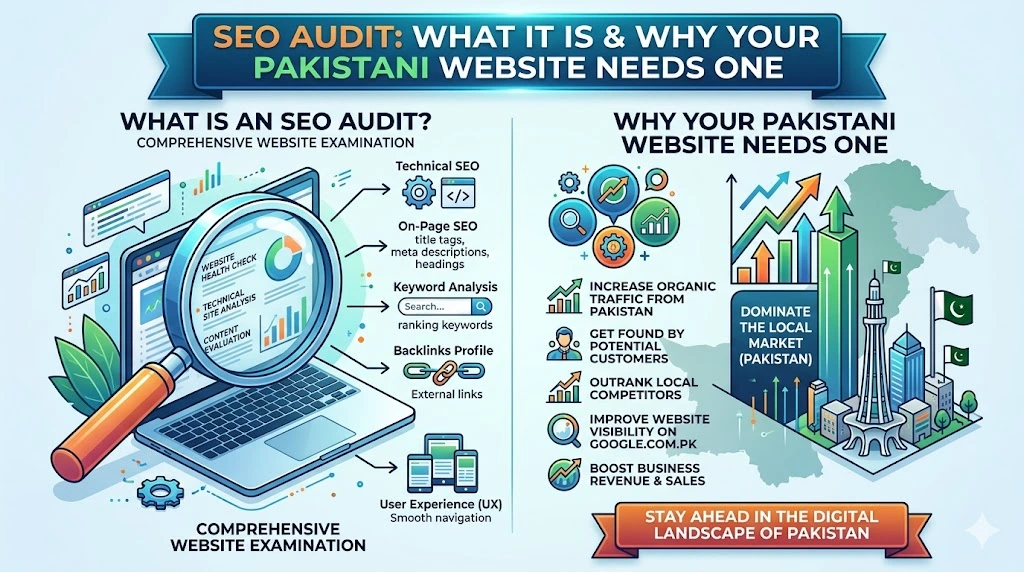
An SEO audit is a comprehensive health check analyzing everything affecting your website’s search visibility. Technical infrastructure, content quality, backlink profile, user experience, and competitive positioning. Think of it as a thorough medical examination for your website, identifying both obvious symptoms (slow loading, broken pages) and hidden diseases (crawl errors, toxic backlinks, poor site architecture) that quietly damage performance without obvious external indicators.
What makes audits valuable: You can’t fix problems you don’t know exist. Most business owners assume their website “works fine” because pages load when they visit. However, search engines experience your site differently than humans. They encounter technical barriers, content issues, and structural problems that remain invisible to casual browsing but devastate search visibility systematically.
The guessing vs knowing cost difference: Without an audit, you’re guessing, “Maybe we need more content? Perhaps social media integration? Should we redesign?” spending money on random improvements, hoping something works. With audit, you know precisely, “Fix these 12 technical errors blocking Google from indexing 147 pages, then address these 8 on-page issues preventing your best content from ranking,” investing strategically in changes that demonstrably improve visibility.
Pakistani business context: Understanding SEO fundamentals provides a broader framework, but audits identify your specific issues rather than generic best practices. Your Karachi e-commerce site faces different problems than the Lahore service business or the Islamabad B2B company. Yudits reveal YOUR website’s unique optimization barriers and opportunities.
What Does a Professional SEO Audit Check? (7 Key Areas)
1: Technical SEO Foundation
Analyzes whether search engines can properly access, crawl, index, and understand your website. Checks site speed (Pakistan’s slow average speeds make this critical), mobile optimization (60% of Pakistani traffic comes from mobile devices), crawl efficiency, indexing status, XML sitemap validity, robots.txt configuration, canonical tags implementation, redirect chains, server errors, and Core Web Vitals performance.
Why this matters: Technical problems block search engines from seeing your content, regardless of quality. Perfect content on a technically broken website remains invisible; fixing the technical foundation comes before everything else.
2: On-Page SEO Optimization
Examines content quality, keyword targeting, heading structure, title tags, meta descriptions, internal linking architecture, image optimization, URL structure, content depth, readability, semantic relevance, and topic coverage.
Pakistani context: Many local websites use thin content (200-300 words), attempting to rank for competitive keywords requiring 2,000+ word comprehensive resources. Audits identify content gaps that competitors fill better.
3: Off-Page SEO Authority
Evaluates backlink profile quality, domain authority trends, toxic link presence, anchor text distribution, referring domain diversity, competitor backlink comparison, citation consistency, and brand mention tracking.
Common finding: Pakistani websites have few quality backlinks or dozens of toxic links from spammy directories. Both scenarios hurt rankings but require opposite solutions (building vs disavowing).
4: User Experience and Engagement
Assesses navigation clarity, conversion path optimization, bounce rate patterns, average session duration, pages per session, mobile usability, form functionality, call-to-action effectiveness, page layout, and visual hierarchy.
Business impact: High bounce rates signal poor user experience. Visitors arriving but leaving immediately tells Google your content doesn’t satisfy search intent, gradually lowering your rankings.
5: Content Strategy and Gaps
Analyzes topic coverage comprehensiveness, competitor content comparison, keyword opportunity identification, content freshness, duplicate content issues, thin content detection, and content performance metrics.
Reality check: You think you’ve covered a topic thoroughly, but competitor analysis reveals they address 15 related subtopics you ignored, explaining why they rank higher despite similar domain authority.
6: Security and Infrastructure
Checks HTTPS implementation, security vulnerabilities, malware presence, blacklist status, hosting performance, server response times, downtime patterns, and CDN configuration.
Pakistani issue: Many local websites still operate on HTTP without SSL certificates. Google actively penalizes non-HTTPS sites in rankings, whilst browsers display scary “Not Secure” warnings discouraging visitors.
7: Local SEO Optimization
Reviews Google Business Profile optimization, NAP consistency across directories, local citation presence, review quantity and quality, location page optimization, and local schema markup implementation.
Applicability: Physical businesses (retail, restaurants, services) need local audit components; pure online businesses focus on the other six areas instead.
Professional SEO services in Pakistan analyze all seven areas systematically rather than spot-checking random issues, ensuring comprehensive problem identification and a prioritized action roadmap.
Technical vs On-Page vs Off-Page: The Three Audit Pillars Explained
Technical Pillar: The Foundation Everything Else Builds Upon
Building analogy: Technical SEO is your website’s foundation and structural integrity. You can have beautiful interior design (great content) and a prestigious address (strong backlinks), but if the foundation cracks or the roof leaks (technical problems) occur, the entire structure suffers regardless of other qualities.
What technical audits catch: A Lahore retailer’s website loaded in 8.7 seconds on mobile, and by the time the pages rendered, 65% of visitors had already abandoned. Simple image compression and hosting upgrade reduced load time to 2.1 seconds, immediately improving rankings as Google’s algorithm rewards fast-loading mobile experiences. The business owner never realized speed problems existed because they tested on fast office WiFi, not typical Pakistani mobile connections.
Critical principle: Fix technical issues BEFORE investing heavily in content or links. Technical problems undermine everything else, like pouring water into a bucket with holes in the bottom.
There are a lot more technical secrets revealed in our comprehensive guide to technical SEO.
On-Page Pillar: Content and Optimization Quality
Content reality: On-page audit examines whether your content actually deserves to rank. Are you providing comprehensive, helpful information users need? Do you target keywords that searchers actually use? Is the content structured properly with clear headings, proper HTML markup, and internal linking connecting related topics?
Modern relevance signals: Google’s algorithms increasingly evaluate semantic relevance and entity relationships beyond simple keyword matching. Your content needs to demonstrate topical authority through comprehensive coverage, natural language semantic connections, and contextual associations with related concepts. Interestingly, search engines now recognize brand mentions and co-citations (your business referenced alongside relevant terms even without direct backlinks) as authority signals. Learn how semantic connections and link building without traditional links can strengthen your content’s authority perception in ways beyond conventional optimization.
Common Pakistani finding: Websites targeting English keywords with Urdu/Roman Urdu mixed content confuse Google’s language detection. Or English content written by non-native speakers with grammatical issues and unclear phrasing, reducing perceived quality and user engagement.
The depth issue: Trying to rank for “digital marketing services” with a 400-word generic page, whilst top 10 competitors all publish 2,500+ word comprehensive guides covering strategy, tactics, pricing, case studies, and FAQs. On-page SEO execution requires matching or exceeding the content depth that competitors establish as a quality threshold.
Off-Page Pillar: External Validation and Authority
Authority signals: Off-page audit assesses how the external web perceives your website’s credibility. Do quality sites link to you? Are you mentioned in industry discussions? Do citations consistently reference your business across directories?
Pakistani challenge: Limited quality link opportunities domestically mean many Pakistani websites have weak backlink profiles compared to international competitors. Audit identifies realistic link-building opportunities within an achievable scope rather than comparing against impossible international standards.
Understanding strategic off-page SEO approaches helps businesses build sustainable authority through quality backlinks rather than risky shortcuts that ultimately damage rankings.
Toxic link reality: Cheap SEO services bought previously have built hundreds of spammy links from low-quality directories, blog networks, or link farms. These toxic links actively harm rankings. Audit identifies them for disavowal before Google penalizes your entire site.
Common Problems Pakistani Websites Fail On
Problem 1: Slow Loading Speeds (Average Pakistani Site: 6-9 Seconds)
Why it happens: Cheap shared hosting, unoptimized images (uploading 3MB photos instead of 150KB compressed versions), no caching, excessive plugins, and bloated code.
Business cost: Google data shows 53% of mobile visitors abandon sites taking over 3 seconds to load. If you’re getting 1,000 visitors monthly but losing 530 due to speed, that’s potentially PKR 50,000-200,000 monthly revenue lost (assuming PKR 100-400 average order value for e-commerce, or 5-10 service inquiries worth PKR 10,000-20,000 each).
Audit catches: Exact load time across devices, specific elements causing delays, optimization recommendations with projected improvement estimates.
Problem 2: Mobile Disasters (60% of Pakistani Traffic Ignored)
Why it happens: Desktop-designed website never tested on mobile, non-responsive templates, tiny unreadable text, buttons too close together for finger tapping, horizontal scrolling required, forms breaking on mobile screens.
Business cost: 60% of Pakistani search traffic comes from mobile devices. A non-mobile-optimized site effectively ignores 60% of potential customers. If mobile optimization doubles usable traffic, you’re currently operating at half capacity.
Let’s understand it with an example:
Islamabad consulting firm’s contact form broke on mobile. The submit button appeared off-screen, requiring horizontal scrolling that most users never attempted. Six months of mobile traffic (thousands of visitors) generated zero inquiries because nobody could actually contact them from phones. Audit caught this immediately; the fix took 2 hours to implement.
Problem 3: Missing HTTPS Security (Still Affecting 30% of Pakistani Sites)
Why it happens: Website built before HTTPS became standard, the web developer didn’t implement an SSL certificate, business owner doesn’t understand the technical importance.
Business cost: Google confirmed HTTPS as a ranking factor in August 2014. Non-HTTPS sites rank lower than equivalent HTTPS sites, all other factors equal. Additionally, browsers display “Not Secure” warnings scaring visitors away, reducing conversion rates by 20-40% as users don’t trust entering personal information.
Fix cost vs impact: SSL certificate costs PKR 2,000-8,000 annually. Implementation takes 2-4 hours. Ignoring this costs you rankings and conversions monthly, whilst competitors with HTTPS capture market share.
Problem 4: Duplicate Content (Ranking Against Yourself)
Why it happens: E-commerce sites create separate URLs for color/size variations, blog posts accessible through multiple category URLs, printer-friendly versions create duplicate pages, HTTP and HTTPS versions both indexable, www and non-www versions both active.
Business cost: Instead of consolidating ranking power into a single authoritative page, you’ve split authority across 3-5 duplicate URLs. Each ranking position 15-25 instead of one ranking position 3-5. You’re competing against yourself whilst competitors dominate singular optimized pages.
Audit identifies: Every duplicate content instance, canonical tag solutions, proper URL structure implementation, and preventing future duplication.
Problem 5: Broken Links (Internal and External Dead Ends)
Why it happens: Pages get deleted without redirecting old URLs, products are removed from e-commerce sites, leaving broken category links, external sites you linked to shut down, and website migration breaks internal link structure.
Business cost: Broken links waste crawl budget (Google spends time crawling dead ends instead of valuable content), hurt user experience (visitors clicking links landing on error pages), and signal poor site maintenance to search algorithms; sites with hundreds of broken links appear abandoned or low-quality.
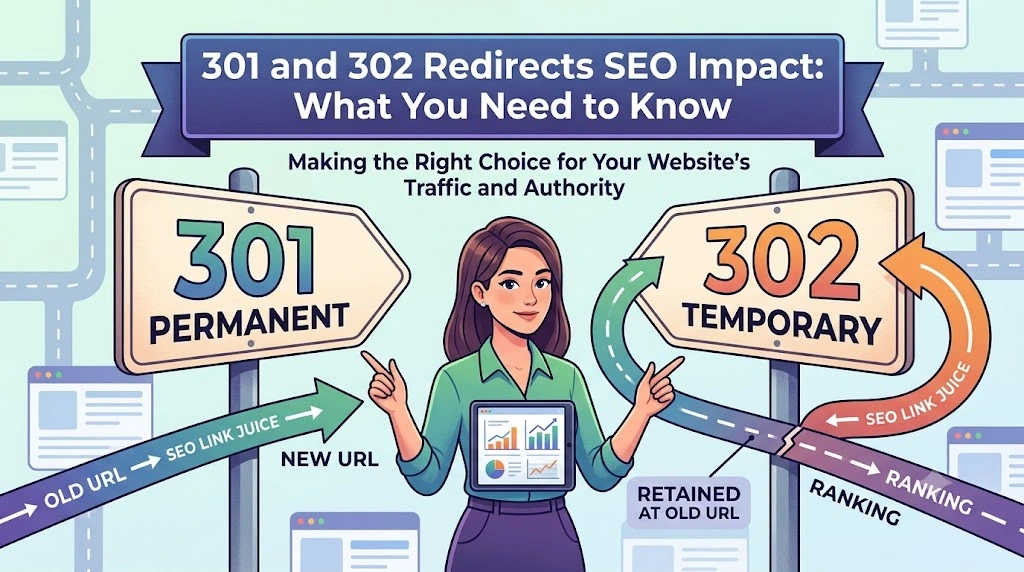
Pakistani pattern: Local businesses redesign websites every 2-3 years, rarely implementing proper 301 redirects from old URLs to new ones, destroying years of accumulated ranking power for existing pages.
Our technical SEO maintenance prevents these issues through systematic monitoring, but audits catch accumulated problems requiring bulk fixes.
How Long Does an SEO Audit Take and What Does It Cost?
DIY Basic Audit (2-4 Hours, Free Tools, Limited Insights)
What you can do yourself: Run free tools, including Google Search Console, Google PageSpeed Insights, and Mobile-Friendly Test, identifying obvious technical problems like indexing errors, severe speed issues, and mobile usability failures.
Limitations: Free automated tools catch surface-level issues but miss deeper problems requiring expert interpretation. They identify “what” is wrong but rarely explain “why” it matters or “how” to fix it properly. Business owners without a technical background struggle to implement recommendations effectively.
When DIY makes sense: Initial exploration before investing in a professional audit, or ongoing monitoring after a professional audit has addressed major issues.
Professional Comprehensive Audit (5-7 Days, PKR 15,000-50,000)
What a comprehensive audit includes:
- Manual expert review: Experienced analyst examining your site beyond automated tool reports
- Competitive analysis: How your site compares against the top 5-10 competitors for target keywords
- Prioritized recommendations: Not just listing problems but ranking them by impact and implementation difficulty
- Implementation guidance: Specific instructions or examples showing how to fix each issue
- Custom strategy: Tailored recommendations based on your business type, goals, competition, and budget
Cost factors: Site size (10-page site vs 1,000-page e-commerce platform), competition level (local service vs national retail), audit depth (basic technical vs comprehensive technical + content + backlink analysis), agency expertise, and reporting quality.
Pakistani market rates
| 1. PKR 15,000-25,000 | For a small business site | 20-50 pages |
| 2. PKR 30,000-50,000 | For medium complexity | 100-300 pages |
| 3. PKR 50,000-100,000+ | For large e-commerce or enterprise sites | Requiring extensive analysis |
Free Initial Audits (What Agencies Like Cloudex Offer)
Why agencies provide free audits: Demonstrates expertise, identifies your specific problems, builds trust, and removes barriers to starting a conversation about fixing issues professionally.
What a free audit typically includes: High-level technical check, critical issue identification, opportunity overview, basic competitive comparison, and enough to reveal whether significant problems exist, warranting professional attention.
Value proposition: Even if you don’t hire the agency immediately, a free audit provides actionable insights you can implement yourself or use to evaluate other service providers. Get a free website audit from Cloudex Marketing, revealing exactly what’s broken on your site and what fixing it could mean for your traffic and revenue.
Free vs paid difference: Free audits identify major issues; paid comprehensive audits provide exhaustive analysis with a detailed implementation roadmap, competitive intelligence, and strategic recommendations beyond problem identification.
What to Do After Your SEO Audit: Turning Findings Into Action
Receiving a detailed audit report feels complex. Dozens of issues across technical, content, and authority categories. Systematic prioritization framework prevents paralysis and focuses effort where it matters most.
Step 1: Prioritize By Impact and Effort Matrix
Critical issues (fix immediately): Security vulnerabilities, major technical problems preventing indexing, and broken core website functionality. These actively harm your site right now. Fix them this week, regardless of other priorities.
High impact, low effort (quick wins): Missing title tags, broken internal links, simple page speed optimizations. These deliver meaningful improvements with minimal implementation time. Tackle within the first 2-3 weeks.
High impact, high effort (strategic projects): Comprehensive content creation, technical site restructuring, link-building campaigns. These require substantial investment but move rankings significantly. Plan 6-12 week implementation timelines with phased execution.
Low impact improvements (ongoing maintenance): Minor optimizations, peripheral improvements, nice-to-have enhancements. Address these after completing higher priority work or during natural website maintenance cycles.
Step 2: Fix Critical Technical Issues First
Foundation before decoration: Technical problems undermine all other optimization efforts. Resolve crawling errors, indexing issues, site speed problems, mobile usability failures, and security vulnerabilities before investing heavily in content creation or link building.
Implementation timeline: Most technical fixes are complete within 4-6 weeks, depending on complexity and whether you’re doing them yourself or hiring developer assistance.
Step 3: Implement Quick Wins for Immediate Improvements
Momentum matters psychologically and practically. Completing 10-15 quick wins within the first month demonstrates progress, builds confidence in the audit process, and delivers measurable ranking improvements for long-tail keywords whilst you’re working on larger strategic initiatives.
Common quick wins: Optimizing existing page titles and meta descriptions, fixing broken internal links, compressing images, implementing basic schema markup, and updating thin content to minimum viable depth.
Step 4: Execute Strategic Long-Term Improvements
Content gaps, comprehensive optimization, and authority building. These transform your website from adequate to exceptional but require sustained effort over months. Working with our experienced SEO company in Pakistan makes sense for strategic implementation because these projects benefit from specialized expertise, established processes, and dedicated resources that most businesses lack internally.
DIY vs professional decision factors:
Handle yourself when: You have technical skills implementing recommendations, you have time consistently (5-10 hours weekly), issues are straightforward without complex dependencies, and you’re committed to learning through implementation.
Hire a professional when: Technical issues exceed your expertise, you lack time for consistent implementation, the competitive market requires sophisticated execution, the opportunity cost of your time exceeds professional service costs (your PKR 5,000/hour business time spent on PKR 2,000/hour SEO work costs you PKR 3,000/hour in lost business opportunity).
Ongoing Monitoring and Re-Auditing Requirements
Audits aren’t one-time projects. Websites evolve. Google’s algorithm updates. Competitors improve. New issues develop over time. Quarterly or bi-annual re-audits ensure you’re maintaining optimization quality whilst identifying emerging opportunities or problems before they significantly impact performance.
What ongoing monitoring involves: Monthly technical health checks, quarterly content performance reviews, bi-annual comprehensive audits, continuous rank tracking and traffic analysis, competitor monitoring, and identifying when rivals surpass your positioning.
An SEO agency in Pakistan providing ongoing management typically includes periodic re-auditing as part of continuous optimization rather than a separate one-off service, ensuring your website maintains technical excellence whilst advancing strategically toward market leadership.
Conclusion
Knowledge enables smart investment. Guessing wastes money.
Every month you operate without knowing your website’s specific problems, you’re losing traffic, leads, and revenue to issues that could be fixed systematically with proper diagnosis. The difference between businesses dominating local search and those remaining invisible isn’t budget. It’s knowledge! They know what’s broken, what’s working, where opportunities exist. You’re guessing, hoping random improvements help, whilst competitors with audit-driven strategies execute precisely targeted optimizations delivering measurable results.
Pakistani websites particularly need professional audits because many were built by developers prioritizing appearance over search visibility, operate on inadequate infrastructure, contain technical problems invisible to business owners, and face specific regional challenges (slow hosting, mobile-heavy traffic, limited quality backlink opportunities) requiring expert diagnosis and strategic solutions rather than generic best practices.
The investment in a comprehensive audit, whether through paid professional analysis or taking advantage of free initial audits agencies offer, provides the roadmap to transforming your website from technical liability into a competitive advantage.
You’ll know exactly what’s preventing better rankings, exactly how much each fix costs, exactly which improvements deliver the strongest ROI, and exactly how your site compares against competitors winning customers you should be capturing.
Stop guessing what’s wrong with your website. Get a free website audit from Cloudex Marketing revealing the specific technical issues, content gaps, and optimization opportunities standing between your current visibility and market dominance. No obligations, no sales pressure. Just honest analysis showing exactly what’s possible when you know what you’re fixing instead of hoping random improvements will work.