
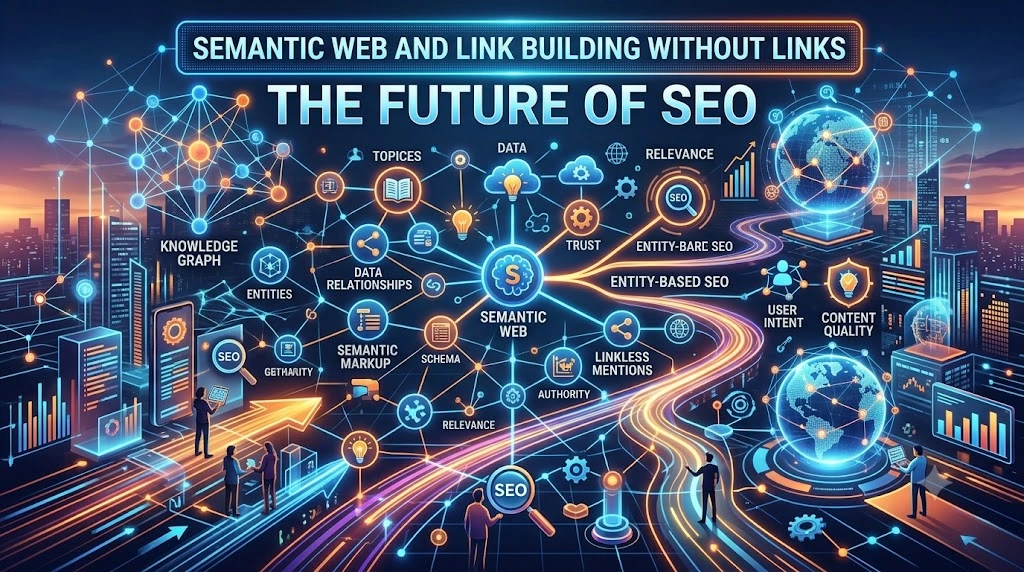
Link building dominated the SEO strategy for two decades. “Acquire enough backlinks with the right anchor text, and rankings improve predictably”. That model eroded gradually before collapsing dramatically as Google evolved beyond simple keyword matching toward understanding meaning, context, and entity relationships.
At the same time, the semantic web, where search engines comprehend what content means rather than just what words it contains, fundamentally changes how authority gets established, how relevance gets measured, and how rankings get determined.
Businesses are still chasing anchor text links whilst competitors build semantic authority through brand mentions, entity recognition, and topical associations, and discover rankings slipping despite link portfolios remaining intact. Understanding modern SEO requires recognizing that hyperlinks represent one authority signal among many, whilst semantic connections increasingly determine which content Google considers genuinely authoritative versus superficially linked.
Semantic Web and Its Significance
What is Semantic?
Semantics is the meaning and interpretation of words, phrases, and content, understanding what something actually means rather than just recognizing the individual words themselves. In the SEO context, semantics involves how search engines comprehend the intended meaning, context, and relationships between concepts within content rather than simply matching keyword strings.
What is the Semantic Web?
The semantic web is the evolution of the internet where machines (search engines, AI systems) understand the meaning, context, and relationships between content pieces rather than just processing keywords. It enables search engines to comprehend that “apple” the fruit differs from “Apple” the technology company through contextual analysis, recognize entity relationships (Paris > France > Europe), and understand user intent beyond literal query words, delivering more accurate, contextual results based on meaning rather than simple word matching.
In practical terms, traditional web-connected documents are accessed through hyperlinks. Semantic web connects meaning, concepts, and entities through understood relationships, enabling search engines to comprehend what content is about, how it relates to other topics, and which entities it involves, powering features like Knowledge Graphs, AI Overviews, and intent-based search results.
How Search Engines Understand Meaning Beyond Keywords
Step 1: Traditional Keyword Matching (The Old Way)
What happened: You typed “apple” > Search engine found pages containing the word “apple” > Returned ALL pages with that word
The problem: The search engine couldn’t distinguish between:
- Apple (the fruit)
- Apple (the technology company)
- Apple (the record label)
- Apple (someone’s name)
Result: You got mixed, irrelevant results requiring YOU to sort through and find what you actually wanted.
Step 2: Entity Recognition (Understanding What Things ARE)
What changed: Search engines began recognizing that “apple” isn’t just a word. It’s multiple distinct ENTITIES (things that exist)
How it works:
- Search engine identifies: “Apple Inc.” = technology company entity
- Recognizes attributes: founded in 1976, CEO Tim Cook, makes iPhones, headquarters in Cupertino
- Understands this is DIFFERENT from: “apple” = edible fruit entity with attributes like red, grows on trees, food category
Result: Search engine now knows WHAT you’re talking about based on context clues in your query.
Step 3: Context Analysis (Understanding WHY You’re Asking)
The evolution: Search engines analyze surrounding words, your location, search history, and time of day to understand intent
Example: “What’s the weather today?”
Traditional response: Just shows temperature and conditions
Semantic understanding asks:
- Why does this person need weather info?
- Searches from the garden center website recently > Might be planning an outdoor project.
- Morning search from home > Might be deciding what to wear
- Searched “weekend activities” yesterday > Might be planning an outing
Result: Shows weather PLUS relevant related information (BBQ recipes if outdoor cooking signals detected, clothing suggestions if morning routine detected, event recommendations if activity planning detected).
Step 4: Relationship Mapping (Understanding How Things Connect)
The breakthrough: Google’s Knowledge Graph (launched 2012) maps billions of connections between entities
Example: “Paris”
Traditional: Pages containing the word “Paris.”
Semantic understanding through Knowledge Graph:
located in
contains
related to
connected to
> History (concept entity)
> Hotels (service entity)
> Restaurants (service entity)
Result: Searching “Paris” doesn’t just return pages with that word. It understands you also want information about French culture, Eiffel Tower visiting hours, nearby hotels, travel tips, historical sites, and best restaurants, because these entities are SEMANTICALLY RELATED even without sharing keywords.
Step 5: Intent-Based Results (Delivering What You ACTUALLY Want)
The outcome: Search results now match what you MEANT, not just what you TYPED
Example progression:
Query: “best running shoes”
Old way: Pages containing words “best,” “running,” “shoes.”
Semantic way:
- Recognizes intent = Commercial (wants to buy)
- Understands entity = Running shoes (product category)
- Identifies related needs = Reviews, comparisons, pricing, where to buy, sizing guides
- Delivers = Product listings, review sites, buying guides, related searches (running socks, fitness trackers)
The result: You get a comprehensive answer to your underlying question, not just literal word matches.
Why This Matters for Businesses
Old SEO: Stuff keywords, get links, rank for that exact phrase
Semantic SEO:
- Establish your brand as a recognized ENTITY
- Build relationships with related ENTITIES
- Cover topics comprehensively, demonstrating UNDERSTANDING
- Generate brand mentions, creating semantic ASSOCIATIONS
- Prove you’re authoritative within your topic SPACE
The shift: From “How many times did I use the keyword?” to “Does Google understand what my business IS, what it’s RELATED to, and why it’s RELEVANT for this topic?”
How to Create and Establish a Semantic Web Presence
Building a Recognizable Brand Entity Status
Establishing your business as a recognized entity requires a consistent, authoritative presence across multiple data sources that Google trusts. This involves the following 4 elements:
1 – Official presence platforms: Verified Google Business Profile, Wikipedia entry (when notable), Wikidata listing, industry directories, professional association memberships. Sources Google uses to validate entity existence and attributes.
2 – Structured data implementation: Comprehensive schema markup across your website, defining organization entity, product entities, service entities, person entities (team members), location entities, and their interrelationships through proper schema.org vocabulary.
3 – Consistent NAP information: Name, Address, Phone appearing identically across all online mentions. Inconsistencies confuse entity recognition algorithms, attempting to consolidate mentions into a single coherent entity understanding.
4 – Brand mention accumulation: Appearing in authoritative content without links, news articles, industry publications, research reports, and expert roundups, where your brand gets mentioned contextually, establishes entity legitimacy through third-party validation.
Establishing Comprehensive Topical Authority
Topic cluster strategies build semantic authority by covering subjects comprehensively rather than targeting isolated keywords. This involves the following 4 things:
1 – Pillar content: Comprehensive resources covering core topics thoroughly, demonstrating depth of knowledge that Google interprets as an authority signal worthy of entity recognition within that topic domain.
2 – Cluster content: Supporting articles addressing specific subtopics, questions, and use cases, creating a semantic network of interrelated content that Google recognizes as thorough topical coverage rather than shallow keyword targeting.
3 – Internal linking architecture: Connecting related content through contextually relevant links using semantic keyword variations, not just exact-match anchors, building clear topical relationships. Google Maps understands your content ecosystem.
4 – Synonym and LSI integration: Using semantically related terms, phrases, and concepts throughout content, demonstrating a comprehensive understanding of topics through natural language, covering concepts from multiple angles rather than repetitive keyword usage.
Creating Semantic Connections Through Strategic Content
Step 1: Entity Linking (Borrow Authority Through Association)
What to do: Link to trusted sources, Wikipedia, .gov sites, universities, industry leaders
Why it works: Google thinks: “This content references Harvard research + cites government data + links to industry leader = must be credible.”
Result: Your content inherits semantic trust through association with established entities.
Step 2: Co-Occurrence Optimization (Teach Google What You’re About)
What to do: Mention your brand NEAR relevant industry terms, competitors, product categories
Example: “Leading CRM platforms like Salesforce, HubSpot, and YourBrand help…”
Why it works: Google sees your brand repeatedly appearing alongside “CRM,” “sales automation,” “enterprise software,” and learns: YourBrand = CRM entity.
Result: Google associates your brand with those topics semantically, and rankings follow.
Step 3: Question Coverage (Prove Comprehensive Knowledge)
What to do: Answer common questions, related searches, and follow-up queries in your content
Why it works: Covering “What is X?” + “How does X work?” + “X vs Y” + “Best X for…” = comprehensive understanding signal
Result: Google sees authority depth, rewards with visibility across question variations.
Step 4: Multimedia Semantic Consistency (Reinforce Meaning Everywhere)
What to do: Use semantic keywords in image alt text, video transcripts, and audio descriptions. Not just body text
Why it works: Multiple content formats saying the same semantic message = stronger topical signal
Result: Google confidence increases: “Every format confirms this page covers X topic authoritatively.”
Therefore, our SEO agency in Pakistan takes care of these things, and our technical SEO implementation, ensuring proper site structure, crawlability, and performance, supports semantic understanding by enabling efficient content discovery and interpretation by search engine algorithms.
Link Building and Its Importance in SEO
What is Link Building?
Link building acquires hyperlinks from external websites pointing to your site, signaling authority and relevance to search engines. Quality backlinks from credible, topically related sources improve rankings by transferring trust and topical authority through connections.
Historical Link Building: The PageRank Era
Traditional link building operated on a straightforward premise: more links with keyword-rich anchor text flowing to your pages meant higher rankings. Google’s original PageRank algorithm treated links as votes, each link transferred authority, links from high-authority pages transferred more authority, and anchor text told Google what the linked page should rank for.
This created a predictable optimization formula: identify target keywords, acquire links using those keywords as anchor text, and watch rankings improve. Off-page SEO meant link acquisition almost exclusively, guest posts, directory submissions, article marketing, link exchanges, paid links, and increasingly manipulative tactics exploiting algorithmic reliance on link signals.
The model worked until it didn’t. As link building became a primary ranking factor, manipulation became rampant. Low-quality content earning artificial links outranked superior content lacking aggressive link building. Google’s search results quality degraded as marketers gamed the link graph rather than creating genuinely valuable resources.
The Evolution: From Quantity to Quality to Relevance
Google’s algorithm updates (particularly Penguin in 2012) began devaluing manipulative link signals. Suddenly, the links that previously boosted rankings triggered penalties instead. The focus shifted from quantity toward quality. Fewer links from truly authoritative, relevant sources outperformed numerous low-quality links.
But quality alone proved insufficient. Relevance became critical. Links from high-authority domains in completely unrelated niches provided minimal value compared to contextually relevant links from moderately authoritative sources within your industry. Google’s Topical PageRank and Phrase-Based Indexing patents enabled evaluating link relevance beyond simple domain authority metrics.
Current Role: Links Still Matter, But Differently
Links remain important ranking signals in 2026, but their role has evolved dramatically. Modern link evaluation considers:
Contextual relevance: Does the linking page discuss topics semantically related to the target page? Are the surrounding paragraphs contextually appropriate?
Natural link profiles: Do links appear naturally within content flow, or do they seem artificially placed for SEO purposes?
Link diversity: Does the link profile include various types, including editorial links, resource links, citations, brand mentions with links, directory listings, or does it skew suspiciously toward a single link type?
Temporal patterns: Did links accumulate naturally over time, or do suspicious velocity spikes suggest manipulation?
Click likelihood: Based on link position, size, color, and surrounding context, would users likely click it? Google’s Reasonable Surfer Model weights links by their probable usage.
Understanding different types of SEO helps businesses recognize that link building represents one component within broader authority-building strategies rather than an isolated ranking tactic.
Common Link Building Misconceptions Businesses Still Believe
Misconception 1: More Links Always Equal Better Rankings
The quantity-over-quality approach died with Penguin, yet businesses still chase link counts. Reality: 10 highly relevant links from authoritative sources within your industry outperform 100 low-quality links from unrelated sites. Google’s algorithms detect unnatural link velocity, suspicious link patterns, and low-relevance link profiles, penalizing rather than rewarding excessive link acquisition.
Focus shifted from “how many links can we get” toward “which specific authoritative sources would naturally reference our content?” Quality, relevance, and natural acquisition patterns matter infinitely more than total link counts appearing in backlink analysis tools.
Misconception 2: Anchor Text Remains the Most Important Factor
Exact-match anchor text dominated early SEO, but over-optimization now triggers red flags. Google’s semantic understanding means it comprehends page topics without relying primarily on anchor text signals. Pages rank for keywords never appearing in incoming anchor text because Google understands semantic relevance through content analysis, entity recognition, and co-occurrence patterns.
Modern best practice: diversified, natural anchor text including brand names, URLs, generic phrases (“click here”), and varied semantic keyword usage. Not concentrated exact-match anchors appear manipulative.
Misconception 3: Any Link from a High DA Site Helps Rankings
Domain Authority (a Moz metric, not a Google ranking factor) doesn’t guarantee link value. A link from a high-DA site in a completely unrelated niche provides minimal benefit. Conversely, a moderately authoritative site deeply relevant to your niche often delivers superior ranking impact through semantic relevance signals that Google prioritizes over pure authority metrics.
Additionally, links from high-DA sites in wrong contexts, spammy comments, irrelevant forum signatures, and paid placements on content farms provide zero value despite impressive authority scores because Google’s quality algorithms detect and devalue these manipulative placements.
Misconception 4: Link Building Only Means Acquiring Hyperlinks
Modern “link building” extends far beyond hyperlink acquisition toward broader authority and entity recognition building. Brand mentions without links, co-citations, social signals, brand searches, and direct traffic. All contribute to authority perception, which Google uses to determine rankings. Businesses fixating exclusively on hyperlinks miss substantial ranking opportunities from linkless authority signals increasingly important in semantic search.
Misconception 5: Quantity Matters More Than Context and Timing
Suspicious link velocity, acquiring hundreds of links suddenly after months of stagnation, triggers algorithmic scrutiny. Natural link profiles accumulate gradually, with occasional spikes when genuinely valuable content earns organic attention. Bad SEO practices include link schemes attempting to manipulate rankings through unnatural acquisition patterns, which Google’s sophisticated algorithms detect easily.
Context matters equally. Links from relevant content discussing related topics within an appropriate semantic context provide exponentially more value than contextually irrelevant links, regardless of source authority.
Link Building Without Links: Co-Citation and Co-Occurrence
What is Co-Citation and Why It Matters
Co-citation occurs when multiple sources mention your brand alongside other brands, concepts, or keywords without necessarily linking to any of them. Google infers relationships and authority through these mention patterns. If authoritative sources frequently mention your brand near industry leaders, industry terms, or quality indicators, Google interprets this as an authority signal.
For example, articles mentioning “leading CRM platforms” that list Salesforce, HubSpot, and your brand together establish semantic association through co-citation. Even without direct links, Google understands your brand belongs in CRM conversation alongside established players, conferring authority through association.
This represents a game-changing development because it transforms content marketing from link-begging toward genuine brand awareness building. Creating remarkable content, generating PR coverage, earning media mentions, and participating in industry conversations.
All build authority through co-citation regardless of whether links accompany mentions.
How Google Measures Lexical Co-Occurrence Patterns
Lexical co-occurrence analyzes how frequently terms appear in proximity to each other across web content. Google’s Phrase-Based Indexing patent describes how search engines evaluate not just individual keywords but phrases and their relationships with surrounding text.
When your brand name frequently appears near specific industry terms, product categories, or service descriptions across multiple independent sources, Google establishes semantic associations informing rankings. Content mentioning “enterprise project management” near your brand repeatedly signals to Google that your brand is a relevant entity within that topic space.
This works because Google recognizes patterns humans don’t consciously notice. If thousands of pages mention your brand within 100 words of specific industry terminology, algorithms infer relationship strength, measuring semantic relevance quantitatively through statistical co-occurrence analysis.
Practical Strategies: Building Authority Through Brand Mentions
Strategy 1: PR-Focused Content Distribution
Create newsworthy content, including original research, industry surveys, expert analysis, and trend reports, distributed to journalists, bloggers, and industry publications. The goal isn’t link acquisition but brand mention generation in authoritative content. When industry publications reference your research findings whilst mentioning your brand, co-citation authority builds regardless of hyperlinks.
Strategy 2: Thought Leadership Positioning
Contribute expert commentary, quotes, and insights to industry articles, podcasts, videos, and reports. Being quoted as an industry expert in publications that do not link to your site still builds authority through association. Your brand appearing alongside recognized industry leaders in expert roundups establishes semantic authority through co-citation patterns.
Strategy 3: Strategic Content Partnerships
Collaborate with complementary brands, industry associations, and content publishers on co-created resources, research projects, or educational initiatives. These partnerships generate brand mentions across multiple authoritative sources whilst building semantic associations with established entities in your space.
Strategy 4: Brand Awareness Campaigns
Traditional brand marketing, not typically considered SEO, builds semantic authority by increasing brand search volume, direct traffic, and brand mention frequency across web content. Google interprets these signals as genuine authority indicators more reliable than manipulable link metrics.
Strategy 5: Industry Recognition and Awards
Pursue legitimate industry awards, certifications, rankings, and recognition programs. Being listed in “Top 50” rankings, industry association member directories, or certification holder listings builds entity recognition through authoritative source validation. Even when listings don’t provide followed links.
Content writing services producing remarkable, cite-worthy content naturally earn brand mentions from sources preferring to reference rather than link, building co-citation authority systematically.
Measuring Linkless Authority Building Success
Tracking brand mentions, co-citations, and semantic signals requires different tools than traditional link analysis:
Brand mention monitoring: Tools tracking unlinked brand mentions across web content, news, social media, forums, and industry publications, measuring mention volume, sentiment, and contextual associations.
Entity recognition validation: Checking whether Google recognizes your brand as an entity through Knowledge Panel presence, branded SERP features, and entity box appearances in AI Overviews and search results.
Brand search volume: Monitoring branded search query volume, increasing brand searches indicate growing awareness and authority, which Google interprets as a legitimacy signal independent of backlinks.
Co-occurrence analysis: Examining which terms, brands, and concepts frequently appear near your brand mentions, validating whether desired semantic associations are forming through natural content patterns.
Share of voice metrics: Measuring mention frequency relative to competitors, tracking whether your brand appears in industry conversations proportionally to your actual market position or authority level.
Implementation: Building Your Semantic SEO Strategy
On-Page Semantic Optimization Essentials
On-page SEO evolved from keyword optimization toward semantic relevance demonstration:
Proximity and keyword relationships: Position target keywords near semantic modifiers and related concepts. Instead of repeating “project management software” identically, use variations like “project management tools,” “project collaboration platforms,” “team management software,” demonstrating semantic understanding through natural language variation.
LSI keyword integration: Latent Semantic Indexing identifies terms statistically likely to appear together. Content about “email marketing” should naturally include related terms like “campaigns,” “subscribers,” “deliverability,” “automation,” and “segmentation,” not through forced keyword stuffing but through comprehensive topic coverage.
Synonym and variant usage: Google understands synonyms, plurals, and variations. Content using “automobile,” “car,” “vehicle,” and “auto” interchangeably demonstrates natural semantic coverage rather than robotic keyword repetition appearing manipulative.
Internal linking with semantic anchors: Link between related content using varied anchor text reflecting semantic relationships. Don’t use identical anchor text repeatedly; use natural variations reinforcing topical connections through linguistic diversity.
Entity linking to authorities: Reference and link to authoritative sources, Wikipedia, government resources, academic institutions, and industry leaders, associating your content with established entities through strategic outbound linking patterns.
Off-Page Semantic Authority Building
Beyond your website, semantic authority grows through strategic presence where industry conversations happen:
Semantic relevance mapping: Identify which topics, entities, and concepts relate semantically to your business. Create content addressing these peripheral but related subjects, expanding your semantic footprint beyond core offerings.
Relevant outreach without link requests: Distribute valuable content to industry publications, journalists, and influencers, focusing on brand awareness and mention generation rather than link acquisition. The mentions build semantic authority whilst natural links often follow organically.
Community participation: Engage meaningfully in industry forums, social platforms, and discussion spaces where the target audience congregates. Regular, valuable participation builds brand recognition, generating natural mentions and semantic associations.
Collaborative content creation: Partner with complementary brands, industry experts, and thought leaders on co-created content appearing across multiple platforms. These collaborations generate entity associations that Google uses to understand your brand’s role within the industry ecosystem.
Realistic Timeline Expectations
Semantic authority builds gradually through sustained effort rather than quick wins:
Months 1-3: Foundation building, implementing schema markup, optimizing on-page semantic signals, initiating content distribution strategies, beginning brand mention generation efforts.
Months 4-6: Early signals. Initial entity recognition improvements, growing brand mention volume, expanding semantic footprint through comprehensive topic coverage, and beginning co-citation pattern establishment.
Months 7-12: Authority emergence. Noticeable ranking improvements for semantically related terms, Knowledge Panel or entity box appearances, increased brand search volume, and growing share of voice in industry conversations.
12+ months: Compounding returns. Established entity recognition, natural link acquisition accompanying brand mentions, rankings extending across semantic keyword clusters, and self-reinforcing authority growth as awareness builds momentum.
Understanding how long SEO takes sets realistic expectations about semantic authority-building timelines, preventing premature strategy abandonment before results materialize.
Conclusion
The future of SEO isn’t abandoning links. It’s recognizing links as one signal among many within a broader semantic authority framework. Google’s evolution toward entity understanding, intent interpretation, and relationship mapping means rankings increasingly depend on whether search algorithms recognize your brand as a legitimate, authoritative entity within your topic space rather than simply counting backlinks pointing to your pages.
Businesses building semantic authority through comprehensive content, strategic brand awareness, entity recognition optimization, and natural mention generation position themselves advantageously as Google’s semantic capabilities advance. Those still chasing link counts whilst ignoring semantic signals discover rankings slipping despite impressive backlink portfolios because Google prioritizes meaning, context, and genuine authority over manipulable link metrics.
The most effective modern SEO strategies combine technical excellence, semantic optimization, strategic content marketing, genuine brand building, and yes, natural, relevant link acquisition, into cohesive approaches recognizing that authority in the semantic search era builds through multiple reinforcing signals rather than isolated tactics.
Ready to build semantic authority for your business? Our SEO services in Pakistan implement comprehensive semantic optimization strategies, including entity recognition building, topic authority development, schema implementation, and strategic content distribution, generating brand mentions and co-citation authority.
Don’t let competitors establish semantic dominance whilst you chase outdated link metrics. Position your brand as a recognized entity within your industry today.
Frequently Asked Questions
Does semantic SEO mean links no longer matter?
No. Links remain important, but their role has evolved. Modern link evaluation considers semantic relevance, contextual appropriateness, and natural acquisition patterns rather than just quantity or anchor text. Quality links from semantically relevant sources still boost rankings significantly. However, semantic signals, brand mentions, entity recognition, and co-citation patterns increasingly supplement traditional link metrics, providing alternative authority pathways.
How long before Google recognizes my brand as an entity?
Entity recognition typically requires 6-12 months of sustained effort building a consistent presence across authoritative sources, implementing proper schema markup, accumulating brand mentions in credible content, and generating branded search volume. Factors affecting the timeline include brand name uniqueness, industry competitiveness, content quality, and mention frequency across web content that Google trusts.
Can small businesses compete with semantic SEO against larger competitors?
Yes. Semantic SEO levels the playing field somewhat because entity recognition and topical authority don’t require massive link portfolios. Comprehensive topic coverage, strategic niche focus, local entity optimization, and consistent brand mention generation enable smaller businesses to establish semantic authority within specific domains despite lacking resources matching enterprise competitors.
What tools help track semantic signals and brand mentions?
Brand mention monitoring platforms track unlinked mentions across web content, social media, news, and forums. Entity recognition validators check Knowledge Panel presence and branded SERP features. SEO platforms increasingly include semantic analysis features examining co-occurrence patterns, topic coverage, and entity associations. Search Console data reveals branded search volume trends indicating growing entity awareness.
Should I stop traditional link building completely?
No. An effective strategy integrates traditional link building with modern semantic approaches. Pursue natural, relevant links from authoritative sources whilst simultaneously building entity recognition, generating brand mentions, and establishing semantic topical authority. The combination proves more powerful than either approach in isolation. Links remain valuable whilst semantic signals provide authority pathways, manipulation-resistant, and increasingly important in determining rankings.