


Everyone’s asking the same question:
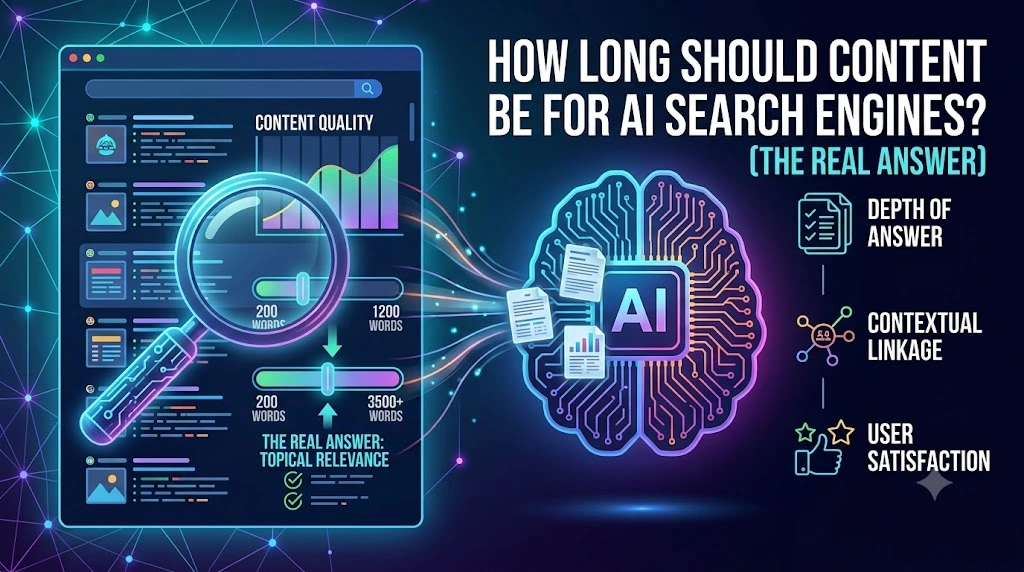
How many words should my content be for AI search engines like ChatGPT and Google AI Overviews? The answer most people get is wrong.
They hear “longer content ranks better” and write 3,000-word articles.
Then they get zero citations from AI search engines. Their content doesn’t appear in ChatGPT responses. Google AI Overviews don’t mention them.
The problem:
- They’re optimizing for the wrong metric.
- Word count doesn’t matter for AI search.
- Structure, clarity, and directness matter.
This guide shows you what actually works.
The Honest Truth: There’s No Perfect Word Count
Forget everything you learned about word count for traditional Google SEO. That doesn’t apply to AI search engines.
Google AI Overviews, ChatGPT, Perplexity, and other AI systems don’t measure success by word count. They measure by:
- Does this content directly answer the user’s question?
- Is the answer easy to understand?
- Is the information well-organized?
- Does the content provide unique value?
A 500-word article that directly answers a question will outperform a 3,000-word article that buries the answer on page 3.
AI systems work differently from traditional Google. With traditional Google, longer articles sometimes ranked better because they tended to be more comprehensive. With AI, length is irrelevant. Clarity is everything.
Cloudex Marketing, as a leading SEO company in Pakistan, understands this fundamental shift. Most SEO providers are still optimizing for traditional Google metrics. We optimize for how AI actually works.
Why Word Count Is Actually Misleading
Here’s the trap businesses fall into:
They learn that AI engines want comprehensive, informative content. They interpret that as “write longer articles.” They start adding more and more information, trying to hit some magic word count target.
The result:
- Bloated content filled with irrelevant information.
- The answer gets buried.
- AI systems skip over their content because it’s not efficient to parse.
Research shows something shocking: 55% of AI Overview citations come from the first 30% of content. Only 21% come from the bottom 40%.
Think about that. More than half of what gets cited comes from the beginning of your article. If you’re filling the first 30% with introduction and filler, you’re destroying your citation chances.
You’re literally shooting yourself in the foot by writing long articles filled with unnecessary information.
What Actually Matters for AI Search Engines
#1: Direct Answer Placement (Put the Answer First)
Don’t bury the answer in a 500-word introduction. Put it right after your heading.
Example:
Bad approach:
“Roof replacement is a common home maintenance task many homeowners face. Throughout history, roofing materials have evolved significantly. The climate affects roofing choices in different regions… [500 more words before mentioning actual cost]”
Good approach:
“Roof replacement typically costs $8,000-$15,000 for an average home. The exact price depends on several factors we’ll explain below.”
AI systems scan for direct answers. Giving them immediately increases your citation chances dramatically.
#2: Structure Matters More Than Length
AI systems need to parse your content quickly. They do this by looking for:
- Clear headings (H2s, H3s, H4s)
- Bullet points and numbered lists
- Short paragraphs
- Simple sentence structures
- Tables and data visualization
A well-structured 800-word article gets more citations than a poorly structured 2,000-word article because AI can understand it faster.
#3: Keep Paragraphs Short (40-60 Words)
Short paragraphs are easier for AI to parse. Aim for 2-3 sentences per paragraph.
Good paragraph length:
“Roof age is the primary cost factor. A 20-year-old roof costs more to replace than a 10-year-old roof. Older roofs require more labor and potentially structural repairs.”
(45 words, easy to parse)
Bad paragraph length:
“Roof age is arguably the most important factor determining replacement costs, and this is because as roofs age they tend to deteriorate in ways that aren’t immediately visible to homeowners, such as deterioration of the underlying structure, which means that when contractors come to replace your roof they discover additional problems that need to be addressed, all of which drives up the total cost of your project significantly compared to replacing a younger roof.”
(Confusing, hard to parse, buried the main point)
When Content Is Too Long (And Destroying Your Citations)
Content can definitely be too long. Here’s how to know:
Sign #1: You have “filler” content
If you can remove a paragraph and the content still answers the user’s question fully, that paragraph is filler.
Sign #2: You’re covering topics tangentially related to your main answer
A page about roof replacement costs doesn’t need sections about finding contractors or roof maintenance. Stay focused.
Sign #3: Early paragraphs don’t directly support the main answer
The first 30% of your content should be your most important information. If it’s not, you’re sabotaging yourself.
Sign #4: You’re repeating the same information in different ways
Say it once, clearly. Don’t say it five times hoping it sticks.
When Content Is Too Short (And Fails to Answer Properly)
Content can also be too short. A 200-word article that oversimplifies won’t get cited either.
Sign #1: You’re only covering the basic surface.
“Roof replacement costs $8,000-$15,000” is too short. You need to explain what factors affect cost.
Sign #2: You’re not answering obvious follow-up questions.
If someone asks about roof replacement cost, they naturally wonder: What affects the price? What materials are available? How long does it take?
Address these natural follow-ups.
Sign #3: You lack supporting details and examples.
Give specific information. Compare materials. Show different scenarios.
The balance: Comprehensive enough to fully answer the question. Short enough to be direct and scannable.
How to Make Your Content Get Cited by AI Engines
Strategy #1: Answer User Intent First
Think about what the user actually wants to know. Put that answer immediately. Don’t make them read through the introduction and background.
Use the inverted pyramid model: Most important information first, supporting details second.
Strategy #2: Structure for Easy Parsing
Use:
- Clear H2s and H3s (one heading per main idea)
- Bulleted lists for comparisons
- Numbered lists for steps
- Tables for data
- Short paragraphs (40-60 words)
- Simple sentences
Strategy #3: Include Original Data and Unique Insights
AI prioritizes citations from sources with unique information. If you include:
- Original research
- Exclusive case studies
- Proprietary data
- Expert quotes (your own expertise)
- Specific examples competitors don’t have
…AI will cite you instead of competitors.
Strategy #4: Apply the 1:80 Rule
For every 80 words of content, include one statistic, data point, or fact that’s citable.
Example: If you write 800 words, include 10 specific facts. This gives AI multiple reasons to cite you.
The Common Mistake: Writing for Word Count
SEO services in Pakistan that still optimize for word count are living in the past. They’re telling clients to write 1,500-2,500-word articles because “longer content ranks better.”
This was partially true for traditional Google. It’s completely false for AI search.
Word count isn’t a ranking factor for AI engines. Relevance, clarity, structure, and originality are ranking factors.
Cloudex Marketing optimizes content for how AI actually works: Clear structure, direct answers, original insights, easy parsing.
What Your Content Should Actually Look Like
For AI search, aim for:
- 500-1,200 words (not fixed, varies by topic)
- Direct answer in the first 100 words
- Clear H2s and H3s throughout
- Short paragraphs (40-60 words)
- Bullet points for key comparisons
- Original data or unique insights
- No filler or tangential information
- Tables summarizing complex information
- Specific examples and scenarios
This structure works for both AI search engines and human readers. It’s scannable. It’s clear. It answers questions directly.
The Real Difference Cloudex Marketing Makes
Most SEO agencies in Pakistan optimize based on outdated formulas. Write 2,000 words. Include 3% keyword density. Build 10 backlinks per month.
Cloudex Marketing, as an SEO service provider in Pakistan, optimizes for reality. We structure content for how AI systems actually parse information. We remove filler. We put answers first. We include original insights AI wants to cite.
The result: Higher citation rates in AI Overviews. More visibility in ChatGPT. Better clicks from AI search engines.
Stop Worrying About Word Count
Your content doesn’t need to hit a specific word count to get cited by AI. It needs to:
- Answer the question directly (known as Responsiveness)
- Be well-structured and scannable
- Provide unique value
- Be easy for AI to parse
A 700-word article structured perfectly outperforms a 2,000-word article filled with filler every single time.
Stop counting words. Start optimizing for clarity, structure, and value.
If your current SEO experts in Pakistan are still obsessing over word count, it’s time to talk to providers understanding how search actually works in 2026.
Cloudex Marketing combines AI search optimization with traditional SEO fundamentals. We help your content get cited where it matters: in AI-generated answers that drive real traffic and leads.
Your competitors are already optimizing for AI search. The question is whether you’ll adapt now or keep losing visibility to competitors who understand the new landscape.