


Most people talking on this topic won’t answer this to you directly. They’ll say “it depends” and leave you there. It does depend, but “depends” is a formula, not a shrug, and this article resolves it.
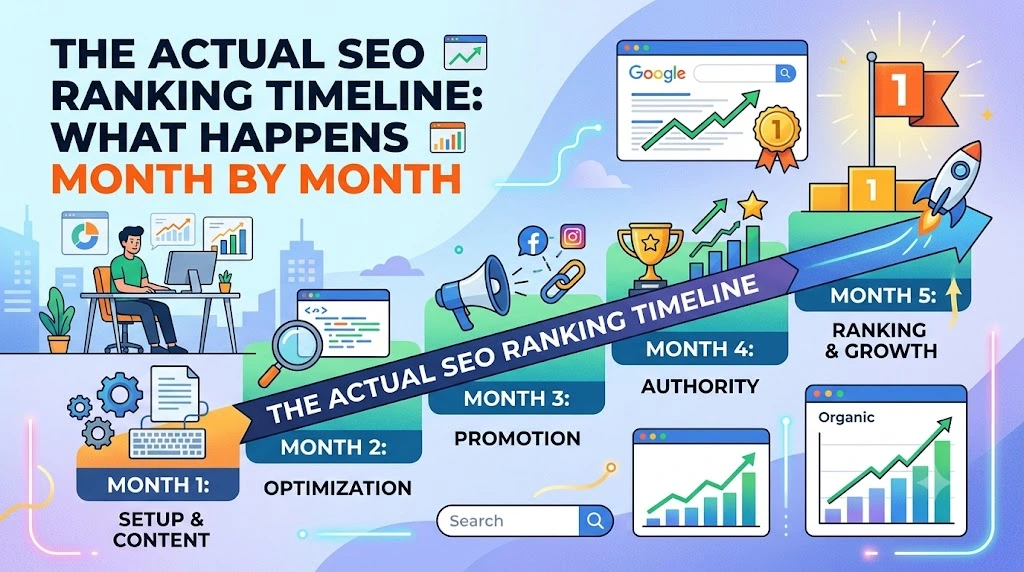
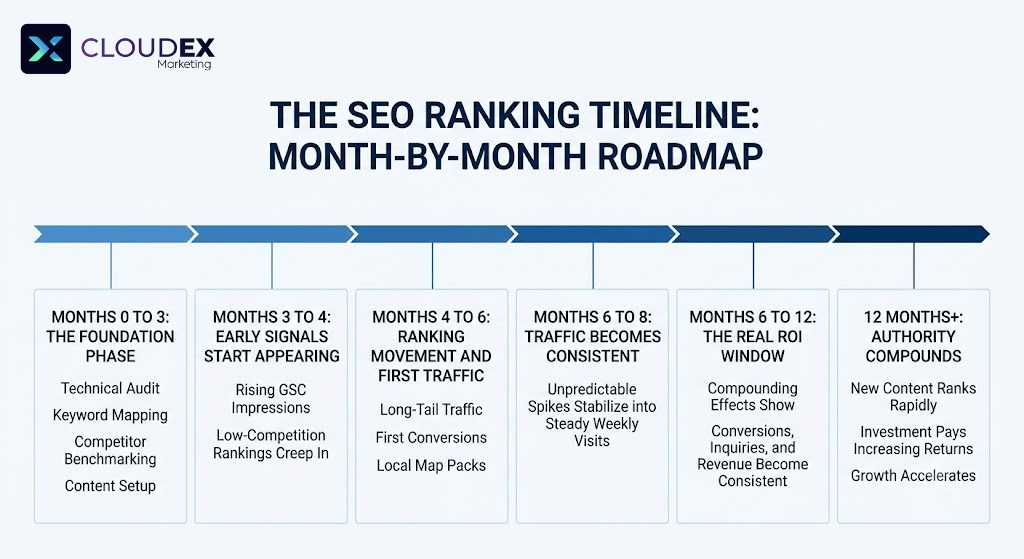
The actual timeline of SEO ranking runs in six measurable phases
- Months 0 to 3: The Foundation Phase
- Months 3 to 4: Early Signals Start Appearing
- Months 4 to 6: Ranking Movement and First Traffic
- Months 6 to 8: Traffic Becomes Consistent
- Months 6 to 12: The Real ROI Window
- 12 Months and Beyond: Authority compounds in this phase, and growth accelerates rather than plateaus.
If you’re new to SEO altogether and some of these terms feel unfamiliar, our complete guide to SEO basics for business owners explains the fundamentals this article builds on.
Months 0 to 3: The Foundation Phase
The first three months are where almost nothing visible happens, and that’s normal. This is the setup stage. Nothing ranks yet because nothing has been built yet.
What actually happens during this phase:
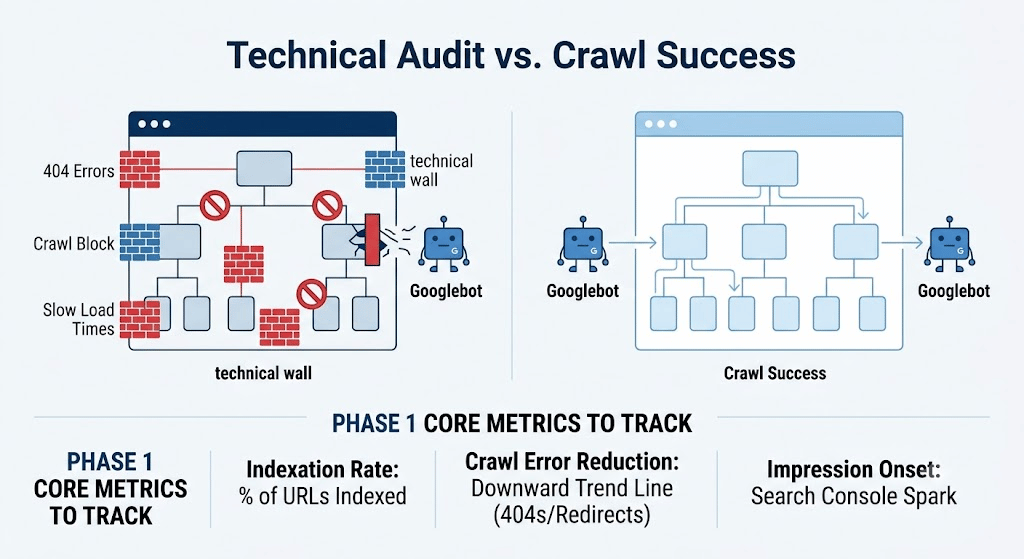
A technical audit comes first. This means checking your website for crawl errors, broken pages, slow load times, and indexing problems. If Google can’t properly access and read your site, nothing else matters. Fixing these issues is the very first job, before any content gets written or any keyword gets targeted.
Next comes keyword mapping. This is the process of figuring out which words and phrases your potential customers actually type into Google, and matching those words to specific pages on your site. Good keyword mapping avoids guesswork. It’s based on real search data, not assumptions about what people might search for.
Competitor benchmarking happens around the same time. This means looking at who already ranks for your target keywords, studying what they’re doing well, and figuring out what it will take to compete with them realistically.
Then content and site structure work begins. Pages get built or improved. Internal links get added so search engines and visitors can move easily between related pages. None of this shows results yet, but skipping it causes problems later.
Why this phase feels slow:
You won’t see much traffic movement in your analytics during these first three months. This is expected, not a sign that something is wrong. Google needs time to crawl your site, read the changes, and start trusting the new signals it’s finding. Foundation work is invisible by nature. It’s the difference between pouring a concrete foundation and building the visible walls of a house. Nobody photographs the foundation, but nothing stands without it.
What to actually track in months 1 to 3:
Since traffic and rankings won’t move much yet, watch different signals instead:
- How many of your pages Google has crawled and indexed
- Whether crawl errors are decreasing over time
- Early impressions in Google Search Console, meaning how often your pages start appearing in search results, even if nobody’s clicking yet
If these early signals are moving in the right direction, the foundation is working, even if your traffic graph still looks flat.
If your site has existing technical issues that are dragging out this phase longer than necessary, a proper SEO audit from Cloudex Marketing’s SEO team identifies exactly what’s blocking progress before you waste months guessing.
Months 3 to 4: Early Signals Start Appearing
This is where the first real movement shows up, though it’s still small and easy to miss if you’re only looking at overall traffic numbers.
What typically happens in the 3 to months phase:
Impressions in Search Console begin climbing steadily. This means your pages are showing up in search results, even if click numbers are still low. Low-competition keywords, meaning search terms with less competition from other websites, often start moving into ranking positions during this window. These aren’t your biggest, most valuable keywords yet, but they’re proof the strategy is working.
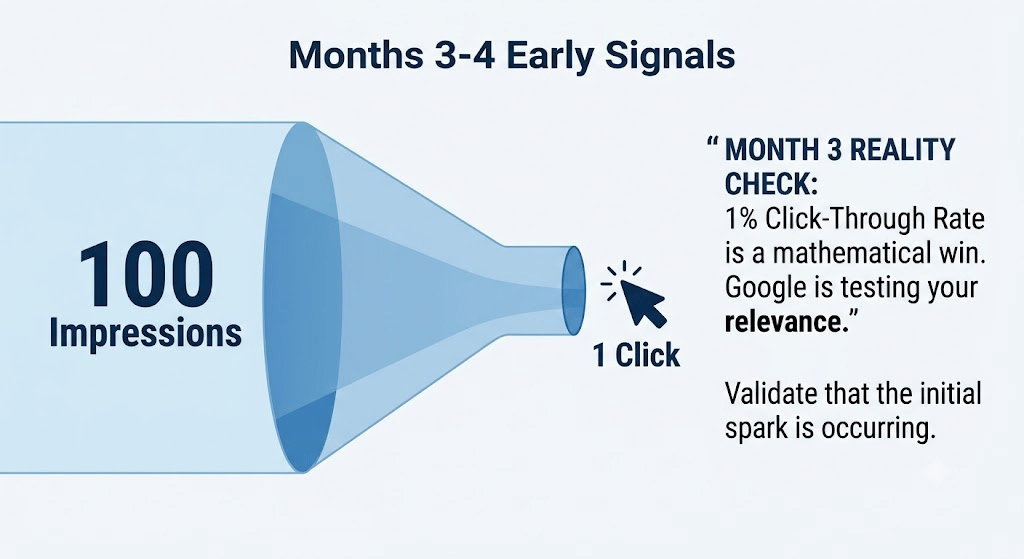
Click-through rate also tends to improve slightly during this stage. Early on, a click-through rate of around 1 percent is common and expected. This simply means that out of every 100 times your page appears in search results, roughly one person clicks through to visit it. That number should grow as your titles, descriptions, and rankings improve over time.
Why this stage matters psychologically:
Months 3 and 4 are where business owners start asking whether SEO is working at all. Seeing small movement here, even just rising impressions or a few keywords appearing on page two of Google, is a genuinely good sign. It means the site has moved past the pure setup stage and into early traction.
If you’re still unsure whether investing in SEO makes sense for your specific business at this point, our article on whether SEO is actually worth it breaks down realistic expectations in more depth.
What to track during this phase:
- Impressions trend, ideally rising week over week
- Which specific keywords are starting to appear, even outside page one
- Click-through rate, watching for gradual improvement rather than instant jumps
Months 4 to 6: Ranking Movement and First Traffic
This is the first phase where actual visitors start arriving from search engines, not just impressions in a dashboard.
What happens during this window:
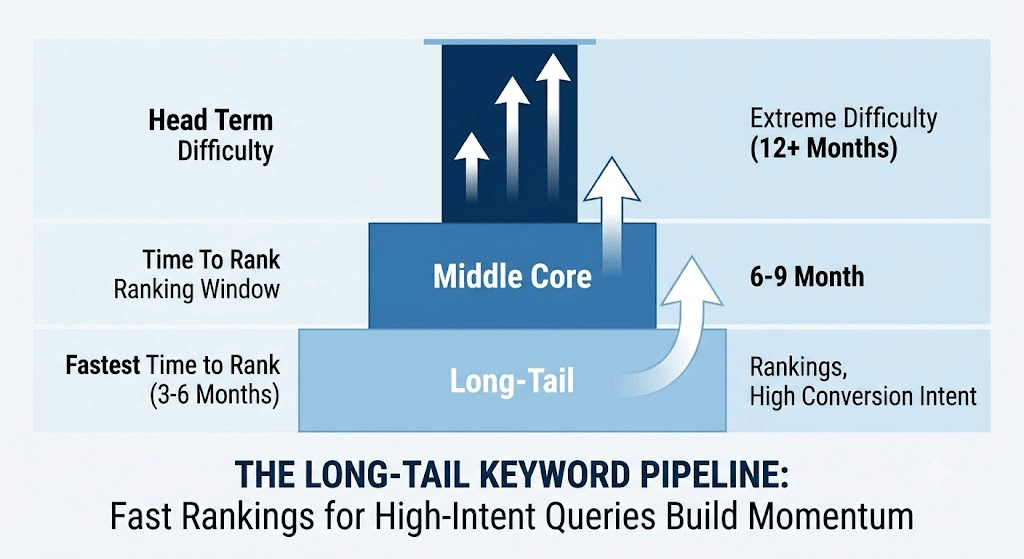
Keyword rankings begin shifting well. Pages that were sitting on page three or four of search results start moving toward page two or even page one, particularly for less competitive terms. This is also when long-tail keywords, meaning longer, more specific search phrases like “affordable SEO services for small clinics” rather than just “SEO services,” start bringing in your first conversions. Long-tail keywords are usually easier to rank for and often attract visitors who are further along in deciding to buy or take action.
If your business depends on local customers, this is also when movement in local map results, the map listings that show up for searches like “near me,” tends to begin.
Why long-tail keywords matter so much here:
Broad, highly competitive keywords take much longer to rank for, since larger, more established websites are also targeting them. Long-tail keywords face less competition, which means they can start working faster, even while your bigger target keywords are still climbing slowly in the background.
What to track during months 4 to 6:
- Actual organic traffic numbers, not just impressions
- Which pages are bringing in that traffic
- Early conversions tied to long-tail keyword traffic
- Local map pack visibility, if relevant to your business
This phase is where SEO starts to feel real. It’s no longer just technical work happening behind the scenes. It’s visitors actually arriving and, in some cases, becoming customers.
Months 6 to 8: Traffic Becomes Consistent
By this stage, growth typically shifts from occasional, unpredictable spikes to a steadier, more reliable pattern.
What changes during this phase:
Traffic stops being sporadic. Instead of a single good week followed by a quiet month, visits from search engines start arriving more consistently, week after week. Early return on investment signals often appear here too, meaning the traffic is starting to translate into real inquiries, sign-ups, or sales, not just page views.
This is also typically when a site’s overall authority, sometimes measured using metrics like Domain Authority or Domain Rating, starts showing measurable improvement. These scores aren’t official Google rankings, but they’re widely used indicators of how much trust and authority a website has built up over time.
Why consistency matters more than spikes:
A single viral post or lucky ranking spike doesn’t prove SEO is working long-term. Consistent, repeatable traffic across multiple pages and multiple keywords is the real signal that your foundation and ongoing strategy are functioning properly together.
What to track during months 6 to 8:
- Week-over-week traffic consistency, not just total volume
- Conversion rate from organic visitors specifically
- Growth in non-brand traffic, meaning visitors finding you through search terms that don’t include your business name, since this shows genuine new audience discovery rather than existing customers simply searching for your brand directly
Months 6 to 12: The Real ROI Window
This is the stage most businesses should actually use to judge whether their SEO investment is paying off, not month two or three.
What “real ROI” actually looks like:
By this window, the compounding effects of months of consistent work start showing clearly. Traffic has grown well beyond the early trickle from months 4 to 6. Conversions are happening regularly, not as isolated events. Your site’s authority has built up enough that new content tends to rank faster than it did when you first started, since search engines already trust the domain more than they did at launch.
Why earlier evaluation almost always disappoints:
Judging SEO ROI at the three-month mark is one of the most common reasons people conclude “SEO doesn’t work” incorrectly. Three months is enough time to judge whether the foundation is solid. It is not enough time for the compounding effects of authority and backlinks to fully show up in revenue numbers. Evaluating ROI too early essentially measures a process before it’s had room to compound, which almost guarantees an unfairly negative conclusion.
A simple way to separate these two evaluation points:
At month 3, ask: is the technical foundation solid, are pages getting indexed, are early keywords showing movement?
At month 6 to 12, ask: is this driving actual traffic, conversions, and revenue?
Keeping these two questions separate prevents the most common source of SEO frustration, expecting revenue results from a stage that was only ever meant to build the groundwork.
12 Months and Beyond: Authority Compounds
Past the one-year mark, growth shifts again, this time in a genuinely encouraging direction.
What changes after 12 months:
New content and new pages start ranking faster than they did in the first year. This happens because your domain has now built up a track record of trust with search engines. Instead of every new page starting from zero, it benefits from the authority the rest of your site has already earned.
This is described as SEO becoming an investment that pays increasing returns over time, rather than requiring the same amount of effort for the same amount of result indefinitely. A well-maintained SEO strategy at this stage tends to require proportionally less new effort to maintain and grow traffic compared to the intensive foundation-building work of the first year.
What this means practically:
If your business has stuck with a consistent SEO strategy through the first year, this is when the investment starts to feel less like an ongoing cost and more like a genuine, compounding asset. To be clear, this isn’t about paying for guest posts or purchasing backlinks to boost off-page authority. Tactics like that risk penalties rather than building lasting trust.
It’s about the cumulative effect of legitimate work already done:
- Technical health
- Quality content
- Naturally earned backlinks
All continuing to pay off with less new effort required to sustain and grow results, compared to the intensive foundation-building work of the first year.
Why “It Depends” Is Actually a Formula, Not a Shrug
Every SEO timeline discussion eventually produces some version of “it depends,” and that answer frustrates people because it sounds like an excuse. Well, it isn’t an excuse. It’s an incomplete formula that’s rarely finished properly.
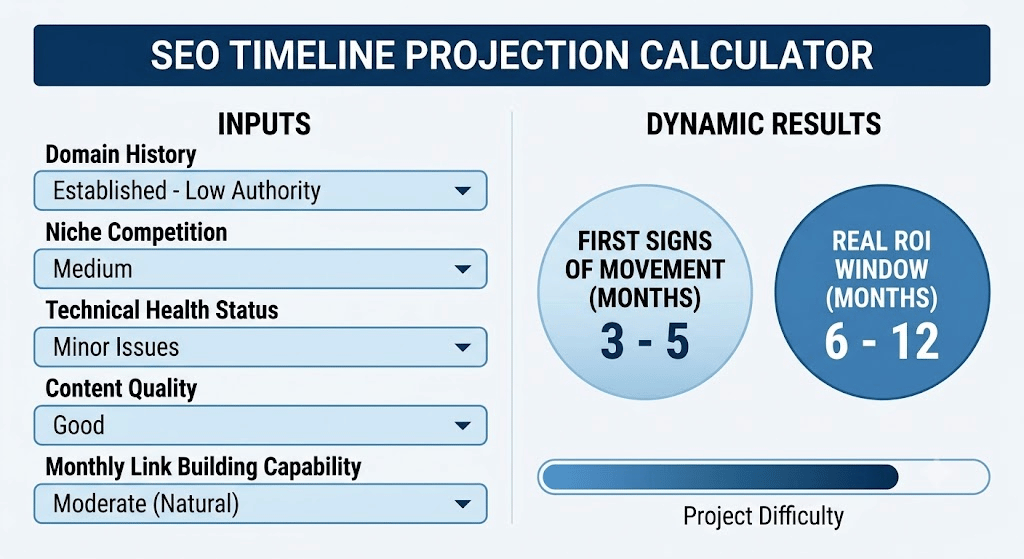
Here’s the finished version. Your realistic timeline is shaped by 5 specific factors:
1. Domain history. A brand new website starts slower than one that already has some existing authority and backlinks pointing to it.
2. Competition and keyword difficulty. Low-competition search terms can move within weeks. Highly competitive terms take significantly longer, no matter how good the work behind them is.
3. Technical SEO health. A site with unresolved crawl errors or indexing problems delays every single stage that comes after it.
4. Content quality and volume. Thin, generic content stretches out the timeline. Comprehensive content that genuinely answers what people are searching for shortens it.
5. Execution capability, especially link building. This is the factor most timeline discussions skip entirely, and it’s arguably the most important one.
Put these 5 factors together, and you get your actual, specific timeline instead of a vague general range. A brand new domain in a highly competitive niche with no ability to build quality backlinks is realistically looking at 9 to 12 months at minimum. An established domain with existing authority in a lower-competition niche can see meaningful movement within weeks.
New Domain vs. Established Domain: Two Different Starting Points
New domains face a real, though often exaggerated, trust delay when they first launch.
What typically happens with a new domain:
Before roughly six months, Google tends to observe a new domain without fully trusting it yet. Concrete ranking signals usually start arriving somewhere between months four and eight, as the site gradually builds natural backlinks and a track record search engines can rely on.
But this isn’t a fixed, unbreakable rule.
A domain with a genuinely strong, relevant backlink profile, whether built steadily over time or inherited from an existing site with real authority, can move through this trust-building stage noticeably faster. The real delay isn’t about how many days old the domain is. It’s about how long it actually takes to build up the trust signals that age usually happens to correlate with.
That distinction matters, because it leads directly into one of the most useful, and most overlooked, ideas in this entire topic.
Time Isn’t the Real Lever. Execution Is.
One perspective worth taking seriously pushes back directly against the common “just be patient and wait it out” advice: time itself doesn’t actually add value to your rankings on its own. An older domain doesn’t earn trust simply because it has existed for longer. Time became associated with SEO results mainly because building genuine authority, primarily through backlinks, naturally takes time to execute well.
The practical claim here is bold but worth understanding: a brand-new domain can start generating search impressions within a single week, provided the target keywords are realistic for that stage, and the person running it has genuine, consistent link-building capability. Not because the domain is new. Because the execution behind it moved quickly and effectively.
This reframes the entire timeline conversation. If you genuinely cannot execute consistent, quality link building, a 9 to 12 month timeline is realistic, and possibly even optimistic.
If you can execute that work well, starting from day one, your timeline compresses significantly, regardless of how new your domain actually is.
This is exactly why so many timeline answers default to “it depends.” People giving that answer usually aren’t being evasive (avoiding a real answer). They genuinely don’t know your specific execution capability, and that capability is the real variable determining your outcome, far more than the calendar itself.
Why 3 Months Isn’t Enough to Judge ROI
3 months is enough time to judge direction. It is not enough time to judge return on investment, and mixing up these two very different questions is where most SEO frustration actually comes from.
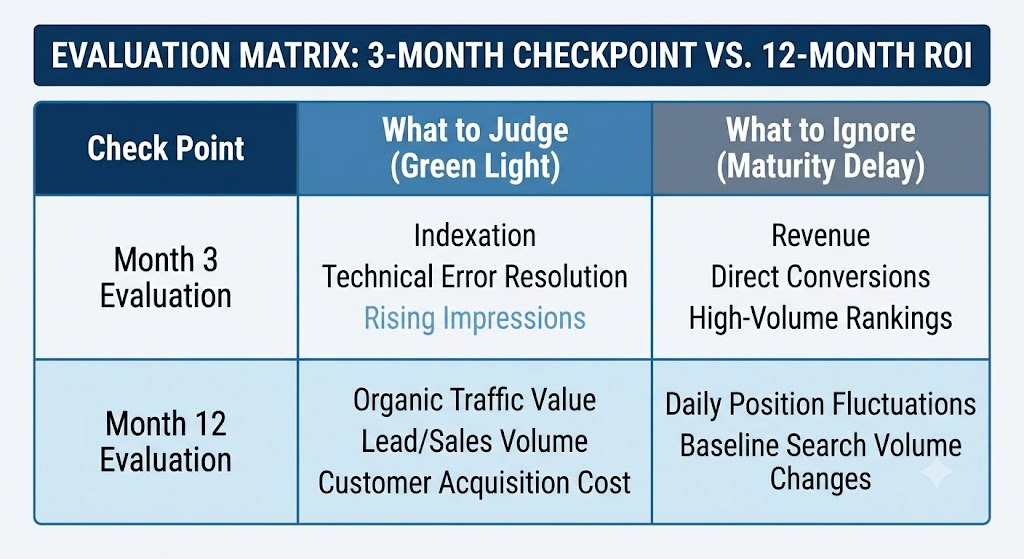
At the three-month mark, you should reasonably expect to see:
- Completed indexation
- Early growth in impressions
- Movement on lower-competition keywords
You should not yet expect meaningful conversions, consistent traffic, or a clear financial return, simply because the compounding effects of authority and backlinks haven’t had enough time to build up yet.
If you’re setting expectations, whether for yourself, a boss, or a client, it helps to separate these two evaluation checkpoints clearly:
At 3 months: Judge whether the foundation is solid. Look at indexation, technical health, and early keyword movement.
At 6 to 12 months: Judge the actual return on investment. Look at traffic, conversions, and revenue impact.
Judging ROI at the three-month checkpoint almost guarantees disappointment. Not because the SEO strategy failed, but because you’re measuring a naturally compounding process at a point before it’s had the time actually to compound.
What If Your Website Already Has Problems Slowing It Down?
Sometimes the reason a timeline stretches longer than expected isn’t a lack of patience. It’s unresolved technical issues, past penalties, or outdated practices dragging everything down from the start.
If your website has been hit by a Google penalty or ranking drop in the past, no amount of new content or waiting will fix that on its own. Recovering from an SEO penalty needs to happen before the normal timeline described in this article can even begin properly, since search engines won’t fully trust a site still carrying unresolved penalty signals.
Similarly, if you’re not sure where your site currently stands, whether it has hidden technical issues, indexing problems, or gaps in its content strategy, starting with a proper audit saves months of guesswork. Our SEO audit service identifies exactly what’s holding a site back before you invest further time and budget into a strategy that might be working against outdated problems in the background.
For businesses working with a smaller starting budget, our affordable SEO service is built specifically to cover this foundation-and-growth process at $99 only without requiring a large upfront agency retainer.
Does This Timeline Still Hold in the AI Search Era?
AI Overviews and AI-generated search results have added genuine unpredictability to ranking timelines, and it’s worth addressing that honestly rather than pretending search behaves exactly the way it did several years ago.
The core mechanics behind this timeline haven’t disappeared. Crawling, indexing, and authority-building still function largely the way they’re described throughout this article. What has changed is the visibility layer now sitting on top of traditional search results. AI-generated summaries can capture attention and clicks that would previously have gone directly to a ranked page, even when that page’s underlying ranking timeline played out exactly as expected.
What this means practically:
The month-by-month framework in this article still holds for how traditional rankings behave. But the traffic outcomes at each stage may look somewhat different than they would have a few years ago, since a portion of search demand now gets resolved directly inside an AI-generated answer before a user ever reaches a traditional search results page.
Building genuine topical authority and solid technical health remains the foundation either way. AI-driven search systems still draw heavily from the same trust and relevance signals that traditional rankings have always relied on. They’re just presenting the results differently.
Frequently Asked Questions
Is 3 months enough to evaluate SEO ROI?
No. Three months is enough to evaluate whether the technical and content foundation is solid, things like indexation, early impressions, and low-competition keyword movement. Judging actual ROI properly requires 6 to 12 months, since conversions depend on accumulated authority and traffic volume that the early months simply haven’t built up yet.
How long before a new website ranks on Google?
A genuinely new domain typically needs 6 to 12 months to build the trust and backlink profile needed for competitive rankings. Low-competition, highly specific search queries can rank faster, sometimes within just a few weeks, if the technical setup and content quality are strong from the very start.
What’s a realistic SEO timeline for a competitive niche?
Competitive niches typically require the full 9 to 12-month window, and sometimes longer, since higher keyword difficulty directly extends the amount of time needed to build enough authority to outrank already-established competitors.
Does domain age affect how fast you rank?
Domain age by itself isn’t really a direct ranking factor. What actually matters is the trust and authority a domain has built up, which often correlates with age simply because that kind of authority typically takes time to accumulate. A newer domain with genuinely strong, relevant backlinks can outperform an older domain that has a weak or neglected link profile.
What should I do if my SEO doesn’t seem to be working at all after several months?
First, check whether you’re judging results at the right checkpoint. 3-months in is too early for ROI judgments. If you’re past the 6-month mark with no meaningful movement at all, it’s worth checking for unresolved technical issues, past penalties, or fundamental gaps in the original strategy, since those problems tend to stall a timeline indefinitely until they’re specifically addressed.
The Bottom Line
The actual timeline of SEO ranking isn’t really a mystery, and it isn’t purely a matter of sitting back and waiting either. Early signals within 3 to 4 months, real traffic building by month 6, measurable ROI somewhere between 6 and 12 months. That’s the consistent pattern across experienced practitioners and search engines’ own guidance alike.
What determines exactly where you land inside that range comes down to five concrete factors, and execution capability, specifically your ability to build genuine authority through quality backlinks and solid technical health, matters more than the calendar itself ever will.
If you’re trying to figure out your own realistic timeline rather than relying on a generic range, starting with a proper look at where your site currently stands is the fastest way to get a real answer. Contact us, have a meeting, and see how Cloudex Marketing approaches this process, or go straight to booking an SEO audit to find out exactly what your specific timeline should realistically look like.