


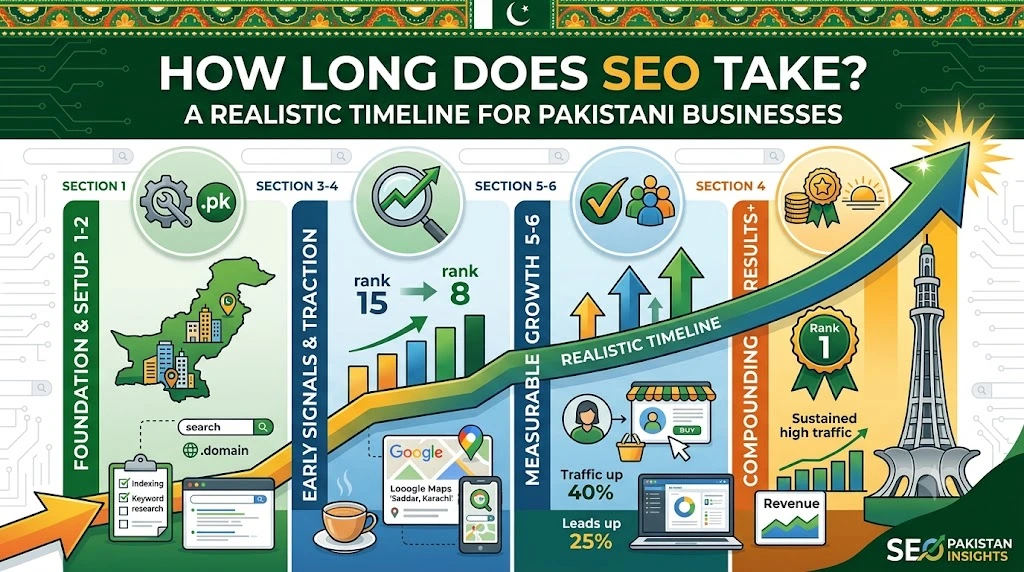
Not 30 days. Not “overnight success.” Not “guaranteed page 1 in two weeks.” SEO takes 3-6 months showing initial results, 6-12 months delivering significant traffic growth, and 12+ months establishing market dominance.
Overnight promises come from agencies that will either take your money and disappear or use tactics that get your website penalized, setting you back further than when you started.
Here’s what actually happens:
Month 1-3 feels like shouting into a void. You’re building a technical foundation whilst competitors seemingly ignore you.
Month 4-6 brings first real movements. Rankings climbing, traffic trickling in, validation that effort isn’t wasted.
Month 7-12 delivers the payoff. Compounding growth, sustained traffic, and business results justifying investment.
And here’s the advantage most Pakistani businesses miss: your timeline runs 30-40% faster than Western competitors’ markets haven’t reached saturation levels where every keyword requires battling decade-old brands with massive budgets.
This guide breaks down exactly what happens each month, which factors accelerate or sabotage timelines, how new versus established sites differ dramatically, what metrics prove progress before rankings move, and which agency promises reveal scams versus legitimate partners.
Why SEO Doesn’t Produce Overnight Results (And That’s Actually Good)
How Search Engines Build Trust: The Step-by-Step Reality
Step 1: Discovery and Crawling
Google discovers your website > Sends crawlers to analyze content > Takes days or weeks for first comprehensive crawl of new sites > Established sites get crawled faster based on historical update patterns.
Step 2: Indexing and Understanding
Google processes content understanding topics, quality, relevance > Compares against billions of existing pages > Determines where your content fits within their index > This analysis happens continuously, but takes weeks to show initial results.
Step 3: Testing and Validation
Google shows your pages to small user samples > Measures engagement: do people click? Do they stay? Do they return to search or find what they needed? > Positive signals gradually increase visibility; negative signals keep pages buried.
Step 4: Authority Assessment
Google evaluates your site’s credibility through backlinks, brand mentions, user behavior patterns, and content consistency > Authority accumulates slowly as signals compound > New sites start with zero authority, requiring months to demonstrate trustworthiness.
Step 5: Competitive Positioning
Google compares your content against competitors already ranking > You must prove superior quality, better user experience, more comprehensive information, or a unique value proposition > Displacing established rankings requires time demonstrating sustained superiority.
The timeline reality: Each step takes weeks or months, not days. This protects users from low-quality sites’ gaming search results whilst rewarding businesses investing in genuine value creation.
The Crawling and Indexing Timeline Nobody Warns You About
New websites face particularly frustrating initial periods. Google doesn’t trust new domains immediately. Too many spam sites are launched and abandoned within months historically. The “sandbox effect” (Google’s informal name for new site delays) means even perfectly optimized new sites show minimal visibility for 3-6 months whilst Google validates legitimacy.
At our SEO company in Pakistan, our technical SEO implementation accelerates this process by ensuring crawlers access content efficiently, understanding site structure clearly, and indexing pages correctly, but it cannot eliminate the fundamental trust-building period.
Established sites enjoy significant advantages. A 5-year-old business website adding new service pages sees those pages ranking within 4-8 weeks because Google already trusts the domain. The same content on a brand-new domain requires 4-6 months to achieve similar visibility because authority transfers from established domain reputation.
Why Pakistani Market Timelines Move Faster
Pakistan’s digital economy maturity creates unique timeline advantages. Consider Lahore’s e-commerce sector. A competitive space domestically, but far less saturated than equivalent Western markets. A Pakistani online retailer competing for “buy leather jackets online” faces perhaps 20-30 serious competitors compared to 200-300 in the market.
Lower competition means:
- Faster ranking movement: Fewer sites to outrank, reaching page one
- Lower authority requirements: Don’t need hundreds of backlinks competing with decade-old brands
- Quicker ROI realization: Traffic converts to business results sooner when rankings arrive faster
- First-mover advantages: Early entrants establish dominance before markets mature
Karachi’s B2B services sector demonstrates this perfectly. Professional services, accounting firms, legal practices, and consulting agencies have minimal online presence. Strong SEO execution can capture market leadership within 6-9 months, a timeline impossible in saturated Western markets where incumbents hold positions for years.
However, highly competitive sectors, like mobile phones, fashion, and real estate in major cities, approach Western timeline requirements because digital adoption reached critical mass, creating genuine competition.
Authority Accumulation: Why Google Makes You Wait
Google’s algorithm fundamentally asks: “Should we trust this content enough to recommend it to millions of users?” New websites haven’t earned that trust yet, regardless of content quality. Authority builds through:
Consistent publishing: Sites updating regularly with quality content signal active management rather than abandoned projects
User engagement patterns: Visitors spending time reading, clicking multiple pages, returning later, indicate valuable content worth ranking higher
External validation: Other websites linking to your content, industry mentions, and social sharing demonstrate third-party recognition of value
Technical reliability: Sites loading quickly, working properly across devices, and maintaining uptime prove professional operation.
These signals accumulate gradually. One great article doesn’t establish authority, but 50 great articles published consistently over 8 months, whilst earning backlinks and engagement, begin shifting Google’s perception from “unknown new site” toward “credible information source worth ranking.”
Understanding SEO benefits helps justify the patience required because long-term compounding returns dramatically exceed short-term gains from paid advertising, which disappear immediately when budgets stop.
Month-by-Month SEO Timeline: What Pakistani Businesses Actually Experience
Months 1-3: Foundation Building and Early Signals (The Frustrating Phase)
What’s happening behind the scenes:
Month 1 focuses almost entirely on technical foundation, fixing crawl errors, implementing proper URL structures, ensuring mobile optimization, installing schema markup, and establishing site architecture. Technical audits identify issues preventing Google from properly accessing and understanding your site.
Month 2 begins content strategy execution. New pages get created following keyword research, existing content gets optimized, and internal linking structures get established. Google starts crawling new content, but hasn’t yet determined how to rank it.
Month 3 shows the first indexing success. Google begins including your pages in search results, but rankings typically sit on pages 3-10 initially. Most businesses see zero traffic increase yet because page 3 rankings generate minimal clicks.
What you should see in analytics:
- Technical metrics improving: Site speed scores increase, Core Web Vitals enter green zones, and indexing errors decrease from initial audit levels.
- Crawl frequency rising: Google Search Console shows more frequent crawler visits as the site gains trust.
- Impressions starting: Your pages begin appearing in search results (impressions) even without clicks yet.
- Long-tail movements: Very specific, low-competition keywords reach page 2 or late page 1.
What Pakistani businesses typically experience:
Karachi retailers see product pages indexing within 3-4 weeks because e-commerce crawling happens faster than informational content. Lahore service businesses take 6-8 weeks to see first rankings appear because service pages require more authority signals before Google ranks them prominently.
Realistic expectations: Don’t expect traffic yet. This phase builds a foundation that enables future growth. Businesses quitting after 3 months abandon investment just before returns materialize, like planting seeds then digging them up after 2 weeks, complaining nothing grew yet.
What you’re investing in: Technical excellence that prevents future problems, content infrastructure supporting traffic growth, and authority signals accumulating toward the threshold where rankings jump.
Months 4-6: Momentum Building and First Real Traffic (Things Start Moving)
The turning point arrives: Most businesses see their first meaningful results during this phase. Rankings that sat on pages 3-5 begin climbing toward page 2 and late page 1. Traffic increases from nearly zero to 20-50% of target levels.
What’s happening:
Google has accumulated enough data to validate your site’s quality. User engagement signals from early visitors showed positive patterns. Backlinks from outreach efforts begin registering in Google’s index. Content volume reaches a critical mass where internal linking creates genuine topic authority.
Month 4 typically shows first page-2 rankings for primary keywords. These don’t generate much traffic yet, but signal progress. Several long-tail keywords crack page 1 positions 7-10.
Month 5 brings breakthrough moments, 1-3 primary keywords reaching page 1 positions 4-8. Traffic jumps noticeably when rankings cross from page 2 to page 1 because click-through rates increase 5-10× between these pages.
Month 6 demonstrates whether the strategy works. If rankings continue improving and traffic grows consistently, fundamentals are sound. If progress stalls, adjustments become necessary before continuing.
What you should see in analytics:
- Keyword rankings moving: 30-50% of target keywords improving positions, with 10-20% reaching page 1
- Traffic increasing: Organic sessions growing 100-300% compared to Month 1 (from low baseline)
- Engagement improving: Average session duration increasing as more targeted visitors find content relevant
- Conversion signals: First meaningful inquiries or sales from organic search traffic
Pakistani market dynamics:
Islamabad professional services break through during Months 5-6 because lower competition allows faster movement once the authority threshold crosses. Karachi retail requires until Month 7-8 because product categories face more competition, requiring additional authority accumulation.
Lahore’s manufacturing and export sectors frequently see international rankings improve faster than domestic rankings during this phase because international competitors have a weaker Pakistani-market focus, creating easier opportunities for locally-focused optimization.
What separates success from stagnation: Businesses seeing strong Month 4-6 progress typically execute fundamentals excellently, quality content addressing real user needs, clean technical implementation, consistent publishing schedule, and strategic backlink acquisition. Those seeing minimal progress usually have execution gaps requiring diagnosis and correction.
On-page optimization quality becomes critical during this phase because Google tests content quality through user engagement; poor content fails these tests regardless of technical excellence.
Months 7-9: Growth Acceleration and Authority Establishment (Compound Returns Begin)
The compounding effect kicks in: Earlier investments begin multiplying returns. Content published in Month 2-3 that gained authority now ranks well. Backlinks acquired in Months 3-4 transfer maximum authority. Internal linking between a growing content library creates topical authority signals that Google rewards with better rankings across related keywords.
What’s happening:
Month 7 brings several primary keywords into the top-5 positions. Traffic growth accelerates as more rankings cross into high-click-through positions 1-3. Brand searches increase as market awareness grows through organic visibility.
Month 8 typically shows consistent performance. Rankings stabilize at improved levels, traffic becomes predictable, and conversion rates improve as audience targeting sharpens through accumulated data.
Month 9 demonstrates whether you’re building sustainable authority or hitting a ceiling. Continued growth indicates a successful strategy. Plateauing signals the need to expand content, increase backlink velocity, or improve conversion optimization.
What you should see in analytics:
- Keyword rankings solidifying: 50-70% of target keywords on page 1, with 20-30% in positions 1-5
- Traffic growing predictably: Month-over-month increases of 15-25% as rankings improve incrementally
- Engagement patterns maturing: Returning visitors increasing, brand searches growing, conversion funnels developing
- Authority metrics rising: Domain authority scores improving, backlink profile diversifying, topic relevance strengthening.
Pakistani competitive advantages:
This phase reveals Pakistan’s market opportunity most clearly. Businesses executing well capture dominant positions because competitors either haven’t invested in SEO yet or executed poorly. First-mover advantages compound as your content accumulates social proof (shares, comments, backlinks) that becomes harder for late-entering competitors to replicate.
Karachi’s competitive sectors see several businesses reaching strong positions simultaneously during this phase, market maturity creating genuine competition. Emerging sectors in smaller cities see your business establishing near-monopoly visibility because you’re the only serious player investing in organic search.
What professional guidance provides: A professional SEO company in Pakistan, monitoring performance during this phase, identifies optimization opportunities, maximizes growth, which content deserves expansion, which keywords need more focus, which backlink sources provide the best returns, and which technical refinements accelerate progress further.
Months 10-12: Established Visibility and ROI Realization (Sustainable Performance)
You’ve built something substantial: By Month 10-12, well-executed SEO creates sustainable competitive advantages that compound for years with proper maintenance. Rankings hold stable positions, traffic arrives predictably, and business results flow consistently from the organic channel.
What’s happening:
Month 10 shows maturity. You understand which content performs best, which keywords drive conversions, and which optimization tactics work for your specific business. Strategy shifts from building a foundation toward refinement and expansion.
Month 11 typically focuses on scaling what works, creating more content around proven topics, building additional backlinks to high-performing pages, and expanding into adjacent keyword opportunities identified through 10 months of data.
Month 12 marks reflection and planning, measuring ROI against investment, determining whether to continue the current approach or adjust the strategy, and identifying new opportunities for Year 2 growth.
What you should see in analytics:
- Keyword rankings dominating: 70-80% of target keywords on page 1, with 30-40% in positions 1-3
- Traffic meeting targets: Organic sessions reaching or exceeding original goals set at project start
- Conversion rates optimization: Enough data refining, targeting, improving landing pages, and enhancing user journeys
- Business impact measurable: Clear ROI from organic leads, sales, or inquiries justifying SEO investment
Long-term trajectory: Months 10-12 aren’t endpoints but rather inflection points where exponential growth becomes possible. Content published now ranks faster because the domain authority has reached a threshold where Google trusts new pages immediately. Backlinks arrive organically because the market recognizes your authority. Traffic compounds as rankings improve for broader keyword sets.
Ongoing SEO investment maintains and expands these gains. The businesses seeing the strongest Year 2-3 growth are those treating Month 12 as a foundation for expansion rather than a finish line.
Pakistani market positioning: Businesses reaching strong positions by Month 10-12 control market leadership for years because overtaking established authority requires competitors investing 12+ months matching your headstart, a difficult commitment for businesses seeing you already dominating organic visibility.
Factors That Speed Up or Slow Down Results in Pakistan’s Market
5 Acceleration Factors Creating Faster Timelines
Factor 1: Lower Competition in Emerging Sectors
Pakistan’s digital economy maturity varies dramatically by sector. Established industries, including mobile phones, fashion, and general retail, face genuine competition online. Emerging sectors, like B2B services, specialized manufacturing, professional consulting, and niche e-commerce, have minimal quality online competition.
Real impact: E-commerce site selling specialized industrial equipment reached page 1 positions in 4-5 months because only 5-10 competitors invested in SEO. Same timeline in saturated Western market requires 9-12 months competing against 50+ established players.
Geographic advantage: Cities beyond Karachi/Lahore present even faster opportunities. Faisalabad textile manufacturer, Sialkot sports goods exporter, Gujranwala ceramics producer. These businesses can dominate local-plus-export search visibility within 6-8 months because international competitors ignore Pakistan-specific optimization, whilst local competitors haven’t discovered SEO yet.
Factor 2: Quality Content Execution
Pakistani businesses face a content quality gap. Competitors produce thin, keyword-stuffed content that Google increasingly devalues. Publishing genuinely helpful, comprehensive content immediately differentiates you from 80% of market competition.
Specific advantage: A 2,500-word comprehensive guide answering customer questions thoroughly outperforms 10 competitors with 400-word keyword-stuffed pages. Google’s quality algorithms reward depth, originality, and usefulness. Areas where effort creates immediate competitive advantage.
Factor 3: Technical Excellence
Many Pakistani websites suffer technical problems, including slow loading speeds, poor mobile optimization, broken functionality, and confusing navigation. Launching a technically excellent site or fixing existing technical issues creates an immediate advantage that Google recognizes within weeks.
Measurable impact: Site loading in 1.5 seconds with a perfect mobile experience outranks a technically poor competitor even when that competitor has stronger content or more backlinks. Technical excellence acts as a ranking multiplier, accelerating all other efforts.
Factor 4: Strategic Link Building
Off-page SEO through quality backlinks remains a critical ranking factor. Pakistani businesses acquiring links from credible local sources, including industry associations, business directories, news publications, and partner websites, build authority faster than waiting for organic links to accumulate slowly.
Timeline impact: Aggressive but quality-focused link building can compress a 12-month timeline to 8-9 months by accelerating authority accumulation that otherwise happens gradually through content alone.
Factor 5: City-Specific Competitive Dynamics
Karachi: Highest competition but largest market. Timelines approach 8-12 months for competitive keywords because digital adoption has reached critical mass. However, niche positioning still offers 5-7 month opportunities in underserved segments.
Lahore: Moderate competition with strong purchasing power. Sweet spot for many businesses. Enough market size justifying investment, insufficient competition preventing easy wins. Typical timelines 6-9 months for meaningful results.
Islamabad: Lower competition in the affluent market. Professional services and B2B companies see the fastest results here. 4-6 months reaching dominant positions because fewer businesses have invested seriously in SEO yet.
5 Deceleration Factors Extending Timelines Unnecessarily
Factor 1: Technical Issues Left Unfixed
Attempting SEO on a technically broken website wastes months. Google cannot rank what it cannot properly crawl, index, and understand. Common problems, including server errors, redirect chains, duplicate content, broken mobile experience, and slow loading, must be fixed before other SEO efforts produce results.
Timeline impact: Technical problems can extend the timeline 3-6 months because Google won’t reward content it cannot access properly, regardless of quality.
Factor 2: High-Competition Sectors Without Differentiation
Entering saturated markets with a generic approach guarantees slow progress. Pakistani fashion e-commerce, mobile phone retail, and general electronics. These sectors face strong competition requiring either exceptional execution or unique positioning, differentiating your offering.
Reality check: Generic “buy mobile phones online” targeting requires 12-18 months competing against established players with years of authority. Specialized positioning,” premium Samsung service center parts Karachi,” reaches visibility in 5-7 months because competition drops dramatically.
Factor 3: Inconsistent or Poor Execution
SEO requires sustained effort. Publishing 10 articles in Month 1, then nothing in Months 2-6 wastes initial investment. Building 20 backlinks in Month 3 through spammy tactics triggers penalties, erasing progress.
Common failure pattern: Business starts enthusiastically, sees no immediate results, reduces effort dramatically, wonders why nothing improves, creating a self-fulfilling prophecy of poor results, confirming initial skepticism about SEO’s value.
Factor 4: Algorithm Updates Creating Volatility
Google releases algorithm updates continuously. Some minor, some major. Updates can temporarily disrupt rankings even for well-optimized sites as Google recalibrates quality assessments. Recovery from negative algorithm impact typically requires 2-4 months of additional time.
Realistic expectation: Plan for potential 1-2 month setbacks from algorithm volatility. Sites built on solid fundamentals recover quickly; sites using questionable tactics never recover.
Factor 5: Unrealistic Keyword Targeting
New website targeting “buy clothes online” (massive competition, international brands, huge budgets) faces a multi-year timeline reaching meaningful visibility. Same website targeting “buy traditional Pakistani lawn suits Lahore” (specific, local, lower competition) ranked within 6-8 months.
Strategic implication: Timeline expectations must match the competitive reality of targeted keywords. Businesses refusing to adjust targeting toward achievable wins extend timelines unnecessarily by fighting unwinnable battles.
New Site vs. Established Site: How Domain Age Affects Your Timeline Dramatically
New Website Reality: 6-12 Months Minimum (Usually Closer to 12)
The trust deficit: Brand-new domains start with zero authority in Google’s eyes. The “sandbox effect,” Google’s informal term for new site delays, means even perfectly optimized new sites show minimal visibility for 4-6 months while Google validates legitimacy through sustained quality signals.
Why does Google make new sites wait?
Too many spam sites have historically been launched, gained quick rankings through manipulation, then disappeared or degraded in quality after achieving visibility. Google learned that requiring time-based validation filters out most spam, whilst legitimate businesses prove commitment through sustained effort.
What the new site timeline looks like:
- Months 1-3: Foundation building, initial indexing, zero meaningful traffic
- Months 4-6: First rankings appear on pages 2-3, and minimal traffic begins
- Months 7-9: Rankings improve toward page 1, traffic grows noticeably
- Months 10-12: Solid page 1 presence developing, meaningful ROI emerging
Pakistani new site advantage: Lower competition means crossing the authority threshold happens faster than in Western markets. New Lahore e-commerce site achieves the Month 12 position that requires 18-24 months in a saturated international market.
Realistic expectations: If launching a new website for a new business, plan 9-12 months before SEO generates meaningful business results. Budget accordingly. Don’t expect organic search to carry business immediately. Use paid advertising, social media, and partnerships to cover the gap whilst SEO builds.
Acceleration tactics for new sites:
- Launch with substantial content (30-50 quality pages minimum) demonstrating serious commitment
- Acquire several quality backlinks immediately through business relationships, industry directories, and partnerships
- Publish consistently, new sites abandoning content schedule after 2-3 months confirm Google’s spam suspicions
- Focus on technical excellence, perfect site architecture, fast loading, and flawless mobile experience signals professionalism.
Established Site Advantage: 3-6 Months for Improvements (Sometimes Faster)
The authority transfer: Websites operating 2+ years with a history of quality content, engaged users, and accumulated backlinks start SEO optimization with significant advantages. Google already trusts the domain, so new optimizations show results dramatically faster.
Why established sites rank faster
Google has already determined that your site provides value to users through years of behavioral data. New content from a trusted source gets evaluated in weeks rather than months. Technical improvements get recognized immediately rather than waiting for the validation period.
What an established site timeline looks like
- Month 1: Technical fixes and optimization show immediate crawl efficiency improvements
- Months 2-3: Rankings begin moving noticeably for optimized pages, and traffic increases start
- Months 4-6: Significant positions reached for target keywords, meaningful traffic growth achieved
Real Pakistani example: Established Karachi logistics company operating for 5 years decides to invest in SEO. Their existing domain authority means new service pages rank within 4-6 weeks, comprehensive content reaches page 1 within 3-4 months, a timeline impossible for a startup competitor with a new domain.
The compounding advantage: Established businesses investing in SEO create nearly insurmountable competitive moats. New competitors must overcome both your market experience AND your accumulated search authority, requiring years of matching your positioning whilst you continue advancing.
Maximizing established site benefits:
- Audit existing content, identifying optimization opportunities, and improving what already ranks delivers the fastest wins.
- Leverage existing backlink profile through internal linking, distribute authority from strong pages to newer content.
- Expand aggressively, and being an established authority means new content ranks faster, making the content volume strategy more effective.
- Don’t take authority for granted; ongoing maintenance preserves advantages whilst competitors chip away at positioning.
Domain Age Sweet Spot: 1-2 Years
An interesting middle ground exists for sites 12-24 months old. Google passed initial sandbox skepticism, but sites haven’t yet accumulated mature authority. These sites see 5-8 month timelines for SEO improvements, faster than new sites but slower than established domains.
Strategic consideration: If planning a major SEO investment, launching a website 6-12 months beforehand, even with minimal content, starts the domain age clock. When serious optimization begins, you’ve already passed some trust barriers new sites face.
What Metrics Prove SEO Is Working Before Rankings Move Significantly
Technical Health Improvements: The Foundation Metrics
Crawl Efficiency Rising
Google Search Console shows how many pages Google crawls daily. A healthy upward trend indicates Google finds your site worth revisiting frequently. Early positive signal even before rankings improve.
What to watch: Crawl requests per day are increasing month-over-month. The new site starts 20-30 crawls daily, reaching 200-300 within 3-4 months if content volume and quality warrant increased attention.
Indexing Progress Expanding
Coverage report in Search Console shows which pages Google indexed successfully. Growing indexed page count proves that content discovery and inclusion are happening systematically.
Realistic expectations: New content takes 3-7 days to get indexed initially. As domain authority grows, new content indexes within 24-48 hours. Observable improvement signaling Google’s trust is increasing.
Core Web Vitals Optimizing
Technical performance metrics, including Largest Contentful Paint, First Input Delay, and Cumulative Layout Shift, directly affect rankings. Improving these scores from red to yellow to green provides measurable progress even before traffic increases.
Pakistani context: Many local competitors have poor technical implementation. Achieving “good” Core Web Vitals scores positions you ahead of 70-80% of the market technically before content quality factors even apply.
Engagement Signals: Users Validating Content Quality
Time on Site Increasing
When rankings improve slightly (moving from page 5 to page 3), visitor time on site indicates content quality. Growing average session duration proves content engages readers rather than disappointing them immediately.
What good looks like: Industry average time on site varies, but sustained month-over-month increases signal improving content relevance and quality, satisfying user needs better than competitors.
Bounce Rate Declining
Bounce rate measures visitors leaving after viewing only one page. Declining bounce rate indicates more visitors find content relevant enough to explore additional pages. Positive quality signal Google monitors.
Context matters: Bounce rate standards differ by industry. E-commerce 40-60% considered normal, blogs 70-80% be fine depending on content type. Focus on trend direction rather than absolute numbers.
Pages Per Session Growing
Engaged visitors explore multiple pages. Growing pages-per-session metric indicates improving content relevance and effective internal linking, encouraging further exploration.
Pakistani advantage: Many local competitors produce single-page sites or minimal content. A comprehensive content library that immediately differentiates you through engagement metrics Google values highly.
Visibility Growth: Early Ranking Signals
Impressions Increasing Dramatically
Before clicks arrive, impressions show your pages appearing in search results. Dramatic impression growth (100-300% month-over-month early on) proves that Google includes your content in relevant searches even if rankings don’t generate clicks yet.
What this signals: Google is testing your content in search results, gathering user response data, and evaluating whether to rank higher. Impression growth without clicks indicates content discovered but not yet positioned enough to generate traffic.
Click-Through Rate Improving
As rankings move from page 3-5 toward page 1-2, click-through rate should improve. Position 20 generate 0.1% CTR; position 8 generate 2% CTR; position 3 generates 8-12% CTR.
What to watch: CTR improvements matching ranking improvements validate that higher positions generate proportionally more clicks, confirming traffic will grow substantially once rankings reach top positions.
Long-Tail Keywords Ranking
Before primary competitive keywords rank well, specific long-tail variations reach page 1 quickly. These low-competition keywords generate minimal traffic individually but collectively prove Google understands your content’s relevance.
Early win example: Targeting “SEO services Lahore” (competitive) takes 8 months to reach page 1. Meanwhile, “affordable SEO agency for small business Lahore Gulberg” (ultra-specific) rank position 3-5 within Month 3-4, generating small but measurable traffic, validating strategy direction.
Authority Indicators: Building Long-Term Strength
Backlink Growth Accelerating
Quality backlink acquisition through outreach, PR, content marketing, and partnerships shows measurable progress. A growing backlink profile (tracking referring domains, not just total links) indicates authority building even before rankings reflect it.
Measurement approach: Focus on referring domains from relevant, quality sources rather than total link count. Five backlinks from credible industry sources outweigh 50 directory links from low-quality sources.
Brand Searches Increasing
People searching your company name directly indicates growing brand awareness, driven partially by improved search visibility. Brand search growth proves market exposure is increasing even before tracking tools show ranking improvements.
Why this matters: Brand searches signal authority to Google. Growing branded query volume indicates a genuine business entity rather than a spam site, accelerating trust building, and affecting overall rankings.
Domain Authority Score Rising
While not an official Google metric, third-party domain authority scores (Moz DA, Ahrefs DR) provide a proxy for authority accumulation. Growing scores month-over-month validate authority-building efforts working even before dramatic ranking changes occur.
Realistic pace: Domain authority grows slowly. 1-2 points monthly is considered strong progress for an established site; 0-1 points monthly is normal for a new site. Sudden dramatic increases signal data anomalies rather than actual authority jumps.
Working with our professional SEO agency in Pakistan provides expertise in interpreting these early metrics correctly, understanding which signals indicate a strong trajectory versus which suggest needed adjustments before continuing investment that does not produce desired results.
Red Flags: Agencies Promising Results in 30 Days (And Why They’re Lying)
The Impossible Timeline Claim
What they say: “We’ll get you page 1 rankings within 30 days guaranteed!”
Why it’s impossible: Google’s indexing, testing, and validation processes require a minimum of 6-8 weeks for even modest ranking improvements on new content. Achieving page 1 positions for competitive keywords within 30 days violates fundamental search engine operation timelines.
The only scenarios where 30-day results happen:
- Ranking for brand name (you already own this)
- Ranking for ultra-specific long-tail keywords with zero competition (minimal business value)
- Temporary rankings from black-hat tactics that disappear quickly or trigger penalties
What legitimate agencies say instead: “Based on competitive analysis, you should see initial ranking movements within 3-4 months, with significant results by 6-8 months. Timeline varies depending on current site condition, competition level, and execution quality.”
Guaranteed Rankings: The Impossibility Nobody Can Deliver
What they promise: “We guarantee first page for your top 10 keywords or money back!”
Why it’s fraudulent: Nobody controls Google’s algorithm except Google. Claiming guaranteed rankings implies either:
(1) manipulating search results through violations,
(2) choosing such easy keywords that rankings mean nothing
(3) outright lying, planning to keep your money regardless of the results.
The algorithm reality: Google releases updates continuously, affecting rankings unpredictably. Algorithm changes beyond anyone’s control can shift rankings regardless of optimization quality. Legitimate SEO creates conditions for ranking success but cannot guarantee specific positions.
What ethical agencies guarantee instead: “We guarantee professional execution of proven SEO strategies. We cannot guarantee specific rankings because Google controls its algorithm, but we’ll optimize systematically and adjust strategy based on results.”
Black-Hat Tactics: Short-Term Gains, Long-Term Devastation
Warning signs they’re using risky tactics:
- Offering to create hundreds of backlinks quickly through “secret networks.”
- Promising rapid results through “proprietary algorithm manipulation techniques.”
- Guaranteeing rankings without understanding your business, competition, or current site condition
- Refusing to explain specific tactics with vague claims about “trade secrets.”
What happens when black-hat tactics work temporarily:
Months 1-2: Rankings jump dramatically through manipulation. Months 3-4: Google’s spam detection algorithms identify unnatural patterns. Month 5: Rankings collapse below pre-optimization levels as a penalty is applied. Months 6-12: Recovery requires months of removing bad links, disavowing toxic backlinks, and rebuilding legitimate authority
The devastating ROI: Pay for 3 months of manipulation producing temporary gains, then spend 6-12 months recovering from damage whilst competitors gain an advantage. Total timeline to genuine results: 15-18 months versus 8-12 months if legitimate SEO is executed from the start.
Too-Good-To-Be-True: Usually Exactly That
Red flag pricing: “We’ll optimize your entire website, create 100 backlinks monthly, write 20 articles, and manage social media for $200/month!”
Why this fails: Professional SEO requires skilled labor, including research, strategy, technical implementation, content creation, outreach, analysis, and reporting. Quality execution cannot happen at prices suggesting 2-3 hours of monthly work.
The cheap SEO reality:
- Outsourced to unqualified freelancers who damage rather than help
- Automated tools producing spammy content and toxic backlinks
- A cookie-cutter approach, ignoring your specific business needs
- Zero strategic thinking or performance analysis
What realistic pricing looks like: Professional SEO for small- to medium-sized Pakistani businesses typically ranges from $500 to $2,000 monthly, depending on competition, market size, and scope. Enterprise SEO for larger businesses or highly competitive markets requires a $3,000-10,000+ monthly investment matching competitive intensity.
How to Evaluate Agencies: Questions Revealing Truth
Ask about timeline expectations:
- Red flag answer: “You’ll see results within 30 days.”
- Good answer: “Initial signals within 2-3 months, meaningful traffic by 6-8 months, strong ROI by Month 10-12.”
Ask about ranking guarantees:
- Red flag answer: “We guarantee top 3 positions for all keywords.”
- Good answer: “We’ll optimize professionally, but cannot guarantee rankings because Google controls that. We’ll report progress transparently and adjust strategy based on results.”
Ask about specific tactics:
- Red flag answer: Vague claims about proprietary secrets or unwillingness to explain the approach
- Good answer: Clear explanation of technical optimization, content strategy, link-building approach, timeline, and reporting methods
Ask for client examples:
- Red flag answer: Cannot provide examples or only shows cherry-picked perfect results
- Good answer: Shares case studies showing realistic progression, including challenges faced, adjustments made, and ultimate results achieved with transparent timelines
Understanding what bad SEO practices look like helps identify agencies using risky tactics before you invest months and money only to discover problems after damage occurs.
Conclusion
Patience paired with professional execution delivers sustainable results.
Pakistani businesses enjoy a time advantage Western competitors lack. Lower digital competition, emerging market opportunities, and strategic positioning possibilities create faster paths toward dominance when execution quality meets market timing. The business is investing seriously in SEO today, building a proper technical foundation, creating quality content consistently, earning strategic backlinks, and monitoring progress professionally. The position itself has been capturing market share for years, whilst competitors remain invisible in search results.
The critical success factors: realistic timeline expectation,s preventing premature abandonment, professional execution, avoiding wasted months on ineffective tactics, consistent effort compounding returns over time, and patience, understanding that sustainable competitive advantages require sustained investment rather than quick fixes delivering temporary gains.
What separates businesses seeing Month 12 dominance from those seeing Month 12 disappointment isn’t luck or algorithm favoritism. Its execution quality from Month 1 forward. Technical excellence, content quality, strategic patience, and professional guidance combine to create trajectories toward market leadership, whilst shortcuts, cheap execution, unrealistic expectations, and premature quitting create predictable failure patterns regardless of market opportunity.
The question isn’t whether SEO works or how long it takes. The evidence proves both conclusively. The real question is whether your business commits to professional execution for a necessary timeline, building genuine competitive advantages, or whether you’ll join the majority quitting after 3-4 months, confirming your initial skepticism, whilst competitors capture the opportunity you abandoned prematurely.
Want a realistic timeline specific to your website and industry? Request a free SEO audit analyzing your current position, competitive landscape, and projected timeline for meaningful results. We’ll show you exactly what’s possible for your Pakistani business. No false promises, just data-driven projections based on your specific situation. Get your free audit today and start building sustainable search visibility.
Frequently Asked Questions
Why does SEO take 3-6 months to show results when paid ads work immediately?
Paid advertising purchases visibility directly. Google shows your ads immediately when you pay. SEO earns visibility through demonstrated quality, requiring Google’s algorithm to validate your site through crawling, indexing, testing user engagement, assessing authority, and comparing against competitors. This validation process cannot be rushed because it protects users from low-quality sites gaming search results. The trade-off: paid ads stop delivering when the budget ends, whilst SEO compounds indefinitely once established. Month 12 SEO investment continues generating traffic for years; Month 12 advertising investment generates nothing after spending stops. Timeline patience buys sustainable asset appreciation; paid advertising never delivers.
Can I speed up the SEO timeline by increasing the budget or team size?
Budget increases help to a point, but cannot eliminate fundamental timeline requirements. Higher budgets enable more content creation, more aggressive link building, better technical implementation, and professional expertise, potentially compressing a 12-month timeline to 8-9 months through accelerated execution. However, Google’s trust-building requirements remain constant regardless of investment. New domain still faces a sandbox period, authority still accumulates gradually through sustained signals, and rankings still require time demonstrating consistent quality. Doubling the budget achieves a 20-30% timeline reduction, but cannot produce 30-day results because algorithm validation processes happen on Google’s schedule, not yours. Investment increases the probability and magnitude of success but cannot bypass time-based trust requirements.
What happens if I stop SEO after rankings improve?
Rankings don’t freeze when effort stops. They decline gradually as competitors continue optimizing, whilst you stagnate. SEO operates like fitness: achieving results requires effort, maintaining results requires ongoing work, and stopping effort erases gains over time. Fortunately, maintenance requires less investment than initial building. Site reaches strong positions in Month 12, maintains them with 30-40% of initial monthly investment, focusing on content updates, technical maintenance, and competitive monitoring. Complete abandonment typically shows ranking declines within 3-6 months as content becomes outdated, technical issues accumulate, and competitors surpass your positioning. Sustainable SEO means treating it as an ongoing marketing channel requiring continuous but manageable investment rather than a one-time project with permanent results.
Do Pakistani businesses really see faster results than Western companies?
Yes, in many sectors, but not universally. Emerging digital sectors, including B2B services, specialized manufacturing, professional consulting, and niche e-commerce, have minimal quality competition in Pakistan, enabling 6-8 month timelines to achieve dominance that requires 12-18 months in saturated Western markets. However, mature Pakistani sectors, including fashion, electronics, and general retail in major cities, approach Western timeline requirements because competition has reached critical mass. Geographic advantages compound: Islamabad professional services see faster results than Karachi equivalents because of lower local competition. The strategic implication: Pakistani businesses identifying underserved niches capture market leadership before competition matures, whilst the opportunity window remains open. First-mover advantages established during this period become difficult for late entrants to overcome, even when the market eventually matures.
How do I know if my SEO agency is making real progress or wasting my money?
Demand transparent reporting on leading indicators visible before rankings improve significantly: crawl frequency increases, indexing expansion, technical health improvements, impression growth, long-tail ranking movements, engagement metric improvements, and backlink quality growth. If the agency shows these metrics improving in Months 2-4, the strategy is likely working even without dramatic ranking changes yet. Red flags indicating problems: unwillingness to share detailed metrics, vague reporting without specific numbers, defensive reactions when questioned about progress, missed deadlines without explanation, and inconsistent execution without adjustments. Professional agencies provide transparent reporting, explain what’s working and what needs adjustment, set realistic expectations, and demonstrate measurable progress through multiple metrics beyond just rankings and traffic that take longer to materialize.