


Pakistan’s ecommerce market hit PKR 500 billion in the previous year, projected to reach PKR 2 to 2.2 trillion by the end of 2026.
Daraz captures 40% of that through marketplace dominance, whilst independent stores struggle with customer acquisition costs, bleeding profits. OLX monetizes classifieds through promoted listings. PriceOye controls electronics comparison traffic. Naheed owns a grocery delivery service in urban centers. Independent stores struggle with customer acquisition costs, bleeding profits whilst competing against platforms controlling customer relationships, data, and repeat purchases.
Sell PKR 10,000 product on Daraz, pay 15-20% commission (PKR 1,500-2,000), plus advertising fees, minus returns. Your PKR 3,000 margin shrinks to PKR 800-1,200 after platform costs. Same sale through your own store via organic search? Keep a full PKR 3,000 margin.
The problem? Getting found.
Google Shopping ads cost PKR 40-80 per click for product keywords. Facebook ads require continuous spending or traffic stops. Marketplaces control customer relationships, data, and repeat purchases.
Organic SEO builds different economics. Rank your store for “buy leather jackets Pakistan” or “best home decor items online,” traffic arrives free, margins stay intact, and you own customer data enabling remarketing and repeat sales. Pakistani ecommerce stores are cracking organic visibility to compete effectively against Daraz’s marketplace power without paying perpetual commissions or advertising fees eroding profitability.
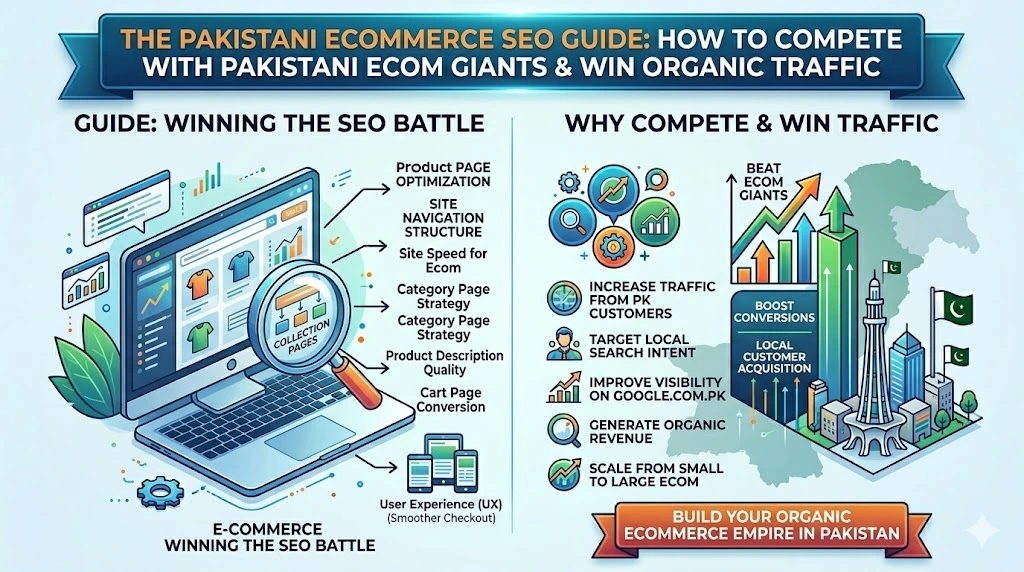
This guide shows exactly how Pakistani online stores optimize product pages, leverage underutilized category pages, fix technical foundations on Shopify and WooCommerce, compete strategically against Daraz for product keywords, and build content assets driving qualified traffic ready to buy. Real tactics, Pakistani market context, no generic international advice, ignoring local competitive realities.
Why Ecommerce SEO Is Different From Regular SEO
Service business SEO and ecommerce SEO operate under fundamentally different rules, challenges, and opportunities. Understanding these distinctions prevents wasting effort on strategies that work for blogs or service sites but fail for online stores.
Scale: Hundreds or Thousands of Pages vs. Dozens
Service businesses have 20-50 pages total: homepage, service pages, about, contact, and 10-20 blog posts. Ecommerce store has 500-5,000+ pages: every product, every category, every filter combination, every brand page. This scale creates both opportunity (more pages = more ranking opportunities) and challenge (optimizing thousands of pages manually is impossible).
Pakistani reality: A local fashion store selling 300 clothing items across 15 categories has 315+ pages minimum before considering size/color variations, creating additional URLs. Each page needs optimization whilst avoiding duplicate content penalties from similar products.
Commercial Intent: Visitors Ready to Buy vs. Researching
Service SEO targets informational searches: “what is digital marketing,” “how to choose an accountant.” Ecommerce targets transactional searches: “buy iPhone 15 Pakistan,” “men’s formal shoes online.” Visitors arrive further down the purchase funnel with higher immediate conversion intent.
Optimization difference: Product pages require different optimization priorities, including pricing visibility, shipping information, trust signals, reviews, and clear CTAs, compared to informational content focusing on comprehensiveness and engagement metrics.
Competition Intensity: Local Businesses vs. National/International Players
Pakistani service businesses compete locally Lahore web designer competes against 20-30 local agencies. Ecommerce competes nationally, internationally, selling electronics means competing against Daraz, iShopping, Telemart, plus international Amazon listings appearing in Pakistani search results.
Strategic implication: Ecommerce SEO requires more sophisticated competitive analysis, stronger technical foundations, and strategic niche positioning because you’re not just competing against neighboring businesses but established national platforms with massive authority and budgets.
Technical Complexity: Simple Sites vs. Dynamic Platforms
The service website is a basic WordPress site with 20 static pages. Ecommerce site is a complex platform, Shopify or WooCommerce, with dynamic product generation, filtering systems, shopping cart functionality, payment processing, and inventory management, all creating technical SEO challenges beyond typical websites.
Understanding broader SEO fundamentals provides a foundation, but ecommerce specifically requires mastering product schema markup, handling out-of-stock items, preventing duplicate content from URL parameters, managing site speed with hundreds of product images, and maintaining crawl efficiency with thousands of pages.
Product Page Optimization: What Pakistani Stores Get Wrong
Product pages are your money pages. They convert visitors into customers when optimized properly. Yet most Pakistani ecommerce stores commit identical mistakes, killing both rankings and conversions.
Mistake 1: Manufacturer Descriptions Copy-Pasted Everywhere
What happens: Store copies the product description directly from the manufacturer or supplier. So do 50 other Pakistani stores sell the same item. Google sees 51 identical descriptions, struggles determining which version deserves ranking, and chooses established marketplace (Daraz) over the independent store with duplicate content.
The fix: Rewrite every product description, uniquely focusing on how Pakistani customers use the item, what problems it solves, and why they should buy from you specifically. 150-300 words minimum, detailed enough to be helpful whilst remaining scannable for mobile shoppers. At Cloudex Marketing, our professional product description writing transforms generic manufacturer copy into unique, conversion-optimized content highlighting benefits relevant to the Pakistani market specifically.
Pakistani example: Instead of “This leather wallet features 6 card slots and premium cowhide construction,” write: “Premium leather wallet fitting Pakistani currency perfectly. 6 card slots for your NADH, bank cards, and business cards. Genuine cowhide withstands daily use in the Pakistani climate without cracking. Fits comfortably in shalwar kameez or jeans pocket.”
Mistake 2: Missing or Generic Title Tags
Common patterns Pakistani stores use:
- “Product 1234” (completely unhelpful)
- “Buy Online” (doesn’t specify what)
- Manufacturer SKU codes (nobody searches these)
- Same template for every product (duplicate titles)
Optimized structure: [Product Name] – [Key Feature] – [Brand] | [Store Name]
Example: “iPhone 15 Pro Max 256GB Natural Titanium – Dual SIM PTA Approved | StoreXYZ”
Why this works: Includes product name (primary keyword), key feature differentiating from variants (storage, color), trust signal (PTA approved, critical for Pakistani electronics), brand name, and store identity. All under 60 characters appear fully in search results.
Mistake 3: No Product Schema Markup
Schema markup is structured data telling Google exactly what information means. This is the price, this is availability, this is the review rating, this is the SKU. Without a schema, Google guesses. With schema, Google knows precisely, enabling rich snippets showing pricing, availability, and reviews directly in search results before users click.
Impact: Products with proper schema markup get rich snippet displays showing star ratings, pricing, and stock status. These visual enhancements increase click-through rates 30-40% compared to plain text listings. You’re competing against Daraz listings with rich snippets; appearing as a plain text listing puts you at an immediate disadvantage.
Implementation: Most ecommerce platforms (Shopify, WooCommerce) offer schema plugins automating this. Enable product schema, including: name, description, SKU, brand, price, currency, availability, review ratings, and images.
Mistake 4: Weak or Missing Product Images
Pakistani pattern: Single product image, low resolution, poor lighting, no lifestyle context showing product in use.
What wins: 5-8 high-quality images minimum: main product shot, detail closeups, different angles, lifestyle images showing product being used, size comparison, packaging (matters for gift items). Pakistani shoppers can’t physically touch products online. Images substitute for in-person examination.
Technical requirement: Optimize image file sizes. Original 3MB photo compressed to 150-200KB without visible quality loss. Slow-loading product images kill both SEO (Google penalizes slow sites) and conversions (impatient shoppers abandon).
Mistake 5: Ignoring Reviews as a Ranking Factor
Reality: Product pages with 10+ reviews rank significantly higher than products with zero reviews, all other factors equal. Reviews provide fresh user-generated content (Google loves fresh content), target long-tail keywords naturally (reviewers use conversational language matching search queries), and signal product quality through social proof.
Strategic approach: Implement review system, incentivize customers leaving reviews (post-purchase email: “Share feedback, get 10% off next order”), respond to every review (engagement signals), display reviews prominently on product pages (conversion optimization).
Category Page SEO: The Most Underused Traffic Asset in Pakistani Ecommerce
Category pages generate more traffic than product pages, yet receive a fraction of optimization attention. This is a massive missed opportunity because category pages target broader, high-volume keywords whilst product pages target specific long-tail searches.
Why Category Pages Matter More Than You Think
Search volume reality: “men’s formal shoes” (category-level) gets 2,000+ monthly searches in Pakistan. “Black Oxford leather shoes size 42” (product-level) gets 20 searches. Category page capturing “men’s formal shoes” delivers 100× traffic potential versus optimizing individual products.
Conversion path: Many shoppers don’t know exactly which specific product they want. They know the category (need formal shoes) but want browsing options before deciding. Category pages serve this browsing intent perfectly, whilst product pages serve the “I know exactly what I want” intent.
Optimizing Category Pages Like Landing Pages, Not Just Product Lists
Mistake most stores make: Category page is just a grid of product thumbnails with pagination. No unique content, no keyword targeting, no value beyond product display.
Optimization strategy:
Top section (300-500 words): Describe the category comprehensively before the products display. “Men’s Formal Shoes in Pakistan – Complete Collection: Browse our selection of formal shoes for Pakistani men, including Oxford shoes, Derby styles, loafers, and brogues. Whether you need shoes for office wear, wedding functions, or formal events, find leather and synthetic options across all sizes with delivery throughout Pakistan.”
Why this works: Provides keyword-rich content that Google indexes whilst helping shoppers understand category scope. Content appears above the product grid, doesn’t push products below the fold.
Filter options as SEO opportunities: Size filters, color filters, brand filters, price range filters. Each generates URLs that can be optimized as separate landing pages targeting specific searches like “formal shoes under PKR 5000” or “black formal shoes Pakistan.”
Bottom section (500-800 words): After products, add buying guide content: “How to Choose Formal Shoes,” “Formal Shoe Care Tips,” “Popular Formal Shoe Styles in Pakistan.” This additional content strengthens category page relevance whilst providing helpful information, improving user experience.
Internal Linking Architecture
Category pages should link to:
- Individual product pages (obvious)
- Related category pages (“You also like: Men’s Casual Shoes, Men’s Sandals”)
- Buying guides or blog content (“Read: Complete Guide to Formal Shoe Sizing”)
Product pages should link back to: Parent category page, related categories, complementary products, creating an interconnected structure, distributing link authority whilst helping Google understand site hierarchy.
Technical SEO Checklist for Shopify and WooCommerce Stores in Pakistan
Platform choice affects technical SEO requirements. Shopify (hosted platform) handles some technical aspects automatically, whilst WooCommerce (self-hosted WordPress plugin) requires more manual configuration. Both need specific optimizations to succeed in the Pakistani market.
Shopify Technical Essentials
Speed optimization is critical on Shopify: The platform is fast inherently, but customizations and apps slow it down. Audit installed apps. Remove unnecessary ones. Optimize images before uploading. Use lazy loading for images below the fold. Minimize custom JavaScript. Shopify website development done properly implements performance best practices from the start, avoiding the need for later optimization to fix slow sites.
URL structure: Shopify forces /products/ and /collections/ in URLs. Can’t be removed. Optimize what you control: use descriptive product handles (slug after /products/), keep them short, include primary keyword.
Mobile optimization: Shopify themes are mobile-responsive, but test thoroughly on actual Pakistani mobile devices and networks. 65% of Pakistani ecommerce traffic comes from mobile. Slow mobile experience kills sales regardless of desktop performance.
WooCommerce Technical Essentials
Hosting matters more: WooCommerce performance depends entirely on hosting quality. Cheap shared hosting (PKR 500/month) can’t handle traffic spikes or large product catalogs. Invest in managed WordPress hosting (PKR 2,500-5,000/month minimum) optimized for WooCommerce specifically.
Plugin bloat control: WooCommerce requires plugins for functionality that Shopify includes natively (payment gateways, shipping, etc.). Every plugin adds code, potentially slowing the site. Use only essential plugins, keep them updated, and remove inactive plugins completely.
Permalink structure: Set WooCommerce permalinks to “/%postname%/” structure in WordPress settings, which creates clean URLs without category slugs or dates cluttering the structure.
Universal Requirements Both Platforms
Mobile-first indexing: Google predominantly uses the mobile version of your site for indexing and ranking. Test mobile usability extensively, including buttons large enough for finger tapping, text readable without zooming, navigation functional on small screens, and checkout process smooth on mobile.
HTTPS mandatory: Running ecommerce site without an SSL certificate in 2026 is business suicide. Payment processors require HTTPS, browsers warn customers, and Google penalizes rankings. If you’re somehow still on HTTP, fix this immediately before anything else.
XML sitemap: Both platforms generate XML sitemaps (Shopify automatically, WooCommerce through plugins like Yoast). Submit to Google Search Console. Verify Google is discovering all products. Large sites sometimes have crawl efficiency issues requiring sitemap optimization, prioritizing important pages.
Out-of-stock product handling: Don’t delete out-of-stock product pages (destroys any ranking they achieved). Mark as out-of-stock, keep page live, show “notify when available” option. If permanently discontinued, 301 redirect to a similar product or a relevant category page.
Structured data implementation: Product schema (discussed earlier) is non-negotiable. Additionally, BreadcrumbList schema (helps Google understand site structure), Organization schema (homepage), and Local Business schema (if you have a physical store).
Site speed for Pakistani networks: Pakistani internet speeds average slower than Western markets. Test on 3G connections, not just fast WiFi. Image compression, code minification, caching, and CDN usage become even more critical than in international markets, assuming fast connectivity.
Our technical SEO implementation provides deeper platform-agnostic fundamentals, but ecommerce specifically requires addressing dynamic content challenges, inventory management impacts on URLs, and checkout process optimization affecting both conversion and technical performance.
How to Rank Against Daraz for Product Keywords
Competing against Daraz seems impossible. They have a domain authority built over 10+ years, a massive product selection, and brand recognition. But strategic positioning enables independent stores to capture meaningful organic traffic even when competing directly for the same keywords.
Niche Positioning vs. Broad Competition
Unwinnable battle: Ranking for “buy shoes online Pakistan” against Daraz, Bata, Servis, plus international sites.
Winnable battle: Ranking for “handmade leather mojari shoes Multan traditional design,” specific enough that Daraz’s generic marketplace approach doesn’t dominate, local enough that you can build targeted authority, and descriptive enough to match exactly what customers searching for niche products actually type.
Strategic principle: Don’t compete on Daraz’s terms (everything for everyone). Compete on your terms (a specific thing for a specific audience, better than a generalist marketplace can serve).
Content Depth Advantage
Daraz product pages: Generic descriptions, basic specs, reviews. Optimized for marketplace efficiency, not deep information.
Your advantage: Write comprehensive product pages including detailed specifications, comparison with similar items, styling suggestions, care instructions, sizing guides, and common questions answered. 500-1,000 words of genuinely helpful content per product beats Daraz’s 150-word generic descriptions on relevance and user satisfaction signals.
Pakistani example: Selling traditional clothing? Don’t just list “lawn suit.” Explain fabric origin, stitching details, styling occasions (formal vs. casual), dupatta matching suggestions, and how to care for delicate embroidery. Information that Pakistani women actively search for but rarely find on marketplace listings.
Local SEO Signals
Physical store advantage: If you have a physical location, leverage local SEO signals that Daraz can’t match for location-specific searches. “Wedding jewelry shop DHA Karachi” will prioritize local businesses over the national marketplace in local pack results.
Local content: Create city-specific landing pages or content: “Best Formal Shoes in Lahore,” “Wedding Shopping Guide Islamabad.” Local relevance beats generic national targeting for geographic searches.
Customer Service and Trust Signals
Reviews and reputation: Can’t compete with Daraz’s volume of reviews initially, but you can compete on review quality and response. Respond personally to every review, showcase detailed testimonials with photos, and highlight repeat customer stories. Small store’s personal touch beats corporate marketplace’s impersonal scale.
Trust signals on product pages: Display security badges, satisfaction guarantees, return policy prominently, and customer service contact information visibly. Independent stores must work harder to establish trust versus a known marketplace brand.
Backlink Strategy Targeting Product Relevance
Reality: You won’t get backlinks matching Daraz’s authority domain-wide. But you can acquire targeted backlinks around specific product niches from blogs, forums, and niche communities where Daraz’s broad marketplace presence is less relevant.
Example: Selling gym equipment? Get featured on Pakistani fitness blogs, trainer directories, and health forums discussing specific equipment. These niche-relevant backlinks boost your authority for fitness equipment keywords specifically, whilst Daraz’s marketplace authority is spread across thousands of categories.
Working with our experienced SEO agency in Pakistan helps identify realistic competitive opportunities and niche positioning strategies where your store can win, rather than banging its head against impossible generic keyword battles with established marketplaces dominating through pure authority accumulation.
Content Strategy for Ecommerce: Buying Guides, Comparisons, and FAQs
Product and category pages alone won’t capture all potential ecommerce traffic. Informational content targeting the earlier research stage brings customers into your ecosystem before they’re ready to buy, building awareness and trust that converts when purchase intent solidifies.
Buying Guides Targeting Problem-Aware Customers
What they are: Comprehensive guides helping customers understand the product category before choosing a specific item. “How to Choose Running Shoes,” “Complete Guide to Buying a Laptop in Pakistan,” “Wedding Jewelry Selection Guide.”
Why they work: Capture searches from people researching the category before brand/product decisions are made. These visitors aren’t ready to buy immediately, but will remember your helpful content when purchase time arrives.
Structure: Problem identification, factors to consider, product type explanations, brand comparisons, budget guidance, and where to buy (naturally mentioning your store). 2,000-3,000 words comprehensive guides targeting keyword variations: “how to choose,” “buying guide,” “what to look for,” etc.
Product Comparison Content
Head-to-head comparisons: “iPhone 15 vs Samsung S24 Pakistan Comparison,” “Nike vs Adidas Running Shoes,” “Leather vs Fabric Sofas.” These target customers were narrowed down to 2-3 options, making the final decision.
Strategic advantage: Create comparison pages even if you only sell one of the compared items. Customer researching “iPhone vs Samsung” arrives, reads comparison, converts on whichever you stock. You’ve captured search traffic that wouldn’t have found you searching individual product names.
Format: Side-by-side specifications table, pros/cons for each, specific use case recommendations, pricing comparison, links to both products on your store (or just the one you sell with a clear note about availability).
FAQ Content as Long-Tail Traffic Driver
Individual FAQ pages: Don’t just add FAQs to product pages. Create dedicated pages answering common customer questions. “Can You Exchange Shoes After Wearing Them Once?” “How Long Does Delivery Take to Karachi?” “What Payment Methods Do Pakistani Online Stores Accept?”
Why this works: People search these exact questions. Dedicated pages targeting question keywords rank for conversational long-tail searches, whilst FAQ sections on product pages don’t.
Implementation: 10-20 common questions across your product categories, 300-500-word answers each, internal links to relevant product pages within answers. These pages won’t generate huge traffic individually, but collectively drive hundreds of qualified visitors monthly.
Size Guides and Specification Charts
Undervalued content type: Comprehensive size guides and specification comparison charts serve dual purposes, helping customers make informed decisions (reducing returns) whilst targeting informational searches around sizing (“shirt size chart Pakistan,” “laptop specification guide”).
Create comprehensive resources: Universal size chart for your category, how-to-measure instructions, brand-specific sizing variations (Nike runs small vs Adidas true to size), conversion between international standards (US vs UK vs EU sizing). Make it genuinely the best resource customers bookmark and share.
Link building opportunity: Comprehensive guides and tools (interactive size calculators, comparison tools) naturally earn backlinks when they’re genuinely helpful resources others reference. These backlinks boost the entire domain authority, whilst focused content relevance improves specific product/category rankings.
At Cloudex Marketing, our professional SEO services in Pakistan help ecommerce businesses develop comprehensive content strategies, balancing immediate conversion optimization with long-term traffic building through informational content targeting various customer journey stages systematically.
Conclusion
So, organic SEO is the long-term ecommerce moat!
Pakistani ecommerce succeeds long-term by owning customer relationships, controlling acquisition costs, and building recurring revenue from repeat customers. Goals marketplace dependence actively undermines. Daraz commissions, advertising fees, and platform policies extracting 20-40% of revenue prevent sustainable profitability for most sellers, whilst the marketplace controls customer data and relationships.
Organic SEO flips this dynamic. Initial 6-9 month investment optimizing product pages, category pages, technical foundation, and content strategy begins generating traffic without ongoing advertising costs, enabling sustainable margins and customer relationship ownership. Each sale builds an email list for remarketing. Each satisfied customer leaves reviews, improving future rankings. Compound effects accelerate as authority grows.
The stores dominating Pakistani ecommerce in 2026 aren’t necessarily those with the largest budgets. They’re those who built organic visibility systematically, whilst competitors remained dependent on paid channels with linear cost structures that never improved. Start implementing these fundamentals today. Product page optimization takes 2-3 weeks. Category page content rollout happens over 4-6 weeks. Technical fixes will be complete within a month. Content strategy builds month-by-month indefinitely, compounding returns continuously.
Running an online store and want to escape dependence on marketplace commissions? See how partnering with us can grow your ecommerce traffic for your Pakistani store through systematic SEO implementation targeting product keywords, category optimization, and strategic content building, achieving sustainable organic visibility and competing effectively against established marketplaces.
Working with our SEO company in Pakistan, specializing in SEO, helps accelerate implementation whilst avoiding costly mistakes that waste months on ineffective tactics, getting you to profitability faster, whilst maximizing return on optimization investment.