

Everyone’s obsessed with Generative Engine Optimization. “How do I get cited by ChatGPT?” “How do I rank in AI Overviews?” “Should I abandon traditional SEO for AI search?” These questions dominate marketing conversations in 2026.
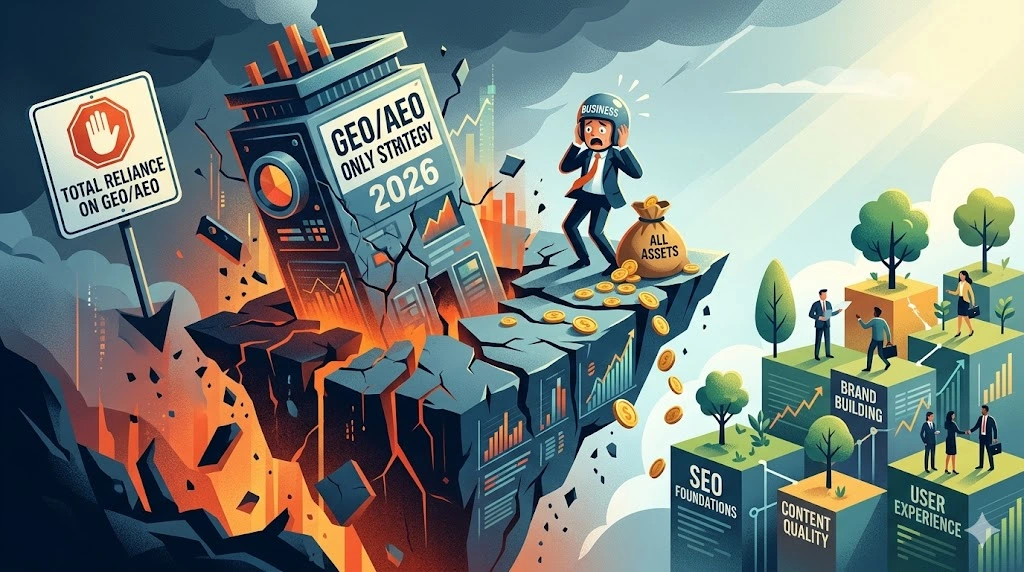
The answer: No. Going all-in on GEO/AEO while abandoning traditional SEO is a catastrophic mistake. Most businesses making this bet will regret it by 2027.
Here’s why, and what you should actually do instead.
The Reality Check: Google Still Dominates
ChatGPT has 700+ million weekly users. That sounds massive until you realize Google handles 8.5 billion searches daily. Google owns 83% of the desktop search market share and 95% of mobile. AI search engines combined hold maybe 10-15% of total search volume.
When businesses see AI gaining traction, they panic. They assume traditional search is dying. It isn’t. It’s transforming, but it’s far from dead.
Most customers still start searches on Google. They use AI for follow-up questions or specific use cases. Google remains the dominant discovery channel by an enormous margin.
Betting your entire strategy on the smaller platform while ignoring the dominant one is betting your business on a trend—not on where customers actually search.
Search Fragmentation Means You Need Multiple Strategies
Search isn’t one channel anymore. It’s many channels.
Customers discover information on:
- Google (traditional search)
- Google AI Overviews
- ChatGPT and Gemini
- Perplexity and other AI engines
- Reddit (people explicitly search Reddit for authentic reviews)
- YouTube (video search)
- TikTok (younger audiences search here)
- Instagram and Pinterest (visual search)
- Industry forums and communities
A business focusing only on ChatGPT visibility is invisible on Reddit, YouTube, and Google. Where most of your actual customers search.
A comprehensive search strategy means being visible across all these channels. This requires traditional SEO fundamentals applied differently per platform. You can’t do this by abandoning traditional SEO.
Our SEO company in Pakistan will manage your visibility across all channels, not just AI engines.
Not Every Audience Uses AI Search
Demographic diversity matters. People 65 and older rarely use ChatGPT. Gen Z uses it heavily. Middle-aged professionals use it differently from young professionals. Different income levels, genders, and geographic regions have vastly different AI adoption rates.
Your customer base probably includes people across these demographics. If you optimize only for AI search, you’re actively invisible to a portion of your paying customers.
The business owner who’s 55 years old searches Google, not ChatGPT. The financial advisor searching for compliance information uses Google. The small business owner in rural areas might not have ChatGPT as their primary search tool.
Abandoning traditional SEO means abandoning these customers to your competitors.
AI Search is Top-of-Funnel Only (Mostly)
When customers use ChatGPT, they’re asking early-stage questions.
- “What is email marketing?”
- “How do I fix my website?”
- “What’s the best CRM for small businesses?”
These are awareness-stage questions. Early in the buyer’s journey. AI is excellent at answering these.
But when customers are ready to buy, they search differently. They search “best email marketing software for nonprofits under $100/month” or “CRM software with SMS integration.” They want comparisons. They want to see actual products. They want reviews.
These bottom-of-funnel searches happen mostly on Google. AI engines provide some BOFU results, but the bulk of purchase-intent traffic comes from traditional search.
If you focus only on GEO/AEO, you get awareness-stage traffic. You miss the customers actually ready to buy. That’s a recipe for vanity metrics and zero revenue.
Our SEO services in Pakistan target all funnel stages for your business, not just for awareness.
Attribution is Still Impossibly Messy
You can’t measure what you can’t track. Traditional SEO has clear attribution. A customer searches “product X,” clicks your result, fills out a form, and becomes a lead. You trace the customer journey. You measure ROI.
AI search attribution is a mess. You can track whether AI mentioned you (using specialized tools). But you can’t easily track:
- Whether the mention directly drove a conversion
- Which specific pages did AI pull information from
- Whether AI cited you because of something you published or because you already had authority
- Whether the mention generated qualified leads or just citations
Without clear attribution, you can’t measure ROI. You can’t justify budget allocation. You can’t prove whether your GEO strategy actually generated business value or just citations.
Imagine reporting to your CEO: “We got mentioned by ChatGPT 500 times this month, but we have no idea if that drove any revenue.” That’s the reality of pure GEO strategy.
The Messy Middle: What Hybrid Strategy Actually Looks Like
Smart businesses in 2026 are doing both, not either/or.
They maintain strong traditional SEO:
- Optimizing for Google rankings
- Building topical authority
- Generating organic traffic to their website
- Building email lists and customer relationships
While simultaneously building AI visibility:
- Earning citations in AI Overviews
- Appearing in ChatGPT recommendations
- Building brand authority that AI respects
- Creating content, AI actually wants to cite
The businesses winning are the ones managing visibility across all channels while measuring what actually matters: customer acquisition cost, revenue per customer, and lifetime value.
This requires both traditional SEO expertise and an AI visibility strategy. You can’t abandon one for the other.
The Practical Reality for Your Business
Here’s what should actually happen in 2026:
Step 1: Maintain your traditional SEO foundation. Google still drives the most qualified traffic. Ranking well on Google is non-negotiable.
Step 2: Build a complementary AI visibility strategy. Get cited in AI Overviews. Appear in ChatGPT recommendations. Build authority platforms like YouTube, Reddit, and LinkedIn where AI models pull information.
Step 3: Measure both. Track Google rankings AND AI citations. Track traditional SEO traffic AND awareness generated through AI mentions. Measure what actually converts to revenue.
Step 4: Adjust based on data. If traditional SEO drives most conversions, weight your strategy there. If AI citations generate awareness that converts later, invest there. Let data decide, not trends.
Our SEO agency in Pakistan will provide a strategy across both channels, not choose one at the expense of the other.
Conclusion
GEO/AEO is important. It’s not important enough to abandon traditional SEO.
The businesses betting everything on AI search in 2026 are making the same mistake they made optimizing only for featured snippets, or only for voice search, or only for mobile. They’re chasing one channel and ignoring the larger ecosystem.
A comprehensive search strategy means competing across all channels. Google, AI engines, social platforms, Reddit, YouTube, wherever customers search, you need visibility.
This requires more effort than betting everything on one channel. But it also generates more revenue, more qualified leads, and more resilience when one platform inevitably changes.
Cloudex Marketing builds omnichannel search visibility. Our SEO team in Pakistan will manage and strengthen your visibility across traditional search, AI, social, and community platforms.
We measure what matters: revenue impact.
If you’re currently betting only on one channel, you’re leaving money on the table. Your competitors optimizing across channels will outsell you.
That’s not a prediction. That’s what’s already happening.