
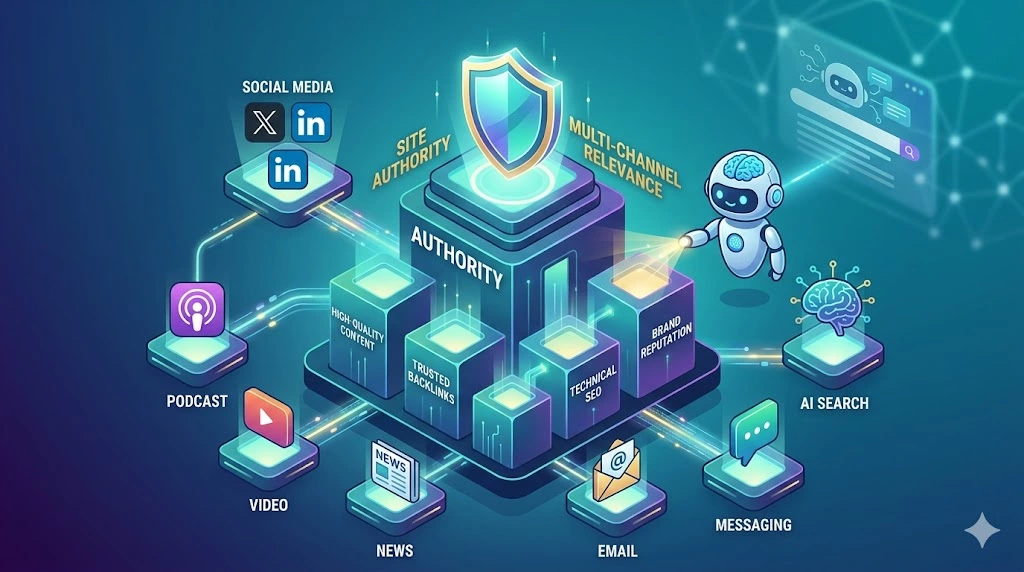
Building authority used to mean earning backlinks from high-domain-authority sites. Today, that’s insufficient. AI search platforms evaluate brands not just through links but through entities, content quality, multi-channel presence, and audience relationships spanning Google, ChatGPT, Reddit, LinkedIn, and YouTube simultaneously.
Businesses optimizing exclusively for Google’s algorithm, whilst ignoring authority signals across emerging platforms, are ceding market share to competitors building pervasive visibility wherever customers research, discuss, and decide.
The shift is substantial. Traditional SEO campaigns, including publishing blog posts, pitching journalists, and earning backlinks, no longer capture the full authority opportunity. Modern authority-building requires mastering E-E-A-T (Experience, Expertise, Authoritativeness, Trustworthiness), optimizing for entity recognition across knowledge graphs, distributing content across multiple channels where audiences naturally congregate, and building direct customer relationships independent of search engine traffic.
This comprehensive approach to authority addresses the fundamental truth of the 2026 search: AI Overviews reduce clicks 49-65%, social platforms become primary discovery channels for younger audiences, and LLMs cite third-party sources 85% more than brand websites. Authority is no longer a singular metric. It’s distributed across platforms, verified through multiple signals, and measured through audience trust rather than domain metrics alone.
Strategy 1: Master E-E-A-T for AI-Era Authority
Google’s helpful content system and LLM training prioritize content backed by genuine human expertise over AI-generated sameness. Anyone is able to prompt ChatGPT to generate serviceable content. Brands distinguishing themselves prove real experience, demonstrated expertise, and verifiable trustworthiness through concrete evidence.
Original Research as Authority Signal
Publishing unique research, such as surveys, data studies, and case studies, creates content that LLMs and journalists do not generate internally. This original information becomes citable source material, earning third-party mentions, mainstream media coverage, and LLM citations simultaneously.
Example: Instead of writing a generic “Digital Marketing Trends 2026” article summarizing competitor insights, conduct an original survey of 500 Pakistani businesses asking how they allocate marketing budgets. Publish findings revealing Pakistani SMBs increase SEO spending 40% annually, but only 23% achieve measurable ROI. This original data becomes the source journalists reference, LLMs cite when answering budget questions, and competitors do not replicate without conducting their own research.
Expert Authorship and Verification
Content authored by credentialed experts carries more authority than generic company bylines. Link author bios to professional profiles (LinkedIn), credentials (ORCID IDs for academics), and previous publications demonstrating a track record.
Format: Instead of “Written by Marketing Team,” use “Written by [Name], Senior SEO Strategist with 12+ years of experience implementing technical SEO for 200+ Pakistani businesses. View professional profile [LinkedIn URL].” This verification signals genuine expertise versus AI-generated content attributed to nobody.
Primary Source Citation
Build content citing original authoritative sources rather than summarizing blog posts. Link directly to academic research, government data, industry reports, and original studies. This citation pattern signals research rigor and helps knowledge graphs understand your content’s factual grounding.
Example: Instead of “Studies show mobile users bounce 40% faster from slow sites,” cite: “Google’s 2023 research shows one-second load delay reduces mobile conversions by 7%.” Include a direct link to Google’s study. This primary sourcing builds authority whilst giving search engines a clearer context.
Strategy 2: Optimize for Entities and Knowledge Graphs
AI models and search engines no longer evaluate content purely through keywords. They understand entities (people, places, brands, concepts) and relationships between entities. Optimizing for entities means explicitly telling search systems what your content discusses and how it connects to broader knowledge graphs.
Implement Comprehensive Schema Markup
JSON-LD structured data provides machine-readable information about content. Beyond basic article schema, implement:
- Organization schema: Your company details, leadership, locations, and contact information
- Person schema: Author credentials, expertise areas, professional history
- Product schema: For e-commerce, detailed product information with pricing, reviews, and specifications
- Article schema: Content type, publish date, author, keywords, featured image
- LocalBusiness schema: For Pakistani businesses, location-specific information for local SEO
This structured data doesn’t directly affect rankings but helps search engines and LLMs understand content accuracy and relevance, whilst improving featured snippet eligibility and rich result appearances.
Build Entity Associations Through Third-Party Mentions
Get mentioned on reputable third-party sites, industry wikis, and authoritative directories, building your brand’s entity profile across knowledge graphs. Examples: Pakistan business directories, industry association listings, Wikipedia mentions (for notable brands), and industry-specific databases.
When multiple authoritative sources mention your brand in a consistent context (as “leading digital marketing agency Pakistan” across multiple sites), Google and AI systems recognize this as entity verification. Your brand profile strengthens across knowledge graphs, improving visibility for entity-related queries.
Create Concept Hierarchies Through Content Clusters
Topic clusters, or pillar pages supported by thematic cluster content, signal comprehensive topical authority to knowledge graphs. Structure content showing clear conceptual relationships:
Pillar page: “Complete Guide to Technical SEO” (5,000+ words covering all aspects) Cluster articles: “Core Web Vitals Optimization,” “XML Sitemap Best Practices,” “Mobile Crawlability Issues,” “HTTPS Implementation” (each 1,500-2,000 words, linked from pillar)
This cluster structure tells search systems you comprehensively understand technical SEO from every angle, strengthening entity recognition and topical authority signals.
Our SEO agency in Pakistan uses entity optimization and structured data implementation as foundational elements of authority-building strategies, ensuring search engines and AI systems recognize and cite your expertise accurately.
Strategy 3: Diversify Multi-Channel Relevance
Authority in 2026 isn’t concentrated on Google. It’s distributed across platforms where your audience actively researches, discusses, and decides. Brands invisible on Reddit, LinkedIn, and YouTube, whilst focusing exclusively on Google rankings, miss 60-70% of potential authority-building opportunities.
Optimize for AI Search Platforms Specifically
ChatGPT, Gemini, and Perplexity have different citation patterns and retrieval mechanisms than Google. Optimize explicitly for these platforms:
Structure for clarity: Use short declarative sentences, bullet points, and numbered lists. LLMs struggle with parsing dense paragraphs and prefer scannable content.
Answer directly: When targeting comparison prompts (“Brand A vs Brand B”), position your product/service early with specific differentiation. Don’t bury positioning in wall-of-text paragraphs.
Use definitive language: “We are the leading [category] for [specific use case]” appears in LLM citations more reliably than hedged language (“We believe,” “We think,” “Some people say”).
Repurpose Content Across Formats
A single blog post has limited reach. Transform into multiple formats, reaching different platforms and audiences:
Written content: Blog post, Medium article, LinkedIn article, email series
Video: YouTube long-form, short-form clips (TikTok, Instagram Reels, YouTube Shorts)
Audio: Podcast episode featuring key insights
Visual: Infographics, social graphics, slide decks
Interactive: Webinar, calculator tool, interactive guide
Same core information distributed across formats reaches audiences preferring different consumption methods, whilst saturation with consistent messaging helps LLMs recognize and cite your brand across multiple sources.
Build Community Presence on Niche Platforms
Reddit, Quora, Discord communities, and specialized forums host engaged audiences actively seeking advice. Presence on relevant communities builds authority through peer recommendations and direct audience relationships.
Example: For a Pakistani digital marketing agency, active participation in r/pakistan (answering digital marketing questions), r/marketing (contributing insights), and Quora (answering SEO questions) builds authority through demonstrated expertise and community trust. LLMs frequently cite Reddit discussions and Quora answers, making community presence directly relevant to AI visibility.
Our professional SEO services in Pakistan incorporate multi-channel authority-building, recognizing that modern visibility requires presence across platforms where target audiences naturally congregate.
Strategy 4: Build Zero-Party Data and Audience Ownership
As AI-driven search reduces click-through rates, relying on search engine traffic creates vulnerability. Brands building direct customer relationships through owned channels, including email lists, membership areas, and direct apps, maintain revenue independence from search algorithm shifts.
Develop Email and SMS Subscriber Base
Gated content (free resources requiring email signup) builds an owned audience whilst collecting zero-party data (information customers willingly provide). Examples: industry reports, SEO checklists, templates, exclusive guides, and email courses.
Each email subscriber represents a direct communication channel independent of search engines. When LLM visibility declines or social algorithms change, email remains a reliable traffic source, driving repeat visits and conversions.
Create Interactive Tools and Membership Experiences
Web apps, calculators, membership areas, and interactive guides encourage repeat direct visits, building traffic independent of search. Examples: SEO audit tools, cost calculators, membership portals with exclusive resources.
These owned experiences serve a dual purpose: direct revenue generation through membership fees or premium features, plus zero-party data collection to understand customer needs, pain points, and behavior patterns.
Build Direct Customer Relationships
Newsletter programs, community forums, customer success programs, and loyalty initiatives create repeat direct traffic and genuine audience relationships. Customers following your newsletter or joining community become repeat visitors and word-of-mouth advocates regardless of search visibility.
When customers actively follow your newsletter or community, they cite you to peers, mention you on social platforms, and represent you in third-party discussions. All strengthening authority signals beyond traditional SEO metrics.
Executing Integrated Authority Strategy
Authority-building requires technical SEO services ensuring on-site foundation supports off-site efforts, alongside off-page SEO services building third-party citations and authority signals. Technology alone fails without content quality; content quality fails without technical infrastructure and strategic distribution.
An integrated approach means:
- Technical foundation enabling search engines and AI to crawl, understand, and rank content
- Content quality demonstrating genuine expertise and original insights
- Multi-channel distribution reaching audiences across platforms
- Direct audience relationships build traffic independent of search
Conclusion
Building authority in 2026 requires abandoning a singular focus on Google rankings. Modern authority is distributed across search engines, AI platforms, social communities, and direct customer relationships. Brands mastering E-E-A-T through original research and expert authorship, optimizing for entity recognition through schema and knowledge graphs, diversifying presence across platforms, and building zero-party data relationships will dominate search and discovery.
The competitive advantage isn’t in finding a single perfect strategy. It’s in systematic integration across all four dimensions simultaneously. This requires investment, patience, and coordination across teams. But brands adapting early capture market share from competitors, still optimizing for 2015 search, whilst the authority landscape fundamentally transforms.
Ready to build an integrated authority strategy dominating search, AI platforms, and community conversations simultaneously? Our team at Cloudex Marketing combines technical SEO services, ensuring search-engine optimization foundation, with off-page SEO services building third-party authority and multi-platform presence, creating distributed authority across all channels where Pakistani businesses capture customers in 2026’s fragmented search landscape.