


Your team publishes consistent blogs. Rankings improve. Traffic climbs. Leads stay flat. This is the uncomfortable reality most businesses face in 2026. SEO content that should generate growth simply doesn’t.
The problem isn’t the work. It’s that the work being done was already obsolete when it started.
For years, SEO operated on a simple formula:
- Find Keywords
- Create Content
- Optimize Pages
- Build Links
- Track Rankings.
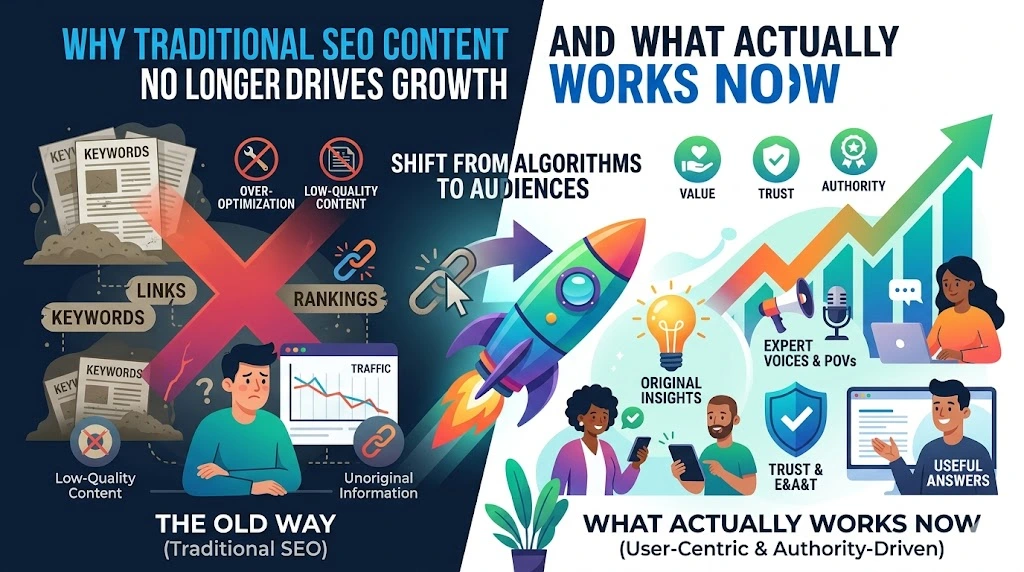
That process still matters. But it’s no longer enough to drive sustainable business growth. AI Overviews, entity-based search, and shifting user behavior have fundamentally changed what drives results. Businesses continuing to treat traditional SEO tactics as their growth strategy are competing with their hands tied behind their backs.
What Actually Changed in SEO
Google’s search ecosystem has transformed. The ten blue link list no longer exists. AI Overviews answer informational queries directly in search results, absorbing clicks that once flowed to websites. Conversational AI assistants (ChatGPT, Gemini, Perplexity) now mediate how users discover information. Entity-based understanding determines rankings more than keyword matching. Knowledge Panels, featured snippets, and synthesized answers replaced traditional rankings as the visible real estate.
This shift happened gradually over 18 months, which is why most businesses haven’t adjusted. The old tactics still produce some results, creating dangerous false confidence. Teams remain busy producing content that barely moves the needle. They publish more pages, wondering why growth stagnates. They’re executing 2022’s playbook in 2026’s search environment.
The uncomfortable truth: keyword research spreadsheets, high-volume content production, and on-page optimization are now table stakes, not competitive advantages. They’re the foundation. The work that actually drives growth happens above the foundation, and most teams aren’t doing it.
The Three SEO Activities No Longer Worth Your Time
1 – Standalone keyword research as a deliverable
Producing 200-keyword lists with search volumes and difficulty scores was billable work. That data is increasingly unreliable. AI Overviews absorb top-of-funnel informational searches. Difficulty scores never accounted for SERP feature crowding. The keywords that convert hide in long-tail territory; no tool surfaces accurately. Strategic keyword thinking still matters. Keyword spreadsheets don’t.
2 – High-volume content production
The old model was simple: find gaps, brief content, publish frequently, watch traffic grow. That model broke in two places simultaneously. AI Overviews eat informational queries, those articles targeted. AI-generated content costs nearly zero, meaning producing more generic content doesn’t differentiate you. If your content could have been generated by anyone using the same prompt, ranking for it is increasingly difficult and increasingly worthless.
3 – On-page optimization is a standalone work
Adding internal links, tweaking title tags, optimizing headers. All still matter.
But they’re the floor, not the strategy. Doing them well gets you a fair chance of being judged on merit. It doesn’t, alone, get you ranking. Teams spending 40% of their week on on-page work while ignoring strategic activities are doing necessary work and skipping what drives growth.
What Actually Drives Growth Now
Entity and brand building
Google increasingly understands who your business is, what it specializes in, and whether it’s trusted. If your brand isn’t recognized as an entity in your space, you compete with disadvantages regardless of content quality. This requires consistent branding across the web, strong Google Business Profile optimization, press mentions, reviews, industry citations, LinkedIn visibility, and expert-led content. Most teams have nobody owning this systematically.
Original research and proprietary data
If you publish insights competitors can’t copy and AI can’t synthesize, you have defensible differentiation. For larger teams, this means scoping and publishing original research that journalists will pick up. For smaller businesses, it means extracting genuine expertise from your experience and turning it into publishable content. Most agencies don’t sell this. Most small businesses don’t have anyone doing it.
Distribution and PR-adjacent work
The assumption that good content earns links naturally was never quite true. It’s certainly not true now. Someone needs to actively put your content in front of the right people. For larger teams, this is a hybrid of SEO judgment and PR craft. For smaller businesses, it’s relationship building and ensuring good work reaches intended audiences. Most teams don’t have anyone owning this.
AI search visibility
How your brand shows up in AI Overviews, ChatGPT, Perplexity, and Claude is now measurable and optimizable. This doesn’t correlate with traditional rankings. Winning here requires strong entity signals, genuine expertise visible across the web, and someone tracking whether it shows up where it needs to. Most businesses don’t ask the question at all.
Analytical depth
Anyone can pull Search Console exports. What has scarcity value is interpreting messy data when AI Overviews distort traffic signals, branded search inflates from LLM exposure, and attribution fragments monthly. Someone needs to understand the gap between analytics and commercial reality, then act on what that gap reveals.
The Uncomfortable Reframe
Your team probably doesn’t need to be bigger. It needs to be differently shaped. A senior strategist thinking entity-first is worth two mid-level content producers churning out briefs. A part-time research relationship is worth a third copywriter.
Reallocating from production to strategy and distribution is a harder internal sell than asking for headcount. But it’s what actually works.
Reporting will get harder before it gets easier. As you shift weight onto entity work, original research, and AI visibility, the lag between effort and measurable outcome stretches. Be honest with leadership about this upfront. A six-month strategy explained in advance is easier to defend than one explained retrospectively when traffic dips temporarily.
Where Most Teams Fail
Most in-house teams and agencies still allocate resources this way:
- 60-70% content production
- 20% on-page optimization
- 10% technical SEO
- 0-5% on strategy, entity building, distribution, and AI visibility
This ratio needs to flip. Not overnight. Not at the expense of fundamentals. But the direction of travel is clear: the teams that adjust skill stacks now, before everyone else realizes necessity, position themselves for the next two years of competitive advantage.
What to Do Now?
Audit your last three months. What percentage of hours went to content production versus strategic activities? For most teams, the answer is uncomfortable. 80% still goes to production, with strategy getting scraps.
Stop producing more low-quality content. Reduce volume. Increase depth and originality.
Assign someone to entity and brand building. Make it their job, not something they do between other tasks.
Track conversions and leads, not just traffic and rankings. Realize that 10,000 irrelevant monthly visits mean nothing.
Build partnerships or hire for distribution. Get serious about PR and relationship building.
Implement AI visibility tracking. Start asking whether your business appears in AI-generated answers.
SEO hasn’t died. The job of SEO has fundamentally changed. Businesses adapting early will be the ones still growing when the next platform changes land.
FAQs
Is SEO still worth it in 2026?
Yes, but traditional optimization alone isn’t enough. Combine technical SEO with authority building, original expertise, AI visibility, and strong brand signals.
Why does my SEO content not drive leads?
Because it focuses on traffic instead of conversion intent. Target high-intent keywords, add clear CTAs, include social proof, and track leads, not just rankings.
Should I publish more blog content?
No. Publish less, but publish better. Depth and originality matter more than volume. One excellent original research piece beats 20 generic blog posts.
What’s the biggest SEO mistake businesses make?
Treating SEO as a standalone channel instead of part of a broader visibility strategy combining entity building, PR, brand authority, and original expertise.
How do I know if my SEO strategy is working?
Don’t measure traffic. Measure leads, conversions, and customer acquisition cost. If traffic grows but conversions don’t, your strategy is broken regardless of rankings.
At Cloudex Marketing, our professional SEO services focus on authority building, original research, AI visibility, and conversion optimization rather than keyword rankings and content volume. We help businesses shift from outdated production-focused SEO to strategy-driven growth.