


AI isn’t replacing SEO. It’s accelerating it. Modern SEO professionals using AI for keyword research, content planning, and optimization complete work in hours that traditionally took days, whilst maintaining quality human judgment guiding strategic decisions. Yet most businesses either ignore AI entirely or over-rely on it, generating mediocre content nobody reads.
The distinction separating successful AI-powered SEO from failure is simple: use AI to handle research, drafting, and data analysis, whilst keeping humans responsible for strategy, accuracy, and brand voice.
This hybrid approach, AI speed + human judgment, is how forward-looking teams stay competitive in 2026’s fragmented search landscape, where traditional SEO alone is insufficient.
What Is AI SEO?
AI SEO means using machine learning tools like ChatGPT, Gemini, and specialized SEO platforms to streamline and improve SEO workflows. Rather than manually researching keywords for hours, analyzing competitor content line-by-line, or drafting from scratch, AI handles repetitive tasks in seconds, surfacing trends, opportunities, and optimization recommendations humans might miss.
AI transforms four core SEO areas:
- Task automation: Keyword research, meta tag generation, sitemap creation, content audits
- Data analysis: Finding patterns across thousands of rankings, identifying opportunities, and predicting outcomes
- Content optimization: Evaluating content against competitors, suggesting improvements, and identifying gaps
- Predictive insights: Forecasting ranking potential, estimating traffic, recommending strategies
The critical distinction: AI provides evidence-based recommendations drawn from millions of data points. But AI hallucinates, generates generic content, and lacks judgment about brand voice, audience context, and strategic decisions. Human expertise remains essential—AI accelerates execution, not strategy.
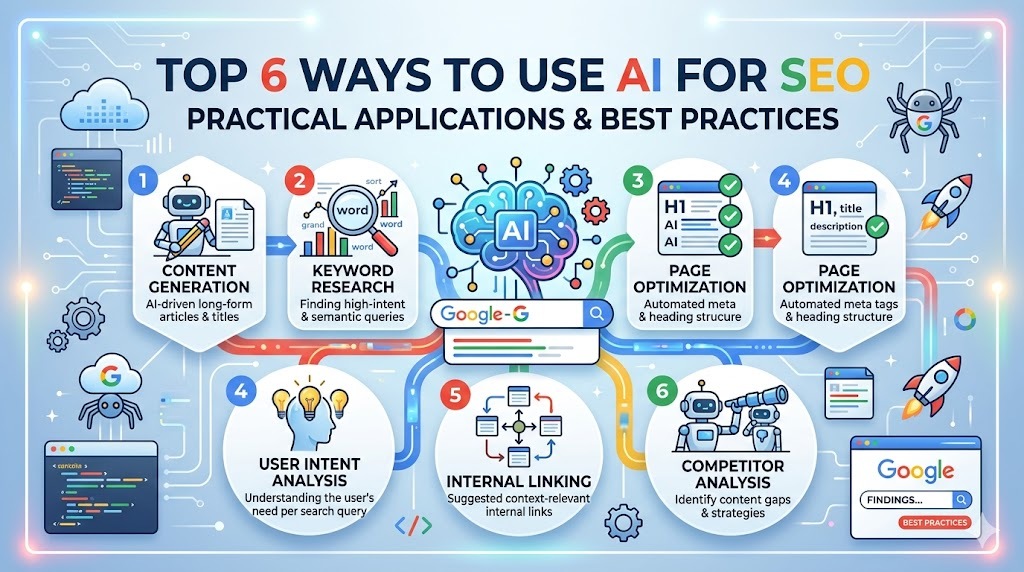
6 High-Impact AI SEO Applications
1. Brainstorm Content Ideas and Angles
AI generates dozens of topic ideas instantly, tailored to your audience, products, and business goals. The more context you provide, the better the output.
Prompt template:
“Act as an SEO strategist for a [B2B/B2C] company selling [product/service]. Generate 10 blog post ideas targeting [target audience], focusing on [awareness/consideration/decision] stage topics. Format as [listicle/comparison/how-to].“
Key limitation: AI lacks real search data, so it can’t tell you topic demand, competition level, or traffic potential. Always validate ideas using keyword research tools before committing to content calendars.
2. Conduct Keyword Research and Validation
AI quickly generates keyword ideas pointing you in the right direction. Use this output as a starting point, then validate with dedicated tools capturing real search volume and competition data.
Sample Prompt:
“Act as an SEO specialist. Generate 20 long-tail keywords that [target audience] searches when evaluating [product/service]. Focus on question-based and purchase-intent terms with a mix of informational and transactional keywords.“
Validation tools:
- Google’s People Also Ask boxes (real questions Google surfaces)
- Google Search Console with regex filtering (exact queries bringing traffic)
- Dedicated keyword tools like Semrush’s Keyword Overview provide personal keyword difficulty metrics.
3. Plan Topic Clusters and Content Architecture
AI groups related keywords into logical topic clusters, showing a pillar page (broad overview) and cluster pages (specific subtopics). This structure helps search engines understand topical authority.
Prompt template:
“Act as an SEO strategist. Based on this keyword list, create one topic cluster with one pillar page targeting a broad keyword and 5-7 cluster pages targeting specific long-tail variations: [keyword list].“
Review output for overlaps, missing subtopics, or pages too broad/narrow before implementing. AI is excellent at pattern recognition, but can’t validate whether the structure matches the actual search demand.
4. Analyze SERPs and Identify Content Gaps
AI reviews top-ranking pages showing what they cover, what’s missing, and what angle would differentiate your content. This accelerates competitive research from hours to minutes.
Prompt template:
“Act as an SEO strategist. Search for [keyword] and analyze the top 5 ranking pages. For each, summarize the main topics, format, and intent. Identify common gaps, content depth, visual usage, and structure. Suggest the strongest angle for the new article, filling those gaps.“
Pro tip:
Always open ranking pages yourself, confirming AI’s analysis. Automated analysis can miss nuances, misread intent, or overlook ranking-specific details.
5. Generate Titles, Meta Descriptions, and FAQs
AI produces multiple titles and meta descriptions instantly optimized for click-through rates and keyword inclusion.
| Element | Best Practices |
| Title Tags | Under 60 characters, include primary keyword, spark curiosity, or highlight benefit, match search intent |
| Meta Descriptions | 105-160 characters, include keyword, describe content clearly, encourage clicks through benefit or hook |
| FAQs | Source from real questions (People Also Ask, GSC, Keyword Tool), concise 2-3 sentence answers, use FAQ schema markup |
AI generates options quickly. You pick the strongest. Always preview in Google SERP Simulator, seeing how they display before publishing.
6. Optimize Content for AI Search Visibility
AI reviews content, identifying whether it’s structured for AI system extraction. Clear headings, concise self-contained answers, E-E-A-T signals, and passage-level relevance improve AI citations’ likelihood.
Optimization focuses:
- Structure: Clear headings, concise answers, and FAQ schema markup help AI identify sections
- E-E-A-T signals: Author credentials, cited sources, firsthand examples, transparent methodology
- Passage-level relevance: Each section contains a self-contained answer to a specific question (AI extracts passages, not whole pages)
Track results using the AI Visibility Toolkit by monitoring mentions, citations, and LLM distribution over time.
Best Practices vs. Common Pitfalls
| Common Challenge | Best Practice Solution |
| Over-reliance on automation | Use AI for research and drafts only; keep humans responsible for strategy and final quality check |
| Hallucination and false facts | Always validate statistics, claims, and recommendations against authoritative sources before publishing |
| Generic repetitive output | Maintain brand voice through prompts, authentic examples, and original insights AI can’t replicate |
| Inconsistent quality | Build documented repeatable workflows (prompt templates for keyword research, outlines, refreshes) |
| Missing strategic judgment | Use AI to generate options; humans decide angle, tone, and whether content serves business goals |
Critical principle: AI excels at volume and options. Humans excel at judgment. Successful AI-powered SEO divides labor accordingly. AI handles research and drafting, humans handle strategy and final pass.
Common AI SEO Mistakes to Avoid
Publishing AI drafts unchanged: AI content lacks depth, voice, and accuracy, requiring substantial editing. Publishing without human review damages brand credibility.
Trusting AI data over search data: AI generates plausible-sounding answers that are sometimes completely wrong. Always cross-check against real data (Google Search Console, keyword tools, ranking competitors).
Over-optimizing for AI at SEO’s expense: Optimizing exclusively for AI citations whilst ignoring traditional SEO creates articles appearing in ChatGPT but ranking nowhere in Google. A balanced approach optimizes for both simultaneously.
Using identical prompts across projects: Generic prompts produce generic output. Detailed prompts with specific context, audience, and requirements generate higher-quality, more relevant output.
Ignoring E-E-A-T and authenticity: AI can’t demonstrate genuine expertise, firsthand experience, or original research. Exactly what differentiates citable content from generated commodities. Add irreplaceable human value that AI can’t produce.
Start Using AI for SEO Strategically
The AI-powered SEO advantage isn’t about doing more faster. It’s about strategic teams doing better work. Use AI to accelerate research, generate options, and handle drafting. Keep humans managing strategy, validating accuracy, and maintaining brand voice.
Start with your highest-impact opportunities: pages ranking page 2 (quickest wins), underperforming existing content (clear baseline), or new content addressing major keyword gaps (validates workflow). Don’t deploy AI across the entire content calendar without testing workflow and quality on 5-10 pieces first.
Pakistani businesses particularly benefit from AI-powered SEO because it levels the playing field against larger competitors. AI speeds available equally to all teams regardless of budget. The advantage goes to teams implementing systematic workflows combining AI velocity with human judgment.
Our professional SEO services in Pakistan integrate AI across the full SEO workflow, from keyword research and content planning to technical optimization and performance tracking, whilst maintaining quality standards and brand voice that only human oversight provides. Our technical SEO services specifically address infrastructure requirements, ensuring AI-assisted content ranks competitively against traditional and AI search platforms simultaneously.
Ready to Accelerate Your SEO With AI?
Don’t manually research keywords, analyze competitors, or draft content when AI handles these tasks in minutes. The competitive advantage isn’t in having AI access. Everyone does. It’s in systematic integration across the full SEO workflow, combined with human judgment ensuring quality, accuracy, and strategic alignment.
Start with a single use case (keyword research, content optimization, or refresh workflow), implementing it systematically across 5-10 pieces. Document what works, refine prompts based on results, then scale to additional use cases. This methodical approach builds repeatable processes producing consistent quality rather than one-off AI experiments generating mediocre content.
Ready to build an AI-powered SEO workflow ensuring faster execution without sacrificing quality or accuracy? Cloudex Marketing helps businesses integrate AI strategically across keyword research, content planning, optimization, and performance tracking, combining AI velocity with human expertise, brand voice, and strategic judgment, ensuring every piece drives measurable rankings, traffic, and conversions.