


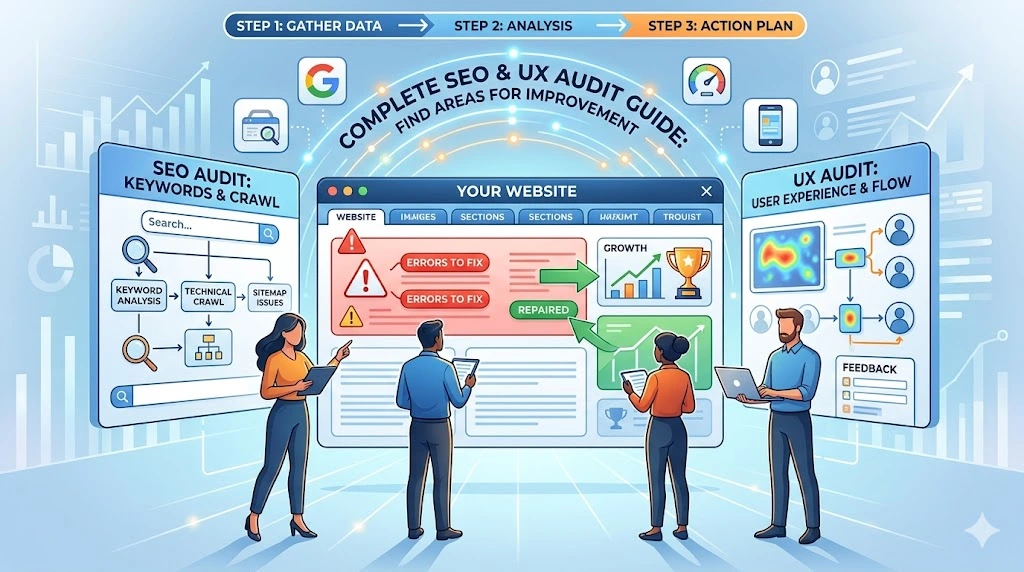
To find areas for improvement on your website, run technical SEO audits checking speed and mobile responsiveness, analyze on-page elements like titles and headers, review user experience and conversion paths, then assess how competitors outperform you in rankings and content depth.
In this guide, let’s take a deep dive into each of these methods and approaches to find areas for improvement on your website.
Why Finding Areas for Improvement on Your Website is Important?
Your website has problems costing you customers daily. You just don’t know what they are yet. Slow-loading pages are losing 40% of visitors before the content even renders. Broken internal links create dead ends where Google’s crawler stops indexing valuable content. Mobile-unfriendly designs ignoring 89% of Pakistani traffic coming from smartphones. Missing meta descriptions reduces click-through rates by 30-50% versus competitors with optimized snippets. Poor conversion paths requiring 8 clicks to complete actions that should take 2.
Most Pakistani business owners know their website “could be better,” but lack a systematic approach to identifying which specific improvements deliver meaningful results versus cosmetic changes providing zero ROI. Should you fix technical issues first? Improve content quality? Optimize for mobile? Add more calls-to-action? The paralysis from not knowing where to start means nothing gets fixed, whilst competitors systematically improve their sites, capturing market share you’re losing through optimization gaps.
This guide provides a complete framework for Pakistani businesses to use in finding and prioritizing website improvements, covering technical SEO audits, on-page optimization analysis, user experience evaluation, and competitive assessment.
You’ll learn which issues matter most, which fixes deliver fastest results, how to audit systematically using free and paid tools, and how to create an actionable improvement roadmap ensuring every optimization hour invested generates measurable traffic, engagement, or conversion gains rather than wasting effort on changes making zero business impact.
Why Most Pakistani Websites Underperform
Pakistani websites typically suffer from predictable patterns of neglect accumulating over months or years as business owners focus on operations, whilst website maintenance falls to the bottom of the priority list until catastrophic problems emerge, rankings disappear overnight, traffic drops 60%, or customers complain about broken functionality, forcing reactive crisis management versus proactive systematic improvement.
Common Pakistani website problems hiding in plain sight:
Slow loading speeds from uncompressed 3MB+ images uploaded directly from cameras, cheap shared hosting collapsing under traffic spikes, excessive plugins bloating WordPress installations, and no caching configured despite simple fixes improving speeds 50-70%.
Mobile disasters where websites display perfectly on the developer’s desktop but break completely on smartphones, 89% of Pakistani visitors use. Tiny unreadable text, buttons too small for finger tapping, horizontal scrolling required, forms impossible to complete on mobile keyboards.
Technical SEO gaps preventing Google from crawling and indexing content properly, missing XML sitemaps, robots.txt blocking important pages accidentally, duplicate content across multiple URLs, broken internal links creating orphaned pages, and no HTTPS security despite Google ranking penalties.
Poor on-page optimization with generic title tags (“Home – Company Name”), missing meta descriptions letting Google auto-generate terrible snippets, no header structure organizing content logically, keyword stuffing damaging readability, and thin content providing minimal value versus comprehensive competitor pages.
Conversion friction requiring 8 form fields when 3 would suffice, unclear calls-to-action buried below fold, confusing navigation preventing users from finding what they need, checkout processes abandoning 70%+ of carts through unnecessary complexity.
The core problem:
Most businesses treat websites as “set and forget” projects. For example, a developer builds a site in 2022, launches it, and then nobody touches it again except adding occasional blog posts. Meanwhile, competitors systematically improve their sites monthly, Google’s algorithm evolves, requiring new optimizations, user expectations change, demanding faster loading and better mobile experiences, and your static, unchanged website gradually becomes less competitive until it actively repels customers rather than attracting them.
Systematic website auditing identifies specific fixable problems versus a vague feeling that “the website is better,” paralyzing improvement efforts. Once you know exactly what’s broken, what’s underperforming, and what competitors do better, creating a prioritized fix list becomes straightforward rather than overwhelming guesswork, hoping random changes help.
The 4-Step Website Improvement Framework
Step 1: Run Complete Technical SEO Audit
Technical SEO provides the foundation that everything else builds upon. Perfect content with beautiful design fails if Google can’t crawl your site, pages load too slowly for users to wait, or mobile rendering breaks completely. Fix technical issues before investing heavily in content or design improvements. Technical problems undermine everything else, regardless of quality.
What Technical Audit Covers:
Crawlability and Indexing
Can search engines access all your important pages? Check:
- An XML sitemap exists and is submitted to Google Search Console – Roadmap, helping Google discover all your pages
- Robots.txt configured correctly – Not accidentally blocking important content from crawlers
- Internal linking connects all pages – No orphaned pages, only accessible by directly typing the URL
- Pages actually indexed – Search “site:yourwebsite.com” in Google, seeing how many pages appear versus how many exist
Quick check: Verify your site’s crawlability instantly with our free crawlability analyzer, showing exactly which pages search engines can access and what’s blocking proper crawling.
Site Speed and Performance
Page speed directly impacts both SEO rankings and user experience. Test using Google PageSpeed Insights or similar tools, checking:
- Largest Contentful Paint (LCP) – Should be under 2.5 seconds (measures main content loading)
- Interaction to Next Paint (INP) – Should be under 200ms (measures responsiveness to user actions)
- Cumulative Layout Shift (CLS) – Should be under 0.1 (measures visual stability, preventing annoying layout jumps)
Pakistani network reality: If your site scores 70 on PageSpeed Insights (simulating 4G), real-world performance on Pakistani 3G networks is 40-50. Target 80+ scores, compensating for the slower actual network speeds most Pakistani users experience.
Test your site right now: Run a free speed test, discovering exactly what’s slowing down your pages and getting specific optimization recommendations fixing performance issues costing you conversions.
Mobile Responsiveness
With 89% Pakistani internet users on mobile, a mobile-friendly design isn’t optional. It’s a fundamental requirement. Check:
- Responsive design adapting to all screen sizes – Test on actual smartphones, not just desktop browser emulation
- Touch-friendly buttons and links – Minimum 48×48 pixels, adequate spacing preventing mis-taps
- Readable text without zooming – Minimum 16px font size for body text
- No horizontal scrolling required – Content fits screen width automatically
- Mobile-specific considerations – Click-to-call phone numbers, condensed navigation, simplified forms
Instant mobile check: Test your mobile compatibility free, seeing exactly how your site displays on smartphones and tablets with specific fixes improving mobile user experience.
HTTPS Security
Google penalizes non-HTTPS sites in rankings, whilst browsers display scary “Not Secure” warnings discouraging visitors. Every Pakistani business website must have an SSL certificate implemented correctly:
- Valid SSL certificate – No browser warnings, padlock icon displaying properly
- All resources loaded via HTTPS – Mixed content warnings indicate some images/scripts still loading over insecure HTTP
- Redirects configured – HTTP automatically redirects to the HTTPS version
Common Pakistani oversight: Business purchases an SSL certificate but never actually installs it, or installs it incorrectly, leaving mixed content warnings that browsers flag as security issues.
Free vs. Paid Technical Auditing:
Free approach (accessible to all Pakistani SMBs):
- Google Search Console (crawl errors, indexing status, mobile usability)
- Google PageSpeed Insights (performance analysis with specific recommendations)
- Google Mobile-Friendly Test (mobile compatibility checking)
- Browser DevTools (manual technical inspection)
- Our free crawlability tool and free speed test
Paid approach (comprehensive automation):
- Semrush Site Audit ($119-449/month) – Automated crawling identifying 120+ technical issues
- Ahrefs Site Audit ($99-999/month) – Technical SEO analysis with prioritized recommendations
- Screaming Frog (£149/year) – Desktop crawler for detailed technical analysis
- At the same time, our professional technical SEO services provide expert implementation, fixing complex technical issues that DIY attempts miss or misconfigure
Priority framework for technical fixes:
Critical (fix immediately): Security vulnerabilities, complete mobile breakage, pages not indexing at all, site-wide speed issues causing 5+ second load times, broken homepage or key landing pages
High impact (fix within 2 weeks): Slow-loading important pages, crawl errors preventing access to valuable content, mobile usability problems on key conversion pages, missing or broken sitemaps, HTTPS mixed content warnings
Quick wins (fix within 1 month): Image compression reducing file sizes 70% with minimal quality loss, browser caching implementation, render-blocking resource elimination, simple code optimization
Long-term improvements (schedule over 2-3 months): Complete hosting upgrade if current infrastructure is inadequate, full mobile redesign if the current site is completely non-responsive, comprehensive site architecture restructuring if information organization is confusing
Our professional SEO audit service provides a prioritized roadmap showing exactly which technical fixes deliver maximum impact for your specific website versus a generic checklist treating all issues equally, regardless of actual business impact.
Step 2: Analyze On-Page SEO Elements
On-page optimization determines whether your content ranks competitively for target keywords, assuming the technical foundation is solid. Perfect technical SEO with poor on-page optimization still results in mediocre rankings because Google can’t understand what your pages are about or why they deserve ranking above competitors.
Title Tags and Meta Descriptions
Title tags are the single most important on-page element. Displayed as a blue clickable link in search results and browser tabs. Check:
- Target keyword included naturally – Primary keyword near the beginning without keyword stuffing
- Compelling and click-worthy – Distinguishes you from 9 other results competing for clicks
- Length optimization – 50-60 characters for desktop, 50-55 for mobile to avoid truncation
- Unique across all pages – No duplicate titles causing confusion about page topics
- Brand name positioning – At the end of the title, unless the brand is the primary search intent
Meta descriptions appear as snippet text below the title in search results. Optimize for:
- Compelling call-to-action – Encourages clicking versus competitor snippets
- Key benefits or value proposition – Answers “Why click this result?”
- Target keyword inclusion – Bolded when matching search query
- Length sweet spot – 120-155 characters (mobile shows less than desktop)
Common Pakistani mistakes: Generic titles like “Home – Company Name” or “About Us – Company Name” provide zero context about page content. Missing meta descriptions, forcing Google to auto-generate snippets, and pulling irrelevant text from the page body.
Analyze your meta tags now: Extract and review all your meta tags instantly with our free tool, identifying missing, duplicate, or poorly optimized titles and descriptions across your entire site.
Header Structure and Content Organization
Headers (H1-H6) provide a hierarchical structure, helping both users and search engines understand content organization and key topics. Audit for:
- Single H1 per page – Primary topic statement (matching or similar to title tag)
- H2s for main sections – Break content into scannable segments
- H3-H6 for subsections – Further organizational depth where needed
- Logical hierarchy – H3s nest under H2s, H4s nest under H3s (not random header levels)
- Keyword-rich but natural – Headers describe content accurately whilst incorporating target keywords organically
Why this matters for Pakistani websites: Mobile users scan content on smartphones. Clear header structure with descriptive headings lets them find relevant information immediately, versus walls of text requiring full reading before determining if the content answers their question.
Check your header structure: Analyze your header hierarchy, freely seeing exactly how headers are organized, whether the structure is logical, and if keywords are distributed effectively across headers, improving topical relevance.
Keyword Optimization and Content Depth
Keywords signal topical relevance, but over-optimization damages readability, whilst under-optimization leaves Google unclear about page focus. Analyze:
- Primary keyword targeting – Each page focuses on 1 main keyword (2-3 closely related variations)
- Keyword placement – Title tag, H1, first paragraph, naturally throughout content, alt text
- Keyword density sweet spot – 1-2% of total content (if 1,000 words, keyword appears 10-20 times)
- Semantic keyword coverage – Related terms and synonyms that Google associates with the main topic
- Content depth and comprehensiveness – Length and detail matching or exceeding top-ranking competitors
Avoid keyword stuffing: Repeating “best digital marketing agency Lahore” 47 times in a 500-word page damages readability whilst triggering over-optimization penalties. Natural language incorporating synonyms and related terms performs better, including “digital marketing agency Lahore,” “Lahore marketing services,” “digital marketing company,” and “SEO and PPC services” used naturally throughout content.
Analyze keyword usage instantly: Check your keyword density free, ensuring optimal keyword distribution without over-optimization, whilst identifying opportunities to incorporate relevant semantic terms competitors use that you’re missing.
Content quality assessment:
- Comprehensiveness – Does your content answer questions completely or leave gaps competitors fill?
- Uniqueness – Original insights, data, examples versus generic information available everywhere?
- Readability – Clear language appropriate for the Pakistani audience’s education level and context?
- Value proposition – Why should someone read your content versus competitor pages ranking above you?
- Update frequency – When was the content last refreshed with current information?
Pakistani content consideration: Many Pakistani websites target an English-speaking audience, but content written by non-native speakers contains grammatical errors and unclear phrasing, reducing perceived quality and professional credibility. Invest in proper content editing, ensuring grammatical correctness and clarity.
Internal Linking Architecture
Internal links connect related content whilst distributing link authority across your site, helping important pages rank better. Audit for:
- Logical linking structure – Related pages link to each other naturally
- Descriptive anchor text – Link text describes destination page (“SEO services for Pakistani businesses” versus “click here”)
- Important pages receive more internal links – Priority pages (services, key products) linked from multiple relevant pages
- No broken internal links – All links lead to working pages, not 404 errors
- Reasonable link volume – 2-5 internal links per 500 words is generally appropriate
Common Pakistani issue: Blog posts are published without any internal links to service pages or related content. Each blog becomes an isolated island rather than connecting to commercial pages that drive conversions.
Analyze your link structure: Run a free link analysis identifying broken internal links, orphaned pages with no inbound links, and optimization opportunities improving site architecture and page authority distribution.
Image Optimization
Images significantly impact page speed whilst providing SEO opportunities through proper optimization. Check:
- File size optimization – Compress images, reducing file size 70-80% without visible quality loss
- Descriptive file names – “karachi-restaurant-exterior.jpg” versus “IMG_3847.jpg”
- Alt text for accessibility and SEO – Describes image content using relevant keywords naturally
- Appropriate dimensions – Images sized correctly for display resolution (not displaying a 3000px image at 500px)
- Modern formats – WebP provides 30% better compression than JPEG, maintaining quality
- Lazy loading implemented – Images load as the user scrolls, versus all loading immediately
Pakistani website pattern: Uploading 3-5MB photos directly from the camera without any compression. A single page with 10 images consumes 30-50MB of data loading unacceptable on Pakistani mobile networks where data costs money and speeds are limited.
Step 3: Evaluate User Experience and Conversion Paths
Technical SEO and on-page optimization drive traffic, but user experience and conversion optimization determine whether visitors become customers. Ranking #1 for the target keyword provides zero business value if the landing page confuses visitors who bounce immediately without taking the desired action.
Mobile User Experience Beyond Responsiveness
Basic mobile responsiveness (site displays properly on small screens) is a baseline requirement. Advanced mobile UX considers:
- Touch interaction design – Buttons, links, form fields sized appropriately for finger tapping without precision required
- Simplified navigation – Condensed menus appropriate for mobile screens versus full desktop navigation overwhelming small displays
- Reduced cognitive load – Fewer choices, clearer paths to conversion, minimal distractions on small screens
- Thumb-friendly zones – Important actions positioned where thumbs naturally rest on smartphone screens
- Mobile-specific features – Click-to-call buttons, location-based features, mobile payment options
Pakistani mobile UX insight: Most Pakistanis browse on budget Android devices (Oppo, Vivo, Xiaomi, Samsung mid-range) with 4-6 inch screens. Testing on actual budget devices, not just the latest iPhone, shows performance and display differ significantly from those of premium devices designers typically use.
Page Speed Impact on Conversions
Site speed directly impacts conversion rates beyond SEO rankings. Research consistently shows:
- 1-second delay = 7% conversion loss – If you generate PKR 100,000 monthly revenue, a 1-second speed improvement adds PKR 7,000 monthly revenue
- 40% of users abandon sites loading over 3 seconds – On Pakistani 3G networks, slow sites never get a chance to convert because users leave before the content loads
- Mobile users are less patient than desktop users – Expect instant loading on smartphones due to mobile-first expectations.
Speed optimization priorities:
- Image compression (the easiest 30-50% speed improvement)
- Minimize HTTP requests (combine CSS/JS files, use CSS sprites)
- Enable browser caching (visitors’ browsers store static files locally)
- Upgrade hosting if the current infrastructure is inadequate (cheap PKR 500/month shared hosting can’t handle traffic)
- Use CDN for faster content delivery (Cloudflare free plan works well for Pakistani sites)
Navigation Clarity and Information Architecture
Users should find what they need in 3 clicks or fewer. Evaluate:
- Primary navigation clarity – 5-7 main menu items maximum, clearly labeled with terms users actually search
- Logical content grouping – Related pages grouped under intuitive category labels
- Search functionality – Especially important for e-commerce or large content sites
- Breadcrumb navigation – Shows current location within site hierarchy
- Mobile menu usability – Hamburger menus that actually work versus breaking on touch
Common Pakistani navigation mistake: Cramming 15+ items into the main navigation because “everything is important.” Result: paradox of choice where nothing stands out, and users feel overwhelmed rather than guided.
Form Optimization and Conversion Friction
Every form field reduces conversion rates. Audit for:
- Minimum required fields – Only ask essential information (name, email, phone versus 15-field forms asking everything upfront)
- Clear field labels – Obvious what each field requires without confusion
- Inline validation – Real-time feedback showing errors before submission versus frustrating “fix these errors” after clicking submit
- Mobile-friendly inputs – Appropriate keyboards triggering automatically (numeric for phone, email keyboard for email field)
- Progress indicators for multi-step forms – Show step 2 of 4 so users know completion proximity.
Pakistani form consideration: Mobile users typing on small touchscreen keyboards. Long forms become torture on smartphones, drastically reducing form fields for mobile users, even if the desktop version has more fields.
Call-to-Action Effectiveness
Clear, compelling CTAs guide users toward desired actions. Evaluate:
- Visual prominence – CTAs stand out through contrasting colors, size, and positioning
- Action-oriented language – “Get Free Quote” versus generic “Submit” or “Learn More.”
- Single primary CTA per page – Don’t overwhelm with 8 different actions competing for attention
- Above-the-fold positioning – Primary CTA visible without scrolling on both desktop and mobile
- Urgency or value proposition – “Start Free Trial Today” is better than plain “Sign Up.”
WhatsApp has 90%+ penetration in Pakistan. “Contact us on WhatsApp” CTAs convert better than traditional contact forms because Pakistanis are more comfortable using a familiar messaging app versus website forms.
Step 4: Assess Competitive Positioning
Understanding how competitors outperform you reveals specific improvement opportunities versus guessing what helps. Competitive analysis identifies:
Content Gap Analysis
What content do competitors have that you don’t?
Research:
- Topic coverage breadth – Competitors are writing comprehensive guides, whilst you only have basic service pages
- Content depth – Their 2,500-word comprehensive articles versus your 500-word thin content
- Content formats – Competitors use videos, infographics, tools, calculators, whilst you only have text
- Update frequency – They publish weekly, whilst you haven’t added content in 8 months.
Identify gaps instantly: Run a free competitive analysis comparing your site against competitors, discovering content topics, keywords, and strategies they’re using successfully that you’re missing entirely.
Keyword Opportunities
Which valuable keywords do competitors rank for while you don’t?
Analyze:
- High-volume keywords – Competitors ranking page 1 whilst you’re invisible
- Long-tail variations – Specific searches competitors capture through comprehensive content
- Question-based keywords – “How to,” “What is,” “Best ways to” queries competitors answer, whilst you don’t address
- Local keywords – City-specific searches, competitors dominate through better local SEO
Find keyword opportunities: Use our free keyword research tool to discover valuable keywords your competitors rank for that you should be targeting through new content or optimizing existing pages.
Backlink Profile Comparison
Quality backlinks signal authority, whilst your backlink deficit versus competitors explains ranking gaps. Compare:
- Total backlink volume – How many sites link to competitors versus you
- Link quality – Domain authority of sites linking to them
- Link-earning content – What specific content earns their backlinks (tools, research, comprehensive guides)
- Link gap opportunities – Sites linking to 2+ competitors but not you
Backlink deficit reveals authority gap you must close through content marketing, digital PR, or strategic partnerships, earning quality links from authoritative Pakistani websites and industry publications.
Technical and UX Advantages
What technical superiority do competitors have?
- Faster page speeds – Their 2-second load time versus your 6-second struggles
- Better mobile experience – Seamless mobile UX whilst yours breaks on smartphones
- Superior content organization – Clear information architecture versus your confusing navigation
- Advanced features – Live chat, personalization, interactive tools, and enhancing engagement
Understanding specific advantages competitors hold over you creates an actionable improvement roadmap targeting weaknesses, preventing competitive rankings, and conversions.
Creating Your Improvement Roadmap
Effective improvement requires prioritization. You can’t fix everything simultaneously. Use the impact versus effort matrix to organize improvements:
High Impact + Low Effort (Quick Wins – Do First):
- Image compression improves speeds 40% in 2 hours of work
- Missing title tags and meta descriptions on key pages
- Broken internal links create dead ends
- Mobile font size adjustments are making the text readable
- Adding calls-to-action on high-traffic pages lacking them
High Impact + High Effort (Strategic Projects – Schedule Next):
- Complete content overhaul, bringing thin pages to comprehensive depth
- Mobile redesign of the current site is completely non-responsive
- Site speed optimization requires development resources
- Backlink building campaign through digital PR and content marketing
Low Impact + Low Effort (Minor Improvements – Do When Capacity Allows):
- Minor content updates and freshness improvements
- Additional internal linking between related pages
- Alt text addition for images missing descriptions
- Incremental page refinements and polish
Low Impact + High Effort (Avoid Unless a Strategic Reason Exists):
- Complete visual redesign with no UX or conversion improvements
- Adding features users don’t need or want
- Perfectionist tweaking provides zero measurable benefit
Resource allocation consideration: Pakistani SMBs typically have 5-10 hours weekly for website improvements. Focus entirely on high-impact changes delivering measurable results rather than spreading effort across low-priority perfectionist polish providing zero business value.
Timeline planning:
- Month 1: Technical foundation (speed, mobile, crawlability, indexing)
- Month 2: On-page optimization (title tags, headers, content quality, internal linking)
- Month 3: Conversion optimization (CTA improvements, form reduction, mobile UX refinement)
- Month 4+: Content expansion and ongoing competitive advancement
For Pakistani businesses lacking internal technical expertise or capacity, our professional website development services implement systematic improvements following proven prioritization frameworks, ensuring optimization efforts deliver maximum ROI versus random changes, hoping something helps.
Tracking Progress Over Time
Measurement validates whether improvements actually work versus assumptions about what should help. Establish baselines before making changes, then monitor:
Monthly metrics tracking:
- Organic traffic volume (Google Analytics)
- Keyword rankings (position tracking for target keywords)
- Page speed scores (PageSpeed Insights)
- Conversion rates (goals completed / visitors)
- Bounce rates (particularly on key landing pages)
- Mobile vs desktop performance (separate analysis for each)
Re-audit quarterly, running a complete technical audit, competitive analysis, and on-page review, identifying new issues that have emerged, checking that previous fixes remain implemented correctly, and discovering new opportunities as your site grows and competition evolves.
When to re-audit:
- After major Google algorithm updates (rankings shift significantly)
- When launching new site sections or features
- If traffic drops unexpectedly without an obvious cause
- Quarterly systematic review regardless of visible issues
Progressive improvement mindset: Websites aren’t “finished” projects you complete and then ignore. Successful Pakistani businesses treat website optimization as a continuous process with monthly improvements compounding over 12-24 months, creating sustainable competitive advantages that competitors struggle to match because they view websites as static projects rather than evolving assets requiring ongoing attention.
Conclusion
Systematic improvement beats random changes. Most Pakistani businesses approach website improvement reactively.
Something breaks, they fix it!
Rankings drop, they panic!
Systematic proactive improvement following the framework above, including technical audit, on-page optimization, UX evaluation, and competitive analysis, identifies specific fixable problems before they become crises, whilst uncovering opportunities competitors miss.
The distinction separating successful websites from mediocre ones isn’t budget. It’s systematic attention. Small Pakistani businesses spending 5 hours monthly on prioritized improvements following a data-driven roadmap outperform larger competitors, making random changes hoping something sticks, because focused systematic effort compounds, whilst scattered unfocused activity wastes resources without measurable impact.
Start with free tools identifying low-hanging fruit:
These quick, free checks reveal immediate opportunities for fixing issues costing you traffic right now.
Ready to transform your website from liability into a competitive asset? Our team at Cloudex Marketing provides comprehensive SEO audit services and technical SEO implementation, helping Pakistani businesses systematically improve website performance, combining data-driven analysis with strategic recommendations prioritizing changes delivering maximum business impact rather than generic checklists treating all improvements equally regardless of actual ROI potential.