

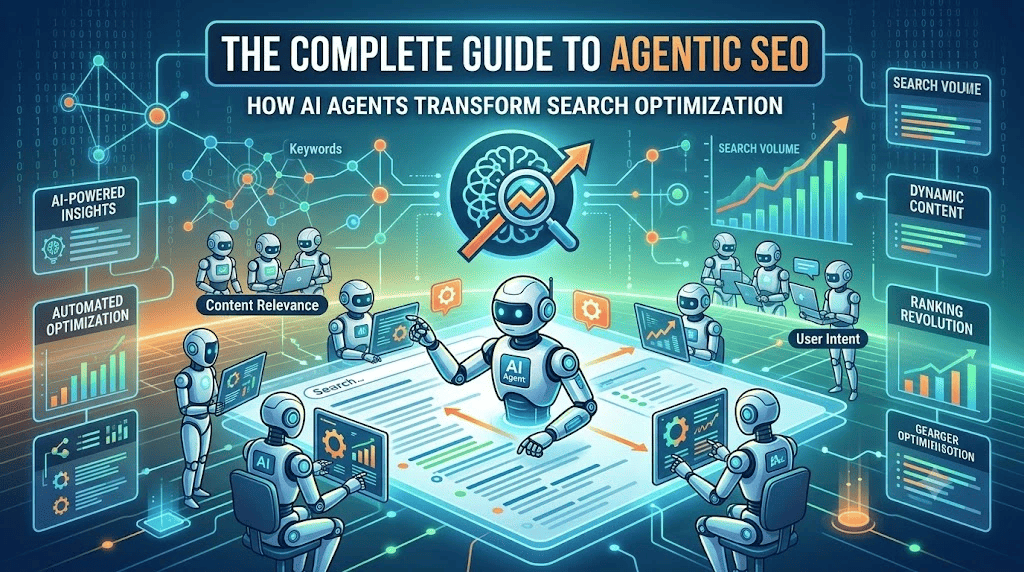
SEO teams jumped enthusiastically onto the AI bandwagon, expecting streamlined workflows but discovered themselves drowning in different work instead, endless prompting, extensive editing, and relentless quality control. The productivity gap between AI adoption and actual efficiency gains frustrated businesses investing in tools promising transformation, yet delivering an administrative burden. Agentic SEO changes this dynamic fundamentally by deploying autonomous AI agents that don’t just generate content when asked but actually plan multi-step workflows, make strategic decisions, and execute complex tasks independently, whilst you focus on high-level strategy rather than micromanaging every prompt.
These systems represent evolution beyond reactive AI tools toward proactive intelligence amplification, agents that research competitors, identify content gaps, map keyword clusters, orchestrate interconnected processes, and continuously adapt based on performance feedback without requiring constant human guidance.
Understanding modern SEO means recognizing that competitive advantage increasingly flows not from working harder manually but from building smarter automated workflows, augmenting human strategic thinking with computational scale impossible to match through traditional methods alone.
Understanding Agentic AI: How It Differs from ChatGPT Fundamentally
What Agentic AI Actually Means: Step-by-Step
Step 1: Traditional AI Responds
You prompt ChatGPT: “Generate keyword list for fitness coaching.” > It generates a list > Conversation ends > You manually analyze results, make decisions, take next actions yourself
Step 2: Agentic AI Plans
You tell the agentic system: “Improve organic visibility for fitness coaching.” > Agent breaks this into subtasks: research current rankings, analyze competitor content, identify gaps, prioritize opportunities, generate strategy
Step 3: Agentic AI Decides
Agent evaluates options independently: “Competitor A ranks well for ‘home workout plans’ with 2,500-word guides. Our content is 800 words and outdated. Priority: expand and update this content first before pursuing new keywords.”
Step 4: Agentic AI Acts
Agent executes decisions autonomously: pulls your current content, analyzes top-ranking competitors, drafts a comprehensive outline, suggests internal links, prepares metadata, and schedules a quality check. All without waiting for your instruction at each step
Step 5: Agentic AI Reports
Agent delivers complete package: “Here’s the updated content strategy for fitness coaching. I identified 12 content gaps, prioritized the top 5 by opportunity score, drafted briefs for each, and scheduled competitor monitoring. Approve to proceed with implementation?”
The fundamental difference: ChatGPT waits for your next prompt. Agentic AI figures out what needs doing next and does it.
GPT vs. Agentic AI: The Critical Distinction
| Aspect | GPT (ChatGPT, Claude) | Agentic AI Systems |
| Operation Mode | Reactive. Waits for prompts | Proactive. Pursues goals independently |
| Task Scope | Single-turn responses | Multi-step workflow execution |
| Decision Making | Follows explicit instructions | Makes strategic decisions autonomously |
| Memory | Conversation context only | Persistent learning across sessions |
| Tool Usage | Cannot access external tools | Connects APIs, databases, analytics platforms |
| SEO Analogy | Helpful assistant awaiting tasks | Junior SEO executing complete projects |
The practical implication for SEO teams: GPT requires you to act as a project manager, breaking tasks into prompts, reviewing each output, and deciding next steps manually. Agentic systems act as team members receiving objectives, determining execution paths, and delivering complete solutions requiring validation rather than constant direction.
Why This Matters for Search Optimization Specifically
SEO involves interconnected tasks where outputs from one analysis inform inputs for the next decision. Traditional AI tools force you to manage these connections manually, exporting keyword data, analyzing separately, uploading to content tools, cross-referencing with analytics, making decisions, then starting over for the next task.
Agentic workflows automate these connections. An agent researching keywords simultaneously analyzes your current rankings, identifies gaps, checks competitor strategies, evaluates search intent, generates content briefs, and prioritizes opportunities by potential impact, completing in minutes what traditionally required hours across multiple tools with manual data transfers between each stage.
Understanding different types of SEO helps contextualize where agentic automation delivers maximum impact versus where human expertise remains irreplaceable for strategic judgment calls.
The 5 Components Making AI Systems Truly Agentic
Component 1: Tools (Giving Agents Hands to Act)
Tools provide agents with capabilities beyond text generation, accessing APIs, querying databases, scraping search results, analyzing competitor backlinks, updating spreadsheets, and pushing data to content management systems.
SEO example: Instead of just suggesting “research competitors,” an agent with tool access can:
- Query the Semrush API for competitor keyword rankings
- Scrape Google SERP features for target queries
- Cross-reference with your current positions
- Calculate opportunity scores automatically
- Update tracking dashboard with findings
Why it matters: Agents transform from advisors into executors, completing entire workflows rather than just first steps.
Component 2: Memory (Context That Persists and Learns)
Unlike ChatGPT forgetting conversations once closed, agentic systems maintain persistent memory across sessions, remembering previous analyses, tracking pattern changes over time, and building a comprehensive understanding of your specific SEO landscape.
SEO example: Agent notices rankings declining for target keywords, automatically recalls:
- Historical performance from 6 months ago
- Previous algorithm update impacts on your site
- Successful recovery tactics from past situations
- Competitor movements during the same period
Why it matters: Agents develop institutional knowledge about your business, eliminating the need to re-explain context constantly, whilst making increasingly informed recommendations based on accumulated learning.
Component 3: Instructions (Standing Directives Guiding Decisions)
Rather than one-off prompts, agents operate under standing instructions shaping ongoing behavior without requiring constant human input.
SEO example instructions:
- “Monitor competitor content gaps weekly, flagging opportunities exceeding 500 monthly searches.”
- “Alert me when core page rankings drop 3+ positions within 7 days.”
- “Automatically audit new content for technical SEO issues before publishing.”
- “Track algorithm update announcements and assess potential site impact.”
Why it matters: Agents become proactive systems continuously working toward objectives rather than passive tools awaiting the next command.
Component 4: Knowledge (Domain Expertise Preventing Errors)
Agents trained on SEO domain expertise understand ranking factors, algorithm behavior, best practices, and preventing hallucinations and false recommendations that could harm search visibility.
SEO example: Agent recognizes that:
- Exact-match anchor text concentration triggers spam signals
- Schema markup requires specific properties for validity
- Page speed impacts mobile rankings more than desktop
- Algorithm updates typically require 2-4 weeks before results stabilize
Why it matters: Domain knowledge prevents dangerous recommendations from systems that otherwise suggest outdated tactics or manipulative strategies, triggering penalties.
Component 5: Persona (Communication Style and Confidence Calibration)
Agents can adopt specific expertise levels and communication approaches, speaking confidently about facts whilst hedging uncertain predictions appropriately.
SEO example persona: “Senior technical SEO consultant.”
- Speaks confidently about crawl budget optimization
- Hedge’s predictions about algorithm changes (“rankings improve within 30-60 days based on historical patterns”)
- Flags when recommendations require human strategic judgment
- Acknowledges knowledge limitations rather than inventing answers
Why it matters: Appropriate persona prevents both under-confidence (agent not acting when it should) and over-confidence (agent implementing questionable tactics without human validation).
Technical SEO implementation benefits particularly from agentic automation because technical audits involve systematic checks following established protocols, perfect for autonomous agent execution with human validation.
What Agentic SEO Actually Does: 5 Core Capabilities Explained
Capability 1: Keyword Research and Strategic Ideation
Traditional approach: Export keyword data > manually cluster by intent > analyze search volumes > check competitor rankings > identify opportunities > document findings (4-6 hours)
Agentic approach: Agent autonomously:
- Analyzes search data from multiple sources
- Spot opportunity patterns using semantic similarity
- Groups keywords by intent automatically
- Cross-references competitor rankings
- Prioritizes by potential impact scores
- Generates strategic recommendations (15-30 minutes)
Real workflow example: You provide a seed topic “project management software.” Agent explores related searches recursively, identifies 247 keyword opportunities, clusters them into 12 topical groups, analyzes competitor content for each cluster, scores opportunities by search volume + competition + your current authority, and delivers a prioritized roadmap with content briefs for top opportunities.
Capability 2: Content Creation and Optimization
Agents draft articles, landing pages, or product descriptions, including proper heading hierarchy, optimized metadata, strategic internal links, and semantic keyword integration, not just generating text but structuring content following SEO best practices automatically.
What agents handle:
- Researching top-ranking content for target keywords
- Analyzing semantic gaps in your existing content
- Structuring headings following search intent patterns
- Suggesting internal linking opportunities from your content library
- Generating metadata optimized for click-through rates
- Formatting content with proper HTML markup
What humans still do: Inject brand voice, add proprietary insights, verify factual accuracy, ensure strategic alignment, and make final publishing decisions.
Topic cluster development becomes dramatically more efficient when agents autonomously map content relationships, identify coverage gaps, and generate interconnected content briefs, maintaining semantic coherence across entire clusters.
Capability 3: Technical Audits and Issue Detection
Traditional technical audit: Crawl site > export data > manually analyze > categorize issues > prioritize fixes > document recommendations > create implementation tickets (8-12 hours for medium site)
Agentic technical audit: Agent systematically:
- Scans site for broken links, redirect chains, orphan pages
- Identifies duplicate content, missing alt text, and thin pages
- Analyzes site speed and Core Web Vitals performance
- Checks schema markup validity and implementation
- Detects indexing issues, robots.txt problems, and canonical errors
- Prioritizes issues by SEO impact automatically
- Generates implementation-ready fix documentation (30-60 minutes)
The scalability advantage: Same agent audits 10 sites as easily as 1 site, maintaining consistency impossible with purely manual processes prone to human oversight errors.
Capability 4: On-Page Implementation and Direct Optimization
Some agentic systems move beyond recommendations toward direct implementation, applying structured data markup, adjusting title tags, optimizing metadata, and updating internal links automatically with human approval gates.
Implementation workflow:
- Agent identifies optimization opportunity
- Generates proposed changes with before/after preview
- Flags for human review showing expected impact
- Upon approval, implements changes directly via CMS integration
- Monitors performance changes post-implementation
- Reports results and suggests iterations
Critical note: Direct implementation requires robust validation processes and rollback capabilities because automated changes at scale can cause issues rapidly if poorly configured.
Capability 5: Performance Monitoring and Adaptive Strategy
After content is published, agents continuously track rankings, impressions, click-through rates, engagement metrics, automatically identifying underperformance, suggesting optimizations, and adapting strategy based on actual results rather than assumptions.
Adaptive workflow example:
- Agent publishes content targeting “email marketing automation.”
- Monitors rankings daily for 30 days
- Notices ranking at position 8, below expectations
- Analyzes the top 5 competitors, identifying a pattern: all include specific comparison tables
- Flags opportunity: “Add comparison table to improve rankings.”
- Generates a table based on competitor analysis
- Presents for human approval with reasoning
- After approval and implementation, continue monitoring for improvement
This closed-loop optimization, including publish, monitor, analyze, adapt, repeat, happens continuously without requiring manual tracking and decision-making at each iteration.
Understanding how long SEO takes helps set realistic expectations about agentic SEO timelines. Agents accelerate execution dramatically, but can’t bypass fundamental ranking timeline realities where Google requires weeks or months to evaluate content quality and authority signals.
The Human-AI Collaboration Model: Partnership, Not Replacement
The Human-in-the-Loop Principle Explained
The most successful agentic SEO implementations follow “human-in-the-loop” collaboration, agents handle research, analysis, and execution grunt work, whilst human expertise guides strategy, validates quality, and makes final decisions.
Why this matters: Agents excel at comprehensive data processing and pattern recognition. Humans excel at strategic interpretation, creative application, brand alignment, and contextual judgment that AI cannot replicate. The combination proves more powerful than either operating independently.
Bad implementation: Agent generates content > automatically publishes without review > quality problems, brand misalignment, factual errors appear at scale
Good implementation: Agent generates content > human reviews for accuracy, brand voice, strategic fit > approves or refines > agent implements > human monitors results
The 4 Stages of Effective Human-AI Collaboration
Stage 1: Strategic Guidance
Human role: Define objectives, set priorities, establish constraints, provide domain context
Agent role: Research relevant data, analyze patterns, identify opportunities, surface insights
Example: You specify “increase organic traffic for B2B software category by focusing on mid-funnel comparison content.” The agent researches which specific comparisons have the highest search volume, analyzes competitor approaches, identifies content gaps, and recommends priority topics with supporting data.
Stage 2: Autonomous Execution
Human role: Monitor progress, provide feedback when the agent requests guidance, and remain available for escalations
Agent role: Execute multi-step workflows independently, make tactical decisions, and handle routine optimization tasks
Example: Agent drafts comparison articles following your approved brief, structures content based on top-ranking patterns, optimizes metadata, suggests internal links, prepares schema markup, delivering complete packages requiring validation rather than creation.
Stage 3: Quality Validation
Human role: Review outputs for accuracy, brand alignment, strategic fit, factual correctness, and creative quality
Agent role: Flag potential issues, explain reasoning behind decisions, provide supporting evidence for recommendations
Example: Agent presents drafted content with notation: “I recommended comparing 5 tools instead of 3 because top-ranking competitors average 5.2 comparisons and longer content correlates with better rankings for this query type.” You validate reasoning, check factual accuracy, verify brand voice, and approve or request refinements.
Stage 4: Publishing and Iteration
Human role: Make final publishing decisions, set strategic direction for optimization iterations, interpret business impact
Agent role: Implement approved changes, monitor performance continuously, flag opportunities for improvement, suggest data-driven iterations
Example: After publishing, the agent tracks rankings daily, notices content ranking position 7 after 14 days, analyzes why top 3 competitors outrank it (longer content, more detailed examples, specific statistics), and recommends specific additions with reasoning for your approval.
Division of Labor: What Each Party Does Best
Agents handle:
- Comprehensive data gathering across multiple sources
- Pattern recognition in large datasets
- Systematic task execution following established protocols
- Continuous monitoring without fatigue
- Rapid analysis of competitor strategies at scale
Humans handle:
- Strategic prioritization based on business objectives
- Creative differentiation and unique angle development
- Brand voice consistency and messaging alignment
- Contextual judgment calls requiring industry expertise
- Final quality validation and publishing decisions
With our SEO agency in Pakistan, your ongoing SEO maintenance becomes more manageable through agentic automation, handling repetitive monitoring and optimization tasks whilst humans focus on strategic initiatives and creative differentiation.
Starting with Ideation: Your Low-Risk Entry Point
Why Ideation Makes the Perfect Starting Point
Reason 1: Low risk, high impact
The ideation stage involves brainstorming, research, and planning. If the agent misinterprets data or suggests off-target ideas, the worst outcome is spending minutes reviewing and refining output rather than publishing problematic content or implementing harmful technical changes.
Reason 2: Immediate value demonstration
Agents can analyze competitors, identify content gaps, and surface opportunities in minutes rather than hours, delivering quick wins that build confidence in the system’s capabilities before expanding into execution workflows.
Reason 3: Forgiving errors
The wrong keyword suggestion gets caught during review. Incorrect technical implementation gets published to the live site, causing actual problems. Starting at the ideation stage provides a safety buffer for learning how agents work whilst minimizing potential damage from mistakes.
Reason 4: Strategic expansion path
Once comfortable with agentic ideation, gradually expand into content creation, technical audits, performance monitoring, and building trust incrementally rather than deploying autonomous systems across the entire workflow simultaneously.
The 3 Ideation Functions Where Agents Excel
Function 1: Topic Discovery Through Recursive Exploration
Traditional approach: Brainstorm topics > manually research each > check search volumes > repeat (time-intensive, sometimes misses connections)
Agentic approach: Agent starts with a seed topic, systematically explores related entities, analyzes SERP patterns across dozens of related queries, identifies emerging vocabulary, and maps a comprehensive topic landscape, revealing opportunities human research commonly misses.
Real example: Seed topic “email marketing” > Agent explores recursively discovering:
- 127 related subtopics (automation, deliverability, segmentation, etc.)
- 43 question patterns people actually search
- 18 emerging terms gaining search volume recently
- 9 content gaps where competitors lack comprehensive coverage
- Priority roadmap ranking opportunities by potential impact
Function 2: Content Cluster Generation from Competitor Analysis
Agents systematically crawl competitor sites, analyze content organization, map internal linking patterns, and identify how competitors structure topical authority, revealing strategic insights about effective content architecture.
Workflow breakdown:
- The agent identifies the top 5 competitors ranking for the target keyword group
- Systematically analyzes their complete content libraries
- Maps how they cluster related topics together
- Identifies linking patterns connecting pillar content to cluster content
- Detects coverage gaps in your current content compared to competitors
- Generates cluster recommendations with specific content briefs
Why this matters: Understanding how successful competitors organize content reveals proven structures worth emulating, whilst identifying unique angles differentiating your approach.
Function 3: Emerging Trend Identification Before Mainstream Adoption
Agents monitor search pattern changes, analyze question evolution, track vocabulary shifts across multiple sources, surfacing opportunities whilst competition remains low before trends hit mainstream keyword tools.
Trend detection workflow:
- The agent monitors the periphery of established topics continuously
- Tracks search suggestion changes, indicating emerging interest
- Analyzes social platform discussions, revealing new terminology
- Identifies vocabulary stabilizing into searchable keywords
- Flags opportunities with supporting evidence: “Term ‘X’ search volume increased 340% last 90 days, still low competition.”
Strategic advantage: Building authority around emerging terminology before it becomes mainstream positions you ahead of competitors still focused on established, highly competitive keywords.
AI-powered search optimization strategies become more effective when agentic systems continuously monitor how AI search features evolve, identifying optimization opportunities as new patterns emerge.
Tools and Platforms Enabling Agentic SEO Implementation
Topic Exploration and Research Tools
Google Gemini Deep Research
What it does: Processes competitor content and generates comprehensive topic maps using advanced AI to understand entire content ecosystems rather than isolated pages.
Agentic capability: Formulates own research questions, follows citation chains automatically, builds knowledge graphs revealing unexpected topical connections humans miss.
Best for: Teams needing comprehensive market research and topic landscape mapping before content strategy development.
OpenAI Deep Research
What it does: Uses advanced reasoning capabilities, investigating topics systematically, following inquiry chains across multiple sources like a human researcher conducting a deep analysis.
Agentic capability: Spends extended periods analyzing search results, cross-referencing information sources, and synthesizing findings into comprehensive reports that would require hours manually.
Best for: In-depth competitive analysis and strategic research requiring thorough source validation and synthesis.
Workflow Customization and Automation Platforms
n8n (Technical Teams)
What it does: Visual workflow builder connecting AI models, data sources, APIs, and output systems into coherent automated sequences.
Agentic capability: Create flowcharts where each node represents an AI task, API call, or data transformation, and the platform handles complex orchestration whilst you define logic.
Best for: Teams with technical capability wanting custom workflows tailored precisely to their specific processes and data sources.
Example workflow:
- Monitor competitor RSS feeds for new content (automated trigger)
- Extract key topics and entities using the Claude API
- Cross-reference against your existing content using semantic analysis
- Identify gaps and generate content brief suggestions
- Validate opportunities against search volume data
- Output prioritized recommendations to the project management system
CursorAI (Development-Focused Teams)
What it does: AI-powered development environment enabling sophisticated automation through code, whilst maintaining human oversight and iteration.
Best for: Technical teams comfortable with code who want maximum flexibility and customization beyond no-code platform limitations.
No-Code Agentic Builders (Democratized Access)
DNG.ai and Similar Platforms
What they do: Provide pre-built templates for common SEO tasks, including keyword clustering, competitor analysis, and content gap detection, customizable through simple forms without coding requirements.
Agentic capability: Automated workflows execute multi-step processes following templates configured through dropdown menus and field inputs.
Trade-off: Less flexibility than custom-built solutions but significantly faster deployment and lower maintenance overhead.
Best for: Most SEO teams without dedicated technical resources wanting quick implementation and operational simplicity.
Workflow Visualization and Documentation
Miro and Lucidchart
What they do: Visual collaboration platforms with customizable templates mapping workflow stages using standardized shapes for sources, processes, and decision points.
Why they matter: Even when not directly executing workflows, visualizing agentic processes helps teams understand task flow, identify optimization opportunities, and communicate automation strategies clearly.
Typical workflow visualization:
- Sources (circles): Data inputs, APIs, content libraries
- Processes (rectangles): Agent tasks, analysis steps, transformations
- Decision points (diamonds): Human validation gates, conditional routing
- Outputs (rounded rectangles): Deliverables, reports, implementation packages
At our SEO company in Pakistan, our content writing processes help when designing agentic workflows that generate drafts requiring human editing, recognizing where AI creation ends, and human creativity becomes essential.
The 5 Key Benefits of Transforming SEO Team Operations
Benefit 1: Time Efficiency (Hours Become Minutes)
Concrete example: Large e-commerce site technical audit
Traditional approach:
- Crawl site using Screaming Frog: 2 hours
- Export and clean data: 1 hour
- Manually categorize issues: 3 hours
- Prioritize by impact: 2 hours
- Document recommendations: 2 hours
- Total: 10 hours
Agentic approach:
- Agent crawls, analyzes, categorizes, prioritizes, and documents automatically: 30 minutes
- Human reviews findings and approves implementation: 30 minutes
- Total: 1 hour (90% time reduction)
Scalability implication: The same agent audits 10 sites in the time that the traditional approach required for 1 site.
Benefit 2: Consistency (Uniform Optimization Eliminating Variables)
The problem: Human SEO work varies. One person optimizes titles aggressively, another conservatively; one checks 15 technical factors, another checks 8; quality fluctuates based on workload, fatigue, and attention.
Agentic solution: Agents apply identical rules across every page, ensuring uniform optimization standards regardless of content volume or time pressure.
Real impact: E-commerce site with 5,000 product pages. The agent ensures every single page has an optimized title length, proper meta description, schema markup, and internal links following identical quality standards rather than inconsistent manual optimization where some pages get thorough attention whilst others get minimal treatment.
Benefit 3: Scalability (Manage More Without Expanding Teams)
Traditional constraint: Managing 5 websites with comprehensive SEO requires roughly proportional team expansion. 10 websites need roughly double the team size to maintain the same quality.
Agentic transformation: Same team manages 10+ websites using agents handling execution, whilst humans focus on strategic oversight and validation across all properties.
Economic advantage: Business growth doesn’t require linear headcount growth when agentic systems handle scaled execution efficiently.
Benefit 4: Adaptability (Rapid Strategy Adjustment)
Scenario: Google releases an algorithm update affecting ranking factors
Traditional response:
- Wait for industry analysis (1-2 weeks)
- Manually audit affected pages (several days)
- Develop recovery strategy (days)
- Implement changes gradually (weeks)
- Total response time: 4-6 weeks
Agentic response:
- The agent immediately analyzes ranking changes across the portfolio
- Identifies patterns in affected versus unaffected pages
- Cross-references with algorithm update characteristics
- Generates a hypothesis about ranking factor changes
- Proposes specific optimizations with supporting evidence
- Total analysis time: Hours, not weeks
Faster adaptation means less traffic loss and quicker recovery when algorithm changes impact visibility.
Benefit 5: Cost Savings Through Resource Reallocation
Traditional resource allocation:
- 60% time: Repetitive execution tasks (audits, reporting, routine optimization)
- 25% time: Analysis and problem-solving
- 15% time: Strategic planning and creative work
Agentic resource reallocation:
- 20% time: Validating agent outputs, refining workflows
- 30% time: Analysis and problem-solving with agent assistance
- 50% time: Strategic planning, creative differentiation, high-value work
Bottom line: The same team produces more strategic value by eliminating low-leverage repetitive work automated effectively by agents.
Understanding SEO benefits becomes more important as agentic automation changes ROI calculations, efficiency gains amplify returns whilst reducing the ongoing time investment required to maintain performance.
Challenges, Risks, and Essential Guardrails for Safe Implementation
Challenge 1: Setup Complexity and Integration Requirements
The reality: Agentic systems don’t work out-of-the-box magically. They require technical integration with content management systems, analytics platforms, keyword databases, and rank tracking tools.
What this means practically:
- API connections must be configured correctly
- Data must be structured consistently for agent interpretation
- Workflows require testing and refinement before reliable operation
- Initial setup demands 20-40 hours of technical investment minimum
Mitigation strategy: Start with a single workflow rather than comprehensive automation, validate thoroughly before expanding scope, and document configurations enabling troubleshooting when issues arise.
Challenge 2: Data Quality (Garbage In, Garbage Out at Scale)
The danger: Agents operating on flawed data produce flawed outputs confidently, and because they work at scale, a single data quality issue can contaminate hundreds of decisions before detection.
Real examples:
- Agent pulls outdated search volume from stale API
- Merges datasets incorrectly, creating false keyword associations
- Hallucinates metrics that look plausible, passing a quick review
- Uses incomplete competitor data, making flawed strategic recommendations
Critical principle: Validate data sources regularly, cross-check agent outputs against known benchmarks, build human checkpoints at critical decision points, and remain skeptical of suspiciously perfect data (real SEO data is messy, incomplete, and contradictory; clean perfection signals problems).
Challenge 3: Hallucination Risk (Confident False Information)
What happens: AI agents sometimes fabricate data, invent statistics, or create plausible-sounding facts that are completely wrong, and because they present this information confidently alongside accurate data, errors slip through validation.
Dangerous scenarios:
- The agent invents conversion rate improvements that never occurred
- Fabricates competitor ranking data informing strategy decisions
- Creates a false correlation between optimization and results
- Generates plausible-but-wrong technical recommendations
Essential safeguard: Never trust agent data without verification, establish source-checking protocols for critical decisions, implement automated validation where possible (e.g., cross-referencing agent-reported rankings with an independent rank tracker), maintain healthy skepticism, especially when data supports desired conclusions too perfectly.
Challenge 4: Over-Reliance Dangers (Automation Without Thinking)
The seductive trap: Agents appear so capable that teams stop critically evaluating outputs, accepting recommendations without strategic consideration of business context, competitive positioning, or long-term implications.
Warning signs:
- Approving agent recommendations without reading the supporting reasoning
- Implementing optimizations without understanding why they work
- Trusting agent data over contradictory human observations
- Expanding agent autonomy without validation checkpoints
Healthy relationship: Agents amplify intelligence but don’t replace it, maintain understanding of how SEO works fundamentally, question recommendations that seem off even when data supports them, and preserve human strategic oversight even as execution becomes automated.
Challenge 5: Ethical and Accountability Questions
Unresolved debates:
- Who bears responsibility when an agent publishes incorrect content, damaging credibility?
- How should businesses disclose AI’s role in content production?
- What happens when agents optimize technically correctly but misalign with brand values?
- How do we ensure agents don’t perpetuate biases in training data?
Current best practice: Maintain human accountability for all published outputs, disclose AI assistance transparently where appropriate, implement review processes catching ethical issues before publication, recognize that legal frameworks lag technology, leaving grey areas requiring conservative judgment.
Challenge 6: Upfront Investment Requirements
Reality check: While agentic SEO saves time long-term, short-term implementation requires:
- Tool licensing costs ($100-$500+ monthly depending on scale)
- Technical setup time (20-80 hours, depending on complexity)
- Workflow configuration and testing (40-120 hours initial investment)
- Team training on new processes (variable by team size)
- Iterative refinement before reliable operation (2-6 months typical)
ROI timeline: Most businesses see positive return within 3-6 months, but shouldn’t expect immediate payoff. This is an investment in operational efficiency with compounding returns over time.
The 4 Essential Guardrails Every Implementation Needs
Guardrail 1: Regular Output Audits
What: Systematic review of agent outputs, checking accuracy, source reliability, data freshness, and recommendation quality
Frequency: Weekly initially, monthly once stable operation is established
What to check: Data accuracy against known sources, recommendation alignment with strategic objectives, output consistency across similar tasks, detection of drift or degradation over time
Guardrail 2: Automated Quality Alerts
What: Systems flagging when agents pull from unvalidated sources, generate suspiciously perfect data, make recommendations outside normal parameters, or produce outputs requiring extra scrutiny
Examples:
- Alert when agent references sources older than 90 days
- Flag when optimization recommendations exceed typical industry benchmarks significantly
- Warn when agent confidence scores drop below reliability thresholds
- Notify when the agent deviates from established workflow patterns
Guardrail 3: Human Review Checkpoints
What: Defined intervention points where human strategists validate agent work before proceeding to the next workflow stage
Critical checkpoints:
- Before publishing any content, the agent-generated
- Before implementing technical changes affecting the site structure
- When the agent recommends strategy shifts based on performance data
- Before expanding agent autonomy into new workflow areas
Guardrail 4: Clear Escalation Protocols
What: Documented procedures for when an agent produces questionable output, when humans should override agent recommendations, how to report systematic issues, and who holds final decision authority
Example protocol:
- Any team member can flag suspicious agent output for senior review
- Technical recommendations affecting >100 pages require dual approval
- Strategy shifts based on agent analysis require validation against external data sources
- Systematic problems (repeated errors, consistent biases) trigger workflow audit and refinement
Understanding bad SEO practices helps configure guardrails, preventing agents from accidentally implementing outdated or manipulative tactics that could trigger penalties despite technical correctness.
Real-World Implementation: Your 6-Step Deployment Roadmap
Step 1: Identify High-Impact Time Sinks (Week 1)
What to do: Audit where your SEO team currently spends time, identifying repetitive tasks consuming hours that agents could automate effectively.
Common high-impact candidates:
- Weekly competitor content monitoring
- Technical SEO audits for new content
- Keyword research for content planning
- Performance reporting and analysis
- Internal linking opportunity identification
How to prioritize: Focus on tasks that are (1) time-consuming, (2) follow consistent processes, (3) don’t require creative judgment, and (4) deliver clear value when completed.
Deliverable: Ranked list of 3-5 workflows worth automating with time savings estimates and implementation complexity ratings.
Step 2: Select Appropriate Tools Matching Capabilities (Week 2)
Technical teams: Consider n8n or CursorAI for maximum customization and integration flexibility
Non-technical teams: Start with no-code platforms like DNG.ai, providing pre-built SEO workflows requiring minimal configuration
Research-focused needs: Evaluate Google Deep Research or OpenAI Deep Research for comprehensive analysis capabilities
Selection criteria:
- Does it integrate with your existing SEO tools (Google Search Console, rank trackers, CMS)?
- Can your team maintain and refine it without external help?
- Does the pricing model align with your budget and usage patterns?
- What support and documentation exists for troubleshooting?
Deliverable: Selected tool with licensing secured, team access configured, and initial training completed.
Step 3: Configure Initial Workflows with Conservative Scope (Weeks 3-4)
Critical principle: Start smaller than you think necessary, prove the single workflow works reliably before expanding the scope.
Example starter workflow: Weekly competitor content monitoring
- Agent scans the top 5 competitor sites for new content
- Extracts topics, identifies patterns, and compares to your content
- Flag opportunities where competitors cover topics you don’t
- Generates a brief report with recommendations
- Delivers every Monday morning for team review
Configuration checklist:
- Define clear inputs (which competitors, what frequency, which topics)
- Establish output format (report structure, data presentation)
- Set validation rules (minimum confidence thresholds, source requirements)
- Create escalation triggers (when to flag for human review)
- Document workflow for troubleshooting and iteration
Deliverable: Fully configured initial workflow with test runs completed and results validated against the manual process.
Step 4: Test Extensively with Close Supervision (Month 2)
Testing approach: Run the agent workflow in parallel to the manual process initially, comparing outputs to identify discrepancies, errors, or improvement opportunities.
What to watch for:
- Data accuracy: Does agent data match manual verification?
- Recommendation quality: Are agent suggestions strategically sound?
- Edge cases: How does the agent handle unusual situations?
- Error patterns: What types of mistakes occur repeatedly?
Refinement cycle:
- Identify the issue in the agent output
- Diagnose root cause (bad data, unclear instructions, tool limitation)
- Adjust workflow configuration addressing the issue
- Re-test, validating the fix worked without creating new problems
- Document learning for future workflow development
Success criteria before expanding: Agent achieves 90%+ accuracy compared to the manual process across 4-8 consecutive weeks.
Step 5: Gradually Expand Agent Responsibilities (Months 3-6)
Expansion strategy: Add one new workflow monthly rather than deploying comprehensive automation simultaneously.
Recommended sequence:
- Month 3: Add technical audit automation
- Month 4: Add content brief generation
- Month 5: Add performance monitoring and reporting
- Month 6: Add internal linking optimization
Why gradual expansion matters: Each workflow teaches you about agent capabilities, limitations, and optimal human-AI division of labor; rushing deployment risks systemic issues affecting multiple processes simultaneously.
Validation between expansions: Ensure previous workflow operates reliably before adding new responsibilities, maintain team capacity for proper supervision, and document learnings to improve future workflow configurations.
Step 6: Measure, Optimize, and Scale (Ongoing)
KPIs tracking agentic SEO success:
- Time savings: Hours saved weekly on automated tasks
- Output volume: Work completed versus pre-automation baseline
- Quality metrics: Error rates, revision requirements, approval rates
- Strategic time: Percentage of team time on high-value work
- ROI: Efficiency gains versus implementation and maintenance costs
Continuous optimization:
- Monthly review of all workflows, identifying improvement opportunities
- Quarterly assessment of whether to expand, modify, or retire workflows
- Ongoing refinement of instructions, validation rules, and output formats
- Regular team feedback on what’s working well versus causing friction
Scaling considerations: As confidence builds, appropriate workflows can gain more autonomy with lighter supervision whilst humans focus on strategic oversight and new workflow development.
Our SEO services in Pakistan incorporate agentic automation, accelerating comprehensive site analysis whilst maintaining human expertise for strategic interpretation and prioritized recommendations.
The Future of Agentic SEO: Evolution Beyond Current Capabilities
Agentic SEO represents early stages of broader transformation in search marketing, where AI agents won’t just assist with tasks but autonomously orchestrate entire workflows from strategy through execution. Current implementations handle the execution layer effectively whilst humans maintain strategic control. Future systems will participate increasingly in strategic planning itself.
Near-term evolution (1-2 years): Agents will move beyond reactive optimization toward predictive strategy, identifying opportunities before competitors discover them through pattern recognition that humans cannot match. Continuous monitoring will trigger autonomous optimization adjustments within predefined parameters, reducing time between performance signals and strategic response from weeks to hours.
Mid-term evolution (2-5 years): Integration between agentic SEO systems and broader marketing automation will enable coordinated optimization across channels. Agents understand how SEO performance influences paid search bidding, content syndication strategies, and conversion optimization priorities. Multi-agent systems where specialized agents collaborate on complex workflows will become standard, with orchestration agents managing task delegation and quality validation across specialized systems.
Long-term potential (5+ years): Agentic systems develop genuine strategic reasoning capabilities, not just executing predefined workflows but proposing novel approaches based on emerging patterns and competitive intelligence. The distinction between human strategist and AI executor blurs as systems demonstrate increasingly sophisticated judgment about priorities, trade-offs, and opportunity evaluation.
What won’t change: Human creativity, brand intuition, ethical judgment, and strategic vision will remain irreplaceable. The competitive advantage flows not from automation alone but from human expertise directing increasingly capable autonomous systems toward business objectives that algorithms cannot fully comprehend.
Positioning for advantage: Businesses developing agentic capabilities now gain a head start on competitors still operating purely manually. Small teams implementing effective agentic workflows can compete with enterprise resources by leveraging computational scale that human teams cannot match through manual processes alone.
The strategic question isn’t whether to adopt agentic SEO but when and how, because competitive dynamics increasingly favor organizations combining human strategic thinking with autonomous execution capabilities, transforming how search optimization operates fundamentally.
ChatGPT SEO strategies and broader AI-powered search optimization intersect with agentic approaches as systems optimizing for traditional search, AI Overviews, and chatbot visibility share underlying automation architectures whilst targeting different ranking algorithms.
Conclusion:
Partnership amplifying human intelligence, not replacing it.
Agentic SEO transforms search optimization from labor-intensive manual execution toward strategic oversight of autonomous systems handling repetitive analysis, systematic optimization, and continuous monitoring. The value proposition isn’t eliminating human expertise but amplifying its impact, freeing SEO professionals from time-consuming grunt work to focus on strategic differentiation, creative positioning, and competitive advantages that automation alone cannot deliver.
Successful implementation requires recognizing what agents do well versus where human judgment remains essential. Agents excel at comprehensive data processing, pattern recognition across massive datasets, systematic task execution following established protocols, and tireless monitoring without fatigue. Humans excel at strategic interpretation, creative angle development, brand alignment, contextual judgment requiring industry expertise, and validation, ensuring quality and appropriateness that automation cannot guarantee independently.
The transition from traditional SEO toward agentic workflows begins with a single low-risk implementation, typically ideation workflows where mistakes cost little whilst demonstrating value quickly. Gradual expansion follows as confidence builds, eventually creating a human-AI partnership where each party contributes unique strengths toward shared objectives neither could achieve independently as effectively.
Businesses delaying agentic adoption risk competitive disadvantage as rivals leverage automation, achieving scale, consistency, and speed impossible through purely manual processes. However, rushing implementation without proper guardrails, validation processes, and strategic oversight creates different risks, poor quality outputs, misaligned optimizations, or systematic errors multiplying at scale.
The optimal approach balances urgency with prudence: begin now with a conservative scope, validate thoroughly, expand systematically, and maintain human accountability throughout. Over 6-12 months, well-implemented agentic systems transform team capabilities dramatically. The same people are producing exponentially more strategic value through computational amplification of their expertise.
Ready to implement agentic SEO workflows? Our SEO services in Pakistan help businesses deploy autonomous optimization systems with proper human oversight, validation processes, and strategic guidance, ensuring automation amplifies rather than replaces expert judgment. Don’t let competitors gain a head start leveraging AI agents whilst you optimize manually. Position your business at the forefront of SEO evolution, combining human creativity with computational scale.
Frequently Asked Questions
What’s the difference between agentic AI and regular ChatGPT for SEO?
ChatGPT generates content or answers questions when prompted, but stops after each response, awaiting your next instruction. Agentic AI plans multi-step workflows independently, makes strategic decisions about next actions, accesses external tools and data sources, maintains memory across sessions, and executes complete projects requiring validation rather than constant direction. Think of ChatGPT as a helpful assistant versus an agentic AI as a junior SEO team member autonomously completing assigned projects. For SEO specifically, this means agents can research competitors, identify opportunities, generate strategies, implement optimizations, and monitor results through interconnected workflows without requiring prompts at every step.
How long before agentic SEO systems show ROI?
Initial setup requires 20-80 hours of technical investment plus 2-3 months of testing and refinement before reliable operation. Most businesses achieve positive ROI within 3-6 months as time savings compound and workflow efficiency improves. The first month typically shows minimal returns whilst configuring systems and learning optimal human-AI collaboration patterns. Months 2-3 demonstrate increasing efficiency as workflows stabilize and confidence builds. Months 4-6 deliver compounding returns as the team reallocates time from repetitive tasks toward strategic work, generating more business value. Long-term ROI continues improving as agents learn your specific patterns and workflow refinements accumulate. Conservative expectation: break-even at 4-6 months, meaningful positive returns by month 9-12.
Can agentic SEO systems damage my rankings through bad optimization?
Yes, if implemented without proper guardrails and validation processes. Agents operating with excessive autonomy can implement technically correct but strategically misaligned optimizations, apply outdated tactics triggering penalties, or make systematic errors multiplying across many pages simultaneously. Critical safeguards include: human approval required before implementing any technical changes affecting site structure, validation checkpoints reviewing agent recommendations before execution, automated alerts flagging suspicious outputs or unusual recommendations, and regular audits ensuring agent outputs maintain quality standards. The risk isn’t the agents themselves but insufficient human oversight. Proper implementation with “human-in-the-loop” validation prevents harmful automation whilst capturing efficiency benefits. Start with conservative autonomy, expand gradually as trust builds through demonstrated reliability.
What skills do SEO professionals need for working with agentic systems?
Strategic thinking becomes more important than manual execution skills. Essential capabilities include: understanding fundamental SEO principles (can’t validate agent work without knowing what good optimization looks like), prompt engineering and workflow design (configuring effective agent instructions), data interpretation and pattern recognition (evaluating agent findings critically), quality validation and error detection (spotting when agent outputs miss mark), tool integration and troubleshooting (maintaining systems when issues arise). Technical skills help, but aren’t mandatory. No-code platforms enable non-technical teams to implement agentic workflows successfully. The bigger shift involves moving from “doing SEO tasks” toward “managing systems doing SEO tasks,” more strategic oversight, and less manual execution. Teams adapting to this shift position themselves competitively; those resisting automation risk obsolescence as efficiency advantages compound.
Should small businesses invest in agentic SEO, or is it only for enterprises?
Small businesses benefit more from agentic SEO than enterprises because automation enables competing with larger competitors despite resource constraints. Enterprise teams save 20 hours weekly through automation, valuable but not transformative. Small business saving 20 hours weekly doubles effective team capacity, potentially game-changing. No-code platforms democratize access, requiring minimal technical expertise or large budgets. Starting with a single workflow (competitor monitoring, technical audits, or performance reporting) requires modest investment ($100-300 monthly tools plus configuration time) whilst delivering disproportionate value for resource-constrained teams. The strategic advantage: small businesses implementing effective agentic workflows compete with enterprises through computational scale, compensating for smaller human teams. Caveat: requires commitment to proper implementation with validation processes; rushing deployment without guardrails wastes investment regardless of business size.