


Meta Keywords: Definition and Modern SEO Implementation
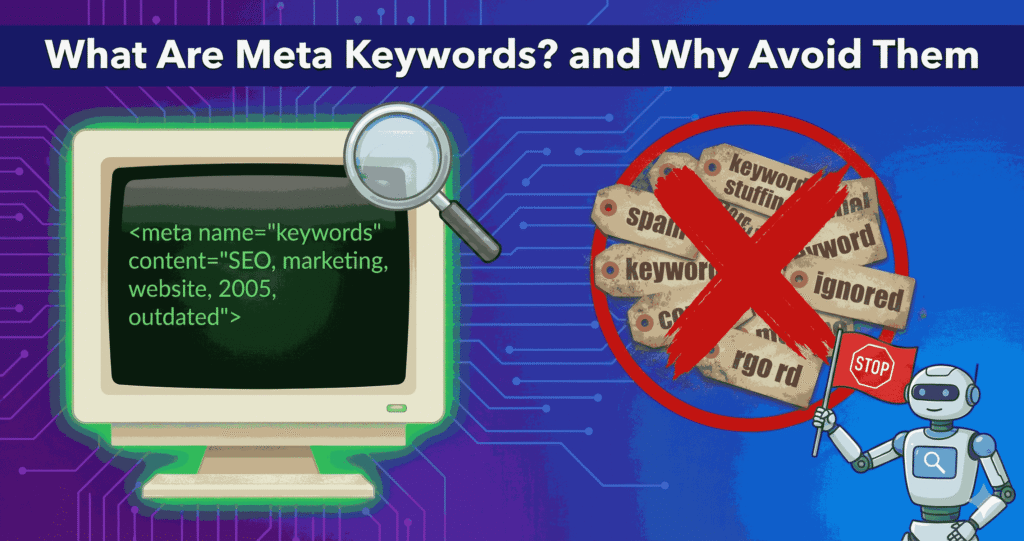
Meta keywords are a deprecated HTML metadata attribute once utilized to communicate a page’s primary topics to search engine crawlers. This tag resides within the <head> section of a document’s HTML code.
The legacy code structure appears as follows:
<meta name="keywords" content="keyword one, keyword two, keyword three">
Search engines, such as Google, Bing, and Yahoo, previously utilized these tags to categorize content. Modern algorithms ignore this attribute in favor of on-page SEO semantic signals.
Why Meta Keywords Should Be Avoided
Reasons to Avoid Meta Keywords in SEO Strategy
Meta keywords provide zero ranking benefit because major search engines, such as Google and Yandex, exclude the tag from their ranking algorithms.
1. Algorithm Exclusion: Google officially confirmed the exclusion of meta keywords from its ranking factors in 2009. The attribute functions as a non-signal for 16 consecutive years.
2. Ignored HTML Elements: Google analyzes specific HTML tags, such as Title Tags, Meta Descriptions, and Canonical Tags, to determine relevance. The meta-keywords tag exists outside this verified list.
3. Resource Waste: Implementing meta keywords consumes optimization time without generating organic visibility.
Algorithm Evolution and The End of Keyword Stuffing
Search engines evolved their ranking systems to prioritize content quality over hidden metadata due to historical manipulation and keyword stuffing.
Early webmasters abused the meta-keyword attribute by inserting irrelevant terms to capture unrelated traffic. This behavior forced search engines to prioritize 4 modern signals:
- Content Quality (Depth, Accuracy, Originality)
- Semantic Context (Entity Relationships, Topical Coverage)
- User Behavior (Click-Through Rate, Dwell Time)
- Search Intent (Informational, Transactional, Navigational)
Search engines parse the visible body text to understand a topic, rendering hidden keyword lists obsolete.
Risks of Utilizing Meta Keywords Today
Using meta keywords exposes your internal keyword strategy to competitors and risks negative spam classification on specific search engines.
Redundant Overhead: Retaining these tags increases the document size without providing a functional upside.
Strategic Exposure: Competitors view your targeted search terms by inspecting the page source code.
Negative Signals: Bing utilizes the meta-keywords tag primarily as a spam signal to identify low-quality websites.
What Works Instead: Modern SEO Optimization Priorities
Successful SEO execution focuses on 5 high-impact elements that determine search visibility and user engagement.
- Title Tags: These serve as the primary clickable headline in search results. Examples include Homepage Titles and Product Category Titles.
- Meta Descriptions: These summarize page content to influence Click-Through Rates (CTR). Examples include Promotional Snippets and Informational Summaries.
- Heading Tags: These organize content hierarchy using H1, H2, and H3 tags to signal topical structure.
- Image Alt Text: This improves accessibility and visual search rankings for media assets.
- Structured Data: This communicates context through Schema.org vocabulary, such as Organization, Article, or Product schema.
Optimize these elements if you intend to establish topical authority. Use definitive data points to demonstrate expertise in your niche.
Legacy Systems and Edge Cases
Meta keywords persist within legacy Internal Site Search (ISS) systems and outdated Content Management Systems (CMS), such as early versions of SharePoint or custom enterprise frameworks.
Some internal search functions reference the keywords tag to categorize internal databases. This serves a backend administrative purpose rather than a search engine optimization goal. Replace these systems with 4 modern alternatives:
- Clean Taxonomy (Categories, Tags)
- Semantic Search Integrations (Algolia, Elasticsearch)
- Structured Data (JSON-LD)
- Descriptive On-Page Copy
Drop Meta Keywords, Invest Where It Counts!
Meta keywords represent a historical relic of the early internet that offers no value in a 2026 SEO environment. Visibility stems from factual certainty and structural precision rather than hidden code snippets.
Execute a technical audit if your website contains legacy metadata. Transition your resources to Content Depth, HTML Structure, and Entity Optimization to achieve sustainable rankings. Modern SEO requires user-focused optimization to satisfy complex search algorithms.
Conclusion:
Meta Keywords Are Dead. Move Forward!
The “meta keywords” tag had its time from the mid-1990s through the early to mid-2000s. But search engines evolved. SEO moved on. In 2026, and later on, we won’t see meta keywords as an essential or compulsory in the SEO universe.
Clinging to outdated tactics keeps you stuck in the past. Real visibility today comes from real content, real metadata, and real user‑focused optimisation.
Cloudex Marketing is ready to help you build a custom SEO strategy that works.