

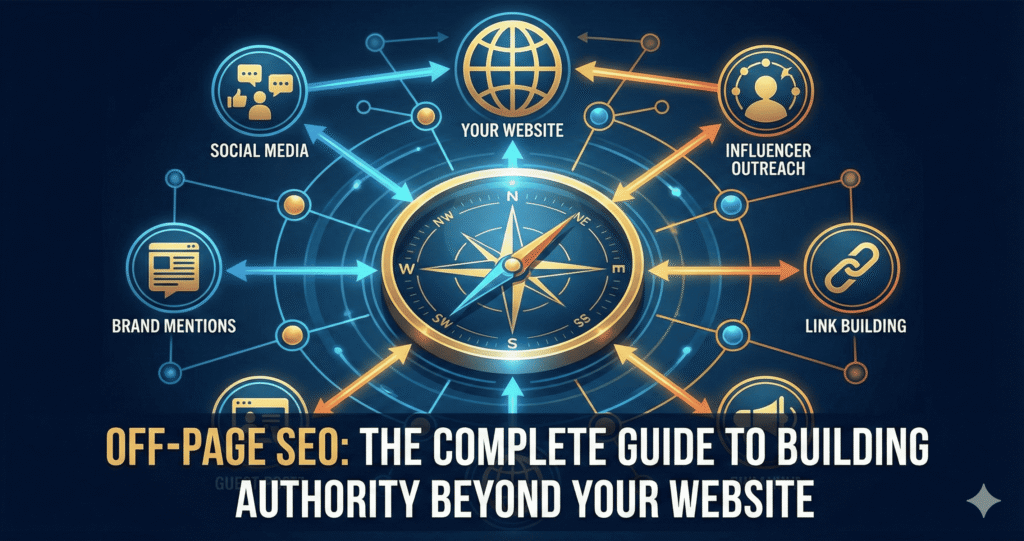
Welcome to our complete guide to Off-page SEO.
Here you’ll get everything you need to know about off-page optimization.Off-page SEO (or off-site SEO) is everything you do outside your website to improve your search rankings.
Websites with strong backlink profiles rank 3.8x higher than those without.
It’s not just about links. It’s about building trust, authority, and relevance across the entire web.
Let’s break down exactly how it works.
What Is Off-Page SEO?
Off-page SEO (also called off-site SEO) refers to all the actions you take outside your own website to impact your rankings in search engine results.
Think of it this way:
Your website is your home.
On the other hand, On-page SEO is everything inside. Clean rooms, fresh paint, organized furniture.
At the same time, Technical SEO is the foundation, plumbing, and electrical work.
But off-page SEO? That’s your reputation in the neighborhood.
It’s what people say about you when you’re not in the room.
Here’s what sets it apart:
| SEO Type | Where It Happens | What You Control |
| On-Page SEO | Your website | 100% |
| Technical SEO | Your website’s backend | 100% |
| Off-Page SEO | Other websites, platforms, mentions | Influenced, not controlled |
You can’t force someone to link to your site. You can’t make a journalist mention your brand. You can’t control what people say about you online.
But you can earn, build, and influence those signals.
And Google notices.
Why Off-Page SEO Matters
Off-Page SEO matters because Google doesn’t just trust what you say about yourself. It trusts what others say about you through backlinks, mentions, and third-party validation signals.
But here’s the hard truth:
- Your website could be perfect.
- Fast, clean, optimized.
- And still lose to competitors.
Why?
Here’s the problem no one talks about:
- Businesses spend all their focus, time, and effort on surface-level fixes
- On-page tweaks and technical adjustments
- while completely ignoring the deeper authority signals that actually move the needle in competitive search results.
Because Google doesn’t just trust what you say about yourself. It looks at what others say about you. This is where you earn Authority or an Authority Gap!
The Authority Gap
Authority is how much Google trusts your site based on external validation, such as backlinks, mentions, and signals from other credible sources across the web.
Imagine two websites selling the same product. Both have great content. Both load fast. Both use the right keywords.
But one has 500 spammy backlinks from random directories and sketchy sites. The other has just 12 quality ones from high-authority sources like industry publications and trusted news sites.
Who wins?
Obviously, the one with 12!
- Backlinks remain one of the top 3 ranking signals Google uses.
- Sites in the top 3 positions have, on average, 3.8x more backlinks than sites ranked #4–10.
What Happens When You Ignore Off-Page SEO
You get stuck on page 2. Or worse, page 5.
Your competitors develop comprehensive off-page SEO strategies while you focus only on your own site. They earn links from industry blogs, get mentioned in news articles, and build authority, trust, and relevance through third-party validation.
And Google rewards them.
You? You’re invisible.
How Off-Page SEO Builds Authority
Authority grows when credible sites link to you. Each quality backlink signals to Google: “This source knows what they’re talking about.”
For example, a single link from Harvard Business Review carries more weight than 100 links from unknown blogs. It validates your expertise in your field.
How Off-Page SEO Builds Trust
Trust comes from third-party validation that Google can verify. Positive reviews, mentions in reputable news outlets, and consistent NAP citations prove you’re legitimate.
For example, a local bakery featured in The Guardian and with 200+ Google reviews earns more trust than one with zero external validation.
How Off-Page SEO Builds Relevance
Relevance is established when industry-specific sites acknowledge you. Links from niche-relevant sources tell Google exactly what you’re about.
For example, a fitness blog earning links from Men’s Health and Bodybuilding.com signals clear topical relevance, helping rank for fitness-related searches better than generic directory links.
The Trust Algorithm
Trust is Google’s confidence that your site is legitimate, credible, and safe for users. The trust algorithm evaluates external signals, like who links to you, mentions you, and vouches for your credibility, to determine if you’re worth ranking.
This is where E-E-A-T comes in.
What is EEAT?
EEAT (Experience, Expertise, Authoritativeness, Trustworthiness) is a framework that Google uses to assess whether content creators (website owners or businesses) have real-world experience, proven expertise, industry authority, and overall trustworthiness.
That means:
- Links from credible sites = trust signals
- Brand mentions in news = authority signals
- Positive reviews and engagement = relevance signals
And that’s exactly what off-page SEO helps you do.
Core Components of Off-Page SEO
Let’s break down the key elements that make off-page SEO strategies work. Each one builds a piece of your online reputation.
1. Link Building (The Foundation)
Link building is the process of acquiring hyperlinks from other websites to your own. It’s a deliberate strategy to earn, build, and secure connections that signal your site’s value to search engines.
Backlinks are the byproduct of link building. The actual links you earn through this process. Think of link building as the effort; backlinks are the result.
And each backlink acts as a vote of confidence from other websites. When a trusted site links to you, Google sees it as validation.
But not all links are equal.
What Makes a Backlink Valuable?
| Factor | What It Means |
| Authority | Links from high-DR sites (like Forbes, BBC, and more) carry more weight |
| Relevance | A link from an industry blog matters more than a random directory |
| Placement | Editorial links in content beat footer or sidebar links |
| Anchor Text | Natural, varied anchor text performs better than keyword-stuffed text |
Types of Backlinks
Dofollow vs. Nofollow:
A dofollow link allows search engines to follow it and pass SEO value (link equity) to your site. A nofollow link includes a tag that tells search engines not to pass direct ranking value, though it still contributes to traffic and brand visibility.
Relation Between Dofollow & Nofollow Links
| Dofollow Links | Nofollow Links |
| Both are hyperlinks pointing to your website | Both are hyperlinks pointing to your website |
| Both drive referral traffic from the linking site | Both drive referral traffic from the linking site |
| Both contribute to a natural backlink profile | Both contribute to a natural backlink profile |
| Both increase brand visibility and awareness | Both increase brand visibility and awareness |
| Both should exist in a healthy link profile | Both should exist in a healthy link profile |
Difference Between Dofollow & Nofollow Links
| Dofollow Links | Nofollow Links |
| Pass SEO value and boost rankings | Don’t pass direct SEO value |
| Most valuable for authority building | Primarily valuable for traffic and brand awareness |
| Followed by search engine crawlers | Ignored by crawlers for ranking purposes |
| Directly influence domain authority | Indirectly support trust signals |
| Preferred for link building campaigns | Often from social media, comments, or sponsored content |
Editorial vs. Directory:
An editorial link is earned naturally when another site references your content within their article or resource. A directory link is a listing you submit to directories like Yelp, Yellow Pages, or niche industry sites.
Relation Between Editorial & Directory Links
| Editorial Links | Directory Links |
| Both are backlinks pointing to your site | Both are backlinks pointing to your site |
| Both contribute to your overall link profile | Both contribute to your overall link profile |
| Both can drive referral traffic | Both can drive referral traffic |
| Both help establish online presence | Both help establish online presence |
| Both should be from relevant, quality sources | Both should be from relevant, quality sources |
Difference Between Editorial & Directory Links
| Editorial Links | Directory Links |
| Earned organically through content quality (gold standard) | Submitted manually to listing sites |
| High trust and relevance signals | Helpful for local SEO and NAP consistency |
| Require outreach, relationships, or exceptional content | Require simple form submissions |
| Context-rich, embedded in relevant content | Standalone listings with basic business info |
| Harder to earn but more valuable for rankings | Easier to acquire but lower individual impact |
Link building is just one piece of the puzzle. To see how all the SEO elements work together, on-page, technical, and off-page, check out our complete SEO guide that breaks down every strategy you need for sustainable rankings.
How to Build Links the Right Way
Here’s the ethical approach that actually works when building links:
Step 1: Identify Link Opportunities
Use tools like Ahrefs or Semrush for competitor analysis. See where your competitors get links. Find gaps.
Example: Your competitor has links from 15 industry blogs. You’re on 3. That’s 12 opportunities.
Step 2: Create Link-Worthy Assets
Build content people want to link to:
- Original research and data
- Ultimate guides (like this one)
- Tools or calculators
- Infographics
Step 3: Conduct Outreach
Build relationships with editors, bloggers, and journalists. Don’t spam. Offer value first.
Simple outreach template:
“Hi [Name], I noticed you wrote about [topic]. I just published [resource] that includes [unique data/insight]. Thought it might be useful for your readers.”
Step 4: Earn Links Through Tactics
- Guest posting: Write for industry blogs, earn editorial links
- Broken link building: Find dead links on relevant sites, suggest your content as a replacement
- Resource pages: Pitch your content to curated lists
- Digital PR: Get featured in news articles, podcasts, or industry publications
Ethical vs. Spam: The Comparison
| Ethical Link Building | Spam Tactics (Avoid) |
| Earn links through quality content | Buy links from link farms |
| Build genuine relationships | Use automated outreach tools |
| Natural, varied anchor text | Keyword-stuffed anchor text |
| Relevant, authoritative sources | Low-quality directories |
| Long-term strategy | Quick wins, high risk |
Google penalizes spam.
Stick to ethical link building,
and you’ll win in the long term.
Want help building a safe, effective backlink strategy? If you need to get help with off-page SEO services, our team can show you exactly where to start.
2. Digital PR & Media Mentions
What is Digital PR?
Digital PR is a strategic marketing approach focused on earning online coverage, mentions, and backlinks from news outlets, industry publications, and authoritative websites through newsworthy content, journalist outreach, and relationship building.
What is Media Mentions?
Media mentions occur when your brand, product, or company name appears in online publications, news articles, blogs, podcasts, or social media—either with or without a direct link back to your website.
Relation Between Digital PR & Media Mentions
| Digital PR | Media Mentions |
| Both increase brand visibility across the web | Both increase brand visibility across the web |
| Both build authority and credibility signals | Both build authority and credibility signals |
| Both can generate backlinks from authoritative sources | Both can generate backlinks from authoritative sources |
| Both require strategic outreach and relationship building | Both require strategic outreach and relationship building |
| Both contribute to E-E-A-T and trust signals | Both contribute to E-E-A-T and trust signals |
Difference Between Digital PR & Media Mentions
| Digital PR | Media Mentions |
| A strategic campaign to earn coverage | The actual result—your brand being mentioned |
| Involves proactive outreach and pitching | Can happen organically without your effort |
| Includes press releases, journalist relationships, and newsworthy content | Simply the appearance of your brand name online |
| Broader strategy encompassing multiple tactics | Single instance of brand visibility |
| Focuses on earning placements through value and newsworthiness | Can be linked or unlinked, positive or negative |
Why PR Matters for SEO
When Forbes, TechCrunch, or industry leaders mention your brand, Google sees you as credible. These placements strengthen domain authority and boost search visibility.
Brands with consistent media coverage rank 2.1x higher for competitive keywords.
Why Media Mentions Matter for SEO
Media mentions, whether linked or unlinked, signal to Google that your brand is talked about, trusted, and relevant in your industry. Each mention validates your authority and helps Google understand your brand’s topical relevance.
Brand mentions contribute to how search engines understand and evaluate entities, even without direct backlinks, strengthening your overall online reputation and search presence.
But here’s the uncomfortable truth: The entire concept of “brand mentions” as a direct ranking factor has been widely misinterpreted in the SEO community.
According toSearch Engine Journal’s analysis, the idea of brand mentions affecting rankings stemmed from a misreading of Google’s patents.
“Unlinked brand mentions aren’t a direct ranking signal. They don’t work the way many SEOs assumed.”
So what’s the real value?
While unlinked mentions don’t directly boost rankings like backlinks do, they still matter for:
- Building brand awareness that leads to searches (which do affect rankings)
- Generating publicity that often results in actual backlinks
- Strengthening brand authority in Google’s entity understanding
Focus on earning mentions that turn into links, traffic, and genuine brand recognition. Not mentions for the sake of mentions.
How to Secure PR Placements
Tactic 1: Create Newsworthy Content
- Original surveys or research
- Industry trend reports
- Expert commentary on breaking news
Tactic 2:
- Pitch Journalists.
- Use platforms like HARO (Help A Reporter Out) to connect with journalists looking for sources.
Tactic 3:
- Partner with Publications.
- Offer exclusive insights, data, or interviews to industry blogs.
A single link from a trusted news site can be worth 100 directory links. Focus on quality, not quantity.
3. Brand Mentions
Brand mentions are any time your business name appears online. Whether on blogs, news sites, forums, or social media. With or without a hyperlink back to your website.
What are Linked Brand Mentions?
Linked brand mentions occur when your business name is mentioned online and includes a clickable hyperlink directing users back to your website, passing SEO value and referral traffic.
What are Unlinked Brand Mentions?
Unlinked brand mentions happen when your business name appears online without a hyperlink. Google can still recognize these mentions and use them as trust and authority signals.
How Unlinked Mentions Help SEO
Google’s algorithms can identify and track brand mentions even without links. According to Google’s John Mueller, mentions contribute to understanding brand authority and relevance.
Example:
“Cloudex Marketing helped us triple our organic traffic in 6 months.”
No link. But Google still sees it as a trust signal.
How to Monitor Brand Mentions
Use tools like:
- Google Alerts: Free, basic tracking
- Ahrefs: Track brand mentions and backlinks together
- BuzzSumo: Monitor social and content mentions
When you find unlinked mentions, reach out politely and ask if they’d add a link. Many will.
4. Social Signals & Engagement
What are Social Signals?
Social signals are the collective metrics from social media platforms, such as likes, shares, comments, and overall engagement, that indicate how users interact with and respond to your content across social networks.
What is Social Engagement?
Social engagement refers to the direct interactions users have with your content on social platforms, such as commenting, sharing, liking, clicking, or discussing your posts, showing active audience participation and interest.
Are Both Connected? How?
Yes, they’re directly connected. Social engagement creates social signals. When users engage with your content (likes, shares, comments), those actions generate measurable social signals that search engines can observe, potentially influencing your content’s visibility and link-earning potential.
Relation Between Social Signals & Engagement
| Social Signals | Social Engagement |
| Both originate from social media platforms | Both originate from social media platforms |
| Both indicate content quality and user interest | Both indicate content quality and user interest |
| Both can indirectly influence SEO through visibility | Both can indirectly influence SEO through visibility |
| Both drive traffic and brand awareness | Both drive traffic and brand awareness |
| Both help content reach wider audiences | Both help content reach wider audiences |
Difference Between Social Signals & Social Engagement
| Social Signals | Social Engagement |
| The measurable metrics (likes, shares, comments count) | The actual user actions creating those metrics |
| Quantitative data search engines can observe | Qualitative interactions between users and content |
| Aggregate numbers reflecting overall performance | Individual moments of user participation |
| Passive indicator of content reach | Active demonstration of audience involvement |
| Used by algorithms to assess content popularity | Represents real human interest and interaction |
How Social Signals Work
When your content gets shared on LinkedIn, Twitter, or Reddit, it:
- Increases visibility
- Drives referral traffic
- Attracts potential backlinks from content creators
Content with high social engagement earns 22% more backlinks on average.
Platform-Specific Strategies
| Platform | Best For | Tactics |
| B2B, thought leadership | Share insights, engage with industry posts | |
| Real-time engagement, news | Participate in trending conversations | |
| Niche communities | Answer questions, share valuable resources (no spam) | |
| Quora | Authority building | Provide detailed answers with links to relevant content |
Engage authentically. Don’t just drop links. Add value first.
5. Local SEO & Citations
Local SEO is the process of optimizing your online presence to attract customers from specific geographic areas through local search results, Google Maps, and location-based queries.
If you serve local customers, local citations are critical.
What Are Citations?
A citation is any mention of your business name, address, and phone number (NAP) online.
Examples:
- Google Business Profile
- Yelp
- Industry directories
- Local blogs
Relation Between Local SEO & Citations
| Local SEO | Citations |
| Both target geographically relevant customers | Both target geographically relevant customers |
| Both improve local search visibility | Both improve local search visibility |
| Both require consistent NAP information | Both require consistent NAP information |
| Both contribute to Google’s local trust signals | Both contribute to Google’s local trust signals |
| Both help businesses appear in map results | Both help businesses appear in map results |
Difference Between Local SEO & Citations
| Local SEO | Citations |
| Comprehensive strategy covering multiple tactics | Specific listings of business NAP information |
| Includes Google Business Profile, reviews, local content, backlinks | Simply business name, address, phone number on directories |
| Broader optimization for local search rankings | One component supporting overall local strategy |
| Ongoing process requiring constant optimization | Can be built once, then maintained periodically |
| Focuses on ranking for “near me” and geo-targeted queries | Focuses on NAP consistency across platforms |
If your business depends on local customers but your citations are inconsistent or missing, you’re losing rankings to competitors who got it right. Our local SEO services help you build accurate citations, optimize your presence, and dominate local search results.
Why NAP Consistency Matters
NAP stands for Name, Address, and Phone Number. They are the three core pieces of business information that must remain identical across every online platform where your business is listed.
Google cross-checks your NAP across the web. Inconsistent info (different phone numbers, outdated addresses) confuses Google and weakens local rankings.
How to Build Local Citations
Step 1: Optimize Google Business Profile
- Complete every section
- Add photos, hours, services
- Collect and respond to reviews
Step 2: Submit to Directories
- Yelp, Yellow Pages, industry-specific sites
- Ensure NAP is identical everywhere
Step 3: Earn Local Backlinks
- Partner with local businesses
- Sponsor community events
- Get featured in local news
6. Influencer & Partnership Marketing
What is Influencer Marketing?
Influencer marketing involves collaborating with individuals who have established credibility and a dedicated following in your industry to promote your brand, products, or content to their engaged audience.
What is Partnership Marketing?
Partnership marketing is a collaborative strategy where two or more businesses or entities work together on joint campaigns, content, or initiatives to mutually benefit from shared audiences and resources.
Types of Partnerships
- Co-marketing: Joint webinars, ebooks, research
- Podcast appearances: Share expertise, earn backlinks
- Video collaborations: YouTube, LinkedIn videos
How to Identify the Right Partners
Look for:
- Relevant audience overlap
- Similar values and quality standards
- Genuine engagement (not just follower count)
Build relationships first. Offer value. Then collaborate strategically.
Relation Between Influencer & Partnership Marketing
| Influencer Marketing | Partnership Marketing |
| Both leverage external audiences for visibility | Both leverage external audiences for visibility |
| Both build credibility through association | Both build credibility through association |
| Both require relationship building and trust | Both require relationship building and trust |
| Both can generate backlinks and brand mentions | Both can generate backlinks and brand mentions |
| Both amplify reach beyond your owned channels | Both amplify reach beyond your owned channels |
Difference Between Influencer & Partnership Marketing
| Influencer Marketing | Partnership Marketing |
| Focuses on individuals with personal following | Focuses on brands or businesses as collaborators |
| Often involves sponsored or paid arrangements | Usually mutual value exchange, less transactional |
| Audience trusts the person, not the brand | Audience trusts both brands equally |
| Campaigns are typically short-term or one-off | Partnerships often long-term and strategic |
| Reaches consumers through influencer’s voice | Reaches customers through co-branded initiatives |
7. Content Distribution & Syndication
Creating great content isn’t enough. You need to distribute it.
What is Content Distribution?
Content distribution is the process of sharing and promoting your content across multiple channels, social media, email, third-party platforms, and communities, to reach wider audiences beyond your own website.
What is Content Syndication?
Content syndication is republishing your existing content on third-party websites or platforms like Medium, LinkedIn, or industry publications to expand reach while maintaining attribution back to the source.
Relation Between Content Distribution & Syndication
| Content Distribution | Content Syndication |
| Both expand content reach beyond your website | Both expand content reach beyond your website |
| Both drive referral traffic and brand awareness | Both drive referral traffic and brand awareness |
| Both can generate backlinks and mentions | Both can generate backlinks and mentions |
| Both leverage external platforms for visibility | Both leverage external platforms for visibility |
| Both amplify content ROI through wider exposure | Both amplify content ROI through wider exposure |
Difference Between Content Distribution & Syndication
| Content Distribution | Content Syndication |
| Broad strategy of sharing content everywhere | Specific tactic of republishing content elsewhere |
| Includes original posts, snippets, and variations | Full republication of existing articles |
| Multiple formats (social posts, videos, infographics) | Typically the same format (article republished as article) |
| Can be real-time or scheduled sharing | Usually happens after original content is published |
| Focuses on maximum visibility across channels | Focuses on leveraging established platforms’ audiences |
Tactics for Wider Reach
- Repurpose blog posts into infographics, videos, podcasts
- Syndicate content on Medium, LinkedIn, industry platforms
- Share on social media with varied messaging
Example: Turn a 3,000-word guide into:
- 10 LinkedIn carousel posts
- A YouTube explainer video
- An infographic for Pinterest
- A podcast episode
More formats = more visibility = more link opportunities.
Great content only works when people see it. If you need high-quality, link-worthy content that’s actually worth distributing, our content writing services and blog writing services help you create assets that naturally attract backlinks and shares.
8. Reputation Management
Reputation management is the process of monitoring, influencing, and controlling how your brand is perceived online through reviews, mentions, customer feedback, and public sentiment across the web.
Your online reputation directly affects how Google (and users) perceive you.
What to Monitor
- Reviews: Google, Yelp, Trustpilot
- Social mentions: What people say about your brand
- Forums and communities: Reddit, Quora, niche sites
How to Manage Reputation
- Respond to reviews (positive and negative).
- Thank happy customers.
- Address complaints professionally.
Example positive review response:
“Thank you so much for the kind words! We’re thrilled we could help. If you ever need anything else, we’re just a message away.”
Example negative review response:
“We’re sorry to hear about your experience. We’d love to make this right. Please contact us at [email] so we can resolve this.”
Address Complaints Professionally
Addressing complaints professionally means responding to negative feedback with empathy, accountability, and a genuine commitment to resolution, turning dissatisfied customers into opportunities to demonstrate your brand’s integrity.
Consequences of ignoring or mishandling complaints:
- Damages online reputation and trust signals
- Discourages potential customers from reading reviews
- Escalates negative sentiment across platforms
- Weakens Google’s perception of your business’s credibility
- Can result in more negative reviews from frustrated customers
Example Scenario:
A customer leaves a 2-star Google review: “Ordered a product that arrived damaged. No one responded to my emails for a week. Very disappointed.”
Poor response (or no response): Silence, or a defensive reply like “We ship thousands of orders perfectly fine. Must be the courier’s fault.”
Professional response:
“We sincerely apologize for the damaged product and delayed response. This isn’t the experience we want for our customers. We’ve sent you a replacement today with expedited shipping and issued a full refund. Please reach out to [email] directly if anything else needs attention. Thank you for giving us the chance to make this right.”
This response shows accountability, offers a solution, and signals to both Google and future customers that you care about service quality.
Track sentiment with tools like:
- Mention
- Brand24
How Off-Page SEO Works: The Process
With these two tools, you can catch issues early.
Here’s exactly how to develop comprehensive off-page SEO strategies step-by-step.
Step 1: Audit Your Current Link Profile
Use tools like Ahrefs or Semrush to:
- See all your existing backlinks
- Identify toxic or spammy links
- Analyze anchor text distribution
What to look for:
- Backlink count
- Referring domains
- Domain authority of linking sites
- Anchor text variety
Not sure where your backlink profile stands or what needs fixing? Our SEO audit service includes:
- A complete backlink analysis
- Identifies toxic links
- gives you a clear roadmap to build a healthier, stronger link profile
Step 2: Analyze Competitor Backlinks
Find out where your competitors get links.
How to do it:
- Enter competitor URL in Ahrefs
- Go to “Backlinks” tab
- Filter by DR (domain rating) >30
- Export the list
Now you have a roadmap of link opportunities.
Step 3: Execute Strategic Link Acquisition
Pick 3-5 tactics based on your resources:
- Guest posting: Pitch 10 industry blogs per month
- Broken link building: Find 20 broken links, offer replacements
- Digital PR: Create 1 data-driven asset per quarter, pitch to journalists
- Resource pages: Find 15 relevant curated lists, pitch inclusion
Track everything. Monitor success rates. Refine your approach monthly.
Step 4: Amplify Through PR and Mentions
Strategize your content calendar around:
- Industry events
- Breaking news
- Seasonal trends
Secure placements by offering:
- Expert quotes
- Original data
- Unique perspectives
Step 5: Optimize Local Citations (If Applicable)
If applicable means if it applies to your situation or if it’s relevant to you.
For example:
A local bakery in Manchester needs local citations on Google Business Profile and Yelp. But an international SaaS company selling software worldwide? Local citations don’t apply. They’re not relevant to their business model.
It depends on whether you serve local customers or not.
But if you’re a local business with an authentic local location and identity:
- Develop a consistent NAP format
- Submit to the top 20 local directories
- Improve Google Business Profile monthly
Step 6: Monitor, Audit, and Refine Continuously
Set up monthly checks:
- New backlinks gained
- Toxic links to disavow
- Brand mention growth
- Competitor movements
Use tools like Ahrefs for backlink monitoring and Google Alerts for brand tracking.
Adjust strategy based on what’s working.
This process works. But it takes expertise, tools, and consistent effort to execute correctly. Let’s get this process working for you. Our off-page SEO services handle everything from link acquisition to brand amplification, so you can focus on running your business while we build your authority.
Benefits of Off-Page SEO (Why It’s Worth the Effort)
Let’s talk results. What do you actually get from solid off-page SEO?
1. Higher Rankings in SERPs
SERPs (Search Engine Results Pages) are the pages Google displays after you enter a search query, where your website either appears prominently or gets buried beneath competitors.
Quality backlinks directly improve your position in these results. The #1 result on the SERPs has an average of 3.8x more backlinks than positions #2-10.
More quality backlinks = better rankings.
When you build authority through off-page SEO, Google trusts your site more and rewards you with higher visibility where it matters most. Page one, top three positions.
2. Increased Organic and Referral Traffic
Organic traffic is visitors who find your site through unpaid search results on Google. Referral traffic is visitors who click through from links on other websites, social platforms, or online mentions.
Links drive traffic two ways:
- Direct clicks from the linking site (referral traffic)
- Higher rankings bring more organic searches
A study by Ahrefs found that pages with backlinks get 5.7x more organic traffic than pages without.
When you earn quality backlinks, you’re not just improving rankings. You’re opening multiple pathways for potential customers to discover you. Every link is both a trust signal to Google and a direct route for qualified visitors.
Want to learn more about maximizing your site’s visibility? Check out our complete guide on:
3. Enhanced Domain Authority and Trust
Domain Authority (DA) is a metric (developed by Moz) that predicts how well your website will rank on search engines, scored from 1-100 based on factors like backlink quality, quantity, and overall link profile strength.
Every quality backlink strengthens your site’s authority. Over time, this compounds.
Google trusts sites that other trusted sites link to. Simple as that.
When reputable industry blogs, news outlets, and authoritative sources consistently link to you, your DA grows, and so does Google’s confidence in ranking your content. The higher your authority, the easier it becomes to rank for competitive keywords and earn even more valuable links.
Building domain authority through off-page SEO is crucial, but it works best when your on-page foundation is solid. Learn how to optimize every element of your website in our on-page SEO guide to maximize the impact of every backlink you earn.
4. Greater Brand Awareness and Recognition
Brand awareness is how familiar your target audience is with your business name, products, and services, essentially, how often people recognize and remember your brand when they need what you offer.
When your brand appears across the web. In articles, mentions, and social posts. More people discover you.
Brand searches increase. And branded searches have higher conversion rates.
Every mention, link, or feature on external sites expands your reach beyond your own marketing efforts. People who’ve seen your brand multiple times across trusted sources are far more likely to choose you over unknown competitors when they’re ready to buy.
5. Long-Term ROI and Sustainable Growth
ROI (Return on Investment) measures the profit you gain compared to what you spend. In off-page SEO, it reflects the lasting value backlinks and authority provide long after the initial effort.
Unlike paid ads that stop when you stop paying, quality backlinks deliver value for years.
One strong link earned today can drive traffic and rankings for months or years.
This compounding effect makes off-page SEO one of the most cost-effective long-term investments. The authority you build today continues paying dividends, creating sustainable growth that doesn’t disappear the moment your budget runs out.
Ready to invest in SEO strategies that keep working long after launch? Let’s talk about building sustainable authority for your business. Get in touch with us, and we’ll show you exactly how.
6. Improved User Experience Through Multiple Discovery Pathways
Discovery pathways are the various routes users take to find your website, whether through search engines, social media, direct links, referrals, or brand mentions across the web.
Users find you through:
- Google search
- Social media shares
- Industry blog links
- News articles
More pathways = more qualified traffic = better business outcomes.
When your brand exists across multiple trusted platforms, you’re not dependent on a single traffic source. Users encounter you organically in different contexts, which builds familiarity and trust before they even visit your site, leading to higher engagement and conversions.
Common Off-Page SEO Mistakes to Avoid
Even smart marketers make these mistakes. Don’t be one of them.
Mistake 1: Buying Links or Using Link Farms
Why it’s bad: Google’s algorithm can identify purchased links. Penalties include ranking drops or complete deindexing.
What to do instead: Earn links through value. Build relationships. Create link-worthy content.
Mistake 2: Ignoring Link Quality for Quantity
100 low-quality links < 10 high-quality links.
Focus on relevance and authority, not just numbers.
Mistake 3: Over-Optimized Anchor Text
Using exact-match keywords in every anchor text looks spammy.
Example of bad anchor text:
- “best SEO services” x 50 links
Example of natural anchor text:
- “this guide”
- “Cloudex Marketing”
- “check this out”
- “best SEO services” (occasionally)
Google prefers variety.
Mistake 4: Neglecting Brand Mentions and Social Signals
Links aren’t everything. Monitor and amplify brand mentions and social engagement, too.
Google tracks unlinked mentions and social activity as trust signals. Ignoring them means missing opportunities to strengthen your authority and leaving your reputation unmanaged. Competitors who actively build brand presence beyond just backlinks will outrank you in credibility.
Mistake 5: Inconsistent NAP for Local Businesses
One wrong digit in your phone number across directories? Google gets confused. Rankings suffer.
Inconsistent NAP data across platforms sends conflicting signals to Google, making it harder to verify your business’s legitimacy. This directly weakens your local search visibility and impacts how customers find you in map results.
Solution: Use a spreadsheet to track NAP across all platforms. Keep it identical everywhere. Google Business Profile, Yelp, industry directories, social profiles. Audit quarterly to catch discrepancies early.
Mistake 6: Failing to Monitor Toxic Backlinks
Not all links help. Some hurt.
Spammy sites linking to you can weaken your profile and trigger Google penalties. Toxic backlinks from link farms, adult sites, or irrelevant foreign domains damage your domain authority and trustworthiness in Google’s eyes.
Use Google’s Disavow Tool to eliminate toxic links you can’t manually remove.
Check your backlink profile monthly. Prevent damage before it happens; catching toxic links early protects your rankings from sudden drops.
Off-Page SEO Best Practices (What Actually Works)
Let’s cut through the noise. Here’s what the experts recommend.
1. Focus on Quality Over Quantity
One link from The New York Times > 1,000 links from random blogs.
Therefore, prioritize authoritative, relevant sites.
2. Build Relationships, Not Just Links
The best links come from real relationships.
- Engage with industry bloggers on social media
- Comment thoughtfully on their content
- Offer value before asking for anything
“The best way to earn links is to create something so valuable that people can’t help but reference it. But relationships accelerate that process. When you’ve built trust with editors and writers, they think of you first when they need sources.”
Build relationships where links become a natural byproduct, not a forced transaction. The strongest backlink profiles come from genuine connections, not cold outreach templates.
3. Diversify Anchor Text Naturally
Use varied anchor text:
- Branded: “Cloudex Marketing”
- Generic: “click here,” “this resource”
- Exact-match: “off-page SEO” (sparingly)
- Partial-match: “learn more about off-page strategies”
Keep it natural. Google identifies patterns.
4. Earn Links Through Value, Not Manipulation
Create content worth linking to:
- Original research
- Comprehensive guides
- Tools and calculators
- Case studies with real data
Then conduct outreach to let people know it exists.
5. Monitor Backlink Health Regularly
Set up alerts in Ahrefs or Semrush. Track:
- New backlinks
- Lost backlinks
- Changes in DR (domain rating)
- Toxic link growth
Refine your strategy based on data.
6. Align Tactics with Google’s Guidelines
According to Google Search Essentials, “The best way to get other sites to create high-quality, relevant links to yours is to create unique, relevant content that can naturally gain popularity.”
Tools for Off-Page SEO (What the Pros Use)
The right tools make everything easier. Here’s what to use:
1. Ahrefs
Best for: Backlink analysis, competitor research
Key features:
- See all backlinks to any site
- Analyze anchor text distribution
- Identify link opportunities
- Track ranking changes
Use case: Enter your competitor’s URL, see where they get links, and find gaps.
2. Semrush
Best for: Link building, brand monitoring
Key features:
- Backlink audit tool
- Link building outreach tracker
- Brand mention monitoring
- Competitor backlink analysis
Use case: Monitor new and lost backlinks weekly. Track brand mentions across the web.
3. Moz
Best for: Domain authority tracking
Key features:
- DA (Domain Authority) and PA (Page Authority) metrics
- Link Explorer
- Spam score for backlinks
Use case: Track your site’s DA growth over time. Compare against competitors.
4. Google Alerts
Best for: Brand mention tracking (free)
Key features:
- Email alerts when your brand is mentioned
- Monitor competitor mentions
- Track industry keywords
Use case: Set up alerts for your brand name. Reach out when unlinked mentions appear.
5. BuzzSumo
Best for: Content distribution insights
Key features:
- See the most-shared content in your niche
- Identify influencers and journalists
- Track content performance across social platforms
Use case: Find trending topics, see who shares similar content, and build relationships with those influencers.
How Long Does Off-Page SEO Take?
Let’s be honest: off-page SEO isn’t instant.
Realistic Timelines
- 3-6 months: Start seeing noticeable improvements in rankings and traffic
- 6-12 months: Significant growth in domain authority and backlink profile
- 12+ months: Compounding results, sustainable traffic increases
Only 5.7% of pages rank in the top 10 within a year. The median time? About 2 years for competitive keywords.
What Affects Speed?
| Factor | Impact |
| Starting point | New site vs. established site with existing links |
| Competition | Low-competition niches move faster |
| Strategy quality | Smart, targeted tactics deliver faster results |
| Resources | More time/budget = faster execution |
| Industry | Some industries (legal, finance) are harder to build authority in |
Why Patience Pays Off
Here’s the good news: results compound.
Your first 10 backlinks might take 3 months to earn. But those links make it easier to earn the next 10. Your growing authority strengthens your ability to secure better placements.
- Month 1-3: Slow progress
- Month 4-6: Momentum builds
- Month 7-12: Exponential growth
- 12+ months: Self-sustaining authority
This is why consistent effort delivers better long-term ROI than quick wins.
Off-Page SEO vs. On-Page SEO vs. Technical SEO
All three work together. Here’s how they compare:
| Aspect | Off-Page SEO | On-Page SEO | Technical SEO |
| What it is? | Actions outside your site to build authority | Optimizing content and HTML on your pages | Backend optimization for crawling and indexing |
| Key Activities | Link building, PR, brand mentions, social signals | Content optimization, meta tags, headers, internal linking | Site speed, mobile-friendliness, structured data, XML sitemaps |
| Control Level | Influenced (you can’t control what others do) | Full control | Full control |
| Impact on Rankings | High (trust and authority signals) | High (relevance and user experience) | High (crawlability and indexing) |
| Timeline | 3-12+ months | 1-3 months | 1-6 months |
| When to Prioritize | After on-page and technical are solid | First step for new sites | Simultaneously with on-page |
How They Work Together
Think of it like building a business:
- Technical SEO = Your infrastructure (store location, plumbing, electricity)
- On-Page SEO = Your product and presentation (merchandise, layout, signage)
- Off-Page SEO = Your reputation and marketing (word-of-mouth, reviews, partnerships)
You need all three to succeed.
A technically perfect site with great content still needs backlinks to compete. A site with 1,000 backlinks but slow loading times won’t rank well either.
Integrate all three for best results.
Frequently Asked Questions About Off-Page SEO
Are backlinks still important in 2025?
Yes. Absolutely.
According to Google’s Gary Illyes, backlinks remain one of the top three ranking factors. A 2024 study by Semrush analyzing 10 million search results confirmed that quality backlink profiles strongly correlate with higher rankings.
While Google’s algorithm has evolved to include hundreds of factors, backlinks still strengthen your site’s authority and trustworthiness in ways other signals can’t.
How many backlinks do I need to rank?
There’s no magic number. It depends on:
- Your niche competition
- The quality of your backlinks
- Your existing domain authority
According to Ahrefs, the average #1 ranking page has 3.8x more backlinks than positions #2-10. But 10 high-authority links often outperform 100 low-quality ones.
Focus on quality and relevance over quantity.
Is off-page SEO safe, or could it get me penalized?
Ethical off-page SEO is completely safe. Google penalizes manipulative tactics like:
- Buying links
- Link farms
- Keyword-stuffed anchor text
- Private blog networks (PBNs)
As long as you earn links naturally, build real relationships, and follow Google’s guidelines, you’re safe.
When in doubt, ask: “Would this tactic exist if search engines didn’t exist?” If yes, it’s probably safe.
Do brand mentions help SEO even without links?
The answer is nuanced. While unlinked brand mentions don’t directly pass ranking value as backlinks do, they still play an indirect role in your SEO strategy.
“According to Google’s John Mueller:
“When people mention your brand name, it helps us to understand that your website is an entity… it helps to provide context for what your site is about.”
However, Mueller has also clarified that unlinked mentions aren’t a direct ranking factor. Their real value comes from:
- Building brand awareness that drives branded searches (which do influence rankings)
- Creating publicity that often leads to actual backlinks
- Helping Google understand your brand as an entity and its topical relevance
Monitor both linked and unlinked mentions. While links remain the priority, widespread brand visibility creates opportunities that ultimately strengthen your authority and drive more valuable linking opportunities.
Can off-page SEO work without links?
Technically, yes. But it’s harder.
You can improve visibility through:
- Social media engagement
- Brand mentions
- Local citations
- Reviews and reputation management
However, backlinks remain the strongest off-page SEO signal. A strategy without links is like trying to win a race with one leg.
Combine multiple tactics for the best results.
What’s the difference between off-page and off-site SEO?
They’re the same thing. Off-page SEO and off-site SEO are interchangeable terms referring to optimization activities outside your website.
Some prefer “off-page” because it mirrors “on-page.” Others use “off-site” to emphasize the external nature.
Either way, it means: actions beyond your website that impact your rankings.
How do I disavow toxic backlinks?
If spammy sites link to you without your consent:
- Identify toxic links using Ahrefs or Semrush (look for low DR, spammy anchor text, irrelevant sites)
- Try to get them removed manually (contact site owners)
- If unsuccessful, use Google’s Disavow Tool
- Upload a .txt file listing the URLs or domains to disavow
Google will then ignore those links when assessing your site. Use sparingly. Only for genuinely harmful links.
Should I focus on dofollow or nofollow links?
Prioritize dofollow links as they pass SEO value directly.
But don’t ignore nofollow links. They:
- Drive referral traffic
- Boost brand visibility
- Contribute to a natural link profile
- Can still send trust signals to Google
Before 2019, the rel=”nofollow” attribute was a directive. A command that forced Google to ignore the link for ranking purposes.
Here’s what changed: In 2019, Google announced a major shift in how they handle nofollow links.
“According to Google’s Danny Sullivan and Gary Illyes,
“nofollow links are now treated as “hints” rather than absolute directives, meaning Google can choose to pass value through them for ranking or crawling purposes.”
This means high-quality nofollow links from authoritative sources like major news sites or Wikipedia may actually contribute more than previously thought.
A healthy backlink profile includes both. Aim for 70-80% dofollow, 20-30% nofollow. An all-dofollow profile looks unnatural and can raise red flags. Focus on earning quality links regardless of their tag. Natural diversity is what Google expects.
How often should I audit my backlink profile?
Monitor monthly at a minimum. Audit deeply every quarter.
Monthly checks (1st of every month):
- New backlinks gained
- Lost backlinks
- Major changes in DR
Quarterly audits (every 90 days):
- Full toxic link review
- Anchor text distribution analysis
- Competitor comparison
- Strategy adjustment
Weekly monitoring (every 7 days): Set up automated alerts in Ahrefs or Semrush so you catch issues immediately. Sudden toxic link spikes, competitor movements, or lost high-value backlinks need quick attention.
Daily for critical campaigns: If you’re running active link-building or PR campaigns, check daily to track new placements and respond to opportunities fast.
Consistent monitoring prevents damage before it compounds and helps you refine your strategy based on real-time data.
Can I do off-page SEO myself, or do I need an agency?
You can do it yourself if you have:
- Time (10-20 hours/week minimum)
- Tools (Ahrefs, Semrush cost $100-400/month)
- Skills (outreach, relationship building, content creation)
- Patience (months to see results)
Most businesses find that getting help with off-page SEO services is more cost-effective than the time investment required to develop comprehensive off-page SEO strategies internally.
If you want expert support building authority the right way, our SEO agency can help you create a custom off-page strategy that will drive real results for you.
Conclusion:
Off-page SEO isn’t a quick fix. It’s a long game. Therefore, Building Authority Takes Time. But It’s Worth It.
But here’s what makes it worth the effort:
Every quality backlink you earn today delivers value for years. Every brand mention strengthens your reputation. Every relationship you build opens new opportunities.
Unlike paid ads that disappear when you stop paying, off-page SEO creates compounding returns. The authority you develop becomes a competitive moat that’s hard for others to cross.
The key is consistency. Focus on earning links through value. Build real relationships. Monitor your progress. Refine your approach based on data.
And remember:
- Google rewards sites that other trusted sites vouch for.
- That’s the entire game.
If you’re ready to develop comprehensive off-page SEO strategies but need expert guidance on where to start, our SEO agency in Pakistan will love to help. Let’s build an authority profile that earns rankings, not just reports.