


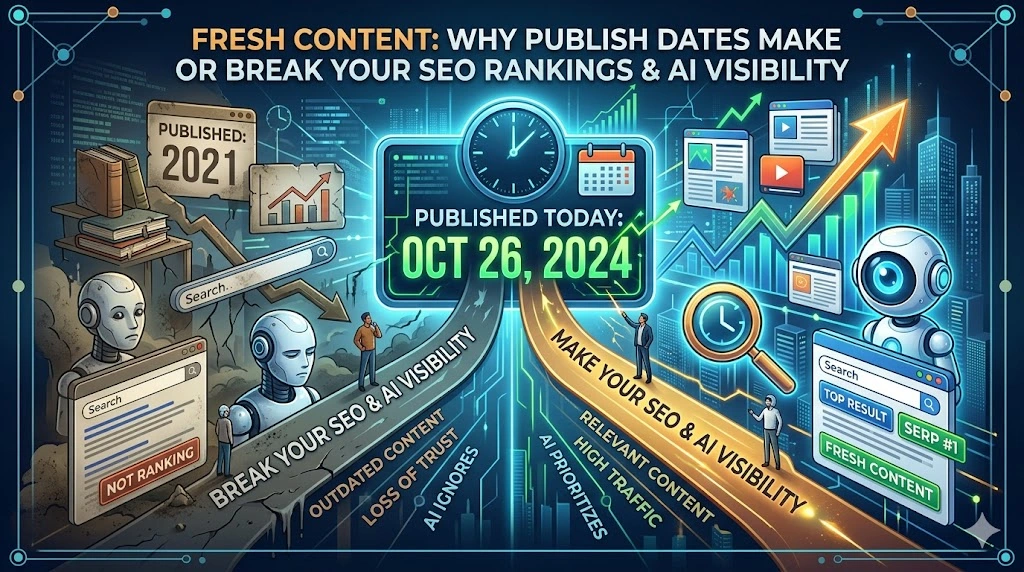
Your website’s oldest articles are actively hurting your rankings while competitors surge ahead with regularly updated content. Fresh content signals to Google and AI assistants that information is current, reliable, and worth prioritizing, earning higher rankings, more clicks, and increased AI citations.
Yet most businesses publish content once, then abandon it for years, watching rankings slowly decay whilst competitors systematically refresh outdated pages, capturing traffic you’re losing.
Content freshness means how recently pages were published or updated. In 2026’s fragmented search landscape, where AI assistants cite 25.7% fresher content than traditional Google results, content age directly impacts both visibility and competitiveness.
Why Fresh Content Wins Rankings and AI Citations
Google’s Query Deserves Freshness (QDF) Algorithm
When Google detects topics that need current information, including breaking news, product launches, and trending topics, it prioritizes recently updated pages. Certain queries semantically signal freshness demand: “new iPhone,” “2025 trends,” “latest news.” But QDF also watches for three signals:
- News sites actively covering the topic
- Blog posts are being published frequently
- Search volume spiking
When all three occur simultaneously, Google boosts fresh content, pushing stale articles down regardless of authority.
Users Prefer and Click Fresh Content
“Best CRM Tools 2023” gets fewer clicks than “Best CRM Tools 2026” at identical ranking positions because users assume outdated content contains obsolete information. Lower click-through rates trigger ranking decay. Google interprets weak clicks as relevance signals, pushing pages lower over time.
AI Assistants Show Strong Freshness Preference
ChatGPT cites content 393-458 days newer than traditional Google results. Perplexity and Gemini also strongly favor fresh content. This matters because AI citations increasingly drive discovery as ChatGPT usage grows 120%+ annually in Pakistan.
Which Content Types Need Most Frequent Updates
Breaking news and recurring events: Election results, tax deadlines, and seasonal topics require updates before peak season, capturing early search traffic.
Product recommendations: “Best laptops 2025” or “top CRM software” lists need annual (or quarterly) updates as new products launch and old ones become obsolete.
Evolving topics: Technology updates, regulations, and industry trends require regular monitoring. SEO strategy articles, AI guidelines, and business tools constantly shift, requiring 3-6 month update cycles.
Statistics and data articles: Outdated statistics undermine credibility and signal staleness to search engines. Replace annually with recent data.
Finding Stale Content at Scale
Use Ahrefs Site Audit or Screaming Frog with regex patterns matching your site’s date format. Search HTML for article:published_time and article:modified_time properties, then filter for pages never updated since publication or last updated before specific dates.
Prioritize pages by traffic opportunity gap, existing authority (measured by referring domains), which means updates show results faster. New content ranking position 11-20 offers quicker wins than page 1 content fighting established authority.
Proven Freshness Tactics
Close topical gaps: Check “People Also Ask” boxes and competitor pages, identifying missing topics. Ahrefs’ AI Content Helper automatically surfaces topical gaps competitors cover that you don’t.
Replace outdated statistics: Swap old data for recent authoritative sources. Add “as of [Month Year]” to key facts signaling freshness.
Update product details: Replace outdated screenshots, remove discontinued products, and address emerging objections. This boosts click-through rates and on-page engagement signals.
Target seasonal windows: Update 3 months before peak season. Black Friday content August/September, tax tips November/December. Google’s QDF algorithm anticipates these patterns.
Promote refreshed content: Republish on social media, support with paid ads, repurpose into webinars. New promotion earns fresh backlinks and visitor traffic that old versions never captured.
Signal updates visibly: Add “Last Updated: [Date]” prominently, update title year (“2025” vs “2023”), change dateModified schema markup. Make freshness obvious to users and search engines.
Measuring Refresh Results
Track these metrics, validating whether updates work:
- Ranking position improvements: Check keywords 1-3 weeks after updating. Even small position gains significantly impact traffic in the top 5 results.
- Organic traffic growth: Fresh content often captures new long-tail variations ranking previously. Traffic spikes signal successful updates.
- AI citation increases: Fresh publish dates and improved rankings make content easier for AI bots to discover. Check AI citation count in Site Explorer.
- Click-through rate improvement: Fresh titles and updated meta descriptions attract more clicks. Compare CTR pre-update vs. post-update in Google Search Console.
Common Content Freshness Mistakes Wasting Effort
Just changing dates: Never update publish dates without substantial content changes. Google detects superficial updates, ignoring them completely.
Updating everything simultaneously: Focus on the top 20% traffic pages first, delivering the biggest impact. Don’t waste resources refreshing the entire site at once.
Over-optimizing for AI: Ignore Google fundamentals, pursuing AI citations. Optimize for Google first. AI visibility follows naturally.
Neglecting user experience: Update for accuracy and user value, not just ranking signals. Meaningless updates won’t help long-term.
Ignoring opportunity cost: Balance freshness maintenance with new content creation. Sometimes new content delivers better ROI than updates. Not every article needs constant refreshing. Evergreen content ranks well for years if matching search intent.
Start Your Content Freshness Strategy Today
Identify your top 20% traffic pages using Google Search Console. Check last update dates, finding pages over 6 months old (content-dependent, news updates monthly, evergreen content annually).
Audit for outdated statistics, broken links, discontinued products, and missing current information. Create a 90-day refresh calendar prioritizing seasonal content before peak demand.
Pakistani businesses particularly benefit from a systematic freshness strategy because stale content becomes an obvious liability, including outdated pricing, local context, or technology references, which signal low-quality sites deserving lower rankings.
Professional SEO services in Pakistan systematically identify stale content, prioritize refresh targets by traffic opportunity, and implement updates to ensure maximum ranking and AI citation impact. Our technical SEO services include schema markup updates, indexing acceleration via IndexNow, and site architecture improvements to support systematic content refresh programs.
Start identifying your stalest content today. The ranking recovery and traffic increases compound over months as refreshed pages gradually climb positions and AI assistants increasingly cite your updated content.