


Pakistan’s healthcare sector grows 8-10% annually, with the private healthcare market exceeding PKR 1.2 trillion in 2026.
Yet most doctors, clinics, hospitals, and medical specialists remain invisible when patients search for “best cardiologist in Karachi” or “dental clinic near me, Lahore.”
Marham.pk captures 55% of healthcare search traffic. Oladoc and Sehat.com.pk split another 25%. Independent medical practitioners. The specialists with decades of experience, the clinics with advanced equipment, the practices with stellar patient outcomes. Lose patients to booking platforms that commoditize doctor appointments whilst charging per-booking fees for patients who should contact practices directly.
Pay Marham PKR 500-800 per confirmed booking, losing 15-20% of consultation fees to platform commissions. Or invest PKR 35,000-70,000 monthly in SEO, owning the traffic permanently, capturing patients searching Google before they reach booking platforms, building direct practice reputation without intermediary fees, and establishing medical authority that compounds for years, whilst platform visibility ends the moment payment stops.
This guide shows exactly why Pakistani healthcare providers struggle ranking organically, which keywords actually generate qualified patient inquiries, how local SEO captures location-specific medical searches, what content strategy positions doctors as trusted authorities, and when professional SEO implementation makes financial sense for medical practices competing in Pakistan’s growing healthcare market.
Why Healthcare Businesses in Pakistan Struggle to Rank on Google
Every doctor has a profile on booking platforms. Few have websites ranking for what patients actually search. The struggle isn’t accidental. It’s structural problems most healthcare websites share, preventing visibility regardless of medical expertise or patient satisfaction.
Problem 1: Thin Medical Profiles Without Substance
Typical pattern: single-page website listing doctor’s qualifications, specialties, and contact information. Zero content about common conditions treated, procedures performed, treatment approaches, patient success stories, or medical insights demonstrating expertise beyond basic credentials that everyone claims.
Why it fails: Google can’t differentiate between 50 cardiologists all showing “MBBS, FCPS, 15 years experience” with identical one-paragraph bios. No depth, no expertise demonstrated, no reason ranking one above others competing for “cardiologist in Karachi.”
Problem 2: Missing Patient-Focused Content
Medical websites speak to other doctors using technical terminology that patients don’t understand or search for. “Laparoscopic cholecystectomy” instead of “gallbladder removal surgery.” “Myocardial infarction” instead of “heart attack treatment.” Patients search for conversational terms, questions, and symptoms. Not medical jargon.
Search reality: “What causes chest pain on the left side” gets 5,000+ monthly searches in Pakistan. “Differential diagnosis of precordial chest pain” gets 20 searches from medical students, not patients with insurance and booking intent.
Problem 3: Zero Local SEO for Healthcare
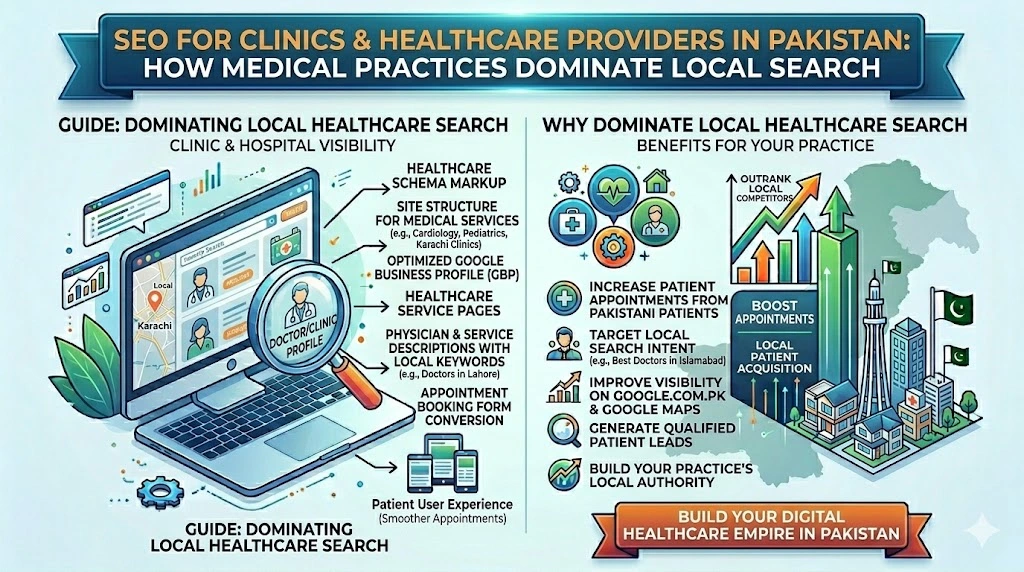
Medical care is hyper-local. Patients search “doctor near me,” “clinic in [neighborhood],” “hospital [city area].” Yet healthcare providers ignore Google Business Profile optimization, NAP consistency, location-specific content, patient reviews management, and medical practice schema markup, enabling Google to understand exactly what conditions you treat and where you practice.
Impact: Local searches trigger a map pack showing 3 medical practices. Without local SEO, you’re invisible in the highest-intent searches from patients ready to book appointments immediately, rather than browsing general information.
Problem 4: Ignoring Patient Reviews as Trust Signals
Healthcare decisions depend heavily on reputation and trust. Patients extensively research doctors before booking, relying on reviews validating expertise and bedside manner. Yet many practices have 3-5 reviews total, whilst competitors with active review generation strategies accumulate 50-100+ reviews, building overwhelming social proof.
Reality: Two equally qualified dentists. One with 2 reviews (4.0 rating), one with 47 reviews (4.6 rating). Which does the patient choose? Reviews aren’t vanity metrics. They’re conversion factors directly affecting patient booking decisions whilst simultaneously improving local search rankings.
The Most Valuable Keywords for Healthcare in Pakistan
Not all medical keywords generate equal patient value. Understanding search intent and booking potential focuses optimization effort where it matters, rather than traffic that never converts to consultations.
High-Intent Appointment Keywords (Priority 1)
These signals of immediate booking intent are worth targeting aggressively:
Format: [Specialty] in [Specific Location]
- “Dentist in Gulberg Lahore”
- “Gynecologist in DHA Karachi”
- “Orthopedic surgeon Islamabad”
- “Child specialist near me”
Monthly searches: 100-800 per specific variation
Conversion rate: 8-12% (high because intent is appointment booking)
Competition: Medium. Platforms dominate, but local practices can rank with proper optimization
Condition + Location Keywords (Priority 2)
Patients search for symptoms and conditions, not always specialty names:
Format: [Condition/Symptom] treatment [Location]
- “Diabetes treatment in Karachi”
- “Back pain doctor Lahore”
- “Thyroid specialist Islamabad”
- “Skin allergy treatment near me”
Monthly searches: 200-1,500 per variation
Conversion rate: 5-8% (specific problem seeking solution)
Competition: High from medical information sites, requires content depth
Procedure and Treatment Keywords (Priority 3)
Patients researching specific medical procedures:
Format: [Procedure] in Pakistan / [City]
- “Laser eye surgery Karachi cost”
- “Root canal treatment Lahore”
- “Knee replacement surgeon Islamabad”
Monthly searches: 500-3,000 for common procedures
Conversion rate: 3-5% (research stage, but high-value patients)
Strategic value: Targets insured patients and those affording premium procedures
Question-Based Symptom Searches (Priority 4)
How patients actually search when experiencing symptoms:
Format: Why/What/How [symptom/condition]
- “Why does my knee hurt when I walk?”
- “What causes frequent urination at night?”
- “How to treat acid reflux naturally.”
Monthly searches: 1,000-10,000 for common symptoms
Conversion rate: 1-2% (information seeking, longer conversion timeline)
Strategic value: Captures patients early in the healthcare journey, builds authority
Avoid Platform-Dependent Keywords
Example: “Marham doctors Karachi” or “Oladoc appointment booking”
Patients using these are already platform-committed. You’re trying to intercept them after they’ve chosen an intermediary rather than capturing them during the initial “I need a doctor” search phase before platform involvement.
Local SEO Tactics Specific to Healthcare in Pakistan
Medical practice success depends on dominating local search in specific areas you serve. National visibility means nothing when patients search “doctor near me” or “[neighborhood] clinic.”
Google Business Profile Optimization for Medical Practices
Critical fields:
- Primary category: Be specific: “Cardiologist,” “Dental clinic,” “Orthopedic surgeon,” not generic “Doctor.”
- Services: List every treatment/procedure (Root canal, Teeth whitening, Dental implants, not just “Dental services”)
- Service areas: List neighborhoods you serve if patients come to you
- Appointment URL: Direct booking link reducing friction from discovery to scheduling
- Business description: Include conditions treated, procedures performed, years of experience, and language spoken (English, Urdu)
- Photos: Office exterior/interior, treatment rooms, equipment, staff (builds trust showing real practice)
- Posts: Weekly health tips, new services, patient success stories, availability updates
Managing Patient Reviews Systematically
The review generation system that works:
After successful treatment/consultation, the doctor or staff member personally asks: “If you’re happy with your treatment, would you mind leaving a quick Google review? It helps other patients find us.” Show them how (many Pakistani patients are unfamiliar with the Google reviews process).
Send WhatsApp message with direct review link next day: “Thank you for visiting [Clinic Name]. If you’d like to share feedback, here’s our review link: [shortlink]. Your review helps us serve patients better.”
Response protocol: Reply to every review within 24-48 hours. Thank positive reviews personally, address negative reviews professionally, and offer to resolve concerns offline.
Why this matters: Practices with 25+ reviews rank significantly higher in the local pack than identical practices with 8 reviews. Volume signals popularity, and trust Google rewards through better positioning.
Medical Practice Schema Markup
Structured data telling Google exactly what you offer:
Medical organization schema including:
- Practice name, address, phone
- Specialties and conditions treated
- Accepted insurance plans
- Languages spoken
- Opening hours
- Patient ratings/reviews
Doctor/Physician schema for individual practitioners:
- Medical credentials and qualifications
- Affiliated hospitals/clinics
- Specialization areas
- Years in practice
Impact: Enables rich snippets showing rating stars, appointment booking links, and accepted insurance directly in search results before clicks. Dramatically improving click-through rates versus plain text listings.
Location-Specific Landing Pages
If you have multiple clinic locations or serve multiple areas, create dedicated pages for each:
“[Specialty] Clinic in [Neighborhood]” structure:
- Location-specific content (not duplicate template)
- Directions and parking information
- Local landmarks for easy finding
- Neighborhood demographics and why you opened there
- Location-specific reviews/testimonials
- Unique photos of that specific clinic
Example: Dental practice with branches in Gulberg and DHA Lahore needs separate optimized pages for each location, not a single page listing both addresses. Google prioritizes geographically-specific content for local searches.
Content Strategy for Healthcare Websites That Generates Patient Trust
Doctor credentials alone won’t rank competitively or build patient trust. Strategic content targets various patient journey stages whilst demonstrating medical expertise that booking platforms can’t match through generic doctor profiles.
Condition-Specific Treatment Guides (Top Priority)
Create comprehensive guides for each condition/specialty you treat:
“Complete Guide to Diabetes Management in Pakistan” (for endocrinologists/diabetologists)
- What is diabetes (Type 1, Type 2, gestational)
- Symptoms Pakistani patients commonly experience
- Diagnostic tests, and when needed
- Treatment approaches available in Pakistan
- Lifestyle modifications for the Pakistani diet and climate
- When to see a specialist
- Cost of treatment in Pakistan
- Insurance coverage considerations
- Patient success stories (anonymized)
Why this works: Captures searches from patients researching conditions before booking appointments. When they contact you after reading a 1,500-word guide demonstrating deep diabetes expertise, they’re pre-educated and trust your knowledge before meeting you.
Procedure Explanation Content
For procedural specialties (dentists, surgeons, dermatologists):
Individual pages explaining each procedure in patient-friendly language:
- “What to Expect During Root Canal Treatment”
- “Laser Eye Surgery Process Explained for Pakistani Patients”
- “Hip Replacement Surgery: Complete Guide”
Include: procedure steps, duration, anesthesia used, recovery timeline, post-procedure care, cost ranges in Pakistan, success rates, when the procedure is recommended, and alternatives available.
Patient benefit: Reduces anxiety through information, answers questions before appointment, positions you as a transparent authority willing to educate rather than just sell procedures.
Symptom Checker Content
Target how patients actually search when experiencing health issues:
“Why Do I Have [Symptom]? Common Causes and When to See a Doctor”
- Chest pain causes
- Persistent headache reasons
- Joint pain triggers
- Digestive issues explanations
Structure:
- Common benign causes (reassure patients)
- Serious causes requiring immediate attention (establish urgency appropriately)
- When to see a specialist
- What to expect during consultation
- How condition diagnosed
- Treatment options available
SEO value: Captures massive search volume for symptom queries whilst positioning you as a helpful educator, building trust before patients even need an appointment.
Health Tips and Preventive Care
Blog content targeting a wellness-conscious audience:
- “5 Heart Health Tips for Pakistani Diet and Lifestyle”
- “How to Prevent Diabetes with Family History”
- “Dental Care Routine for Pakistani Climate”
- “Managing Asthma in Karachi’s Pollution”
These rank for informational searches whilst establishing your practice as a proactive healthcare partner, not just a reactive treatment provider. Patients remember helpful content when medical needs arise.
FAQ Content Addressing Common Patient Questions
Individual pages answering specific questions patients ask:
Medical questions:
- “When Should I Take My Child to a Pediatrician?”
- “What Blood Tests Are Included in a General Checkup?”
- “Can I Exercise After Heart Stent Surgery?”
Practical questions:
- “Do You Accept XYZ Insurance Plan?”
- “What Payment Methods Do Pakistani Clinics Accept?”
- “Can I Get Same-Day Appointment for Dental Emergency?”
These rank for long-tail conversational searches whilst demonstrating a patient-first approach, addressing real concerns and questions.
What to Look for in an SEO Agency That Understands Healthcare
Generic SEO agencies struggle with medical practices because they don’t understand the following healthcare-specific requirements:
- Patient privacy regulations (avoiding sharing patient information, even anonymized, without proper consent)
- Medical authority establishment through expert content
- Trust-building through reviews and credentials
- Local SEO for neighborhood-based practices
- Conservative messaging appropriate for healthcare rather than aggressive marketing
Therefore, for your healthcare business, you should only hire an SEO specialist with the following expertise.
Healthcare SEO Expertise Indicators
Portfolio proof: Ask to see the medical websites they’ve ranked. Verify they understand healthcare-specific optimization. How they handled medical content, patient review generation, local search for clinics, HIPAA/privacy considerations. Not just generic SEO applied to any industry.
Medical content capability: Healthcare content requires accuracy, appropriate medical terminology balanced with patient-friendly language, and ethical messaging. The agency should have medical content writers or partnerships with healthcare content specialists, not just general copywriters.
Local SEO experience: Medical practices live or die on local search. The agency must demonstrate Google Business Profile optimization for healthcare, medical schema markup implementation, patient review management strategies, and location-specific content positioning doctors for “[specialty] near me” searches.
Understanding healthcare patient journey: Patients research extensively before choosing doctors. The agency should propose an educational content strategy (condition guides, procedure explanations, health tips), building trust during the research phase rather than expecting immediate appointment bookings from every website visitor.
Reputation management skills: Healthcare depends on reputation more than most industries. Agency needs patient review generation systems, review response strategies, online reputation monitoring, and crisis management capabilities for negative reviews or feedback requiring professional handling.
Working with our SEO company in Pakistan with healthcare experience ensures you’re not paying an agency to learn medical marketing, whilst competitors with specialist help capture patient searches and appointment bookings your practice should be generating through organic visibility.
Conclusion
Pakistan’s growing healthcare market rewards medical practices controlling patient acquisition rather than depending on booking platforms extracting fees for every appointment. Marham, Oladoc, and Sehat built successful businesses aggregating doctor availability, then charging doctors per booking for patients whose reputations were initially attracted to the platforms. Independent practitioners, clinics, and hospitals possess the medical expertise, treatment quality, and patient care capabilities these platforms lack, but lose patients through search invisibility.
Organic SEO flips this relationship. Rank your website for specialty-specific and location-based medical searches. Capture patients directly, own the relationship, pay no per-booking fees, collect patient data enabling follow-up for preventive care and specialist referrals. Initial 6-9 month investment in proper healthcare SEO begins generating qualified patient inquiries at effectively zero marginal cost, whilst platform expenses continue per appointment regardless of patient lifetime value.
Ready to stop paying platforms for your own patients? Get an industry-specific SEO strategy for your healthcare business tailored to Pakistan’s medical market, local search requirements for clinics, patient search behavior patterns, and trust-building content strategies. Healthcare demands specialized SEO understanding medical practice challenges, patient privacy considerations, local search dominance for neighborhood practices, and long-term content strategies generating sustained patient trust and appointment bookings rather than vanity traffic that never converts to actual consultations.