


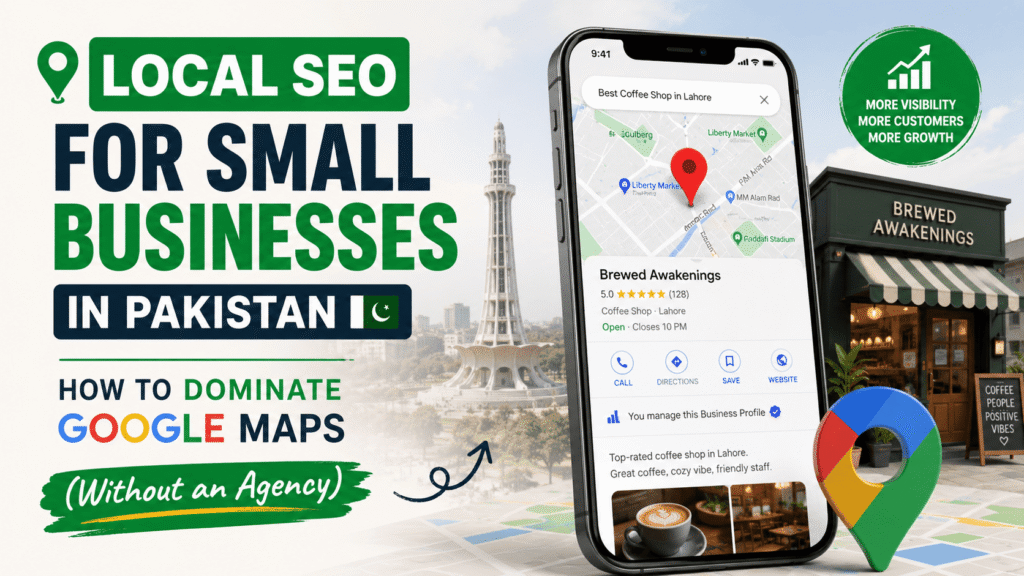
Here’s what every Pakistani small business owner needs to understand: 73% of customers searching “near me” visit a business within 5 kilometers that same day.
When someone in Gulberg searches “plumber near me” or “best biryani DHA Karachi,” Google shows 3 businesses in the local pack.
Those coveted map listings appear above organic results. If you’re not in that top 3, you’re invisible to customers actively ready to buy right now in your neighborhood. Local SEO puts small businesses, like tailors in Saddar, dentists in Bahria Town, or restaurants in MM Alam Road, on the map literally and figuratively, competing effectively against larger brands through geographic relevance rather than massive marketing budgets.
This guide shows exactly how Pakistani small businesses set up, optimize, and dominate local search visibility, covering Google Business Profile optimization, NAP consistency requirements, Pakistani citation sources that actually matter, review generation strategies working in local markets, and honest assessment when DIY execution hits limits requiring professional help scaling beyond initial setup.
What is Local SEO and Why It Matters for Pakistani Businesses
Local SEO optimizes your business for geographic searches, ensuring you appear when customers search “[your service] near me” or “[your product] [your city].” Unlike traditional SEO targeting national or international visibility, local SEO focuses on capturing customers within a specific geographic radius, typically 5-25 kilometers, depending on service type.
The local search behavior shift in Pakistan: Smartphone penetration reached 68% in urban Pakistan by 2025. People searching from mobile devices expect immediate, nearby solutions. “Repair shop” becomes “mobile repair shop Johar Town Lahore.” “Restaurant” becomes “Chinese restaurant delivery Clifton.” These searches trigger Google’s local algorithm, showing businesses near the searcher’s location rather than generic national results.
Why local SEO delivers disproportionate ROI for small businesses:
Geographic monopoly potential: National brand dominates “buy furniture Pakistan” searches, but a local furniture store in Satellite Town can own “furniture store Satellite Town Rawalpindi” through proper local optimization. You’re not competing against the entire country. You’re competing against 10-30 businesses in your immediate area.
High-intent customers: Someone searching “electrician near me” needs an electrician NOW, not researching generally. These searches convert 3-5× higher than informational searches because intent is immediate and specific.
Mobile-first visibility: Local searches predominantly happen on mobile devices whilst people are out, ready to visit, call, or buy. Desktop searches involve research; mobile searches trigger action.
Pakistani market opportunity: Many small businesses have zero online presence beyond a Facebook page. Even basic local SEO implementation positions you ahead of 60-70% of local competitors who remain invisible in search results, as customers actively use finding services daily.
Understanding SEO fundamentals provides a broader context, but local SEO specifically targets the “near me” searches and map visibility that drive foot traffic, phone calls, and immediate sales rather than general awareness.
Setting Up and Optimizing Your Google Business Profile in Pakistan
Google Business Profile (formerly Google My Business) is the single most important local SEO asset. This free listing controls your appearance in Google Maps, local pack results, and knowledge panel. Pakistani businesses without optimized GBP essentially don’t exist for local searches, regardless of website quality.
The Complete Pakistani GBP Setup Checklist
Step 1: Claim and verify your business
Visit google.com/business and claim your business listing. Google sends a verification postcard to your physical address containing a code you enter to confirm legitimacy. The process takes 7-14 days in Pakistan. Don’t delay because you’re invisible until verified.
Critical for Pakistani businesses: Use your actual business address, not a PO Box or virtual office. Google validates addresses; suspicious locations get flagged, reducing visibility.
Step 2: Complete every single field accurately
Business name: Exact registered name. Don’t stuff keywords like “Best Dentist Lahore Dr. Ahmed Dental Clinic” (against Google guidelines, gets flagged)
Category selection: Choose the primary category most accurately describing your business. Pakistani restaurant chooses “Pakistani restaurant” not just “Restaurant.” Precision matters for relevance matching.
Service areas: If you serve customers at their location (plumber, electrician, caterer), specify service areas by neighborhood or radius. If customers come to you (retail store, restaurant), specify the exact address.
Hours of operation: Accurate hours, including holidays. Update during Ramadan when hours change. Incorrect hours frustrate customers, finding you closed when Google says you’re open, a negative signal Google tracks.
Phone number: Pakistani landline or mobile starting with the correct city code. Use WhatsApp Business number if that’s the primary customer contact method.
Website URL: Your actual website, not Facebook page. No website yet? Better to leave blank than link social profile (Google prefers real websites for ranking factor).
Step 3: Write a compelling business description
400-750 words describing what you do, what makes you different, what services you offer, and why customers should choose you. Include naturally relevant keywords: “family dentist in DHA Lahore specializing in painless root canal treatment” rather than keyword-stuffed spam.
Pakistani business reality: Many competitors leave the description blank or write 2 generic sentences. A comprehensive, helpful description immediately differentiates you whilst providing Google with a content understanding of what you actually do.
Step 4: Upload high-quality photos
Minimum 10 photos showing:
- Exterior: Storefront, signage, entrance (helps customers find you)
- Interior: Shop floor, office, workspace (builds trust, shows professionalism)
- Products/services: What you sell or do (visual proof of offerings)
- Team: Staff photos (humanizes business, builds connection)
- Customer interactions: People shopping, being served (social proof)
Photo quality matters: Clear, well-lit, professional-looking images. Blurry phone photos hurt more than help. Pakistani businesses neglect photos entirely. Uploading quality images provides an immediate competitive advantage.
Step 5: Add products/services with prices
List specific services with descriptions and prices when possible. “Haircut – PKR 800” is more useful than the vague “Hair services available.” Transparency builds trust and helps customers decide before contacting you.
Pakistani pricing context: Many businesses hide prices, fearing competitors. However, transparent pricing attracts serious customers whilst filtering tire-kickers, improving inquiry quality dramatically.
Step 6: Enable messaging and booking
Activate messaging, allowing customers to contact you directly through GBP. Add booking links if you use an appointment system. Reduce friction between discovery and contact. Every extra step loses potential customers.
Ongoing Optimization Requirements
GBP isn’t set-and-forget. Active profiles rank higher than abandoned ones.
Weekly posts: Share updates, offers, new products, and events through GBP posts. These appear in your listing, increasing engagement signals that Google rewards. “This week only: 20% off all winter lawn collections” or “New menu item: Afghani Pulao now available.”
Photo uploads: Add new photos monthly, minimum. Fresh content signals active business. Google prioritizes over stale profiles last updated 2 years ago.
Q&A monitoring: Customers can ask questions publicly on your GBP. Answer promptly and helpfully. Both for customer benefit and to show Google your business actively manages its presence.
Review responses: Reply to every review. Positive and negative. Detailed in the review section below, but critical GBP management component.
NAP Consistency: Why Small Errors Kill Your Local Rankings
NAP stands for Name, Address, & Phone. The three critical business identifiers Google uses to validate your legitimacy across the internet. Inconsistent NAP information confuses Google’s algorithm, making it uncertain whether listings refer to the same business or different entities sharing similar details.
The Pakistani Business NAP Problem
Common inconsistencies killing Pakistani local rankings:
Address format variations:
- GBP: “Shop 23, Plaza Centre, Main Boulevard, Gulberg III, Lahore”
- Website: “23 Plaza Centre Main Blvd Gulberg 3 Lahore”
- Facebook: “Plaza Centre Gulberg Lahore”
- Directory: “Main Boulevard, Gulberg, Lahore”
Google sees four different addresses, unsure if the same location. Confidence drops, rankings suffer.
Phone number variations:
- GBP: 042-35714234
- Website: +92-42-35714234
- Directory: 03001234567 (mobile instead of landline)
- Facebook: 923001234567 (international format)
Different formats confuse Google’s entity matching algorithms.
Business name inconsistencies:
- GBP: “Ahmed Electronics”
- Website: “Ahmed Electronics & Appliances”
- Directory: “Ahmed Electronics Pvt Ltd”
- Signage: “Ahmed Elect.”
These variations fragment your entity, distributing authority across multiple perceived businesses rather than consolidating into a single strong presence.
The Fix: Absolute Consistency Everywhere
Standardize your NAP format:
Choose a single format and use IDENTICALLY across every online property:
Business Name: Exact registered name. “Ahmed Electronics” without additions or abbreviations
Address: Full format consistently: “Shop 23, Plaza Centre, Main Boulevard, Gulberg III, Lahore, Punjab 54000, Pakistan.”
Phone: Single format consistently: “+92-42-35714234” (international format prevents confusion)
Update everywhere NAP appears:
- Google Business Profile
- Website header/footer/contact page
- Facebook About section
- Instagram bio
- LinkedIn company page
- Industry directories (Pakpages, HamariWeb Business, etc.)
- Citation sites
- Review platforms
The audit process: Search “[your business name] [your city]” and check every listing appearing in the results. Document the current NAP on each platform. Update any inconsistencies immediately to match your standardized format.
Why this matters more in Pakistan: Many Pakistani businesses operate from complex addresses, including plaza names, shop numbers, and area subdivisions. This complexity increases the risk. Strict adherence to a single format becomes even more critical than in markets with simpler address systems.
Local Citations and Pakistani Directories That Actually Move the Needle
Citations are online mentions of your business name, address, and phone number on other websites, like business directories, industry sites, local blogs, and news sites. Each citation validates your business existence and location, building Google’s confidence in your entity’s legitimacy.
Pakistani Citation Sources Worth Your Time
National directories (high priority):
1. Pakpages.com: Pakistan’s largest online business directory. Free business listing with NAP, description, hours, and photos. High domain authority, well-crawled by Google.
2. HamariWeb Business Directory: Significant Pakistani traffic, good indexing. Free listing with basic information.
3. Rozee.pk Company Profiles: Originally a job site, but company profiles provide valuable citations for businesses hiring employees.
4. BusinessRecorder.pk Company Directory: Financial publication’s business listings, particularly valuable for B2B and professional services.
5. Zameen.com Business Directory: Real estate portal, but includes local business listings across Pakistani cities.
City-specific directories:
Karachi: Karachi.org business listings, Karachievents.com vendor directory
Lahore: LahorePages.com, LahoreVisitor.com business section
Islamabad: IslamabadGuide.pk, PakistanTourism business listings
Industry-specific citations:
Restaurants: Foodpanda merchant listing (even if not delivering), Cheetay merchant profile, local food blogs
Hotels: Booking.com, Agoda, Trivago, TripAdvisor—international sites Google trusts highly
Healthcare: PakDoctors.com, DoctorsHospital.pk practitioner listings, Marham.pk provider profiles
Retail: Daraz seller profile (if selling online), OLX business account
Professional services: LinkedIn Company Page (critical for B2B), relevant association directories (Bar Council for lawyers, PEC for engineers, etc.)
Citation Building Strategy for Pakistani Businesses
Phase 1: Major platforms first (Week 1)
Claim and complete profiles on the top 10 national directories listed above. These provide the strongest citation value with the broadest reach.
Phase 2: City-specific sources (Week 2-3)
Add your business to 5-10 city-specific directories relevant to your location. Local sources carry geographic relevance weight.
Phase 3: Industry-specific citations (Week 4)
Identify and list on 3-5 industry-relevant directories or platforms where your target customers discover businesses like yours.
Phase 4: Ongoing monitoring (Monthly)
Check quarterly that existing citations remain accurate. Sites update, redesign, or purge listings periodically. Ensure your profiles stay active with current information.
What About Paying for Citations?
Free citations build 80% of the value. Paid directory listings provide marginal benefit unless they’re industry-specific platforms where customers actually search (e.g., WeddingWala.pk for wedding vendors, PropertyPortal for real estate).
Focus time on quality free citations rather than paying for questionable directories nobody visits. Your citation strategy should prioritize platforms that:
(1) Google crawls frequently
(2) Users actually visit
(3) allow accurate NAP consistency
Getting and Managing Google Reviews in a Pakistani Market Context
Google reviews are the single strongest local ranking factor after GBP optimization and NAP consistency. Businesses with 20+ reviews rank significantly higher than competitors with 5 reviews or zero reviews, all other factors equal.
The Pakistani Review Challenge
Cultural context: Pakistanis don’t habitually leave online reviews like Western markets. Satisfied customers rarely volunteer reviews unprompted. You must actively request them whilst making the process extremely easy.
WhatsApp-first reality: Most Pakistani customers contact businesses via WhatsApp rather than phone or email. Review request strategies must account for this communication preference.
The Review Generation System That Works in Pakistan
Step 1: Identify review-worthy moments
Request reviews when customers are happiest:
- Retail: Immediately after purchase, when satisfaction is highest
- Services: After successful project completion or service delivery
- Restaurants: At the end of the meal, when the experience is fresh
- Healthcare: After successful treatment resolution
Step 2: Make requesting reviews frictionless
The WhatsApp shortlink method:
Create Google review link for your business: google.com/search?q=[your-business-name] > Find your GBP > Click “Write a review” > Copy that URL
Shorten it using bit.ly or tinyurl, creating a memorable link: bit.ly/ReviewAhmedElectronics
Send via WhatsApp after positive interaction: “Thank you for visiting Ahmed Electronics! If you’re happy with your purchase, would you mind leaving us a quick Google review? It helps other customers find us. Takes just 30 seconds. Thanks so much!“
Step 3: Timing matters enormously
Immediate request > Delayed request
Asking during purchase or service delivery works better than emailing days later when enthusiasm fades. Train staff requesting reviews at the point of sale or service completion.
Step 4: Incentives are done carefully
Allowed: “Customers who leave reviews get 5% off next purchase” (incentive for action, not for positive content)
Not allowed: “Leave 5-star review and get discount” (paying for positive reviews violates Google policy, can get GBP suspended)
Alternative: “Share feedback (positive or honest) and receive a small thank-you gift” (rewards participation, not bias)
Responding to Reviews (Critical Management Component)
Reply to every single review: positive, negative, or neutral. Response rate signals active management, and Google rewards.
Positive review response template:
“Thank you [Name] for the wonderful review! We’re thrilled you enjoyed [specific service/product mentioned]. Looking forward to serving you again soon at [Business Name]. – [Your Name]“
Keep it personal, specific to their review, not copy-paste generic thanks.
Negative review response strategy:
Never argue or get defensive publicly. You’re responding for future customers reading, not just the reviewer.
Template approach:
- Apologize genuinely: “We’re sorry to hear about your experience…”
- Address specific issue: “The delay you mentioned is unacceptable, and we’ve…”
- Show action taken: “We’ve retrained staff on proper [procedure]…”
- Invite resolution: “Please contact us at [phone] so we can make this right personally.”
Pakistani context note: Negative reviews happen less frequently in Pakistan than in Western markets but carry more weight when they do appear. One negative review among 5 total reviews is 20% of your reputation, devastating. Build review volume proactively so individual negative reviews represent a smaller percentage of the total.
Review Velocity and Consistency
Sudden review spike looks suspicious. Going from 3 reviews to 30 reviews in one week triggers Google’s spam detection. Build reviews steadily. 2-5 per week is a healthy pace. 15 per day looks fake.
Consistent review acquisition demonstrates ongoing business activity. Businesses with reviews clustered 2 years ago, then nothing recent appears, are dormant or no longer providing good service. Recent reviews signal active, quality business Google prioritizes.
When to Hire a Local SEO Agency vs Doing It Yourself
The honest DIY reality: Small business owner CAN handle initial setup, claiming GBP, ensuring NAP consistency across 10-15 major citations, implementing basic review request system. This takes 10-20 hours over 2-4 weeks, but is learnable and executable without specialized expertise.
Where DIY hits limits:
Scale Limitations
Citation building beyond the top 20 sources: Finding, claiming, and managing 50-100 citations across Pakistani and international directories becomes a full-time job. Time spent managing citations is time not spent running your business.
Review generation systematization: Creating automated review request workflows integrated with your POS system, CRM, or booking software requires technical implementation, which most small business owners lack expertise in executing properly.
Competitive monitoring: Tracking what competitors rank for locally, which citations they have that you don’t, and how their GBP optimization evolves. This competitive intelligence requires tools and analytical skills beyond those of most business owners.
Technical Complexity
Local schema markup implementation: Adding structured data to your website, helping Google understand your business location, hours, and services, requires coding knowledge most small businesses don’t possess.
Local link building: Acquiring backlinks from Pakistani news sites, local blogs, and industry publications improves local authority. Professional outreach, relationship building, and content creation required here exceed most business owners’ capabilities.
Multi-location optimization: Businesses with 3+ locations face exponentially more complex local SEO, managing separate GBP profiles, location-specific landing pages, and differentiated citation profiles. Professional help becomes nearly essential for multi-location businesses.
Ongoing Management Requirements
Local SEO isn’t a one-time setup. It requires continuous management:
- Weekly: GBP posts, review monitoring, and responses
- Monthly: Citation audits, ensuring consistency, competitor tracking
- Quarterly: Strategy refinement based on performance data, new citation opportunities
Time cost calculation: Local SEO management requires 5-10 hours weekly once established. At PKR 2,000-5,000 hourly opportunity cost (what you’d earn running your business instead), you’re spending PKR 40,000-200,000 monthly in time value. Professional SEO services in Pakistan typically cost PKR 40,000-100,000 monthly, cheaper than the time cost while delivering superior results through specialized expertise and efficient execution at scale.
The Hybrid Approach That Works Best
DIY initial setup: Handle GBP creation, NAP standardization, and top 10-15 citations yourself. This builds foundational knowledge whilst keeping initial costs minimal.
Month 3-4: Evaluate results and limitations. If you’ve achieved decent visibility improvement but hit technical or time barriers, that’s when professional help delivers maximum incremental value, building on your foundation rather than starting from zero.
Professional help for:
- Advanced technical implementation (schema, landing pages, site structure)
- Scale citation building (50-100+ directories efficiently)
- Multi-location management (2+ locations)
- Competitive markets (facing 10+ sophisticated local competitors)
- Ongoing management (freeing your time for business operations)
Keep in-house:
- Review responses (personal touch matters; don’t outsource customer interaction)
- GBP posts and updates (you know your business, promotions, and news best)
- Photo uploads (authentic business photos better than generic stock images)
Understanding when ongoing SEO investment makes sense versus when initial optimization suffices depends on competitive intensity, business growth ambitions, and whether local visibility represents a primary customer acquisition channel or supplementary marketing tactic.
Conclusion
Local SEO provides small Pakistani businesses the most accessible path toward digital visibility and customer acquisition. Unlike national SEO, requiring months of building authority against established competitors, local SEO delivers tangible results within 4-8 weeks for businesses executing fundamental tactics properly, including complete GBP optimization, NAP consistency, strategic citation building, and active review generation.
The competitive landscape in most Pakistani cities remains wide open. Even in Karachi and Lahore’s most competitive sectors, proper local optimization positions you ahead of 60-70% of competitors with zero or minimal local presence. In smaller cities, including Faisalabad, Multan, Sialkot, Gujranwala, and beyond, opportunities are even more dramatic because digital adoption among small businesses remains low, whilst consumer search behavior accelerates rapidly.
Start with the fundamentals covered here. Claim and optimize your Google Business Profile this week. Audit and fix NAP consistency across your top 10 online properties. Add your business to 5-10 major Pakistani directories. Implement systematic review requests for every satisfied customer. These actions alone will improve your local visibility measurably within 30-45 days.
When you hit scale limitations, technical complexity barriers, or time constraints preventing ongoing management, that’s when professional help accelerates progress exponentially. But you don’t need to wait for agency help to start. The best time to begin local SEO was 6 months ago. The second-best time is today.
Ready to dominate local search in your Pakistani city? Get a free local SEO audit showing exactly where you rank now, which local visibility opportunities you’re missing, and what’s possible when local optimization is executed professionally. No obligations, just data showing you the path from invisible to unavoidable in your local market.