


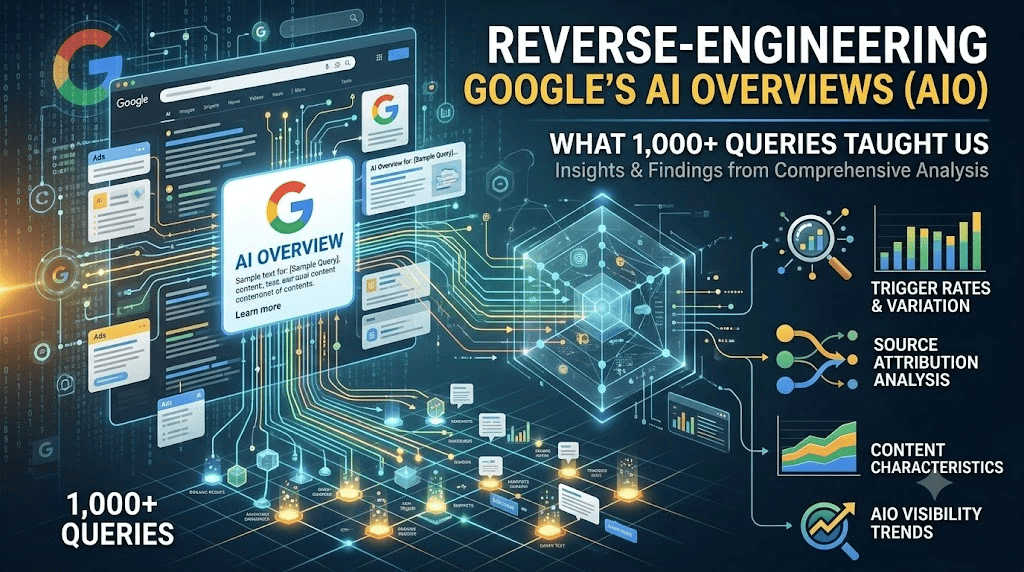
Google AI Overviews evolved gradually through multi-year development before reaching widespread deployment, fundamentally transforming how search results display and which content receives visibility. Understanding how AI systems select which content to cite determines whether your brand appears in answers customers see or remains invisible despite ranking well traditionally.
Multiple independent analyses, including rigorous studies examining 1,000 AI Overviews across 10 query intents and 5,000+ queries across diverse industries, reveal concrete selection patterns businesses can engineer for immediately.
The Evolution Nobody Noticed Until It Was Everywhere
Google tested AI-generated search responses through Search Labs experiments, called Search Generative Experience (SGE). Limited user testing provided feedback, whilst most businesses continued optimizing for traditional rankings.
May 2024 marked the official AI Overviews launch announcement, rolling out to US users gradually before expanding globally throughout 2024-2025.
By early 2026, AI Overviews dominate search experiences for informational queries, yet many businesses still optimize using 2022 strategies, ignoring fundamental changes in how visibility works.
Traditional ranking factors like domain age and page speed matter less than previously assumed. Content structure, credibility signals, and specific technical implementations now determine citation likelihood more than conventional SEO wisdom suggests. Understanding SEO fundamentals means recognizing that AI-powered search requires different optimization priorities than traditional organic rankings demanded historically.
Why AI Overview Selection Differs From Traditional Rankings Fundamentally
The Shift From Position to Inclusion
Traditional SEO optimized for position within ten blue links. AI Overview optimization targets inclusion within 3-5 citation slots appearing before traditional results display. This fundamental shift changes everything about how Google evaluates content worthiness for visibility.
Position three in organic results roughly equals citation slot value in click-through terms according to third-party CTR studies through Q1 2026. However, the signals producing them differ dramatically. Citation slots reward structured, well-sourced, schema-marked content from credentialed domains regardless of publication recency. Traditional rankings weighted domain authority, backlinks, and freshness signals more heavily.
The Traffic Collapse Nobody Prepared For
The mechanical change is simple yet profound. When AI Overviews render for queries, click-through rates to traditional blue links collapse 30-60% depending on vertical, with informational and definitional queries hit hardest. What replaces that traffic isn’t clicks on AI Overview panels themselves. Those remain rare. Instead, citation links inside AI-generated responses become the only meaningful traffic vector for large query classes.
If your page appears in citation lists, it captures high-intent clicks. If not, the query becomes invisible to your site regardless of traditional ranking position. Understanding different types of SEO helps businesses recognize which optimization approaches remain effective versus which require complete strategic rethinking.
Domain Authority Still Matters, But Less Than You Think
Domain authority correlation with citation rates measures +0.61 according to rigorous analysis of 1,000 AI Overviews examining 4,243 unique cited URLs against control sets of 50,000 non-cited pages for the same queries. This represents a meaningful but not dominant influence. Page-level signals often override pure domain reputation when determining citation worthiness.
The Concentration Problem: Top 1% Captures Nearly Half of All Citations
The most striking finding reveals extreme citation concentration. The top 1% of cited domains, roughly 12 sites including Wikipedia, Reddit, Forbes, Healthline, Investopedia, NYT, plus larger gov and edu domains, capture 47% of all citations. The next 9% (approximately 100 domains) account for another 31%. Long-tail 90% of cited domains together share the remaining 22%. This concentration exceeds the underlying organic SERP distribution, where the top 1% typically captures closer to 25-30% of position-one listings.
Practical implication: the 22-25% long-tail citation share represents a realistic battleground for non-top-1% editorial sites. Inside that addressable market slice, page-level signals, schema markup, content structure, named-source citations, and content depth exert much larger relative effects than in the highly competitive top tier, where domain reputation already saturates AI model confidence.
Content Structure Requirements: Determining Citation Probability
Schema Markup: The Most Engineerable Citation Lever Available
Schema markup implementation emerges as the single largest engineerable lever affecting citation rates across multiple independent analyses. However, reported impact varies significantly based on methodology, sample size, and measurement approaches employed.
Independent Reddit-based analysis examining 5,000+ queries across different industries reports schema markup increases citation likelihood by 40%. More rigorous academic-style study analyzing 1,000 AI Overviews with controlled methodology reports schema-marked pages cited 2.3× more often than unstructured equivalents, representing 130% increase, substantially exceeding the initial estimate.
Understanding the Variance in Schema Impact Studies
This variance likely stems from different sample compositions, query intent distributions, and control group definitions rather than conflicting findings. The 40% figure may represent a conservative estimate across all schema types, including poorly-implemented markup. The 2.3× multiplier specifically measures properly-implemented Article schema plus BreadcrumbList baseline against comparable unstructured pages after controlling for domain authority confounds.
The 5 Schema Types Delivering the Strongest Citation Performance
Key schema types performing strongest include:
Article schema: Baseline structured data enabling clear content identification, author attribution, publication date, and headline extraction. AI systems parse efficiently.
BreadcrumbList schema: Navigation hierarchy signals helping AI understand content context within broader site structure, improving topical relevance assessment.
HowTo schema: Procedural content markup delivering 2.8× citation multiplier when editorially appropriate for step-based pages according to 1,000-query analysis. Highest single schema performance measured.
FAQ schema: Question-answer pairs formatted explicitly for machine extraction, enabling direct inclusion in AI-generated responses with proper attribution maintained.
Product schema: E-commerce content structured data supporting commercial intent queries, though these trigger shorter citation lists (3.1 average vs. 4.2 overall).
The Schema Implementation Trap Most Teams Fall Into
Invalid schema implementation performs worse than no markup at all. HowTo schema applied to non-procedural content confuses AI parsing, reducing rather than improving citation probability. Schema markup implementation requires editorial judgment, ensuring markup accurately reflects actual content structure rather than wishful categorization, hoping for citation advantages.
Why Heading Hierarchy Matters Beyond Schema
Heading hierarchy matters substantially beyond the schema alone. A clear H1-H6 structure enables AI systems to parse content organization efficiently. Proper heading tag usage signals information architecture, helping algorithms identify key sections, supporting claims, and logical flow within longer content pieces.
List Formatting: The Underrated Citation Factor
Bullet points and numbered lists feature more frequently in AI citations compared to dense paragraph-only content. Lists provide clear, scannable formatting, and AI models extract easily while maintaining context. Optimal list length ranges from 3-7 items; shorter lists lack sufficient depth, whilst longer lists dilute focus, reducing extraction likelihood.
FAQ Sections: Direct Pipeline to AI Citations
The FAQ sections demonstrate extremely high citation rates across both independent analyses. Direct question-answer formatting matches exactly how AI systems structure responses, making FAQ content a natural candidate for citation. Optimal FAQ implementation includes 5-8 questions addressing common queries with concise 40-60 word answers formatted clearly under distinct question headings.
The Content Length Sweet Spot: Where More Becomes Better
Content depth shows a step-shaped relationship rather than a linear correlation with citation rates. Pages exceeding 2,500 words get cited 1.6× more often than pages under 800 words, according to controlled analysis. The lift kicks in around 1,800 words and saturates near 3,500 words. Mechanism appears to be that longer pages provide more structured content AI models extract from, rather than length itself signaling quality directly.
E-E-A-T Evolution: How Experience, Expertise, Authoritativeness, and Trustworthiness Affect AI Selection
Author Credentials: The E-E-A-T Signal AI Systems Actually Check
Google’s E-E-A-T framework, emphasizing Experience, Expertise, Authoritativeness, and Trustworthiness, evolves significantly in the AI-powered search context compared to traditional ranking signals.
Author bylines with credentials significantly boost citation selection according to multiple independent analyses. Visible author names with professional qualifications, relevant experience details, and credible affiliations signal content originates from genuine experts rather than anonymous corporate content farms. AI systems evaluate author credentials as a primary credibility indicator when determining citation worthiness.
The 4 Elements of Citation-Worthy Bylines
Optimal byline implementation includes:
Full author names: Not “Admin” or “Marketing Team,” real individuals with verifiable identities AI systems can cross-reference.
Relevant credentials: Professional certifications, academic degrees, and industry experience demonstrating subject matter expertise directly.
Author bio linking: Profile pages detailing broader expertise, previous work, and publications, establishing consistent authority across topics.
Contact information: Email addresses, social profiles, and professional websites enabling verification of author legitimacy and expertise claims.
The Recency Myth: Why 14-Month-Old Content Still Gets Cited
Publication date recency shows surprising complexity in citation correlation. Initial analyses suggested recent publication dates weighted heavily in AI selection. However, a rigorous 1,000-query study reveals the median cited page is 14 months old. AI Overviews are not recency-biased the way fresh-news ranking operates traditionally.
Recency matters primarily for explicit news-intent queries where current information proves essential. For evergreen topics, well-maintained 12-24 month-old pages outperform fresh-but-thin equivalents consistently. AI models reward page authority, content structure, and named-source citations more than publication timestamps for most informational queries.
Why This Changes Everything About Content Refresh Strategies
This counterintuitive finding contradicts conventional SEO wisdom emphasizing constant content refreshing. While periodic updates maintain relevance, comprehensive older content with established authority outperforms hastily published recent content lacking depth or credible sourcing.
Named-Source Citations: The 2.1× Citation Multiplier
Named-source citations within the content body deliver 2.1× citation lift according to controlled analysis. Pages citing named sources, such as researchers, academic papers, official agencies, and credible publications, are inlined within body text rather than just footer link lists and get cited substantially more often by AI Overviews.
The mechanism appears to be AI models using body-level citation presence as a credibility signal, treating pages as higher-quality knowledge sources worthy of citation themselves. This creates a virtuous credibility loop: pages citing authoritative sources earn authority recognition, enabling their own citation by AI systems.
The 4-Part Framework for Optimal Source Citation
Optimal source citation implementation:
Minimum 2-3 named sources: Every tier-1 page should cite at least 2 distinct authoritative sources inline within the content body with anchor links to source documents.
Attribution clarity: Explicitly name sources “according to Stanford research,” “CDC guidelines state,” “Harvard study found,” rather than vague “studies show” claims lacking specificity.
Diverse source types: Mix academic research, government data, industry reports, and credible news publications, demonstrating comprehensive research rather than single-source dependence.
Inline placement: Citations within body paragraphs supporting specific claims rather than collected in a separate references section disconnected from the content context.
User-Generated Content: The Authenticity Signal AI Recognizes
User-generated content, including reviews, testimonials, and comments, performs well in citation selection, particularly for commercial and review-intent queries. AI systems recognize authentic user perspectives as valuable information sources complementing expert analysis, especially for product recommendations and service evaluations.
Understanding on-page SEO fundamentals helps implement E-E-A-T signals effectively through proper content structure, author attribution, and credibility markers that AI systems evaluate when determining citation worthiness.
Query Intent Matching: How AI Systems Evaluate Content Relevance
The Death of Single-Intent Optimization
AI Overviews blend multiple intent types into single comprehensive responses—behavior fundamentally changing content strategy requirements compared to traditional single-keyword, single-intent optimization approaches.
Analysis of 200 cruise-related informational queries revealed 88% triggered AI Overviews, with 52% mixing multiple intent layers, including brand suggestions, booking options, and comparisons, alongside basic information initially requested. This intent expansion means AI doesn’t just answer queries; it anticipates what users want, knowing next, acting as a digital concierge rather than a traditional search engine returning link lists.
How AI Blends 4 Intent Types in Single Responses
For example, Mediterranean cruise searches return AI Overviews including:
4 distinct intent layers blended: Best time to go (informational), booking process (commercial), cruise lines (navigational), pricing (transactional). All within a single AI-generated response.
AI systems prefer content that directly answers specific questions posed while simultaneously addressing logical follow-up questions users typically ask next. Content covering only the initial query without anticipating related questions loses out to comprehensive resources addressing a broader topic scope through interconnected answers.
Topic cluster strategies support this multi-intent approach by organizing related content comprehensively rather than isolating individual keyword targets artificially.
Conversational Tone: Why Natural Language Wins
Conversational tone consistently outperforms formal corporate language in citation selection across multiple analyses. AI-generated responses adopt a natural conversational style; content matching that tone gets selected more frequently than stiff, jargon-heavy alternatives. This doesn’t mean sacrificing professionalism. It means writing clearly, directly, and naturally without unnecessary formality obscuring meaning.
The Follow-Up Question Advantage
Content addressing follow-up questions earns citation bonus points according to observed patterns. AI systems favor comprehensive resources, anticipating related queries over narrow content answering only explicit questions asked. Optimal content structure includes the following 4 types of questions:
1 – Primary question answer: Direct response to main query in first 100-150 words
2 – 3-5 related sub-questions: Logical follow-ups users typically ask next, each answered in dedicated subsections with clear headings
3 – Practical examples: Specific implementations, case studies, or scenarios demonstrating concepts rather than abstract explanations alone
4 – Action steps: Clear guidance on implementing information provided, particularly for how-to and procedural queries
Why Specific Examples Outperform Generic Advice
Local and specific examples consistently outperform generic advice in citation selection. Content stating “Melbourne businesses benefit from local SEO” outperforms “businesses benefit from local SEO” for location-specific queries. Geographic specificity, industry examples, and concrete scenarios demonstrate the practical applicability of AI systems recognize as higher-value than abstract generalizations.
The Power of Quantification in Citations
This specificity extends beyond geography. Content citing “3.2× traffic increase over 6 months” outperforms “significant traffic increase” lacking quantification. Concrete data points, specific timeframes, and measurable outcomes signal credibility and usefulness. AI algorithms are rewarded with citation priority.
Technical Optimization Factors Affecting Citation Likelihood
Brand Mentions: The Surprising Citation Booster
Beyond content structure and credibility signals, several technical factors influence citation selection probability through mechanisms not immediately obvious from traditional SEO experience.
Brand mentions within content increase citation likelihood even for unbranded queries, according to a surprising discovery from 5,000+ query analysis. Content mentioning established brand names. Not just focusing on the brand itself. It demonstrates commercial awareness and real-world applicability, which AI systems interpret as a credibility indicator.
How Brand Context Creates Credibility Signals
For example, CRM software comparison mentioning Salesforce, HubSpot, and Zoho by name gets cited more frequently than generic “leading CRM platforms” without specific brand identification. This works even when the query itself doesn’t mention brands. AI recognizes brand references as signals of comprehensive, practical content grounded in actual marketplace realities.
Statistics and Data Points: The 3× Citation Multiplier
Content containing specific statistics and data points gets featured 3× more often according to independent analysis. Quantified claims like “47% of citations” or “2.3× increase” outperform vague “most citations” or “significant increase” dramatically. Numbers provide:
Verification potential: Specific data can be cross-referenced and validated
Precision signaling: Exact figures demonstrate research depth and accuracy commitment
Answer completeness: Quantified responses satisfy information needs more completely than qualitative descriptions
Credibility markers: Statistical specificity indicates expert knowledge rather than casual familiarity
Video Transcripts: The Overlooked Citation Source
Video transcripts weigh heavily in AI selection decisions according to multi-platform analysis. Pages embedding video content with accurate transcripts benefit from dual signals: multimedia engagement indicating a comprehensive resource, plus textual content that AI systems can parse and cite directly. Optimal implementation includes 4 elements:
1 – Complete transcripts: Full video content transcribed accurately, not just highlights or summaries
2 – Timestamp integration: Transcript sections corresponding to specific video moments, enabling precise citation
3 – Supplementary text: Additional context beyond the transcript explaining key points in formats optimized for text-based AI extraction
4 – Accessibility compliance: Proper formatting ensuring transcripts serve both users and AI parsing systems effectively
User Engagement Signals: Comments and Community Discussion
Comment sections and user engagement signals matter for citation consideration according to observed patterns. Active comment threads, user questions with answers, and community discussions indicate content relevance and ongoing value. AI systems appear to interpret engagement signals as social proof supporting content quality assessment.
However, comment quality matters more than quantity. Substantive discussions, expert responses, and constructive dialogue boost citation probability. Spam comments, promotional replies, or flame wars potentially reduce perceived quality. Moderation, maintaining constructive engagement, serves both user experience and AI evaluation criteria simultaneously.
Technical SEO implementation, ensuring proper infrastructure, crawlability, and performance, supports AI content discovery and evaluation processes underlying citation selection decisions.
Citation Tracking: Measuring What Actually Matters in 2026
Why Traditional Metrics Miss the Point
Traditional SEO metrics include Organic traffic, keyword rankings, and click-through rates. They all tell incomplete stories when AI Overviews dominate search experiences. New measurement frameworks track visibility more accurately.
Citation share replaces position tracking as the primary KPI for AI-era SEO, according to emerging best practices. Citation share measures how frequently your content gets cited in AI Overviews for priority query sets compared to competitors. This metric directly correlates with the actual visibility users experience, rather than traditional rankings that users may never see when AI answers questions first.
The 4 Tool Categories for Citation Monitoring
Tools for monitoring AI Overview citations include 4 tool categories:
1 – Custom scripts: Programmatic capture of AI Overview renderings plus citation lists for priority query sets every week.
2 – Schema validators: Verification tools ensuring markup is implemented correctly without errors, reducing citation eligibility.
3 – Content structure analyzers: Auditing platforms evaluating heading hierarchy, list formatting, and FAQ implementation against citation best practices.
4 – Cross-platform monitoring: Tracking citation appearances across Google AI Overviews, ChatGPT, Perplexity, and emerging AI search platforms.
Citation Rate Benchmarks: Setting Realistic Targets
Baseline citation rate benchmarks vary dramatically by industry and query intent:
Definitional queries: Average 5.6 citations per AI Overview. Widest source pool, highest opportunity for non-top-tier sites
How-to queries: Average 5.1 citations. Structured content, premium rewards, clear procedural formatting, with strong schema implementation
Informational queries: Average 4.6 citations. Authority-weighted, harder for newcomers breaking into established domains
Commercial queries: Average 3.1 citations. Shortest lists, most conservative selection, favoring credentialed publications
Why Context Matters for Citation Targets
Understanding these benchmarks helps set realistic citation share targets. Attempting to achieve 30% citation share in commercial queries proves unrealistic when Google typically cites only 3 sources total. However, capturing a 15-20% share in definitional queries with 5-6 citation slots becomes achievable through proper optimization.
The 5 Success Metrics Replacing Traditional Rankings
Success metrics beyond traditional traffic measurements include 5 success metrics:
1 – Citation inclusion rate: Percentage of priority queries where your content appears in AI Overview citations
2 – Citation position: Ranking within citation list when included. The first citation typically captures more clicks than the fourth
3 – Citation durability: How long citations persist as AI models update and refresh content selections
4 – Cross-platform citations: Appearance frequency across multiple AI systems, including Google, ChatGPT, and Perplexity, indicating broad authority recognition
5 – Attributed traffic: Clicks arriving specifically from citation links within AI Overviews rather than traditional organic results
Competitive Citation Analysis: Understanding Your Position
Competitive citation share analysis reveals positioning relative to direct competitors. If your citation rate reaches 8% while competitor A achieves 15% and competitor B manages 3%, you understand competitive standing within the addressable market independent of traffic volume fluctuations.
Calculating ROI in the Citation Era
ROI calculation methods for AI optimization investment compare citation acquisition costs against attributed traffic value and conversion rates from that traffic. High-intent users clicking citations despite AI answer availability typically convert better than casual browsers, potentially offsetting reduced traffic volumes through superior visitor quality.
Understanding SEO benefits in AI-powered search requires measuring visibility, authority recognition, and citation share rather than exclusively tracking traditional traffic and ranking metrics.
Implementation Roadmap: Prioritized Actions for Citation Optimization
Why Sequencing Determines Success
Converting analysis into action requires a systematic four-stage workflow that any business can implement within a single quarter. Sequencing matters. Quick wins first establish foundation before longer-cycle improvements compound results.
Stage 1: Schema Implementation Sprint (Weeks 1-2)
Audit the top 200 editorial pages for schema markup presence. Ship the Article plus BreadcrumbList schema on every page lacking it. This represents 2.3× citation lever implementable in a single sprint with one engineer. Add the HowTo schema only where pages genuinely follow procedural step-by-step formats. An invalid schema performs worse than none.
Expected timeline: 1-2 weeks for implementation, 30-60 days before citation rate improvements become measurable as AI refresh cycles incorporate changes.
Investment required: 20-40 engineering hours plus quality verification, ensuring proper implementation without validation errors.
Stage 2: Editorial Restructure for Credibility (Weeks 3-8)
Update editorial standards, ensuring every tier-1 page:
Cites 2-3 named sources inline within body text with anchor links to source documents, not just bibliography-style references disconnected from content flow
Targets a minimum of 2,500 words for comprehensive topics (empirical citation floor from controlled analysis)
Includes author byline with relevant credentials and professional background, establishing expertise
Implements FAQ section with 5-8 questions addressing common queries in 40-60 word answers
Expected timeline: 6-8 weeks for the editorial team to restructure priority content, 30-60 days before citation gains become measurable.
Investment required: 100-200 editorial hours, depending on the content volume requiring restructuring.
Stage 3: Citation Tracking Infrastructure (Weeks 9-10)
Build a monitoring pipeline capturing AI Overview renderings plus citation lists for priority query sets weekly. Position tracking misses the actual visibility metric in AI-dominated search. Citation share becomes the primary KPI, replacing traditional rankings as a performance indicator.
Expected timeline: 2 weeks for technical setup, immediate visibility into current citation performance, and establishing a baseline.
Investment required: 30-50 engineering hours, building scraping and tracking infrastructure, plus ongoing monitoring time.
Stage 4: Domain Authority Building (Months 4-12)
Domain authority represents the longest-cycle lever requiring a sustained 6-12 month investment. PR-driven backlink acquisition, topical authority hubs, and partnerships with credentialed publications in your vertical build authority AI systems recognize when evaluating citation worthiness.
Only attempt after stages 1-3 are operational. Doing authority work first leaves cheap engineerable wins untapped whilst pursuing expensive, slow-return activities. Schema and editorial structure deliver larger multipliers shipping in weeks rather than months.
Expected timeline: 6-12 months before measurable DA improvements translate into citation rate increases.
Investment required: Ongoing PR, outreach, and content partnerships, varying significantly by industry and competitive intensity.
The Mistake Costing Teams Thousands
Common mistake: Teams attempting stage 4 first, spending the entire quarter on PR outreach for marginal DA gains, whilst editorial pages remain unstructured and under-sourced. Deliberate sequencing maximizes return on investment through quick wins, establishing a foundation before long-cycle improvements compound existing advantages.
Our SEO services in Pakistan implement comprehensive citation optimization programs, handle schema audits, editorial restructuring, tracking infrastructure, and authority building systematically rather than expecting internal teams to master emerging specializations while maintaining existing responsibilities.
Common Mistakes in Reducing Citation Probability Systematically
Over-Optimization Patterns AI Systems Detect and Penalize
Understanding what not to do prevents wasted effort on tactics actively harming citation likelihood despite appearing beneficial from traditional SEO perspectives.
Over-optimization patterns AI systems penalize:
Keyword stuffing in attempts to force relevance signals backfires in AI evaluation. Natural language processing models recognize unnatural keyword density, penalizing rather than rewarding forced optimization. Write naturally for human comprehension; AI systems trained on natural language perform better at evaluating conversational content than keyword-optimized alternatives.
Irrelevant schema markup applied, hoping for citation advantages confuses rather than helps AI parsing. HowTo schema on non-procedural content, Product schema on informational articles, Recipe schema on non-recipe pages. All reduce citation probability below properly-structured content without a schema at all.
The 3 Schema Errors Killing Citation Chances
Schema implementation errors:
Missing required properties within schema types render markup invalid, eliminating citation advantages. Article schema requires a headline, an image, datePublished, and author at a minimum. Incomplete implementation wastes effort without delivering benefits.
Conflicting schema types on the same page confuse parsing algorithms. Don’t mark a single page as both Article and Product unless genuinely serving dual purposes with proper nested schema relationships maintained.
A hidden schema in JSON-LD disconnected from visible content gets ignored or penalized. The schema should accurately describe content users actually see, rather than attempting to game systems through invisible markup describing aspirational content not actually present.
Content Structure Problems: Reducing Parseability
Content structure problems:
Wall-of-text paragraphs without a clear heading hierarchy reduce AI parsing efficiency dramatically. Break content into logical sections with descriptive H2-H6 headings enabling quick navigation and comprehension for both users and algorithms.
Ambiguous pronoun usage requiring context from previous sentences reduces quotability and citation likelihood. Each paragraph should stand relatively independently, enabling extraction without requiring extensive surrounding context for comprehension.
Buried answers forcing users to scroll extensively before finding information sought reduce user satisfaction signals AI systems monitor when evaluating content quality and relevance.
Authority Signal Weaknesses Undermining Credibility
Authority signal weaknesses:
Anonymous authorship, eliminating E-E-A-T signals, reduces citation probability substantially. “Marketing Team” or no byline at all signals content factory output rather than expert knowledge worthy of citation.
Lack of source citations within the content body suggests opinion rather than researched information. AI systems prefer citing content that itself cites authoritative sources, creating credibility chains validating information accuracy.
Outdated information without recent updates signals potential inaccuracy even for evergreen topics. While the median cited page is 14 months old, abandoned content showing no maintenance or updates for 2+ years faces reduced citation likelihood compared to periodically refreshed equivalents.
Avoiding bad SEO practices becomes even more critical in AI-powered search, where manipulation attempts face algorithmic detection, reducing visibility rather than improving it through shortcuts.
Conclusion
Engineering for citation share replaces traditional position optimization.
AI Overview citation patterns reveal clear, actionable signals businesses can engineer for systematically. Schema markup delivers 2.3× citation lift. Single largest implementable lever available to editorial teams. Named-source citations in the content body add a 2.1× multiplier. Long-form content exceeding 2,500 words provides a 1.6× advantage. These effects compound when implemented together rather than in isolation.
What doesn’t predict citation contradicts conventional SEO wisdom: page recency matters less than expected, with the median cited page 14 months old, page load speed shows no measurable citation effect in desktop analysis, and reading-grade level spans the full range without clear correlation. Signals that matter emphasize content structure, credibility demonstration, and comprehensive topic coverage rather than technical performance metrics that traditional SEO historically prioritized.
The 22-25% long-tail citation share represents a realistic addressable market for businesses outside the top 1% of domains, capturing 47% of all citations through established authority AI systems that automatically. Within that addressable market, page-level signal optimization creates competitive advantages that determine which businesses achieve visibility when AI systems answer customer questions directly.
Treat citation optimization as a separate ranking problem rather than assuming organic position automatically translates into citation inclusion. Different signals matter. Different strategies work. Different measurements track success accurately.
Ready to optimize content for AI Overview citations? Our SEO agency in Pakistan implements comprehensive schema markup, editorial restructuring for credibility signals, citation tracking infrastructure, and ongoing optimization, ensuring your content appears when AI systems answer customer questions. Don’t wait until competitors’ own citations in your industry. Position your business where AI sources authoritative information today.