


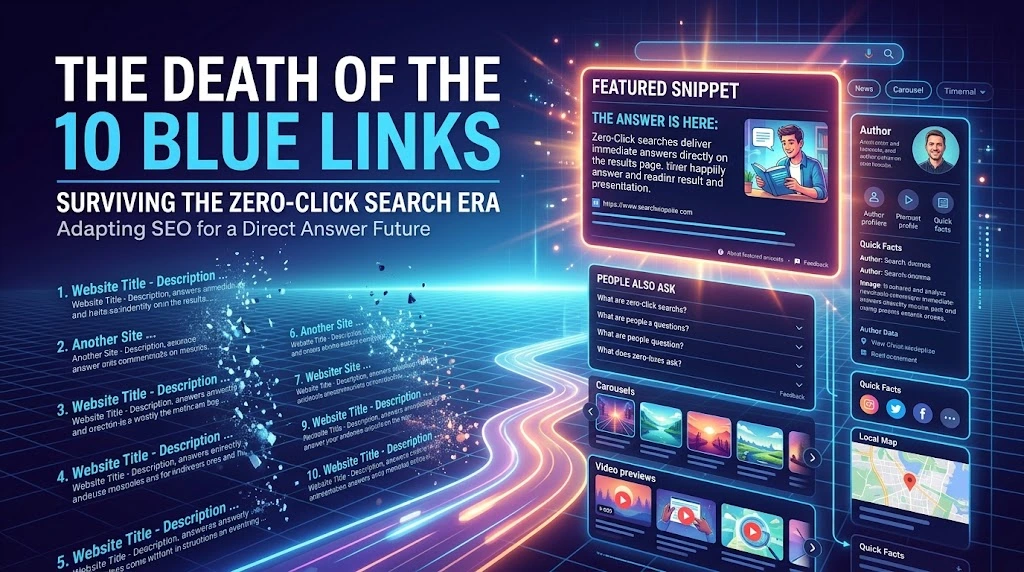
Google’s “10 blue links” format was not stopped overnight, but rather phased out over nearly two decades through a series of major updates, with the final shift to an AI-first experience largely replacing them.
Google now answers 93% of AI-powered queries without sending a single visitor to your website.
Traffic plummets. Rankings hold steady. Revenue disappears.
This isn’t another algorithm update requiring minor adjustments. This represents a fundamental transformation, reshaping how customers discover businesses online.
Zero-click searches dominated by AI Overviews, ChatGPT, Perplexity, and Microsoft Copilot eliminate the click-through step. Customers get answers instantly without ever seeing your brand, despite your content providing the information that AI systems synthesize.
Understanding what SEO actually means today requires acknowledging this seismic shift affecting every business relying on organic visibility for customer acquisition and revenue generation.
What Are Zero-Click Searches and Why They Matter Now
Zero-click searches occur when users get complete answers directly from search results without clicking on any website. Google’s featured snippets started this trend years ago. AI Overviews accelerated it dramatically. Now customers type questions, receive comprehensive AI-generated responses synthesizing multiple sources, and close browsers satisfied without visiting a single site.
When Did Google’s 10 Blue Links Actually Disappear?
The traditional “10 blue links” didn’t vanish overnight through official discontinuation; instead, they faded gradually through multi-year evolution, reaching a critical tipping point during 2024-2025 when AI-powered search experiences dominated results pages. Google never announced ending the format explicitly; data shows it simply became obsolete as AI Overviews, featured snippets, and knowledge panels progressively replaced link-based results.
| Period | Evolution Stage | Key Changes |
| 2007-2020 | Initial Diversification | Images, news, videos, and knowledge panels appear alongside organic links |
| 2021-2023 | Featured Snippet Dominance | Zero-click searches increase; answers appear before traditional results |
| 2024-Early 2025 | AI Overviews Rollout | Gemini-powered summaries provide direct answers; links become secondary |
| Mid-2025 | AI Mode Launch | Conversational search replaces link lists entirely in the AI Mode interface |
| Late 2025 | Final Symbolic Shift | Google removes 100-results-per-page option; curated content prioritized |
| 2026-Present | Post-Links Era | 93% of AI Mode searches end without clicks; the traditional format is obsolete |
The evolution happened faster than most businesses anticipated. Traditional searches presented ten blue links requiring users to click, evaluate, and compare. Featured snippets provided quick answers whilst maintaining clickable results below. AI Overviews replaced this model entirely, presenting detailed, conversational responses, eliminating click necessity completely.
Current data reveals an alarming reality. Traditional Google searches end without clicks 60% of the time. Searches triggering AI Overviews end without clicks 83% of the time. Google’s AI Mode, the conversational interface launched in March 2025, ends without clicks 93% of the time. Only 1% of users click links embedded within AI Overview responses themselves.
This transformation affects everyone differently. Informational content suffers most severely. Transactional searches maintain better click-through rates. Local businesses experience minimal impact. Understanding SEO fundamentals in this new context determines survival versus obsolescence as search continues evolving rapidly.
The Numbers Behind Zero-Click Reality
Statistics paint a stark picture requiring honest assessment rather than optimistic denial. According to Semrush data updated September 2025, zero-click rates vary dramatically by search type and platform implementation.
Traditional search results: 60% of queries end without clicks, customers finding answers in featured snippets, knowledge panels, local packs, or deciding information is insufficient without exploring further.
AI Overviews: 83% of searches triggering AI Overview features end without clicks. Users read synthesized answers, judge them adequate, and abandon search sessions without visiting sources providing original information that AI systems referenced.
Google AI Mode: 93% of conversational AI searches end without external clicks. This represents the most severe traffic cannibalization yet observed in search engine history.
Organic click-through rate decline: Websites ranking for keywords triggering AI Overviews experienced 61% year-over-year CTR reduction according to Seer Interactive analysis in November 2025.
AI Overview prevalence: 25% of all Google searches now display AI Overviews. For informational keywords specifically, that number reaches 99.9%, virtually every “how to,” “what is,” “why does” query triggers an AI-generated response according to Ahrefs November 2025 data.
Industry breakdown reveals uneven impact distribution. Science-related queries trigger AI Overviews 43.6% of the time. Health queries 43%. Technology and B2B searches reach 70% AI Overview exposure. Conversely, e-commerce queries trigger AI Overviews only 3.2% of the time.
Google pulled back after discovering AI responses weren’t converting into purchases. Real estate queries sit at 5.8%, sports at 14.8%.
Gartner’s 2024 forecast predicted 25% traditional search traffic decline by 2026. Current data suggests reality matches or exceeds predictions. Some sectors lost 40-70% organic traffic within a single year.
How AI Overviews Actually Work Under the Hood
Understanding technical mechanisms helps develop effective adaptation strategies. Google AI Overviews and AI Mode operate through a sophisticated process called query fan-out. System launches 16 parallel searches on related subtopics for each user question, collects results, filters information, synthesizes findings, and produces a unified answer. Essentially, an automated research assistant reads sixteen articles simultaneously, delivering a summary within seconds.
AI Overviews versus AI Mode represent different implementation approaches. AI Overviews appear automatically atop traditional search results, brief, non-interactive summaries that users see without requesting them specifically. Traditional blue links remain visible below, maintaining click possibility albeit significantly reduced.
AI Mode operates as a separate conversational experience that users activate deliberately. Completely replaces traditional results with AI-generated dialogue. Users ask questions, receive answers, and ask follow-ups conversationally. Includes Canvas workspace for organizing information, shopping ads with direct purchase options, and Personal Intelligence connecting Gmail and Google Photos for personalized responses.
This distinction explains the dramatic zero-click rate difference. AI Overviews display summaries whilst preserving traditional results. Users can still click. AI Mode eliminates traditional results; clicking requires deliberate effort to access cited sources manually.
Google’s 91% search market share makes these changes unavoidable for businesses seeking online visibility. Microsoft Bing holds a distant 3.5% share despite aggressive Copilot integration powered by OpenAI investment. Perplexity AI and similar platforms remain niche despite abandoning the link-list model entirely, positioning themselves as “answer engines” rather than search engines.
Implementing structured data through schema markup helps AI systems understand content context, identifying products, reviews, and events, enabling accurate information extraction for AI-generated responses.
Business Impact: Traffic Loss and Revenue Implications
Traffic statistics reveal only surface-level impact. Deeper analysis exposes fundamental business model disruption affecting how companies acquire customers, generate revenue, and build brand recognition through organic search visibility.
Google Search AI features lost 38% organic traffic within three months. Rankings remained stable, and the page stayed on the first page throughout the traffic decline. The problem wasn’t ranking position deterioration but rather Google answering user questions directly before searchers ever saw the results list.
The traditional customer acquisition funnel operated predictably for decades. User searches for a question, clicks your guide article, reads the content establishing your expertise, remembers your brand, and returns later for purchase. This journey generated measurable ROI, justifying content marketing investment.
AI-powered search compresses this funnel dramatically. User searches a question in AI Mode, Google synthesizes an answer from six sources, including your article, the user receives the answer without clicking anything, never sees your brand, and never returns. Your content contributed to the AI response. Your brand received zero visibility, zero traffic, and zero future revenue opportunity.
Publishers, informational content creators, and affiliate marketers face an existential crisis. When users get news summaries directly from AI, the incentive to visit publisher sites diminishes dramatically. E-commerce and affiliate sites face similar threats. If AI provides product recommendations directly, the entire review site ecosystem is bypassed completely.
Revenue models built on traffic assumptions collapse when traffic disappears, regardless of content quality or ranking position. Advertising revenue requires impressions. Affiliate commissions require clicks. Lead generation requires form submissions. Newsletter growth requires visitors. Nothing happens when AI answers questions without sending traffic.
However, not all businesses suffer equally. Local searches remain largely unaffected. Only 7.9% of local queries trigger AI Overviews. Queries like “restaurant near me,” “emergency plumber,” and “dentist in Chicago” generate clicks because they require physical action, calling, visiting, or booking. AI cannot complete remotely.
Understanding different types of SEO helps businesses identify which strategies remain effective versus which require complete rethinking, given AI-powered search dominance.
Seven Survival Strategies for the Zero-Click Era
Adaptation isn’t optional anymore. It’s a survival requirement. These seven strategies work in 2026 based on documented results from businesses navigating zero-click reality successfully.
1. Target Transactional Queries, Not Just Informational Ones
“How to” queries suffer 99.9% AI Overview cannibalization. “Buy,” “best for,” “price of” queries trigger AI Overviews only 3-4% in e-commerce contexts. Strategic pivot toward transactional intent keywords captures traffic AI hasn’t claimed yet.
B2B businesses should shift content focus from generic guides toward product comparisons, detailed demos, and case studies with specific metrics. These prove harder for AI to synthesize, whilst sitting closer to conversion stages where purchase intent runs highest.
2. Become the Cited Source, Not the Clicked Result
If 93% don’t click but Google cites sources, the new optimization goal becomes earning citations in the AI Overview rather than ranking position one. Seer Interactive data shows brands cited in AI Overviews experience 35% higher CTR compared to those not cited, a significant advantage when overall CTR drops 61%.
Achieving citation requires a strategic approach. Implement comprehensive schema markup enabling machine understanding. Publish original data, including surveys, benchmarks, and proprietary research AI systems can cite authoritatively. Secure citations from authoritative sources, building trust signals. Provide direct, concise answers to common questions formatted for easy extraction.
Google prioritizes citing sources, responding clearly and verifiably. Content structured for machine parsing, whilst maintaining human readability, maximizes citation probability.
3. Invest in Direct Brand Awareness
When Google stops sending traffic, alternative discovery channels become essential. Branded searches, “your company name + keyword,” resist zero-click better because users want you specifically, not generic answers.
Build brand recognition through channels independent of search algorithms. Email newsletters depend on no algorithm. Average open rates remain 21%, providing direct audience access. Podcasts, YouTube, professional communities, live events, and webinars create brand touchpoints AI cannot intercept.
LinkedIn organic social for B2B businesses consistently delivers superior content ROI. YouTube operates as the world’s second-largest search engine. AI Overviews don’t cannibalize video content yet. Google Discover drives traffic through a different logic than traditional search, remaining a viable traffic source.
4. Create Content AI Cannot Replicate
AI synthesizes existing information. It cannot have firsthand experiences, run original tests, conduct exclusive interviews, or hold opinions backed by years of professional practice. Content based on verifiable personal experience proves harder to cannibalize.
Websites stating things like “Tested 12 CRM platforms for 3 months and here’s what happened” provide value that AI cannot reproduce because it didn’t conduct testing. First-hand case studies, original research, proprietary methodologies, expert commentary from personal experience. These content types maintain differentiation that AI cannot easily replace.
Google’s E-E-A-T framework emphasizes Experience as the first pillar deliberately. Content demonstrating genuine expertise through documented experience earns priority; AI systems struggle to match.
5. Use Structured Data Aggressively
Schema.org markup, structured FAQs, HowTo schema, Product schema, Review schema, LocalBusiness schema, and comprehensive structured data implementation increase citation probability dramatically.
The more structured information provided, the easier AI systems to extract content for inclusion in generated responses rather than paraphrasing without attribution. Proper heading tag structure combined with schema markup creates a machine-readable content hierarchy that AI systems prefer citing.
The FAQ schema is particularly effective. Formats questions and answers explicitly, making extraction straightforward whilst providing the value users seek directly.
As of May 2026, Google has officially discontinued FAQ rich results for all websites. While the specific “rich result” display (the expandable accordion dropdown in search results) is gone, the FAQPage schema itself still exists as a valid technical markup.
6. Diversify Traffic Sources Beyond Google
Dependence on organic Google traffic always carries risk. Now it’s realized as a danger requiring immediate diversification.
Email marketing delivers predictable reach without algorithm dependency. Referral partnerships with complementary businesses drive qualified traffic. Social media organic reach varies by platform but provides algorithm-independent audience building. YouTube SEO operates under different rules. Video content maintains visibility. AI text responses haven’t been captured yet.
Google Discover operates through interest-based content recommendation rather than query-based search. Different optimization requirements create alternative traffic opportunities. Understanding how to drive organic traffic across multiple channels reduces single-point failure risk.
7. Track Different Metrics Than Before
When organic CTR drops 61%, measuring success through “clicks from Google” becomes misleading. New metrics reveal actual performance more accurately.
AI Overview citations: Track how often your content gets cited in AI-generated responses. Semrush and Ahrefs are adding citation tracking features specifically.
Brand search volume: Increasing branded searches indicate visibility is working despite reduced referral traffic. People searching your company name specifically demonstrate awareness that AI responses cannot intercept.
Share of Voice: Measure how frequently your brand appears in AI responses compared to competitors. Relative visibility matters more than absolute traffic when everyone experiences declines.
Direct conversions: Traffic arriving despite the AI Overview presence demonstrates higher intent. These visitors read AI answers, decided they wanted more, and deliberately clicked through. Conversion rates from this traffic typically exceed pre-AI casual browser traffic significantly.
Ongoing SEO requires accepting these metric shifts whilst maintaining optimization discipline, adapting to a new measurement reality.
What to Measure When Clicks Disappear
Traditional metrics like organic traffic, click-through rate, and keyword rankings tell an incomplete story in the zero-click era. Businesses need new performance indicators revealing actual impact despite reduced direct traffic.
Citation frequency measures how often AI systems reference your content in generated responses. Tools now track this metric specifically, essential for understanding whether content reaches audiences even without clicks.
Brand mention volume in AI responses indicates the visibility level. Your company appearing in 40% of AI answers for industry topics demonstrates a strong presence despite zero traffic attribution.
Engagement quality metrics from traffic that does arrive. Bounce rate, time on site, pages per session, conversion rate. These reveal whether reduced traffic volume is compensated for through higher visitor intent quality.
Direct traffic growth often increases as brand awareness builds through AI citations. Users discovering your brand through AI responses later visit directly, bypassing search entirely.
Branded search volume trending upward indicates successful visibility maintenance. People searching your company specifically prove awareness developed despite not arriving through traditional organic channels.
Competitor comparison metrics provide context. If your traffic dropped 30% but competitors lost 50%, relative performance actually improved despite an absolute decline.
Therefore, our SEO agency in Pakistan provides technical SEO services, including AI citation tracking, structured data optimization, and alternative metric reporting, helping businesses understand actual performance beyond traditional traffic measurements.
The Future: GEO Replaces Traditional SEO
Generative Engine Optimization (GEO) represents SEO evolution for the AI era. Instead of optimizing to rank in ten blue links, optimize for citation in AI-generated responses. This shift requires different priorities, strategies, and measurements.
GEO emphasizes structured data implementation aggressively. Content with original, citable data. Direct answers to questions in Q&A format. Domain authority through E-E-A-T signals. Publication speed on trending topics before AI systems synthesize information from slower sources.
GEO doesn’t replace traditional SEO. It extends it. On-page SEO fundamentals remain essential. Technical SEO requirements intensify because they determine citation eligibility. Off-page authority building becomes more important as AI systems evaluate source credibility.
Content strategy must shift toward originality, proprietary data, and formats AI cannot replicate easily. SEO as “write 2,000 words on a keyword and wait for clicks” died. SEO as “build authority AI systems must cite” just began.
Businesses investing now in GEO-focused optimization position themselves advantageously before competition recognizes the necessity. Those waiting until traffic collapses completely face steeper recovery challenges rebuilding visibility from weakened positions.
Implementing comprehensive topic cluster strategies combined with aggressive structured data deployment creates a foundation for GEO success as AI-powered search continues dominating how customers discover businesses online.
Conclusion
Adapt now or become invisible!
Zero-click searches represent the most significant search evolution since mobile-first indexing. The 93% zero-click rate in AI Mode isn’t a temporary glitch. It’s the deliberate direction Google pursues, becoming an answer provider rather than a gateway to answers. For businesses, professionals, and marketers relying on organic visibility, this demands fundamental strategy rethinking.
Declining traffic metrics don’t automatically mean failure. Citation frequency, brand awareness, engagement quality, and conversion rates tell a more complete story. The traffic arriving demonstrates higher intent. Users who read AI answers yet deliberately sought sources convert better than casual pre-AI browsers.
Survival requires accepting reality: traditional search traffic won’t return to previous levels. Success requires adaptation: building authority AI systems must cite, diversifying beyond Google dependence, creating content machines cannot replicate, and tracking metrics revealing actual business impact.
The game changed. Winners recognize it immediately, adapt strategies aggressively, and position themselves where AI sources information. Losers keep optimizing for vanished traffic patterns, wondering why rankings no longer generate revenue they used to deliver reliably.
Ready to adapt your SEO strategy for the zero-click era? Our SEO services in Pakistan include AI citation optimization, structured data implementation, and GEO-focused strategies, helping businesses maintain visibility when traditional traffic disappears. Don’t wait until your traffic collapses completely; position your brand where AI systems source information today.