
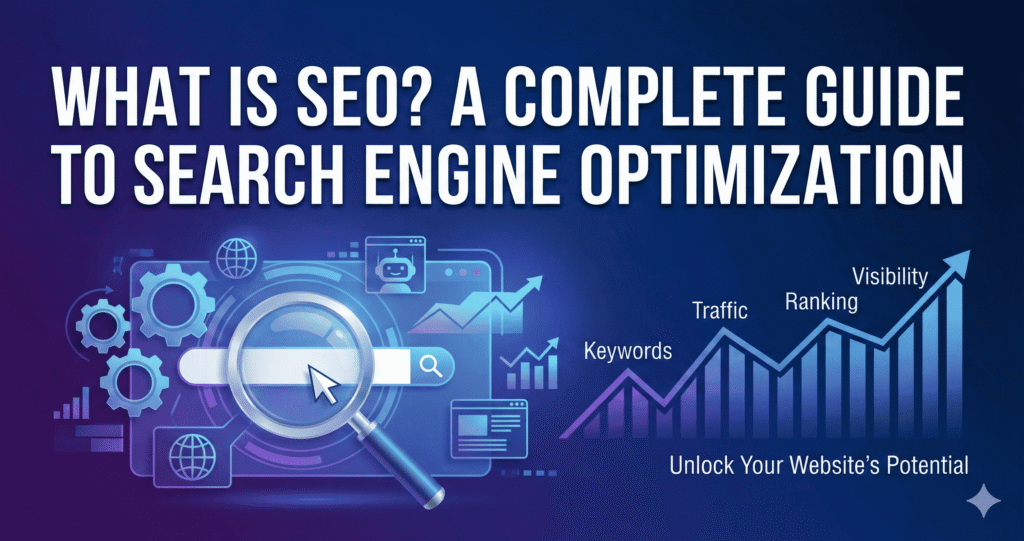
Welcome to the complete guide on search engine optimization.
Whether you’re a business owner, marketer, or someone curious about how websites get found online, this guide breaks down SEO into simple, actionable steps.
Here’s what you’ll learn:
- What SEO actually is
- Why it’s one of the most valuable digital marketing channels
- How search engines actually work
- Why it matters for your website
- The difference between organic results and paid ads (and why organic traffic is worth pursuing).
- Practical ways to improve your rankings, from technical fixes to content creation.
- The types of SEO that drive real results, and which ones matter most for your business.
- How to measure success and avoid common mistakes that waste time and money.
- Modern SEO strategies for 2026, including AI search, mobile-first indexing, user experience signals, and more.
What Is SEO?
SEO is the systematic optimization of your digital presence to rank higher in unpaid search engine results.
Let’s keep it simple:Search engine optimization (SEO) is the practice of improving your website through SEO services in Pakistan to increase visibility when people search for products or services related to your business on Google, Bing, and other search engines.
organic search drives 53% of all website traffic, making it the single largest source of visitors for most businesses.
The better your pages rank in search results, the more likely you are to attract attention and convert potential as well as existing customers.
Here’s the reality of SEO most people miss:
Search engines can’t rank what they can’t understand. Your content might be excellent, but if Google’s systems can’t properly interpret your site’s structure, you’re invisible.
Most websites fail at getting found. Not because their content is bad, but because search engines struggle to access, process, or categorize it correctly.
Modern SEO isn’t about repeating keywords until they stick. It’s about creating a website that search engines can easily crawl, understand, and confidently recommend to searchers.
3 Core Components of Search Engine Optimization (SEO)
1. On-Page SEO (Content & Relevance):
On-Page SEO is the practice of optimizing individual web pages to rank higher and earn more relevant traffic. This includes keyword optimization, creating high-quality content, writing compelling titles and descriptions, optimizing images, and building internal links between related pages.
2. Off-Page SEO or Off-Site SEO (Authority & Trust):
Off-Page SEO or Off-site SEO refers to actions taken outside of your website to improve your rankings through building authority and reputation. The primary focus is on link building, earning backlinks from other reputable sites. Social signals, brand mentions, and digital PR also contribute to how search engines perceive your trustworthiness.
3. Technical SEO (Crawlability & User Experience)
Technical SEO is the process of optimizing your website’s infrastructure to help search engines crawl, index, and understand your content efficiently. This covers site architecture, fast loading times (measured through Core Web Vitals), mobile-friendliness, secure HTTPS connections, and structured data implementation.
Struggling with technical issues that hurt your rankings? Cloudex Marketing’s technical SEO services identify and fix crawl errors, speed problems, and indexation barriers.
These three pillars work together. Strong content won’t rank if search engines can’t access your site. Perfect technical infrastructure means nothing without quality content. And even the best content and technical setup need authority signals to compete in competitive niches.
SEO works on search engines like Google, Bing, and emerging AI-powered platforms like ChatGPT, Perplexity, and Claude.
It produces organic traffic. It means the visitors who find your site naturally through search rather than through paid advertisements.
It depends on content quality, technical infrastructure, and authority signals working together.
What Are the 4 Pillars of SEO?
The 4 Pillars of SEO are the fundamental categories that support successful search engine optimization. The 4 pillars of SEO are:
- Content
- Technical Performance
- Authority
- User Experience
For example, these pillars are like the legs of a table. If anyone is weak or missing, the entire structure becomes unstable ,and your SEO strategy suffers.
These four pillars encompass all major ranking factors and optimization activities. Understanding them helps you build a balanced, comprehensive SEO strategy rather than focusing too narrowly on any single aspect.
Let’s examine each pillar and why it matters.
Pillar 1: Content (Relevant, High-Quality Information)
Content is all the information, text, images, videos, and other media that users consume on your website.
High-quality content satisfies user search intent by providing accurate, comprehensive, and valuable information that answers questions or solves problems.
Content quality determines whether users find your pages helpful and whether search engines consider them worthy of ranking. This pillar encompasses:
- Topic Selection (writing about what your audience searches for)
- Depth And Comprehensiveness (covering topics thoroughly rather than superficially)
- Accuracy And Reliability (fact-checking information and citing credible sources)
- Originality (providing unique perspectives or information not available elsewhere)
How Google Evaluates Content?
To evaluate the quality of your content, Google uses E-E-A-T.
E-E-A-T is an advanced content evaluation framework, which signals Experience, Expertise, Authoritativeness, and Trustworthiness. Each of them are critical content quality marker. Demonstrating that content creators have genuine expertise and experience in their field builds both user trust and search engine confidence.
Content also includes:
- Keyword optimization (naturally incorporating terms people search for)
- Proper formatting (using headers, bullet points, and clear structure for readability)
- Multimedia elements (images, videos, infographics that enhance understanding)
- Regular updates (keeping information current and relevant)
Without strong content, the other three pillars become irrelevant. Perfect technical implementation can’t compensate for thin, low-quality information that doesn’t satisfy user needs. Authority signals won’t help content that users immediately abandon because it’s poorly written or inaccurate.
Google’s helpful content system became a core ranking system in March 2024, specifically rewards people-first content created to genuinely help users rather than content created primarily to rank in search engines.
Pillar 2: Technical Performance (Infrastructure and Accessibility)
Technical performance refers to the behind-the-scenes infrastructure and code that enables search engines to discover, crawl, render, and index your website efficiently.
This pillar ensures that search engine bots can access your content and that your site performs well technically for both crawlers and users.
Key technical performance elements include:
- Crawlability (making sure search engine bots can discover all important pages through clear site architecture, XML sitemaps, and proper internal linking)
- Indexability (ensuring pages can be added to search engine indexes without barriers like noindex tags or crawl blocks)
- Site speed and Core Web Vitals (fast loading times with LCP under 2.5 seconds, FID under 100ms, CLS under 0.1)
- Mobile optimization (responsive design and mobile-first indexing compliance)
Technical performance also covers:
- HTTPS security (SSL certificates encrypting user connections)
- Structured data implementation (Schema markup helping search engines understand content context and enabling rich results)
- URL structure (clean, descriptive URLs that communicate page content)
- Canonical tags (specifying preferred versions of similar pages to prevent duplicate content issues)
Can You Ignore Technical Optimization?
Many businesses overlook technical search engine optimization (SEO) because it’s less visible than content, but technical problems create invisible barriers. Even exceptional content won’t rank if search engines can’t crawl it, if pages load too slowly that will increase bounce rate, or if mobile users can’t access the site properly.
Technical performance provides the foundation that enables the other pillars to work effectively.
Pillar 3: Authority (Trust and External Validation)
Authority is the measurement of how trustworthy, credible, and expert search engines consider your website based on external signals and validation from other sources.
Search engines use authority signals to determine which sites deserve top rankings when multiple pages contain similar quality content. The more authoritative source typically wins.
Backlinks: The Primary Authority Signal
The primary authority signal is backlinks. Backlinks are the links from other websites pointing to yours. Not all links carry equal weight. A single editorial link from an industry-leading publication carries more authority than hundreds of directory links.
Link quality depends on the:
- Linking the site’s own authority
- Topical relevance (links from related industries matter more)
- Editorial placement (links earned through merit rather than paid)
- Anchor text diversity (natural variation in link text)
Beyond Backlinks: Building Complete Authority
Authority extends beyond backlinks & includes:
- E-E-A-T demonstrations (showing expertise through author credentials, professional experience, and proven knowledge)
- Brand recognition (direct searches for your brand name, mentions across the web, media coverage)
- Online reputation (positive reviews, testimonials, third-party validation)
At the same time, domain authority is a site’s overall trust and credibility accumulated over time. It affects how quickly new content ranks. Established, authoritative domains rank faster for new pages than newer sites with less proven track records.
Building authority takes significant time and cannot be rushed or manipulated. Earning quality backlinks requires creating link-worthy content, building relationships within your industry, contributing genuine expertise to conversations, and establishing your brand as a trusted source over time.
Pillar 4: User Experience (Usability and Engagement)
User experience (UX) is about how visitors interact with your website. The 4 major factors that affect user experience are:
- Speed
- Usability
- Design quality
- Overall satisfaction with their visit
Search engines increasingly prioritize UX because satisfied users indicate that content successfully answered their queries and deserves high rankings. That’s why you must either develop the website with proper expertise or hire website development services in Pakistan to get it done professionaly.
How to Measure User Experience?
Core Web Vitals is a set of three key metrics that Google uses to measure technical User experience. Those three metrics are:
- Loading performance (Largest Contentful Paint or LCP)
- Interactivity (First Input Delay or Interaction to Next Paint – FID or INP)
- Visual stability (Cumulative Layout Shift)
These metrics quantify how fast and smooth your site feels to users.
User experience also includes:
- Mobile-friendliness (responsive design that works perfectly on all screen sizes and devices)
- Intuitive navigation (logical site structure, making it easy to find information)
- Readability (appropriate font sizes, contrast, white space)
- Engagement signals (time on page, bounce rate, pages per session, return visits)
Accessibility matters for both users and SEO. Sites that work well for users with disabilities typically provide better overall experiences. This includes proper heading hierarchies, alt text for images, keyboard navigation, and clear focus indicators.
What If You Ignore UX?
Ignoring UX will result in poor user experience (UX).
Poor UX drives users away quickly, signaling to search engines that the content didn’t meet their needs. Even if users clicked your result initially, high bounce rates and low dwell time indicate dissatisfaction, and potential ranking penalties.
Good UX keeps visitors engaged, encourages deeper exploration of your site, builds trust that leads to conversions, and generates positive signals that reinforce rankings.
How the 4 Pillars Work Together
All four pillars must work in harmony for SEO success.
Content without Technical Performance remains undiscovered by search engines.
Authority without quality Content is wasted. Also, backlinks to poor content don’t produce rankings.
User Experience multiplies the effectiveness of good Content by keeping visitors engaged.
Technical Performance enables Authority signals to flow properly through internal linking and crawl efficiency.
That’s why our SEO strategies at Cloudex Marketing balance investment across all four pillars rather than over-optimizing any single area. Our SEO campaigns audit each pillar separately, identify weaknesses, and systematically strengthen every foundational element for comprehensive optimization.
What Are the 3 C’s of SEO?
The 3 C’s of SEO is a simplified framework that breaks down search engine optimization into three core categories: Content, Code, and Credibility.
This model helps beginners understand SEO without getting overwhelmed by hundreds of ranking factors.
Think of the 3 C’s as the three legs of a stool. All three must be strong for SEO to work effectively.
1. Content
Content refers to everything visible to users on your pages, such as text, images, videos, and how well it satisfies what people are actually searching for.
High-quality content demonstrates depth (comprehensive coverage), accuracy (fact-checked information), originality (unique perspectives), and expertise (E-E-A-T signals).
Search engines prioritize content that genuinely helps users solve problems, answer questions, or make decisions.
But great writing alone isn’t enough. Content must match search intent. If someone searches “how to tie a tie,” they want instructions, not a history of neckwear.
Content quality directly impacts engagement metrics like time on page, bounce rate, and whether users find what they need.
2. Code
Code encompasses all technical elements that search engines interact with, but users don’t see, including HTML structure, site architecture, structured data markup, and backend optimization.
Clean code means search engines can easily crawl your site, understand your content’s meaning, and index it correctly.
This includes proper HTML semantics (using H1 tags for main titles, not just styling), structured data that enables rich results, fast-loading pages through optimized code, and logical URL structures.
Technical implementation also covers mobile responsiveness, HTTPS security, XML sitemaps that guide crawlers, and robots.txt files that manage crawler access.
Poor code creates barriers, such as slow loading, crawl errors, and indexation problems that prevent even excellent content from ranking.
3. Credibility
Credibility is the measurement of how trustworthy and authoritative search engines consider your site based on external validation.
The primary credibility signal is backlinks. When other reputable websites link to yours, it’s like a vote of confidence saying, “This source is reliable.”
But credibility extends beyond links. It includes brand mentions across the web, positive reviews, author credentials, and expertise (E-E-A-T), and recognition within your industry.
Search engines use credibility to determine which sites deserve top rankings when multiple pages have similar content quality. The more credible source wins.
Building credibility takes time. You can’t fake it with manipulative tactics. Genuine expertise, consistent quality, and earning respect within your field naturally build credibility signals that search engines reward.
How the 3 C’s Map to the 4 Pillars:
The 3 C’s framework simplifies the 4 Pillars of SEO (Content, Technical, Authority, UX) into actionable categories:
Content (1st C) = Content Pillar
Code (2nd C) = Technical Performance Pillar
Credibility (3rd C) = Authority Pillar
User Experience spans all three. Good content satisfies users, clean code delivers fast experiences, and credibility builds trust
This framework is particularly useful for businesses new to SEO because it reduces complexity while covering all essential optimization areas.
SEO: An Important Digital Marketing Channel
Digital marketing is promoting products or services through online channels like search engines, social media, email, and websites to reach customers.
Here, SEO is a foundational component of digital marketing strategies, working alongside paid advertising, social media marketing, and content marketing efforts.
But here’s what makes it different:
- Unlike paid advertising channels, where traffic stops the moment you stop paying, SEO delivers compounding returns.
- Each piece of optimized content continues working for you months and even years after publication.
- A critical consideration in long-term marketing strategy development.
As internet marketing has evolved over the past decade, SEO has shifted significantly. Early SEO strategies focused on keyword repetition and manipulation. Today’s approach centers on comprehensive topic coverage, user experience, and building genuine authority.
SEO vs. Other Digital Marketing Channels
Here’s how SEO compares to other marketing channels:
| Digital Marketing Channel | Cost Structure | Time to Results | Sustainability | Traffic Quality | Scalability |
| SEO (Organic) | Time + expertise investment | 3-6 months | High (compounds) | High intent-match | High |
| Paid Advertising (PPC) | Ongoing ad spend | Immediate | Low (stops when budget ends) | Variable | Medium |
| Social Media Marketing | Time + content creation | 1-3 months | Medium | Lower intent | Medium |
| Content Marketing | Creation costs + distribution | 2-4 months | High (evergreen) | High | High |
| Email Marketing | Software + list building | 1-2 months | Medium | High (existing customers) | High |
Let’s have a detailed comparison of SEO with other digital marketing approaches
SEO vs. SEM
SEM stands for search engine marketing. It is the umbrella term for the combination of SEO and PPC activities that drive traffic from search engines.
Search marketing includes both organic optimization (SEO) and paid search advertising, working together to maximize visibility in search results.
Technically, SEO is one component of SEM. The other is PPC.
Here’s how they differ:
SEO drives organic (unpaid) traffic by optimizing your website to rank naturally in search results.
SEM drives both organic and paid traffic by combining long-term SEO strategies with immediate paid advertising.
PPC (the paid side of SEM) drives paid traffic by bidding on keywords and paying for each click.
Think of it this way: SEM is a coin. SEO is one side. PPC is the other.
When to use SEM:
Most businesses benefit from both. Start with PPC for immediate traffic while building SEO for sustainable long-term results. As organic rankings improve, you can reduce paid spend without losing visibility.
Cost comparison:
- SEO requires upfront time and expertise investment, but delivers “free” clicks once you rank.
- PPC requires an ongoing budget but gives you instant visibility.
- SEM combines both, balancing immediate results with long-term growth.
SEO vs. PPC
PPC stands for pay-per-click. It is a digital marketing channel where advertisers are charged whenever one of their ads gets clicked on.
Advertisers bid on specific keywords or phrases they want their ads to appear for in search engine results.
When a user searches for one of those keywords, the advertiser’s ad appears among the top results, clearly labeled as “Sponsored” or “Ad.”
The Fundamental Difference Between SEO and PPC:
With PPC, you pay for every visitor. The moment your budget runs out, traffic stops completely.
With SEO, you invest upfront in optimization, but visitors arrive “free” once you rank. Traffic continues flowing even if you pause active optimization work.
Cost Structure Comparison:
| Channel | Cost Model | Investment Details |
| PPC | Ongoing ad spend | Competitive keywords cost $1-$50+ per click, depending on the industry. A small business might spend $1,000-$10,000+ monthly just to maintain visibility. |
| SEO | Time and expertise investment upfront | Agency costs typically range from $2,000-$10,000+ monthly. But the traffic you earn doesn’t stop when you pause spending. |
Timeline comparison:
| PPC | SEO |
| Immediate results | Delayed gratification. |
| Launch a campaign in the morning, get traffic by afternoon. | Expect 3-6 months before seeing significant ranking improvements. |
Sustainability comparison:
| PPC | SEO |
| Zero sustainability | High sustainability. |
| Pause your campaign, and traffic instantly drops to zero. | Pause active work and rankings may gradually decline, but established content continues attracting visitors for months or years. |
Which should you choose?
Most businesses benefit from both, but here’s when each makes sense:
Choose PPC when: You need immediate traffic, you’re testing new markets, you’re promoting time-sensitive offers, or you’re in ultra-competitive niches where SEO takes too long.
Choose SEO when: You want sustainable traffic growth, you have 3-6 months to wait for results, you want to reduce long-term customer acquisition costs, or you’re building brand authority.
Choose both when: You can afford it, which is ideal for most businesses. Use PPC for immediate visibility while your SEO efforts mature.
SEO vs. Social Media Marketing
Social Media Marketing is a marketing approach that uses platforms like Facebook, Instagram, LinkedIn, TikTok, and Twitter to build brand awareness, engage audiences, and drive traffic to your website.
This includes both organic social posts (free) and paid social advertising (sponsored posts, display ads).
The core difference:
SEO captures existing demand. People actively search for solutions, and you appear with the answer.
Social Media Marketing creates demand. You interrupt people’s browsing with content designed to generate interest.
Intent Comparison:
| Channel | User Intent | Buying Journey Stage |
| SEO traffic | High intent. Users are actively looking for what you offer. | Further along in the buying journey |
| Social traffic | Lower intent. Users are browsing for entertainment or connection, not necessarily ready to buy. | Early awareness stage |
Sustainability Comparison:
| Channel | Content Lifespan | Long-term Value |
| SEO | Content compounds. A blog post from 2023 can still drive traffic in 2026. | High – evergreen content continues performing |
| Social Media | Content decays rapidly. A Facebook post gets most of its engagement within 24 hours. A TikTok video’s lifespan is even shorter. | Low – constant content creation required |
Cost Structure Comparison:
| Channel | Investment Type | Details |
| SEO | Upfront investment in optimization and content creation | Returns compound over time |
| Social Media Marketing | Ongoing time investment for content creation plus potential ad spend for reach | Organic reach on most platforms has declined significantly—you often need paid promotion to be seen |
Timeline Comparison:
| Channel | Time to Build Momentum | Result Duration |
| SEO | 1-3 months | Long-lasting – results persist for months/years |
| Social Media | 1-3 months | Short-term – engagement fades quickly |
Which should you choose?
Choose SEO when: You want to capture people actively searching for your products or services. Best for bottom-of-funnel conversions.
Choose Social Media when: You want to build brand awareness, engage with your audience, or reach people who aren’t yet aware they need your solution. Best for top-of-funnel awareness.
Choose both when: You want a complete digital marketing strategy. SEO captures demand, social media creates it.
SEO vs. Content Marketing
Content Marketing is the strategic creation and distribution of valuable content (blog posts, videos, podcasts, ebooks, guides) to attract and retain a clearly defined audience.
The goal is to drive profitable customer action by providing helpful information rather than directly pitching products.
Here’s the relationship:
SEO and content marketing aren’t competitors. They’re complementary.
Content marketing is the creation of valuable content.
SEO is the optimization of that content to be discovered through search engines.
You can do content marketing without SEO (sharing content only through email or social). But modern content marketing almost always includes SEO as a distribution strategy.
The Key Differences:
Content Marketing focuses on what content to create and how to make it valuable for your audience.
SEO focuses on how to make that content discoverable and how to structure it for search engines.
Distribution Comparison:
| Channel | Distribution Methods |
| Content Marketing | Distributed through multiple channels: email newsletters, social media, partnerships, guest posting, podcasts, etc. |
| SEO | Focuses specifically on distribution through organic search results |
Measurement comparison:
| Channel | Key Metrics |
| Content Marketing | Engagement metrics: time on page, shares, comments, newsletter signups, downloads |
| SEO | Visibility metrics: rankings, organic traffic, impressions, click-through rates |
Timeline comparison:
| Channel | Time to Results | Consistency Requirement |
| Content Marketing | 2-4 months | High – benefits from ongoing consistency |
| SEO | 2-4 months | High – benefits from ongoing consistency |
Sustainability comparison:
| Channel | Long-term Value |
| Content Marketing | Highly sustainable. Evergreen content continues delivering value for years |
| SEO | Highly sustainable. Evergreen content continues delivering value for years |
Which should you choose?
This is a tricky question. You shouldn’t choose between them.
The most effective approach combines content marketing strategy (what to create) with SEO optimization (how to make it discoverable).
Create valuable content that genuinely helps your audience. Then optimize it for search engines so people can actually find it.
SEO vs. Email Marketing
Email Marketing involves sending targeted messages to a list of subscribers who have opted in to receive communications from your business.
This includes newsletters, promotional campaigns, automated sequences, and one-off announcements.
The fundamental difference:
SEO attracts new visitors who don’t know you yet. It’s a customer acquisition channel.
Email Marketing nurtures relationships with people who already know you. It’s primarily a retention and conversion channel.
Audience Comparison:
| Channel | Audience Type | Brand Awareness |
| SEO | Cold traffic, people searching for solutions | May have never heard of your brand |
| Warm to hot traffic, existing subscribers | Already shown interest by giving you their email address |
Cost Structure Comparison:
| Channel | Investment Type | Ongoing Costs |
| SEO | Time and expertise investment upfront | Ongoing content creation and technical maintenance |
| Email Marketing | Software costs ($10-$500+ monthly, depending on list size) | Time for content creation and list building |
Timeline Comparison:
| Channel | Time to Results | Details |
| Faster: 1-2 months | Build a list and start seeing engagement and conversions | |
| SEO | Slower: 3-6 months | Before significant organic traffic materializes |
Traffic Quality Comparison:
| Channel | Intent Level | Trust Level |
| SEO | High intent but cold audience | Actively searching but don’t yet trust you |
| Highest intent warm audience | Already opted in, more likely to engage and convert |
Sustainability Comparison:
| Channel | Long-term Value | Maintenance Required |
| Medium sustainability | Lists decay over time (people change addresses, unsubscribe, lose interest). Requires ongoing list-building efforts | |
| SEO | High sustainability | Once you rank, traffic continues without needing to rebuild your “list” |
Which Should You Choose?
Use both together for maximum impact:
SEO drives new visitors to your website.
Email captures those visitors (via newsletter signups, lead magnets, etc.) and nurtures them into customers.
SEO provides consistent top-of-funnel traffic. Email moves that traffic down the funnel toward conversion.
The ideal flow: Someone finds you through search, subscribes to your email list, receives nurture emails, and eventually becomes a customer. They will then remain on your list for future promotions and updates.
What is the Key Advantage of SEO?
SEO traffic is “free” in the sense that you don’t pay per click.
But it requires upfront investment in optimization, consistent content creation, and ongoing maintenance.
For most businesses, this trade-off makes sense. Once you start ranking, that traffic continues flowing without the recurring costs of advertising.
Unlike other channels that require constant feeding (ad spend, content creation, email sends), SEO compounds. Each optimized page continues working for you months and years after publication.
That’s why SEO remains one of the highest-ROI marketing channels for businesses that are willing to invest in it properly.
To understand why SEO delivers such sustainable value, you need to understand the search engines (Google, Bing, etc) first.
What Are Search Engines?
Search engines are software/information retrieval systems that discover, catalog, and rank websites to match user queries with relevant results that appear on SERPs (search engine results pages). They use automated programs (spiders/crawlers) to discover content, build a massive index, and then use complex algorithms to rank pages for relevance, quality, and speed when a user searches.
1. The Global “Big Two” (Traditional)
- Google: Remains the dominant global leader. In 2026, it is heavily integrated with “AI Mode” (powered by Gemini), providing AI overviews alongside traditional links.
+1 - Bing: Microsoft’s engine. It has gained significant ground by being the first to deeply integrate “Bing AI” (now largely referred to as Copilot in Bing).
+1
2. Regional Powerhouses
- Baidu: The undisputed leader in China, optimized for Chinese language and local regulations.
- Yandex: The primary search engine in Russia and many CIS countries, offering a massive ecosystem similar to Google.
3. Privacy & Mission-Focused
- DuckDuckGo: The most famous “no-tracking” search engine.
- Startpage: A unique “proxy” engine—it gives you Google’s high-quality results but strips away all the tracking and personal profiling.
- Brave Search: A newer, independent index (not relying on Google/Bing) that prioritizes privacy.
- Ecosia: Uses its ad revenue to fund reforestation. It primarily uses Bing’s search infrastructure to generate results.
4. AI-First Search (Generative)
- Perplexity AI: Operates more like a “research assistant.” Instead of a list of links, it writes a cited report based on real-time web data.
- You.com: One of the first to pioneer the “multimodal” AI search, allowing you to toggle between traditional search, AI chat, and specialized “agent” modes.
- ChatGPT Search: (An important addition for 2026) OpenAI now has a full-fledged search feature that rivals Perplexity, providing direct answers with live web citations.
Search engines not publicly accessible:
- Amazon A9 (Powers Amazon product search, but not available asa standalone public search engine)
- Facebook Search (Restricted to Facebook platform members only)
- LinkedIn Search (Accessible only to LinkedIn members, not general public web search)
- Elasticsearch (Enterprise search platform, requires setup and hosting, not a public consumer search engine)
- Algolia (a hosted search engine, not a public-facing search engine)
- IBM Watson Discovery (Enterprise AI search, requires IBM Cloud account and payment)
What are SERPs?
SERP stands for Search Engine Results Page. It is the page you see after typing a query into Google or Bing and hitting enter.
It’s where the real battle for visibility happens. And understanding how SERPs work is crucial because that’s where your SEO efforts either pay off or fall flat. It is not only one page, but there are also many of them, which can be navigated through the ‘next’ button or by page numbers that appear at the bottom of the SERP.
Types of SERPs:
1. Organic listings:
These are the unpaid results that appear based on relevance and quality. They’re what SEO aims to improve.
2. Paid advertisements:
These are clearly labeled as ads and appear at the top or bottom of results. Advertisers pay each time someone clicks. We’re not covering paid ads in this guide. Only organic search optimization.
Why DoesThe SERP Position Matter?
The top organic result gets 27.6% of all clicks.
Results on page 2 and beyond? They receive less than 1% of clicks. In fact, 75% of users never scroll past the first page.
Track SERP performance through web analytics platforms like Google Search Console to measure impressions, clicks, and average position over time.
Features of SERPs You Should Not Ignore in 2026
1. Featured Snippets:
Featured snippets are highlighted answer boxes that appear at “position zero” above the first organic result, providing direct answers extracted from web pages.
Appearing in featured snippets dramatically boosts visibility since they capture user attention first, answer questions without requiring clicks, and position your brand as an authoritative source.
Featured snippets receive significant click-through rates despite answering questions directly, as users often want more detailed information.
Optimizing for featured snippets means structuring content with clear, concise answers in 40-60 words, using lists or tables when appropriate, and directly answering common questions in your content.
2. Knowledge Panels:
Knowledge panels are information boxes that appear on the right side of desktop search results (or at the top on mobile) displaying structured facts about entities like companies, people, places, products, and topics.
Getting your business or brand featured in a Knowledge Panel establishes credibility and authority since Google essentially validates your brand or business’s website as significant enough to deserve dedicated information display.
These panels pull data from various sources including your website, Google Business Profile, Wikipedia, and structured data markup, making them crucial for brand visibility and trust-building.
For businesses, appearing in Knowledge Panels means searchers see your information, such as logo, description, contact details, social profiles, without even clicking, increasing brand awareness even for non-clickers.
3. People Also Ask (Paa) Boxes:
People Also Ask boxes are expandable accordion-style sections showing 3-4 related questions that appear in search results, with each question revealing an answer snippet when clicked. Appearing in PAA boxes extends your visibility beyond a single ranking.
One page can appear multiple times for different related questions, multiplying exposure. These boxes are valuable because they capture users exploring topics broadly, not just searching one specific query, and they often generate additional clicks as users expand questions.
To optimize for PAA, create comprehensive content answering related questions within your topic area, use question-based headers (H2/H3), and provide clear, direct answers in 2-3 sentences following each question.
4. Local Pack:
The local pack is a map-based SERP feature showing three local business listings that appears for location-based searches like “plumbers near me” or “coffee shops in Chicago.”
Appearing in the local pack is critical for local businesses because it dominates the top of search results above organic listings, captures high-intent nearby customers ready to visit or call, and provides immediate visibility with phone numbers, directions, and reviews.
The local pack pulls primarily from Google Business Profile data, making GBP optimization essential. Accurate NAP (Name, Address, Phone), complete business information, regular posts, customer reviews, and high-quality photos all influence local pack rankings.
5. AI Overviews:
AI Overviews (formerly Search Generative Experience or SGE) are AI-generated summaries that appear at the top of search results for certain queries, synthesizing information from multiple sources into conversational answers with citations.
Being cited in AI Overviews is important because it provides brand visibility and credibility even without direct clicks, positions your content as an authoritative source Google trusts, and adapts your presence to the future of search as AI integration expands.
While AI Overviews may reduce click-through rates initially, being cited builds brand awareness and establishes your site as a go-to resource in your field.
Optimizing for AI Overviews requires creating well-structured, factual, comprehensive content with clear topic coverage, implementing schema markup, demonstrating E-E-A-T signals through author credentials and citations, and covering topics thoroughly rather than superficially.
6. Video And Image Carousels:
Video and image carousels are horizontal scrollable sections displaying visual content from YouTube, websites, and other sources directly in search results for relevant queries.
Appearing in these carousels expands your visibility beyond text-based results, captures visual learners and users preferring video content, and provides additional traffic sources beyond traditional organic listings.
Video carousels particularly benefit from YouTube SEO optimization (since YouTube is owned by Google), while image carousels reward high-quality images with proper file names, alt text, and surrounding context.
For businesses creating visual content, such as tutorials, product demonstrations, infographics, before/after photos, optimizing for these carousels means using descriptive filenames, implementing image schema markup, creating engaging thumbnails, and ensuring images and videos are relevant to target search queries.
Why Are SERP Features Important?
SERPs are increasingly complex. Ranking in position 1 is still valuable, but appearing in featured snippets, local packs, or People Also Ask boxes is also necessary to establish your website as an authority-rich expert that will drive significant traffic too.
SERP analysis requires research into competitor positioning, which features appear for your target keywords, and how difficult it will be to capture visibility.
How Search Engines Work?
Search engines work like a three-step process to help you find information on the internet. First, they crawl the web. It is done by sending out bots (called crawlers or spiders) that visit websites and follow links from page to page, like exploring a giant web of connected documents.
Second, they index what they find, storing and organizing all this information in a massive database, similar to creating a detailed catalog of every book in a library.
Finally, when you type in a search query, they rank the results, using complex formulas to decide which pages are most relevant and helpful for what you’re looking for, then displaying them in order from best to worst match.
Let’s take Google (a publicly available search engine)
Now, think of Google as a massive library with billions of books. When you search for something, Google doesn’t read every book in real-time. Instead, it consults an index it’s already built. A massive database of pages it has crawled and analyzed.
This happens through three stages, which are discussed below:
Step 1: Crawling – How Search Engines Discover Content
Crawling is the automated process where search engine bots systematically browse the web to discover and visit web pages.
Google’s main crawler is called Googlebot. Microsoft’s is Bingbot. These crawlers constantly scan websites, following links from page to page, looking for new or updated content to add to their discovery queue.
How Crawling Works
Entry points: Crawlers start with known web addresses from previous crawls, XML sitemaps submitted by site owners, and URLs manually submitted through tools like Google Search Console.
Link following: As bots visit each page, they follow every link they find—both internal links to other pages on your site and external links to other websites. This is how they discover new content across the web.
Crawl budget: Search engines don’t have unlimited resources. They allocate a specific “crawl budget” to each site based on factors like site authority, how often content updates, and server performance. High-authority sites with frequent updates get crawled more often.
Rendering: Modern crawlers don’t just read HTML. They execute JavaScript to render pages as users would see them, which is crucial for sites built with frameworks like React or Vue.
Factors That Affect Crawling
1. Site architecture matters. Flat hierarchies (where pages are only 2-3 clicks from the homepage) get crawled more efficiently than deep hierarchies requiring 5+ clicks to reach important content.
2. Internal linking structure determines what gets discovered. Pages with zero internal links pointing to them (called orphaned pages). They remain invisible to crawlers even if they exist on your server.
3. XML sitemap quality helps crawlers prioritize. A well-structured sitemap listing your important URLs tells search engines what to focus on first.
4. Robots.txt configuration controls access. This file tells crawlers which parts of your site to avoid. Misconfigured robots.txt files accidentally block important pages from being discovered.
5. Server response time impacts crawl frequency. Slow servers make crawling inefficient, so Google may reduce how often it visits your site if response times consistently exceed 200-300ms.
6. Mobile-friendliness gets priority. Since Google uses mobile-first indexing, it prioritizes crawling mobile versions of pages over desktop versions.
7. Crawling software like Googlebot executes increasingly sophisticated rendering capabilities, including JavaScript processing that impacts how single-page applications get indexed.
8. Crawl efficiency depends on web development practices, such as clean HTML, logical URL structures, and minimal redirect chains, which enable faster discovery.
9. Technical SEO audits assess crawl coverage by analyzing server logs, identifying crawl errors, and detecting pages wasting crawl budget without delivering value.
Why Crawling Matters
Google’s crawling systems prioritize URLs based on historical update frequency, link signals, and user demand patterns.
Pages that receive more traffic and fresh backlinks get crawled more frequently, creating a compounding advantage for authoritative content.
If crawlers can’t access your pages, nothing else matters. Your content won’t get indexed, won’t rank, and won’t drive traffic, regardless of quality.
Step 2: Indexing – How Search Engines Catalog Content
Indexing is the process of analyzing crawled pages and storing information about them in a massive database so they can be quickly retrieved when someone searches.
After crawling a page, search engines don’t just save the raw HTML. They perform deep analysis to understand what the content is actually about, how it relates to other topics, and whether it deserves a spot in the index.
How Indexing Works
Content analysis:
Search engines extract all text, identify images and videos, parse structured data markup (like Schema.org), and extract metadata from title tags and meta descriptions.
Entity extraction:
Natural language processing algorithms identify specific concepts, such as people, places, companies, products, and topics. Indexing leverages artificial intelligence for disambiguation, determining whether “Apple” refers to the fruit, company, or record label based on the surrounding context.
Semantic classification:
Content gets categorized into topical clusters based on relationships between concepts and which terms appear together. This enables search engines to understand that a page about “running shoes” is related to topics like “marathon training” and “athletic performance.”
Duplicate detection:
Canonical signals and content similarity analysis prevent duplicate indexation. If Google finds ten nearly identical pages, it chooses one primary version to index and ignores the rest.
Index storage:
Processed content enters inverted indexes organized by terms, topics, and concepts for lightning-fast retrieval when someone searches.
Factors That Affect Indexation
1. Content uniqueness matters. Thin, duplicated, or scraped content often gets filtered out before indexing.
2. Canonical tags specify which version to index when you have similar pages (like product variations or paginated content).
3. Meta robots directives explicitly tell search engines whether to index a page. A noindex tag blocks indexation entirely.
4. Structured data validity helps. Properly implemented Schema.org markup enables rich results and helps search engines understand page purpose.
5. Content quality gets evaluated. Pages demonstrating depth, relevance, and E-E-A-T signals (Experience, Expertise, Authoritativeness, Trustworthiness) are more likely to be indexed and rank well.
6. Google’s research into understanding language enables indexing systems to classify content beyond simple keyword matching, recognizing topical authority through comprehensive coverage.
7. As the internet has grown to billions of pages, indexing efficiency has become critical. Search engines must decide what deserves storage in their limited databases.
Common indexation problems
Noindex tags accidentally blocking important pages. It is a frequent mistake when developers forget to remove staging site tags before launch.
Orphaned pages with zero internal links never get discovered by crawlers, so they can’t be indexed.
Thin content gets flagged as low-quality and filtered out. Pages with minimal unique text (under 200-300 words) often don’t make it into the index.
JavaScript rendering failures occur when content loads via JavaScript, but crawlers can’t execute it properly.
Duplicate content across multiple URLs forces Google to choose one version, potentially ignoring the one you actually want ranked.
Why Indexing Matters
Not every crawled page gets indexed. You might have 10,000 pages on your site but only 7,000 in Google’s index.
Only indexed pages are eligible to rank in search results. If indexation fails, all your optimization efforts are wasted.
The index is what makes search fast. When you search, Google doesn’t scan billions of live websites. It searches its pre-built index, organized for instant retrieval.
Step 3: Ranking – How Search Engines Evaluate & Order Results
Ranking is the process by which algorithms evaluate billions of indexed pages and decide which ones best answer a search query and in what order they should appear.
When someone searches, algorithms don’t just look for keyword matches. They analyze over 200 factors to determine which results will be most useful.
This happens in milliseconds. Every search triggers a complex evaluation across relevance, authority, user experience, and intent matching.
Factors That Affect Ranking
Relevance (30-40% estimated weight):
Relevance is how well your content matches what users are actually looking for when they search.
Search engines don’t just match keywords. They understand intent, context, and what type of content satisfies different queries.
For example, “apple” could mean the fruit, the technology company, or Apple Records, depending on context clues in the search query andthe user’s search history.
Relevance considers keyword matching (are target terms present?), topical alignment (does the page comprehensively cover the topic?), content freshness (is information current for time-sensitive queries?), and intent matching (does format match what users want, tutorial, comparison, product page?).
Creating relevant content requires understanding your audience, researching what they search for, analyzing competitors’ ranking for target keywords, and structuring content to directly answer common questions.
Authority (25-35% estimated weight):
Authority is how trustworthy and expert search engines consider your site based on external validation and demonstrated expertise.
High-authority sites rank faster for new content, recover quicker from algorithm updates, and compete better in difficult industries.
Authority comes from backlinks (especially from other authoritative sites in your field), E-E-A-T signals (demonstrating experience, expertise, authoritativeness, trustworthiness through author credentials, citations, and proven knowledge), brand recognition (direct searches for your brand name, mentions without links), and content consistency (regularly publishing quality information over time).
Building authority is a long-term investment. It requires creating link-worthy content, earning media coverage, contributing expertise to your industry, and establishing your brand as a trusted source.
You can’t buy real authority; manipulative tactics like link schemes get penalized. Genuine expertise naturally earns the signals search engines reward.
User Experience (20-30% estimated weight):
User experience encompasses how visitors interact with your site’s speed, usability, design, and overall satisfaction.
Search engines measure UX through the following:
1. Core Web Vitals (loading speed, interactivity, visual stability). Core Web Vitals performance:
- LCP (Largest Contentful Paint) under 2.5 seconds
- FID (First Input Delay) under 100 milliseconds
- CLS (Cumulative Layout Shift) under 0.1
2. Mobile-friendliness (responsive design, touch-friendly navigation)
3. Engagement metrics (time on page, bounce rate, pages per session)
4. Accessibility (readability, clear navigation, logical structure).
Good UX keeps visitors engaged, reduces bounce rates, and signals to search engines that content satisfies user needs.
Poor UX drives users away quickly. Even if the content is excellent. Slow loading (over 3 seconds) causes 53% of mobile users to abandon sites. Intrusive pop-ups, confusing navigation, and poor mobile experiences all damage rankings.
Improving UX requires optimizing page speed, implementing responsive design, creating clear information hierarchies, removing unnecessary friction, and continuously testing based on real user behavior data.
Engagement signals like dwell time (how long users stay), bounce rate (how quickly they leave), and pogo-sticking (returning to search results immediately).
Technical Optimization (10-15% estimated weight):
HTTPS security is a baseline requirement. Google confirmed SSL certificates as a ranking signal.
Structured data markup enables rich results like review stars, recipes, FAQs, and product information.
Mobile-first indexing compliance since Google now uses mobile versions as the primary ranking signal.
Site architecture with logical hierarchy and strategic internal linking, distributing authority to important pages.
Ranking algorithms represent mathematical optimization problems, balancing relevance, authority, and user experience to maximize satisfaction measured through engagement metrics.
Ranking performance requires continuous analytics monitoring via Google Search Console, tracking position changes, click-through rates, and impression share to identify opportunities.
Enterprise SEO often integrates ranking data with customer relationship management systems to attribute organic search conversions to revenue outcomes and calculate customer lifetime value by channel.
Google’s Major Ranking Systems
Google uses multiple AI and algorithmic systems to evaluate and rank content. These systems analyze different aspects. Let’s take a closer look at each ranking system Google uses:
1. Bert (Bidirectional Encoder Representations From Transformers):
BERT is an artificial intelligence system that helps Google understand natural language by analyzing how words relate to each other in context. It enables Google to interpret complex queries more accurately by understanding how combinations of words express different meanings and intent, rather than just matching individual keywords.
2. Rankbrain:
RankBrain is a machine learning system that helps Google understand the relationships between words and concepts. It allows Google to return relevant content even when pages don’t contain the exact search terms by understanding that different words can express similar ideas; for example, recognizing that “best budget smartphones” relates to “cheap mobile phones.”
3. Neural Matching:
Neural matching is an AI system that understands the meaning behind queries and content rather than just matching keywords. It analyzes representations of concepts in both search queries and web pages, connecting them based on semantic meaning, helping Google show results that conceptually match what users are looking for, even when word-for-word matches don’t exist.
4. Pagerank:
PageRank is Google’s foundational algorithm that evaluates the importance of web pages based on the quantity and quality of links pointing to them. While it has evolved significantly since Google’s founding in 1998, link analysis remains fundamental to how Google assesses authority and trustworthiness. Pages with more high-quality backlinks generally rank higher.
5. Passage Ranking:
Passage ranking is an AI system that analyzes and ranks individual sections or passages within a page rather than evaluating only the entire page as a whole. This allows Google to surface relevant content even when only a specific portion of a long page directly answers a query, improving results for specific questions buried within comprehensive articles.
6. MUM (Multitask Unified Model):
MUM is an advanced AI system capable of both understanding and generating language across multiple languages and formats simultaneously. Currently used for specific applications like improving COVID-19 vaccine information searches and enhancing featured snippet quality, MUM can process text, images, and other content types to provide more comprehensive answers.
7. Helpful Content System:
The helpful content system is a ranking signal integrated into Google’s core algorithms in 2024 that identifies and rewards original, people-first content created to genuinely help users. It demotes content created primarily to manipulate search rankings, prioritizing pages written by humans for humans over content generated solely for SEO purposes.
8. Reviews System:
The reviews system is a ranking algorithm designed to reward high-quality product, service, and business reviews that demonstrate genuine expertise. It prioritizes reviews with insightful analysis, original research, hands-on experience, and detailed comparisons from experts who genuinely know the topics well, demoting shallow, template-based, or affiliate-focused reviews.
9. Site Diversity System:
Site diversity is a ranking mechanism that limits search results to generally two listings from the same domain to ensure variety. This prevents any single website from dominating an entire results page, giving users access to multiple sources and perspectives, though Google may show more results from one site when particularly relevant.
10. Freshness Systems:
Freshness systems are algorithms that detect when queries need current, up-to-date information and prioritize recently published or updated content. These systems activate for breaking news, current events, and rapidly changing topics where timeliness matters—while ignoring freshness for historical or evergreen queries where older content remains relevant.
11. Spam Detection Systems:
Spam detection systems, including SpamBrain, are automated filters that identify and demote manipulative content and behaviors that violate Google’s spam policies.
These systems detect link schemes, keyword stuffing, cloaking, scraped content, automatically generated spam, and other black-hat tactics, protecting search quality by removing low-value, deceptive content.
12. Local News Systems:
Local news systems are algorithms that identify and surface journalism from local sources when searches have geographic relevance. These systems display local news through “Top stories” and “Local news” features, helping users find coverage from nearby publications that report on community events, regional issues, and location-specific news.
Why Rankings Change Constantly
Rankings aren’t static. They fluctuate as new content publishes, existing content updates, links are gained or lost, and user behavior patterns shift.
A page ranking #1 today might drop to #5 next month if competitors publish better content, earn stronger backlinks, or if Google’s algorithm changes.
Algorithm updates happen regularly. Google confirms several major core updates annually plus smaller adjustments continuously.
This is why SEO requires ongoing effort. You’re competing not just against today’s content but against every improvement your competitors make tomorrow.
What Is an Example of SEO?
Let’s look at three real-world examples that show SEO in action.
Example 1: E-commerce Product Page Optimization
Imagine an online retailer selling running shoes that optimized their product pages with these specific improvements:
Added structured data markup (Product schema) so search engines could understand pricing, availability, and reviews.
Included comprehensive details, such as size charts, color options, material specifications, and care instructions.
Encouraged customer reviews and displayed them prominently on each product page.
The results:
340% increase in organic impressions over 3 months.
127% growth in organic traffic to product pages.
Why it worked: Search engines could clearly understand what the page offered, match it to relevant searches, and display enhanced results with pricing and ratings visible in search listings.
Example 2: Local Service Business
Let’s say a plumbing company in Chicago focused on local visibility with these tactics:
Optimized their Google Business Profile with accurate information, photos, service areas, and business hours.
Ensured NAP consistency (Name, Address, Phone number) across all online directories and citations.
Created location-specific content—blog posts about Chicago plumbing codes, neighborhood service pages, and local case studies.
The results:
83% increase in visibility for “near me” searches and location-based queries.
54% more qualified leads from organic search within 6 months.
Why it worked: Google’s local algorithms prioritize businesses with consistent, detailed information across the web. The company made it easy for search engines to verify their location and relevance to local searches.
Example 3: SaaS Company Blog
For example, a project management software company built topical authority through strategic content:
Created content clusters around core topics like “project management,” “team collaboration,” and “productivity tools.”
Published comprehensive guides covering related concepts thoroughly rather than surface-level posts.
Interlink related articles to help search engines understand topic relationships.
The results:
250% organic traffic increase in 6 months (documented in a case study by SEO expert Koray Tugberk).
Rankings for hundreds of related keywords from a single content cluster.
Why it worked: By covering topics comprehensively and showing clear relationships between content, search engines recognized the site as an authoritative source on project management.
Each example demonstrates how company-specific optimization, defining what you offer, improving how search engines understand it, and providing measurable value, enables better rankings. SEO examples also show a direct correlation between organic visibility and sales pipeline growth, especially for companies with long sales cycles where prospects research extensively before buying.
Is your website invisible in search results despite having quality content?
The problem might not be your content. It could be how search engines interpret your site’s structure. Our SEO audit will identify technical barriers, content gaps, and optimization opportunities that are blocking your visibility.
We’ll show you exactly what’s preventing rankings and provide a prioritized action plan based on what will drive results fastest.
Now that we’ve established that SEO is a fundamental discipline within digital marketing, let’s examine the three core mechanisms that determine whether search engines can discover, understand, and rank your content.
How Does SEO Work?
SEO (Search Engine Optimization) is about making your website easier for search engines to find, understand, and recommend to people searching online. It works by aligning your content with how search engines operate, helping them discover your pages, properly interpret what they’re about, and recognize them as valuable answers to user questions.
SEO involves optimizing three key areas that match the search engine’s workflow:
- Making your site crawlable so search engines can find your content
- Making it indexable so they can understand and store it correctly
- Making it rankable so they choose to show it to users over competing pages
Understanding these core processes, how search engines discover, catalog, and evaluate content, is essential for building an effective SEO strategy.
1. Crawling
Crawling is the process by which automated programs called bots (or spiders or crawlers) systematically browse the web to discover and visit web pages.
Google’s main crawler is called Googlebot. It constantly scans websites, following links from page to page, looking for new or updated content.
Think of crawlers as tireless explorers mapping the internet. They start with a list of known web addresses from previous crawls and sitemaps submitted by website owners. As they visit each page, they follow every link they find, discovering new pages to add to their crawl queue.
2. Indexing
Indexing is the process of analyzing crawled pages and storing information about them in a massive database so they can be quickly retrieved when someone searches.
After crawling a page, search engines don’t just save the raw HTML. They analyze the content, images, videos, and other elements to understand what the page is actually about.
Modern search engines leverage artificial intelligence and machine learning to understand context, interpret meaning, and predict user intent.
3. Ranking
Ranking is the process algorithms use to evaluate billions of indexed pages and decide which ones best answer a search query and in what order they should appear.
When someone searches, algorithms don’t just look for keyword matches.
These algorithms consider over 200 factors to determine relevance, authority, user experience quality, and which results best match what the searcher is actually looking for.
For example, you’re publishing a book:
- First, libraries need to know your book exists (crawling).
- Then they catalog it with the right topic labels so people can find it (indexing).
- Finally, they decide which shelf to place it on based on quality and relevance (ranking).
Similarly, in SEO, if any step fails, your content remains invisible to searchers.
TYPES OF SEO
SEO splits into specialized disciplines, each targeting different ranking factors within the crawling-indexing-ranking mechanism.
While practitioners debate exact categorizations, the four foundational pillars are Technical SEO, On-Page SEO, Off-Page SEO or Off-Site SEO, and Local SEO.
Each type addresses a specific part of how search engines discover, understand, and rank your content.
Think of it like building a house. Technical SEO is the foundation and framework. On-Page SEO is the interior design and furnishings. Off-Page SEO is the neighborhood reputation and property value. Local SEO is the street address and local community presence.
All four work together to create a complete optimization strategy.
Technical SEO: Infrastructure Optimization
Technical SEO is the optimization of website infrastructure to enable search engines to access, crawl, render, and index your content efficiently.
This is the foundation of all SEO efforts. Without proper technical implementation, even the best content remains invisible to search engines.
What Technical SEO covers:
Crawlability and indexability:
Ensuring search engine bots can access and add your pages to their index using tools like robots.txt files, XML sitemaps, and proper server configurations.
Site architecture:
Organizing your site logically for easy navigation by both users and crawlers. This includes URL structure, internal linking strategies, and site hierarchy design.
Page speed:
Optimizing load times through image compression, code minification, browser caching, and server response improvements. Core Web Vitals measure this: LCP (Largest Contentful Paint) under 2.5 seconds, FID (First Input Delay) under 100 milliseconds, CLS (Cumulative Layout Shift) under 0.1.
Mobile-friendliness:
Making sure your site works perfectly on mobile devices with a responsive design, readable text without zooming, and touch-friendly navigation. Critical since Google uses mobile-first indexing.
Security:
Implementing HTTPS protocol with valid SSL certificates to encrypt connections and build user trust. Google confirmed HTTPS as a ranking signal.
Structured data (Schema markup):
Adding code that helps search engines understand content context and display rich results like review stars, recipes, product details, and FAQs in search results.
Indexation management:
Using canonical tags to specify preferred page versions, noindex directives to exclude certain pages, and hreflang tags for international sites with multiple language versions.
Duplicate content management:
Identifying and resolving duplicate content issues through canonicalization, proper URL structures, and content consolidation.
Sites implementing comprehensive technical SEO typically see 40-60% crawl error reduction and 2-3x faster indexation of new content.
Technical SEO bridges SEO strategy and web development, requiring collaboration between marketers and developers to implement crawlability improvements and performance optimizations.
Technical audits identify infrastructure issues blocking rankings, crawl errors, indexation problems, Core Web Vitals failures, and prioritize fixes by impact on organic visibility.
Technical SEO often requires specialized software tools like Screaming Frog for crawl simulation, Google PageSpeed Insights for performance analysis, and Schema Markup Validator for structured data testing.
Technical SEO vs. Other Types:
- Technical SEO vs. On-Page SEO: Technical handles HOW search engines access content; On-Page handles WHAT content says
- Technical SEO vs. Off-Page SEO: Technical is internal infrastructure; Off-Page is external reputation signals
- Technical SEO vs. Local SEO: Technical applies to all sites; Local focuses specifically on geographic visibility
- Priority: Technical SEO must be fixed first. You can’t rank without proper crawling and indexing
Common technical SEO issues:
- Pages blocked by robots.txt accidentally preventing indexation of important content.
- Slow server response times (TTFB over 600ms) causing crawl budget waste.
- Broken internal links creating orphaned pages invisible to search engines.
- Missing or incorrect canonical tags causing duplicate content confusion.
- JavaScript rendering failures preventing content from being indexed.
- Mobile usability errors making pages inaccessible on smartphones.
- Missing structured data leaving rich result opportunities on the table.
Is your site technically sound? Technical issues can kill your rankings, no matter how great your content is. Cloudex’s technical SEO audit identifies crawl errors, speed problems, indexation barriers, and mobile issues, with a prioritized fix list based on impact.
On-Page SEO: Content & Element Optimization
On-Page SEO is the practice of optimizing individual web pages to rank higher and earn more relevant traffic by improving content quality and HTML elements.
This focuses on making your content valuable for users while ensuring search engines understand what each page is about.
What On-Page SEO covers:
Content quality:
Creating original, helpful, in-depth content that satisfies user search intent. This includes depth (comprehensive topic coverage), accuracy (fact-checked information), originality (unique perspectives, not copied), and E-E-A-T signals (demonstrating experience, expertise, authoritativeness, trustworthiness). Quality content takes time and expertise to produce consistently.
Our content writing services deliver SEO-optimized, expert-written content that ranks and converts.
Keyword optimization:
Strategic placement of target keywords and semantic variations naturally throughout content, titles, URLs, and headings (H1, H2, H3) without keyword stuffing. Natural integration maintains readability while signaling relevance to search engines. While keywords matter, some outdated practices actually hurt rankings.
Learn why meta keywords should be avoided and which keyword strategies work today.
Title tags:
Crafting compelling, keyword-rich snippets of 50-60 characters that appear in search results. Place primary keywords near the beginning while remaining click-worthy for users. Duplicate titles confuse search engines and waste ranking potential.
Discover how to fix duplicate title tags and improve your click-through rates.
Meta descriptions:
Writing persuasive 150-160 character descriptions that summarize page content and encourage clicks. While not a direct ranking factor, they impact click-through rates, which influence rankings.
Header hierarchy:
Using logical structure (H1 for main title, H2 for main sections, H3 for subsections) to organize content for both readability and SEO. Headers help search engines understand content structure and key topics. Proper header implementation affects both user experience and crawlability.
Our comprehensive guide explains heading tags and their importance in SEO.
URL structure:
Creating clean, descriptive URLs with keywords that help both users and search engines understand page content before clicking. Use hyphens to separate words, keep URLs short, and avoid unnecessary parameters. Well-structured URLs improve both rankings and click-through rates.
Follow our step-by-step guide to create SEO-friendly URLs.
Internal linking:
Connecting related pages through contextual links using descriptive anchor text. This helps users navigate, distributes PageRank throughout your site, and shows search engines topic relationships.
Image optimization:
Using descriptive file names (not IMG_1234.jpg), adding alt text for accessibility and search understanding, compressing file sizes for faster loading, and using modern formats like WebP.
Alt text serves both accessibility and SEO purposes, but many sites miss this opportunity. Learn what alt text is, why it matters, and how to optimize it.
Page speed and mobile-friendliness:
Ensuring fast loading times and a responsive design for an excellent user experience across all devices. These directly impact both user satisfaction and rankings.
Schema markup:
Implementing structured data to help search engines better understand content context and potentially earn rich results in SERPs. Schema enables featured snippets, review stars, and other rich results that boost visibility.
Our Guide to Schema Markup explains what it is and how to implement it correctly.
On-page SEO is inseparable from content marketing; high-quality, intent-aligned content forms the foundation for rankings, while optimization ensures search engines understand topic relationships.
Effective on-page SEO requires copywriting skills that balance keyword integration with natural readability, avoiding keyword stuffing while maintaining topical relevance.
On-page optimization begins with strong writing—clear, valuable content that satisfies user intent earns engagement signals (dwell time, low bounce rates) that reinforce rankings.
On-Page SEO vs. Other Types:
- On-Page SEO vs. Technical SEO: On-Page optimizes content and elements; Technical optimizes infrastructure and accessibility
- On-Page SEO vs. Off-Page SEO: On-Page is fully under your control; Off-Page depends on external actions
- On-Page SEO vs. Local SEO: On-Page applies to all content; Local optimizes specifically for geographic searches
On-page optimization checklist:
- Target keyword appears in the title tag, H1, and naturally throughout content
- Title tag is 50-60 characters with primary keyword near beginning
- Meta description is compelling and 150-160 characters
- Headers (H1-H6) create a logical content hierarchy
- Content demonstrates E-E-A-T through expertise and citations
- Images have descriptive alt text and optimized file sizes
- Internal links connect to relevant pages
- URL is clean, descriptive, and includes the target keyword
- Content length matches search intent (comprehensive for informational queries)
- Page loads in under 3 seconds on mobile
Ready to optimize your content for maximum visibility? Our comprehensive On-Page SEO guide covers keyword research, content optimization, title tag formulas, and internal linking strategies that drive rankings.
Off-Page SEO: Authority Building
Off-Page SEO, or Off-Site SEO, refers to actions taken outside of your website to improve your rankings by building authority, credibility, and reputation through external signals.
Think of it as getting “votes of confidence” or endorsements from other reputable sites across the web.
Core concept: All activities happen off your domain. Other sites linking to you, mentions of your brand, social media engagement, and reviews on third-party platforms.
Goal: Increase authority, demonstrate E-E-A-T (Experience, Expertise, Authoritativeness, Trustworthiness), and improve visibility in search results.
What Off-Page SEO covers
Backlink building:
Earning links from high-quality, relevant websites to your site. Not all links are equal. One editorial link from an industry authority beats 100 directory links. Links pass PageRank and trust signals, with contextual links from topically related sites increasing authority by 35-50%.
Digital PR:
Conducting outreach to earn media coverage, brand mentions, and features in industry publications. This builds both backlinks and brand recognition simultaneously.
Brand mentions:
Unlinked mentions of your brand across the web still signal authority to search engines, even without hyperlinks. Monitoring and converting these to linked citations adds value.
Guest posting:
Contributing valuable content to industry publications and relevant blogs (when editorial and genuinely helpful. Not spammy link schemes). This builds exposure while earning contextual backlinks.
Social media marketing:
Building engagement and presence on platforms like Facebook, X (Twitter), Instagram, and LinkedIn. While social signals don’t directly impact rankings, they drive traffic, build brand awareness, and lead to natural link acquisition.
Online reviews and ratings:
Positive user feedback on third-party sites like Google, Yelp, Trustpilot, and industry-specific review platforms. Reviews build trust and influence local rankings significantly.
Broken link building:
Finding dead links on relevant sites and offering your content as a replacement. It is beneficial for both parties.
Link quality factors that matter:
- Domain authority of the linking site (links from established, trusted sites carry more weight).
- Contextual relevance (links from sites in the same topical space are more valuable than random links).
- Editorial vs. paid/sponsored links (editorial links earned through merit outperform paid placements).
- Anchor text diversity (natural link profiles use varied anchor text, not just exact-match keywords repeatedly).
- Link placement (links within main content carry more weight than sidebar or footer links).
Unlike paid advertising, off-page SEO builds sustainable authority, backlinks continue passing value indefinitely, while ad campaigns stop generating traffic when budgets end.
Off-page SEO represents digital marketing’s “word-of-mouth,” third-party endorsements through links signal trust more effectively than self-promotional content.
B2B companies with strong off-page SEO profiles achieve 45% shorter sales cycles, as backlinks from industry authorities pre-establish credibility with prospects before direct contact.
Why Off-Page SEO matters:
Builds trust: Signals to Google that your site is credible and authoritative. Search engines use external validation to assess content quality.
Improves rankings: High-quality off-page signals directly influence SERP positions. Backlinks remain one of Google’s top ranking factors.
Drives traffic: Earned mentions and links bring direct referral traffic from other sites, creating multiple traffic sources beyond search engines.
Off-Page SEO vs. Other Types:
- Off-Page SEO vs. Technical SEO: Off-Page is reputation-building externally; Technical is infrastructure internally
- Off-Page SEO vs. On-Page SEO: Off-Page depends on others’ actions; On-Page is fully under your control
- Off-Page SEO vs. Local SEO: Off-Page builds general authority; Local builds geographic authority through location-specific signals
- Time investment: Off-Page requires ongoing relationship building—you can’t control when others link to you
Common off-page SEO mistakes:
- Buying links from link farms or PBNs (private blog networks). Google penalizes manipulative link schemes.
- Over-optimizing anchor text with exact-match keywords repeatedly. Unnatural patterns trigger spam filters.
- Pursuing quantity over quality. 100 low-quality links hurt more than they help.
- Ignoring link relevance. Links from completely unrelated sites provide minimal value and may appear suspicious.
- Neglecting brand building, focusing only on links while ignoring brand mentions, social presence, and reputation management.
Want to build authority that lasts? Our Off-Page SEO guide covers white-hat link-building strategies, digital PR tactics, and relationship-building approaches that earn high-quality backlinks naturally.
Local SEO: Geographic Targeting
Local SEO is the optimization of your online presence to attract customers from location-based searches in specific geographic areas.
Local SEO services in Pakistan focuses on appearing in Google’s Local Pack (the map with three business listings), “near me” searches, and location-specific queries.
What Local SEO covers:
Google Business Profile (GBP):
Claiming and fully optimizing your free Google Business Profile with accurate information, including business name, address, phone number (NAP), hours, categories, photos, service areas, and regular posts. This is the foundation of local visibility, appearing in the Local Pack depends heavily on GBP optimization.
NAP consistency:
Ensuring your business name, address, and phone number are listed identically across all online directories, your website, and citations. Inconsistent information confuses search engines and damages local rankings.
Local citations:
Getting your business listed on local directories like Yelp, Yellow Pages, TripAdvisor, and industry-specific sites. The quantity and consistency of citations signal legitimacy to search engines.
Website optimization:
Creating location-specific pages (like “Plumbing Services in Chicago” or “Austin Office Location”) with relevant local keywords, clear site structure, and embedded Google Maps showing your location.
Review management:
Encouraging satisfied customers to leave Google reviews and responding professionally to all reviews (positive and negative). Review quantity, quality, recency, and response rate all impact local rankings. 87% of consumers read online reviews before purchasing from local businesses.
Local content:
Producing blog posts, guides, FAQs, or resources relevant to your local community, regional events, local partnerships, and neighborhood-specific services.
Local backlinks:
Earning links from local news sites, chambers of commerce, local business associations, community organizations, and complementary local businesses.
Geo-targeted keywords:
Optimizing for location-based search terms like “[service] near me,” “[service] in [city],” and “[city] [service provider].”
Local ranking factors:
- Proximity to searcher’s location (the closer, the better for “near me” searches).
- Google Business Profile completeness and optimization.
- Review quantity, quality, and response rate.
- Citation consistency across the web.
- On-page local signals (NAP on website, location-specific content, local keywords).
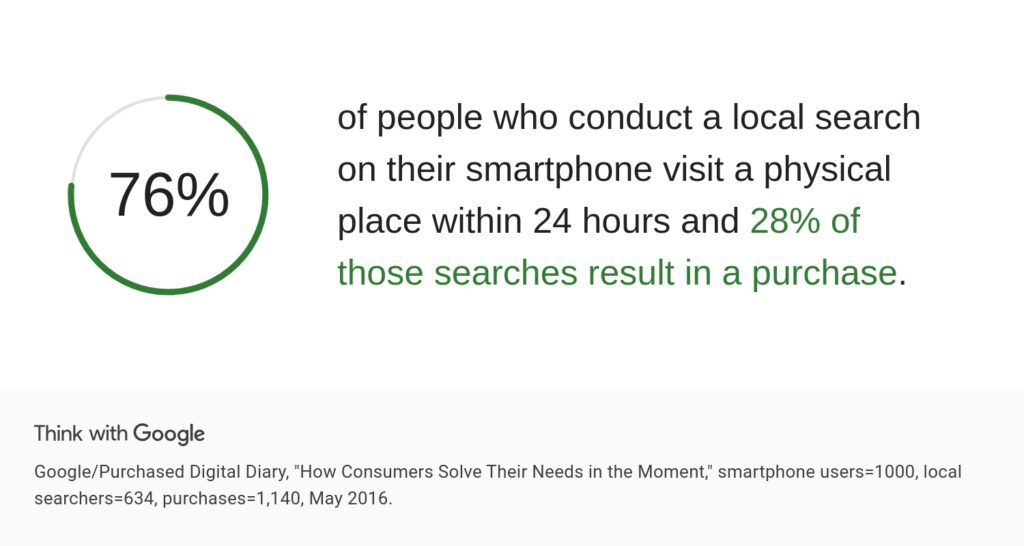
Source: Think with Google
76% of mobile local searches result in store visits within 24 hours, making local SEO critical for businesses with physical locations.
Local SEO integrates with customer relationship management by tracking review sources, local search conversions, and in-store attribution from organic searches.
Multi-location companies require scalable local SEO strategies, such as centralized NAP management, location-specific content templates, and review monitoring across all branches.
Why Local SEO matters:
The Local Pack appears above organic results for location-based queries, capturing attention first. If your business appears here, you can secure a prominent position.
Mobile searchers use location-based searches more than desktop users, and mobile traffic continues growing.
Local searches lead to offline conversions, as people researching online before visiting physical locations.
Local SEO vs. Other Types:
- Local SEO vs. Technical SEO: Local requires a technical foundation, but adds geographic signals
- Local SEO vs. On-Page SEO: Local includes on-page elements plus location-specific optimization
- Local SEO vs. Off-Page SEO: Local builds geographic authority through local citations and reviews, not just general backlinks
Local SEO checklist:
- Google Business Profile claimed, verified, and fully optimized
- NAP consistent across website, GBP, and all citations
- Active in major local directories (Google, Yelp, Facebook, industry-specific)
- Regular Google reviews with professional responses
- Location pages created for each service area or physical location
- Local schema markup implemented (LocalBusiness)
- Phone number click-to-call enabled on mobile
- Embedded Google Map on location/contact pages
- Local content mentioning the city, neighborhood, and regional events
- Local backlinks from community organizations and local sites
Who needs Local SEO?
- Businesses with physical locations (restaurants, retail stores, medical practices)
- Service area businesses (plumbers, electricians, contractors, landscapers)
- Multi-location businesses (franchises, chains, regional companies)
- Professional services (lawyers, accountants, consultants serving specific cities)
- Any business where “near me” searches are relevant
Who doesn’t need Local SEO?
- Pure e-commerce stores shipping nationally/globally without physical stores
- SaaS companies serving customers regardless of location
- Information websites without geographic relevance
- National service providers where location doesn’t matter
Are you struggling to appear in local searches? Our Local SEO services will provide Google Business Profile optimization, citation building, review strategies, location page creation, and more that will drive foot traffic and local conversions.
Which Type of SEO Should You Focus On?
All four types work together.
But if you need to prioritize based on resources, here’s the recommended order:
Start with Technical SEO. Fix foundation issues first. You can’t rank if search engines can’t crawl and index your site properly.
Add On-Page SEO. Create quality, optimized content. Even with perfect technical implementation, you need valuable content to rank for relevant queries.
Build Off-Page SEO. Earn authority through backlinks and brand mentions. This takes time but compounds. Start early and be consistent.
Include Local SEO (if applicable). For businesses serving specific geographic areas, local optimization captures high-intent, nearby customers ready to convert.
For most businesses, the priority looks like this:
| Timeline | SEO Type | Key Activities |
| Months 1-2 | Technical SEO | Fix crawl errors, improve speed, implement HTTPS, and add structured data |
| Months 2-4 | On-Page SEO | Keyword research, content creation, title/meta optimization, internal linking |
| Months 3-6 | Off-Page SEO | Start earning backlinks, digital PR, and building relationships |
| Ongoing | Local SEO | Maintain GBP, earn reviews, build citations (for applicable businesses) |
Remember:
SEO isn’t a one-time project. It’s ongoing optimization across all four types, adapting to algorithm updates, competitor actions, and changing user behavior.
The most successful SEO strategies integrate technical excellence, quality content, earned authority, and (when relevant) local visibility into a cohesive approach.
Want to dive deeper into each type? Our comprehensive guide covers all SEO types in depth, including specialized approaches like E-commerce SEO, Enterprise SEO, International SEO, and more.
Strategic Value Of SEO & Impact Of SEO On Business
SEO delivers measurable business outcomes across four strategic dimensions: organic traffic acquisition (customer reach), trust signals (brand credibility), return on investment (cost efficiency), and sustainability (compounding advantages).
Understanding these value drivers helps prioritize SEO within a broader marketing strategy and justify investment to stakeholders who need concrete reasons beyond “everyone does it.”
Let’s break down each dimension and why it matters for your business.
Driving Sustainable Organic Traffic
Organic traffic is the visitors who find your website through unpaid search engine results rather than paid advertisements, social media, or direct visits.
These are people actively searching for solutions, products, or information related to what you offer, making them highly qualified potential customers.
According to BrightEdge, organic search accounts for 53% of all trackable website traffic, making it the single largest source of visitors for most businesses.
What makes organic traffic valuable is intent. Unlike social media scrolling or display ads that interrupt people, search traffic comes from users actively looking for what you provide. They’re further along in the buying journey, researching solutions to problems they already recognize.
This intent qualification explains why SEO leads convert at 14.6% compared to just 1.7% for outbound methods like cold calling or direct mail, according to HubSpot research.
Organic traffic represents the most sustainable digital marketing channel, unlike paid advertising that stops when budgets end, SEO investments continue generating returns indefinitely.
The compounding effect is powerful. Each piece of optimized content can rank for months or years, driving continuous traffic without additional cost per click. As you publish more content and earn more backlinks, your site’s authority grows, making it easier to rank for competitive terms.
B2B companies report that organic search influences 47% of sales pipeline, with longer research cycles heavily dependent on ranking for educational content that builds trust before sales conversations even begin.
As internet usage grows, over 8.5 billion searches are happening on Google daily in 2025, and SEO becomes increasingly critical for capturing demand at scale.
Want to learn specific tactics? Our guide covers how to drive organic traffic to your website with actionable strategies.
Building Trust & Credibility Through Rankings
Trust and credibility refer to how reliable and authoritative users perceive your business based on where you appear in search results.
Search engine visibility signals credibility to users. Higher rankings imply expertise, as consumers perceive Google’s algorithm as an authority filter.
Think about your own behavior. When researching a product or service, don’t you trust results on page 1 more than page 3? That’s not accidental. 75% of users judge a company’s credibility based on search rankings, according to Stanford Web Credibility Research.
Sites ranking on page 1 for industry terms gain trust advantages that impact conversion rates, pricing power, and competitive positioning.
If you rank #1 for “Chicago personal injury lawyer,” potential clients assume you’re among the best in the city before ever visiting your site.
Trust-building through SEO operates differently than traditional marketing; rather than claiming expertise through advertising, rankings provide third-party validation via Google’s algorithmic endorsement.
Company credibility derives increasingly from digital presence, executive visibility through content, thought leadership rankings, and recognition in Knowledge Panels (informational boxes on Google Search results that provide quick, authoritative summaries about the query user searched), all of which signal authority to both users and business partners.
Cost Efficiency & Long-Term ROI
Return on Investment (ROI) measures the financial return you get compared to what you spend on SEO efforts.
Here’s how SEO compares to paid advertising over time:
| Metric | SEO (Organic) | PPC (Paid Ads) |
| Upfront Investment | $5,000-$30,000 (6 months) | $5,000-$30,000/month ongoing |
| Time to Results | 3-6 months | Immediate |
| Sustainability | Continues indefinitely | Stops when budget ends |
| Click Costs | $0 per click (after investment) | $1-$50+ per click (varies by industry) |
| 5-Year ROI | 1,000%+ (compounding) | 100-300% (linear, dependent on spend) |
| Scalability | High (new keywords, topics) | Medium (budget-constrained) |
SEO’s ROI advantage over advertising stems from asset creation. Content ranks perpetually without recurring costs, while ad campaigns require ongoing spend for visibility.
Consider this: A single blog post that ranks for a competitive keyword can drive thousands of visitors monthly for years. That’s free traffic every month after the initial creation and optimization investment.
Long-term marketing strategy prioritizes SEO’s compounding returns, early investments in technical infrastructure and content pay dividends for years, unlike campaign-based tactics that stop producing when you stop spending.
Sales teams benefit from SEO’s efficiency, organic leads cost 61% less than outbound leads while converting at higher rates due to intent-qualification. That’s more customers at lower acquisition costs.
Compounding Advantages & Sustainability
Sustainability in SEO means your rankings and traffic continue growing over time without proportional increases in ongoing investment.
SEO delivers compounding returns through topical authority accumulation. Each optimized page reinforces others, internal linking distributes PageRank, and historical content continues ranking long after publication.
This creates defensive moats against competitors and algorithm updates.
Key sustainability factors:
Content longevity: Evergreen content ranks for years. A comprehensive guide published in 2020 can still drive traffic in 2026 with minimal updates. A 10-year+ lifespan is common for quality content.
Authority compounding: Backlinks accumulate over time without decay. Each quality link earned stays valuable, building on previous link acquisition efforts.
Topical authority: Comprehensive coverage creates ranking advantages across related queries. Once Google recognizes you as an authority on “project management,” ranking for related terms becomes easier.
Algorithm resilience: Sites built on solid fundamentals weather algorithm updates better than those using manipulative tactics.
Sustainable internet marketing requires asset creation rather than rental—SEO builds owned digital properties you control, while paid channels rent temporary visibility that disappears when spending stops.
Strategic marketing planning accounts for SEO’s delayed but compounding returns—allocating budgets to long-term asset building alongside short-term campaign tactics creates balanced growth.
Is SEO Free or Paid?
SEO is “free” in that organic clicks cost nothing once you rank, but optimization requires investment, including time, expertise, tools, or agency fees.
Compared to PPC, where you pay per click indefinitely, SEO involves upfront costs that generate ongoing returns without recurring per-click charges.
For understanding, cost of SEO by countries, read following articles:
Cost structure breakdown:
| Metric | DIY SEO | Freelance SEO | Agency SEO | PPC (Comparison) |
| Time Investment | 10–20 hours / week | Project-based | Full-service management | Ongoing management |
| Financial Cost | $100–$500 / month (Tools) | $75–$200 / hour | $2,000–$10,000+ / month | $1,000–$50,000+ / month |
| Primary Focus | Hands-on learning & tool execution | Specific tasks (Audits, Content) | Scalable strategy & competitive growth | Immediate traffic & ad spend |
The “free” part of SEO refers to not paying for individual clicks. But make no mistake. Effective SEO requires investment in expertise, content creation, technical optimization, and link building.
For most businesses, the trade-off makes sense. Upfront investment in SEO creates assets that continue producing results, while advertising budgets must be renewed constantly to maintain visibility.
SEO’s strategic value, traffic, trust, ROI, and sustainability establish clear business justification beyond vague promises of “better rankings.”
But the landscape is evolving rapidly with AI integration, mobile-first indexing, and new ranking factors.
Let’s examine modern SEO challenges and opportunities in 2026 and how to adapt your strategy for the future of search.
Modern SEO: AI, Mobile-First, and Evolving Search Behaviors
Search engine optimization in 2026 differs fundamentally from a decade ago—AI-powered search experiences, mobile-first indexing, Core Web Vitals, and generative search are reshaping how users find information and how websites earn visibility.
Understanding these shifts enables future-proof strategies aligned with algorithmic evolution rather than outdated tactics that no longer work.
AI Overviews & Generative Search
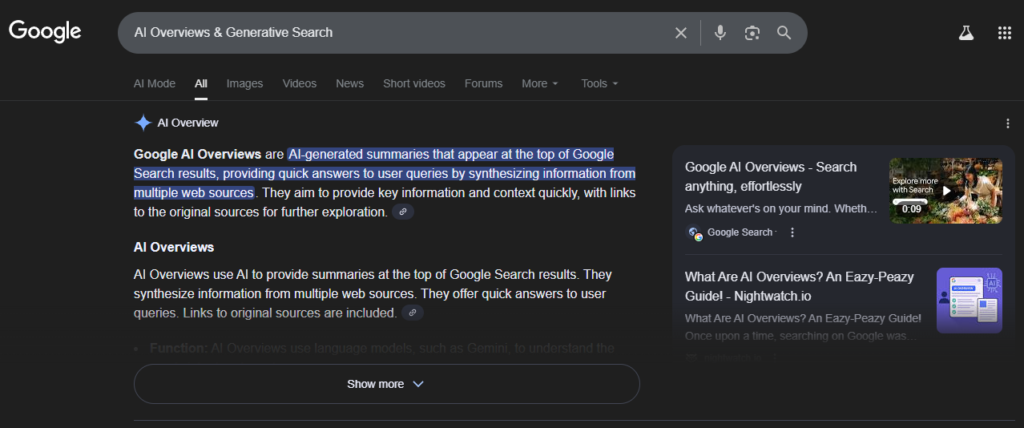
AI Overviews (formerly Google SGE – Search Generative Experience) are AI-powered summaries that appear above traditional organic results for many queries, synthesizing information from multiple sources into quick and conversational answers.
This represents the biggest change to search results pages since Google’s founding. Instead of ten blue links, users increasingly see AI-generated summaries that answer questions without requiring clicks.
Want to dominate AI Overviews and get cited as an authoritative source?
Our comprehensive guide reveals 25 proven strategies to optimize your content for Google’s AI-generated summaries, increase brand visibility, and adapt to the future of search.
The Impact of AI Overviews on SEO:
Visibility has shifted. AI Overviews prioritize and cite sources differently than traditional rankings. A page ranking #3 organically might be cited prominently in the AI summary, while the #1 result gets ignored.
However, citation in AI summaries drives brand awareness and authority even without direct clicks. Users see your site mentioned as a trusted source, building credibility.
According to Lily Ray, SEO Director at Amsive Digital, “The key to appearing in AI Overviews is creating content that directly answers questions with clear, well-structured information that AI can easily extract and understand.”
Optimization Strategies for AI Visibility:
Structure content with clear definitions and explanations that AI can extract. Use headers, bullet points, and concise paragraphs that directly answer common questions.
Implement schema markup extensively. Structured data helps AI understand the context, relationships between concepts, and the meaning of information. Not just what words say.
Focus on E-E-A-T signals. AI systems prioritize authoritative, expert sources when selecting citations. Content from recognized experts gets cited more frequently than anonymous or unverified information.
Create comprehensive, authoritative content, covering topics thoroughly. Surface-level articles rarely get cited; depth and expertise increase citation likelihood significantly.
As artificial intelligence integrates into search interfaces, SEO strategies must adapt from keyword matching to business’s clarity and semantic optimization that AI systems can understand.
Can ChatGPT Do SEO?
ChatGPT and similar AI tools assist with specific SEO tasks, such as keyword research, content outlines, meta tag generation, and schema markup code, but cannot replace strategic thinking or execute comprehensive optimizations.
Where AI excels in SEO:
Content ideation and outlining based on keyword research and competitive analysis.
Generating keyword variations and semantic alternatives for target terms.
Drafting meta descriptions and title tag options for A/B testing.
Creating schema markup code in JSON-LD format for various content types.
Critical AI limitations:
No direct access to Google’s ranking algorithms or proprietary ranking data. AI tools make educated guesses based on publicly available information.
Cannot perform technical audits requiring actual site access, crawl simulations, or server log analysis.
Lacks strategic prioritization. AI can’t determine which technical fixes matter most for your specific competitive situation.
Cannot build backlinks. Link building requires genuine outreach, relationship-building, and creating link-worthy content. Human skills AI can’t replicate.
No ability to analyze competitors’ technical implementations or reverse-engineer their optimization strategies.
“AI is excellent for brainstorming and initial drafts, but SEO success still requires human expertise to validate recommendations, prioritize tactics, and execute technical changes correctly.”
Effective AI Use in 2026:
Leverage AI for efficiency in repetitive tasks, generating variations, drafting initial content, coding schema, while humans handle strategy, technical execution, competitive analysis, and relationship-based link building.
AI-powered SEO software, like Clearscope and MarketMuse, has emerged for content optimization, but effectiveness depends on correct human implementation of recommendations. Machines suggest; humans validate and execute.
Voice Search Optimization
Voice search is the technology that allows users to perform searches by speaking their queries aloud to devices like smartphones, smart speakers (Alexa, Google Home), and virtual assistants (Siri, Google Assistant) rather than typing.
40% of Gen Z users prefer speaking to Google over typing,, especially via mobile devices and smart assistants.
It is A trend reshaping how people find information.
Voice Search in 2026:
Voice technology has matured significantly, with improved natural language understanding and multi-turn conversations becoming standard.
Smart speakers are now in over 35% of households, and voice commerce (purchasing via voice commands) has grown substantially.
Google’s AI advancements and integration with Gemini have made voice search more conversational and context-aware, understanding follow-up questions and remembering previous queries within sessions. Mobile voice search continues dominating local queries, with “near me” searches reaching all-time highs as users seek immediate, location-specific answers while on the go.
Voice queries differ fundamentally from typed searches. When typing, users might search “best Italian restaurant Chicago.” When speaking, they ask “What’s the best Italian restaurant near me?” or “Where can I find good pasta in Chicago tonight?”
Key Differences In Voice Search Behavior:
Conversational language: Voice searches use natural, complete sentences rather than short keyword phrases. People speak like they’re talking to a human, not a search engine.
Question format: Voice queries often begin with “who,” “what,” “where,” “when,” “why,” or “how,” seeking direct answers rather than browsing multiple results.
Local intent: Many voice searches include “near me” or location-specific terms, with 58% having local intent.
Longer queries: Voice searches average 29 words compared to 3-4 words for typed searches, providing more context for search engines to understand intent.
Optimization Strategies For Voice Search:
Target long-tail, conversational keywords that match how people actually speak. Optimize for the questions your audience asks verbally.
Create FAQ content with direct, concise answers to common questions. Voice assistants often read featured snippet content as voice search answers.
Optimize for local SEO if you serve specific geographic areas. Ensure Google Business Profile is complete, accurate, and optimized for “near me” queries.
Use natural language throughout content. Write conversationally as if answering questions verbally rather than formal, keyword-stuffed text.
Implement FAQ schema markup to increase chances of appearing in voice search results, which often pull from structured data.
Focus on featured snippets (position zero). Voice assistants frequently read featured snippet content as the single answer to voice queries.
The Impact of Voice Search on SEO Strategy:
Voice search doesn’t require entirely separate optimization. It reinforces existing best practices around natural language, comprehensive content, and user intent matching.
However, the rise of voice means zero-click searches increase. Users get answers without visiting websites, making brand mentions and featured snippet positioning crucial even without direct traffic.
Sites optimized for voice search typically rank well in traditional search too, since both prioritize natural language, user intent, and comprehensive answers to questions.
As voice technology improves and adoption grows beyond Gen Z to all demographics, optimizing for conversational queries becomes standard practice rather than a specialized tactic.
Mobile-First Indexing
Mobile-first indexing means Google uses the mobile version of your content as the primary source for ranking evaluation and indexing, rather than desktop versions.
More than 70% of all Google searches now come from mobile devices, which is 68% higher than in 2024.
Therefore, Google’s index must prioritize what most users actually see.
Mobile optimization requirements in 2026:
Responsive design that adapts seamlessly to all screen sizes from phones to tablets to desktops.
Touch-friendly navigation with tap targets minimum of 48×48 pixels to prevent accidental clicks.
Mobile page speed targeting under 3 seconds load time, mobile users are even less patient than desktop users.
Readable text without zooming, using a minimum 16px font size and appropriate line height.
No intrusive interstitials or pop-ups blocking content immediately after page load; Google penalizes these.
Mobile-first indexing requires web development approaches prioritizing mobile experiences through progressive enhancement, not desktop-first design with poor mobile adaptations.
E-E-A-T: Quality Signals in Content
E-E-A-T stands for Experience, Expertise, Authoritativeness, and Trustworthiness. It is Google’s framework for evaluating content quality.
In 2022, Google added “Experience” to its E-A-T model, transforming it into E-E-A-T.
Experience: First-hand, practical experience with products, services, or topics. Real user experiences in reviews, case studies, and documented usage carry weight.
Expertise: Subject matter knowledge demonstrated through credentials, proven skills, and accurate information.
Authoritativeness: Recognition as a go-to source, shown through citations, industry mentions, and reputation among peers.
Trustworthiness: Accuracy, transparency, and security through HTTPS, clear policies, proper fact-checking, and reliable information.
Signals Google Evaluates:
Author bylines with credentials and background information visible on pages.
Detailed About pages showcasing team expertise, qualifications, and company background.
Citations and references to authoritative sources supporting claims made.
External mentions and backlinks from recognized authorities in your field.
Content accuracy verified through fact-checking and regular updates.
Transparency through clear authorship, accessible contact information, and published policies.
Marie Haynes, SEO consultant and E-E-A-T expert, emphasizes that “E-E-A-T isn’t a direct ranking factor with a numerical score, but rather a lens through which Google’s algorithms evaluate whether content deserves to rank—especially for YMYL (Your Money Your Life) topics.”
E-E-A-T-compliant content requires demonstrating expertise through cited sources, explained methodologies, showcased credentials, and evidence-based claims rather than unsubstantiated opinions.
Structured Data & Schema Markup
Structured data is standardized code (using Schema.org vocabulary) that annotates content with semantic metadata, explicitly telling search engines what information means rather than forcing them to interpret it.
Implementing schema markup increases eligibility for rich results. Enhanced search listings with review stars, pricing, availability, FAQs, and other visual elements that boost click-through rates by 30-40% according to various studies.
Common Schema Types and Their Benefits
| Schema Type | What It Does | Where It Appears |
| Article | Enables featured snippets, article metadata, and Top Stories placement | Search results, Google News, Discover |
| Product | Shows pricing, availability, reviews, and product details | Product rich results in search listings |
| LocalBusiness | Displays business information, hours, location, contact details | Local pack, Knowledge Panels, Maps |
| FAQ | Triggers expandable question-answer sections | Directly in search results pages |
| HowTo | Displays step-by-step instructions with visual steps | Rich results showing numbered instructions |
| Review | Shows star ratings and review counts | Search listings with prominent rating display |
| Recipe | Displays cooking time, ingredients, ratings, nutrition info | Recipe rich results with image and details |
| Event | Shows event dates, times, location, ticket availability | Event rich results and Google Events |
| Video | Enables video rich results with thumbnails and key moments | Video carousels and search results |
| Breadcrumb | Shows page hierarchy navigation path | Search result URLs showing site structure |
| Book | Displays book ratings, author, availability | Book-specific rich results |
| Course | Shows course provider, description, ratings | Educational course listings |
| Movie | Displays ratings, showtimes, streaming availability | Movie-specific rich results |
| Offer | Shows pricing, availability, merchant information | Product and service listings |
| Logo | Specifies official brand logo for Knowledge Panels | Knowledge Graph, brand search results |
| ContactPoint | Provides customer service contact information | Knowledge Panels, business listings |
| Clip | Highlights specific video segments with timestamps | Video search results with key moments |
Structured data helps AI systems understand context, classify content accurately into topical clusters, and recognize entities for inclusion in Knowledge Graphs.
Want to implement the schema correctly? Our comprehensive Guide to Schema Markup explains:
- What it is
- Which types to use
- How to implement it step-by-step with validation
- And more
Implementing structured data requires web development knowledge for adding JSON-LD scripts to page templates, validating markup syntax, and testing rich result eligibility through Google’s tools. Here, the web development experts at our SEO agency will help you and get the implementation of structured data done smoothly.
Modern SEO challenges include:
- AI integration
- Mobile-first indexing
- Core Web Vitals
- E-E-A-T requirements
They all demand updated strategies but don’t fundamentally change optimization principles.
Quality content, technical excellence, earned authority, and user-focused experiences remain essential.
Whether pursuing DIY optimization or hiring SEO professionals, understanding career paths, learning resources, and service models helps make informed decisions about SEO investment and execution.
SEO Careers, Learning Paths, and Service Models
The global SEO services market is projected to reach $122.11 billion by 2030, which continues to drive record demand for specialized talent.
It means that there will be more gates of opportunities are going to be opened for those who’re considiering SEO as a career.
Whether you’re considering SEO as a career, learning for in-house optimization, or evaluating whether to hire service providers, understanding the professional landscape helps make informed decisions.
Let’s explore when DIY makes sense, what SEO careers look like, and how to learn effectively.
People also ask that
Can I Do SEO Myself?
Yes, you can do. It is called Do-it-yourself (DIY) SEO. DIY SEO is search engine optimization you perform yourself without hiring agencies, consultants, or specialists, handling everything from keyword research to technical fixes to content creation in-house.
Self-service SEO works best for:
Small businesses with limited marketing budgets under $2,000/month who can’t afford professional services.
Simple sites with 10-50 pages and straightforward architecture without complex technical requirements.
Low competition niches like local services or specific long-tail topics where ranking doesn’t require extensive authority building.
Content-focused strategies for blogs and informational sites where publishing quality content drives most results.
DIY limitations to consider:
Time-intensive commitment, expect 10-20 hours weekly minimum for 6+ months before seeing meaningful results. Most business owners underestimate this significantly.
Technical barriers exist for site architecture optimization, JavaScript rendering issues, and schema implementation, requiring coding knowledge most marketers lack.
Link building demands outreach skills, relationship-building abilities, and PR expertise that take years to develop effectively.
Strategic blind spots make it difficult to audit your own work objectively or identify what you don’t know you’re missing.
DIY marketing approaches work reasonably well for SEO’s content components but struggle with technical optimization. Most business owners lack web development skills for advanced implementations.
Company size determines DIY viability. Startups with lean teams may successfully bootstrap basic SEO, while enterprises require dedicated resources or agencies to achieve meaningful scale and compete effectively.
The hybrid approach often proves optimal:
Handle content creation in-house where you have subject matter expertise, but hire SEO specialists for:
- Technical audits
- Schema implementation
- Site speed optimization
- Strategic link-building campaigns
- And more
Is SEO a Good Career Choice?
An SEO career involves professional work optimizing websites to rank higher in search engines, either as an in-house specialist, agency employee, consultant, or freelancer.
SEO offers strong career prospects driven by high demand, remote-friendly roles, diverse specializations, and a growing industry that shows no signs of slowing.
Pros of Career In SEO:
Growing demand with 25% year-over-year increase in SEO job postings across major job boards as of 2025.
Competitive salaries:
- $45-60K for Entry-level SEO
- $70-95K for Mid-level SEO
- $100-150K+for senior SEO
- $150-250K+ for Director-level SEO
Remote options are abundant. 78% of SEO roles offer remote or hybrid work arrangements, providing geographic flexibility.
Diverse career paths allow specialization in technical, content, local, enterprise, or link-building focuses based on interests and strengths.
Entrepreneurial opportunities abound through freelancing, consulting, or building your own agency with relatively low startup costs.
Cons of Career in SEO:
Constant learning is required as algorithms change quarterly and tactics evolve rapidly. What worked last year may not work today.
Results take time, typically 3-6 months minimum for wins, requiring patience from employers and clients who want immediate results.
Ambiguity exists since there’s no direct algorithm access. Some educated guesswork is involved, which frustrates people who prefer definitive answers.
Competition is crowded at the entry-level with many people claiming “SEO expert” status, though genuine specialization helps differentiation.
SEO careers increasingly overlap with sales skills, such as:
- Client acquisition
- Stakeholder management
- Demonstrating ROI
- And more
They all require persuasion and relationship-building beyond pure technical optimization.
Senior SEO roles demand marketing strategy expertise, balancing SEO with paid channels, content marketing, and broader business objectives rather than siloed optimization work.
SEO is a solid career choice for those who are analytical, patient learners who enjoy problem-solving, data analysis, and adapt well to constant change.
If you get frustrated by ambiguity or need immediate gratification, SEO may not be the right fit.
Should I Learn SEO?
Yes, you should learn SEO if you work in digital marketing, create content, own a business, or want a flexible career with strong growth potential. SEO skills increase your marketability, reduce dependence on agencies, and open entrepreneurial opportunities with relatively low barriers to entry.
Learning SEO means acquiring the skills to optimize websites for search engines through study, practice, and hands-on experience rather than formal degrees or certifications.
Who should learn SEO:
Digital marketers, looking to expand their skill set beyond paid advertising and social media to include organic channel expertise.
Content creators, wanting to improve how their articles, videos, and other content perform in search and reach larger audiences.
Web developers, seeking to add strategic thinking to technical skills, making them more valuable and capable of building SEO-friendly sites from scratch.
Business owners, aiming to reduce agency dependence, cut marketing costs, and understand what SEO providers actually do.
Career changers, seeking an accessible entry point to digital marketing without requiring formal education or expensive bootcamps.
Where to Start in SEO?
Starting SEO means beginning your learning journey with foundational concepts before progressing to advanced tactics and specializations.
Here’s a realistic 4-6 month learning path for beginners:
Phase 1: Fundamentals (4-6 weeks)
| What to Learn | Key Topics |
| Search engine mechanics | Crawling, indexing, ranking mechanisms |
| Keyword research basics | Free tools (Google Keyword Planner), search intent analysis |
| On-page optimization | Title tags, meta descriptions, header hierarchy, content structure |
Resources For Phase 1
- Google’s SEO Starter Guide
- Moz Beginner’s Guide to SEO
- YouTube tutorials from reputable sources
Phase 2: Technical Foundations (6-8 weeks)
| What to Learn | Key Topics |
| HTML/CSS basics | Reading page structure, identifying technical issues |
| Site architecture | URL structure, internal linking, information hierarchy |
| Core Web Vitals | Page speed, interactivity, visual stability |
| Crawler management | XML sitemaps, robots.txt configuration |
Resources For Phase 2
- Google Search Central documentation
- Technical SEO courses (Coursera, LinkedIn Learning)
Phase 3: Content Strategy (4-6 weeks)
| What to Learn | Key Topics |
| Search intent analysis | Understanding what users actually want |
| Content optimization | Keyword integration, natural readability, comprehensive coverage |
| Technical SEO | Technical optimization techniques that you can learn from our Complete Technical SEO Guide |
| Internal linking | Authority distribution, content navigation |
Resources For Phase 3
- Koray Tugberk’s semantic SEO research
- Hobo Web
- Content Marketing Institute
- Backlinko guides
Phase 4: Analytics & Measurement (4 weeks)
| What to Learn | Key Topics |
| Google Search Console | Performance data, coverage issues, enhancements |
| Google Analytics 4 | Organic traffic tracking, user behavior, conversion attribution |
| Ranking & traffic tracking | Measuring optimization impact over time |
| Reporting & attribution | Demonstrating SEO business value |
Resources For Phase 4
- Grow With Google
- Search Console Help documentation
Phase 5: Specialization (Ongoing)
| What to Learn | Key Topics |
| Choose a focus area | Technical, content, local, link building, or enterprise SEO |
| Advanced training | Industry certifications, documented case studies |
| Hands-on experience | Personal projects, volunteer work, freelance clients |
Resources For Phase 5
- Industry conferences (MozCon, Pubcon)
- Specialized courses
- Continuous hands-on practice
Key SEO Job Roles and Specializations:
| SEO Role / Specialization | Core Focus & Responsibilities | Key Deliverables |
| SEO Specialist / Generalist | Manages on-page optimization, keyword research, and content strategy for small to mid-size sites. | On-page audits, keyword maps, and basic performance reports. |
| Technical SEO Specialist | Focuses on site architecture, crawl optimization, JavaScript rendering, and Core Web Vitals. | XML sitemaps, robots.txt optimization, and site speed improvements. |
| Content SEO Strategist | Develops topic clusters, performs intent research, and ensures content meets high-quality standards. | Editorial calendars, content briefs, and topical authority maps. |
| Link Building Specialist | Executes digital PR, relationship outreach, and authority-building partnerships. | Backlink acquisition, guest post placements, and media mentions. |
| Local SEO Specialist | Optimizes Google Business Profiles (GBP) and manages location-specific citation consistency. | GBP optimization, local citation building, and review management. |
| Enterprise SEO Manager | Manages large-scale sites (10,000+ pages), coordinates cross-functional teams, and handles automation. | Large-scale technical audits and cross-departmental SEO workflows. |
| SEO Director / Head of SEO | Oversees department strategy, budgets, and reports ROI/Organic growth directly to the C-suite. | Annual SEO roadmaps, budget allocation, and revenue attribution. |
SEO learning requires continuous research, following algorithm updates via Google’s official channels, reading patents for insights into ranking systems, analyzing case studies, and experimenting with different tactics on test sites.
Content-focused SEO careers particularly benefit from writing skills, creating optimized content, editing for clarity and engagement, and balancing keyword integration with natural readability that serves users first.
Analytics skills underpin effective SEO measurement, tracking performance accurately, identifying meaningful trends in noisy data, and demonstrating ROI through clear data analysis and visualization.
Ready to implement professional SEO strategies? While learning takes time, working with experienced professionals accelerates results. Our SEO services combine technical expertise, content strategy, and authority building to drive measurable organic growth.
Is SEO Easy?
SEO difficulty refers to how challenging it is to learn and execute search engine optimization effectively enough to achieve competitive rankings and traffic growth.
The honest answer: SEO is easy to start but hard to master.
Easy Components Beginner Seo Can Handle:
Keyword research basics using free tools to identify search terms with decent volume and manageable competition.
On-page title and meta description optimization following simple best practices and character limits.
Content writing incorporates target keywords naturally while providing genuine value to readers.
Medium Difficulty Tasks Requiring More Seo Skill:
Technical audits identifying crawl errors, indexation issues, and site speed problems using tools like Screaming Frog.
Structured data implementation, adding schema markup in JSON-LD format to enable rich results.
Link building outreach, crafting compelling pitches, and building genuine relationships with potential link sources
.
Hard Components Requiring Advanced Seo Expertise:
JavaScript SEO for modern frameworks like React, ensuring content renders properly for search engine crawlers.
Large-scale enterprise optimization managing 100,000+ page sites with complex technical architectures and organizational coordination.
Competitive link acquisition in saturated industries where every competitor actively pursues the same authoritative link sources.
Algorithm update recovery, diagnosing traffic drops and implementing fixes when Google releases major updates.
Required Seo Skill Mix:
Technical skills: HTML/CSS understanding for reading page source, basic coding for schema markup implementation, server and hosting knowledge for speed optimization.
Analytical skills: Data interpretation, separating signal from noise, ranking factor prioritization based on impact, and ROI calculation proving business value.
Creative skills: Content strategy, identifying topics worth creating, compelling copywriting that ranks and converts, outreach messaging that earns responses.
Strategic skills: Competitive analysis, understanding what competitors do well, resource allocation, prioritizing high-impact activities, long-term planning, balancing quick wins with sustained growth.
Realistic Timeline Expectations:
6-12 months of consistent practice for foundational skills competency, where you can optimize basic sites independently.
2-3 years for advanced proficiency in handling complex technical challenges, competitive niches, and enterprise-scale implementations effectively.
SEO difficulty increases dramatically with technical complexity; sites built on modern JavaScript frameworks require web development knowledge for proper crawling and rendering optimization that most marketers lack.
Learning SEO software tools like Ahrefs, SEMrush, and Screaming Frog adds initial complexity but ultimately accelerates analysis. Most professionals achieve basic tool proficiency within 2-3 months of regular use.
The learning curve never truly ends. Even experienced SEO professionals continually learn as algorithms evolve, new technologies emerge (like AI Overviews), and best practices shift with Google’s changing priorities.
SEO Service Models
| Model | Cost Range | Best For | Pros | Cons |
| Freelancer | $75-$200/hr | Small businesses, specific projects | Cost-effective, flexible, specialized skills | Limited bandwidth, no team, potential inconsistency |
| Agency | $2K-$10K+/month | Mid to large businesses, comprehensive needs | Full-service, scalable, diverse expertise | Higher cost, potential account management layers |
| In-House | $60K-$150K salary | Companies with ongoing SEO needs | Dedicated focus, brand knowledge, team integration | Hiring costs, limited perspectives, resource constraints |
| Consultant | $150-$500/hr | Strategic guidance, audits | Expert insights, objective analysis | No execution, requires internal resources |
When to Hire Professional SEO:
- Technical issues beyond your skill level (JavaScript rendering, international hreflang, enterprise-scale architecture)
- Competitive industries requiring link building expertise
- Algorithm penalties or traffic drops needing urgent diagnosis
- Lack of internal time/resources for 10-20 hrs/week commitment
Our SEO experts can audit your website’s current situation and recommend the right approach based on your competition level, site size, and business goals.
Whether you’re just starting with SEO or need enterprise-level optimization, our strategic SEO methodology delivers sustainable organic growth backed by Google’s documented ranking behaviors. Not guesswork.
Frequently Asked Questions About SEO
What Is Meant by SEO?
Search Engine Optimization (SEO) is the process of optimizing websites to increase visibility in organic (unpaid) search engine results through technical infrastructure improvements, content relevance, and authority signal acquisition.
We covered this comprehensively in “What Is SEO?” above where we break down the three core components and how they work together.
What Is SEO for Beginners?
For beginners, SEO means making your website easier for search engines to find, understand, and rank.
Start with three fundamentals:
Technical basics: Ensure search engines can crawl your site by submitting an XML sitemap to Google Search Console and fixing any crawl errors that prevent access.
Content optimization: Write helpful content targeting what your audience actually searches for. Use keyword research to identify topics people want information about.
Build authority: Earn backlinks from relevant websites in your industry. Focus on quality over quantity. One link from an authoritative site beats hundreds from low-quality directories.
Beginners should focus on “low-hanging fruit,” fixing technical errors blocking indexation, optimizing existing high-traffic pages with better titles and content, and creating content around low-competition keywords before tackling advanced tactics like competitive link building.
What Are the 4 Types of SEO?
The four primary types are Technical SEO (infrastructure optimization), On-Page SEO (content and element optimization), Off-Page SEO (authority building through backlinks), and Local SEO (geographic targeting for local businesses).
Each type addresses specific aspects of how search engines discover, understand, and rank your content. We cover each in depth in the section “What Are the 4 Types of SEO?” above.
Which Type of SEO Is Best?
No single type is universally “best”. effectiveness depends on your business model, competition level, and current optimization state.
Technical SEO establishes the foundation by ensuring search engines can access your content. On-Page SEO ensures relevance by matching content to what users search for. Off-Page SEO builds authority through external validation. Local SEO captures geographic demand for location-based businesses.
Most successful strategies balance all four types rather than over-investing in any single area. See Which Type Should You Focus On? for prioritization guidance.
What Are the 4 Pillars of SEO?
The 4 Pillars of SEO are Content (relevant, high-quality information), Technical Performance (crawlability, speed, mobile optimization), Authority (backlinks and trust signals), and User Experience (Core Web Vitals, usability, engagement).
These pillars encompass all major ranking factors and provide a framework for balanced optimization. We’ve explained each pillar in detail in section “What Are the 4 Pillars of SEO?” above.
What Are the 3 C’s of SEO?
The 3 C’s of SEO are Content (relevant information), Code (technical implementation), and Credibility (authority signals).
This framework simplifies SEO into three actionable categories that are easier for beginners to understand than memorizing 200+ ranking factors. Learn more in The 3 C’s Framework explained above.
What Are the 5 Important Concepts of SEO?
The 5 foundational concepts are Crawlability (search engine access), Relevance (content-query matching), Authority (trust signals), User Experience (engagement and usability), and Comprehensive Topic Coverage (thorough subject expertise).
Understanding these concepts helps you grasp how search engines evaluate and rank content.
What Is the Golden Rule of SEO?
The golden rule of SEO is: “Satisfy user intent first, optimize for search engines second.”
This means:
Write content that genuinely helps users solve problems, answer questions, or make decisions. Not keyword-stuffed content created solely for rankings.
Ensure technical excellence through fast loading, mobile-friendliness, and security to serve users well, which search engines reward.
Build authority through valuable content that naturally earns links because it’s genuinely useful, not through manipulative link schemes.
Measure success by user satisfaction, engagement metrics, conversions, problem resolution, not just rankings in isolation.
Why Does the Golden Rule of SEO Matters:
Google’s algorithms prioritize user satisfaction. Pages that comprehensively answer queries, load quickly, and provide excellent experiences rank higher.
Trying to “trick” algorithms while ignoring user needs leads to penalties, ranking losses, and wasted investment.
The Golden Rule of SEO in Practice:
Research what users actually want through search intent analysis. Are they looking for:
- Information
- Comparison
- Ready to buy?
Create comprehensive, accurate content prioritizing depth and usefulness over keyword density.
Optimize technical elements like speed and mobile usability to remove friction from the user experience.
Earn authority naturally through quality content and relationship-building, not through buying links or other manipulation.
The golden rule aligns SEO with core marketing principles, understanding customer needs and delivering genuine value, rather than gaming systems for short-term gains.
Quality content creation naturally follows this rule, focusing on clarity, value, and reader engagement produces content that both users and search algorithms reward simultaneously.
Time To Wrap Up
Let’s Recall What We Have Learned:
SEO is about clear communication & structure content so not only users but also search engines understand what you offer and who you serve.
Different types serve different functions, for example:
- Technical SEO (infrastructure)
- On-Page (content)
- Off-Page (authority)
- Local (geographic)
Four pillars that determine rankings include:
- Content quality
- Technical performance
- Authority signals
- User experience
Modern challenges require adaptation of the following:
- AI Overviews
- Mobile-first indexing
- Core Web Vitals
- E-E-A-T standards
Implementing SEO: From Understanding to Action
Search Engine Optimization succeeds through strategic optimization aligned with how search engines actually work, crawling to discover content, indexing through analysis and understanding, ranking based on relevance, authority, and user experience.
Action Steps by Experience Level
For Beginners
| Priority | Action Steps |
| 1 | Set up Google Search Console and submit XML sitemap |
| 2 | Conduct basic keyword research (Google Keyword Planner, free tools) |
| 3 | Optimize 5 highest-traffic existing pages (titles, meta descriptions, content depth) |
| 4 | Fix critical technical errors (broken links, mobile usability issues) |
| 5 | Create 1 comprehensive, well-researched content piece monthly |
For Intermediate Practitioners
| Priority | Action Steps |
| 1 | Conduct full technical audit (Screaming Frog, Search Console analysis) |
| 2 | Implement structured data on key page types (Article, Product, LocalBusiness) |
| 3 | Build topical content clusters (10-15 pages covering topics comprehensively) |
| 4 | Develop link building strategy (outreach targets, content assets) |
| 5 | Improve Core Web Vitals (achieve passing thresholds on 80% of pages) |
For Advanced/Enterprise
| Priority | Action Steps |
| 1 | Implement strategic content architecture with clear topic organization |
| 2 | Scale technical optimizations (JavaScript rendering, international hreflang, large-site crawl management) |
| 3 | Build competitive link acquisition programs (digital PR, thought leadership) |
| 4 | Integrate SEO with broader digital marketing (attribution modeling, conversion optimization alignment) |
| 5 | Develop proprietary research and tools (earn natural backlinks through unique assets) |
Common SEO Pitfalls to Avoid
Technical Mistakes:
- Blocking important pages with robots.txt or noindex tags
- Ignoring mobile optimization (60%+ of traffic now mobile)
- Slow page speeds (>3s load times)
- No structured data implementation
Content Errors:
- Keyword stuffing (damages readability and rankings)
- Thin content (300-word pages can’t compete)
- Ignoring search intent (ranking for wrong query types)
- Unclear topic focus (ambiguous content struggles to rank)
Authority Building Mistakes:
- Buying links (penalty risk)
- Irrelevant link sources (no SEO value)
- Over-optimized anchor text (unnatural patterns trigger filters)
- Ignoring E-E-A-T signals (no author credentials, no citations)
Strategic Failures:
- Expecting instant results (SEO requires 3-6 months minimum)
- Not measuring ROI (tracking rankings but not conversions)
- Ignoring algorithm updates (strategies become outdated)
- No competitive monitoring (losing market share invisibly)
Regular Audits Prevent SEO Pitfalls, Such As:
- Quarterly technical checks
- Content quality reviews
- Backlink profile monitoring
- And more
All of them catch issues before they damage rankings.
Essential SEO Tools
Free Tools
| Tool | Purpose |
| Google Search Console | Performance tracking, indexation monitoring, technical issue identification |
| Google Analytics 4 | Traffic analysis, conversion tracking, user behavior insights |
| Google PageSpeed Insights | Core Web Vitals testing, speed optimization recommendations |
| Google Keyword Planner | Basic keyword research, search volume estimates |
| Schema Markup Validator | Structured data testing, rich result eligibility checking |
Paid Tools (Industry Standards)
| Tool | Pricing | Best For |
| Ahrefs | $99-$999/month | Backlink analysis, keyword research, rank tracking, competitor analysis |
| SEMrush | $165-$455/month | All-in-one SEO platform, competitor research, keyword tracking |
| Screaming Frog | $259 (£199) per year for a single user license | Technical crawling, site auditing, finding broken links |
| Clearscope | $189-$199 for the basic Essentials plan | Content optimization, real-time content grading, keyword recommendations |
| MarketMuse | $99 to $1,500/month | AI-powered content planning, topic research, content gap analysis |
Most SEO professionals use 3-5 core tools for keyword research, technical audits, and analytics. Continuous learning through industry blogs, Google’s official documentation, and case study analysis keeps strategies current as algorithms evolve.
Major SEO Learning Resources
- Google’s SEO Starter Guide (free, official documentation)
- Moz Beginner’s Guide to SEO (free, comprehensive beginner resource)
- Search Engine Journal (news, updates, industry insights)
- Google Search Central Blog (algorithm updates, official guidance)
Ready to Implement Strategic SEO?
Search Engine Optimization works not through manipulation or shortcuts, but through strategic optimization aligned with Google’s documented ranking systems.
If your organic traffic has plateaued despite quality content, there may be technical barriers or optimization gaps blocking your visibility.
Cloudex Marketing delivers the top SEO services in Pakistan and it’s cities like Karachi, Islamabad, Lahore, Rawalpindi, Peshawar and beyond, grounded in how search engines actually work. We get your SEO done the right way though:
- Clear Content Structure
- Technical Excellence
- Proven Authority-Building Strategies
We’ll identify what’s preventing proper indexation, which technical issues hurt rankings, and how to build sustainable organic growth through strategic optimization.
Integrating SEO into your marketing strategy means aligning optimization with brand positioning, customer acquisition goals, and competitive differentiation efforts.