

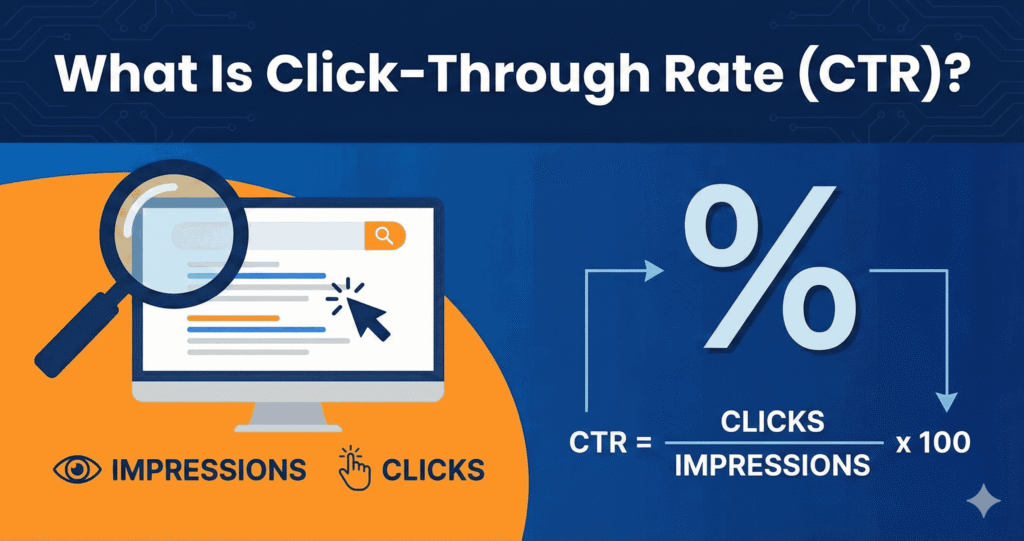
CTR measures how often people click a link after seeing it. In SEO (organic search) or ads, that link could be your search result, a banner, or any listing shown to users.
The Click-Through Rate (CTR) Formula:
- CTR = (Number of clicks ÷ Number of impressions) x 100%
If 1000 people see your page listed and 80 click it.
CTR = (80/1000)*100 = 8%.
In practice, CTR is a quick gauge of how attractive or relevant your listing is to the searcher or user.
Why CTR Matters: Beyond Just a Metric
Signals Relevance And Listing Strength
A higher CTR means many people who see your page decide it’s worth clicking. That suggests your title, URL, and meta description (or ad copy) resonate with the searcher’s intent.
When multiple pages rank similarly, the one with higher CTR performs better long-term, because it proves its relevancy to real searches.
Generates More Organic Traffic Without Extra Effort
Better CTR = more visitors. Improved CTR means your existing ranking yields more value. It’s a way to boost traffic without needing more backlinks or new content.
Improves Cost‑effectiveness (In Ads & Campaigns)
In paid search or ads, a strong CTR can improve quality score or ad ranking, lowering cost‑per‑click and increasing return on spend.
Better User Experience And Engagement Signal
If your listing delivers what the user expects (matching the search query), users are more likely to stay engaged, reducing bounce, and increasing dwell time. CTR isn’t just a click number; it’s part of broader user satisfaction.
How to Improve CTR: What Actually Works
Boosting CTR isn’t magic. It’s about improving how your listing looks and reads in search results.
Here are proven steps to improve CTR:
1. Write compelling titles (title tags)
Your title is often the first thing people see. Make it clear, relevant, benefit-driven or problem‑solving. A good title can significantly lift CTR.
Tips
- Use the primary keyword naturally without stuffing.
- Add clarity or value: e.g., “…: Complete Guide”, “…in 2025”, “…You Need to Know”.
- Avoid clickbait. Deliver what you promise. Overpromising leads to distrust and drop-offs.
- Consider including numbers or results if appropriate: e.g., “5 Ways to Improve CTR in 2025”.
2. Craft meta descriptions that encourage clicks
Your meta description should summarise what the page offers and hint at value, without giving everything away. Use action‑driven language.
Best practice
- Keep it under 150–160 characters to prevent truncation in search results.
- Highlight the main benefit or unique selling point (USP).
- Include a soft call-to-action: e.g., “Learn how to…”, “Discover …”, “See examples of…”.
- Make it aligned with the search intent so users feel confident your page delivers what they need.
3. Use clean, relevant URLs
A short, readable URL, ideally with your target keyword, helps searchers understand what your page is about before they click. It builds trust.
Avoid messy strings or irrelevant code.
But How?
- Include your target keyword naturally in the URL.
- Avoid messy strings, random numbers, or irrelevant codes.
- Keep it simple and descriptive, e.g., www.example.com/ctr-tips
- Do not structure it like: www.example.com/page?id=1234.
4. Add structured data (schema) when relevant
If your content fits rich-result types (products, reviews, FAQs, recipes), consider structured data. Rich snippets (like star ratings, price info, and FAQ dropdowns) stand out in SERPs and can boost CTR.
Best Practices:
- Use schema markup for relevant content types: products, reviews, FAQs, recipes, events.
- Validate your schema with Google’s Rich Results Test to ensure it works.
- Make the structured data accurate and reflective of page content to avoid misleading users.
5. Match content to search intent
CTR improves when users see a title + snippet that aligns with what they expect. If your page content delivers on that, plus gives a clear benefit or solution, click‑through likelihood rises.
Tips:
- Review the keywords and queries driving impressions in GSC.
- Ensure the page content satisfies the query promised in the snippet.
- Include clear value propositions in headings or first lines to match intent.
- Avoid generic or off-topic content that misleads users.
6. Use emotional triggers and clarity, without being spammy
Headlines or meta descriptions that tap into curiosity, urgency, or clear benefit tend to attract more clicks. But avoid over‑promising or misleading.
Best Practices:
- Use curiosity or numbers: e.g., “7 CTR Mistakes You’re Probably Making”.
- Include benefit-focused phrases: e.g., “Boost traffic in 30 days”.
- Avoid over-promising; the snippet must reflect page reality.
- Keep language clear, concise, and actionable.
7. Test and refine consistently
Don’t set & forget. Use tools like Google Search Console (GSC) to identify pages with high impressions but low CTR. Then update titles, meta descriptions, or snippet layout and monitor changes. Revisit regularly.
Tips:
- Use Google Search Console to spot pages with high impressions but low CTR.
- Experiment with different titles and meta combinations, tracking results over time.
- Monitor snippet changes in SERPs for real-world impact.
- Repeat regularly, what works today needs updating as trends, competitors, and SERPs evolve.
Remember It & Improve Your CTR Anytime!
| Element | What to check/change |
| Title tag | Clear, on‑keyword, benefit‑oriented, honest |
| Meta description | Concise (≤ 160 chars), summarises value, includes soft CTA |
| URL slug | Short, descriptive, keyword‑relevant |
| Structured data (if relevant) | Use schema for products, reviews, FAQs, recipes, etc. |
| Content alignment | Deliver what the title & snippet promise, solve user intent |
| Snippet clarity & honesty | No clickbait. Misleading titles kill trust |
| Testing & monitoring | Use GSC (Google Search Console) and GA (Google Analytics) to find low‑CTR pages; update & retest |
What a “Good” CTR Looks Like (and Why It Varies)
There’s no universal “perfect” CTR. What’s good depends on:
- How competitive the search results are
- whether there are ads, featured snippets, or rich results competing for attention
- the type of page (blog, product, informational, local)
- how well your title, snippet, and URL match search intent
Still, as a rough benchmark: many consider 2–5% as a decent organic CTR.
Important: a lower CTR doesn’t always mean poor content. But it means your snippet or listing isn’t compelling, or you’re competing against SERP features (ads, knowledge panels, snippets).
Where CTR Improvement Fits in an Overall SEO Strategy
Focusing on CTR isn’t an isolated task. It’s part of a holistic SEO approach. When you improve CTR, you’re enhancing first impression, user relevance, and potential traffic, making all other SEO efforts (content quality, backlinks, technical SEO) more effective.
For example:
- When content and structure are solid, a high‑CTR listing drives real traffic and engagement.
- Over time, steady CTR improvements enhance domain credibility, user behaviour data, and visibility.
If you’d like to explore a full SEO approach that combines on‑page, off‑page, and snippet/CTR optimisation, check out our guide on omni-channel SEO. It outlines how all pieces fit together naturally.
When your listing looks good, matches intent, delivers value, then ranking, clicks, engagement, and conversions start to follow.
How Cloudex Marketing Can Help You Boost CTR (and Real Traffic)
Let’s Audit Your Search Snippets
We can review your titles, meta descriptions, URLs, and snippet visibility. Then we optimise for relevance, clarity and user appeal. Not just rankings.
Combined SEO & CTR Strategy
We build your SEO plan to cover content, technical optimisation, metadata, and listing‑level improvements. That way, your ranking, clicks, and conversions all improve together.
If you’d like, we can run a free snippet‑and‑meta review for your site to spot low‑CTR pages holding back your traffic.
Conclusion
CTR Isn’t a Bonus Metric. It’s a Gatekeeper
CTR looks like a small percentage. But it’s often the difference between an invisible page and a well‑trafficked listing.
Get your title, meta, URL, and content aligned with what searchers expect. Make the listing as relevant, honest and click‑worthy as possible.
Over time, these improvements stack.
More clicks > more traffic > better engagement > better SEO performance.
If you want a straightforward, no‑fluff approach to improve your site’s CTR and organic reach, Cloudex Marketing is here to help!
Let’s build a snippet and SEO plan that actually pulls in real visitors.